On John Adams

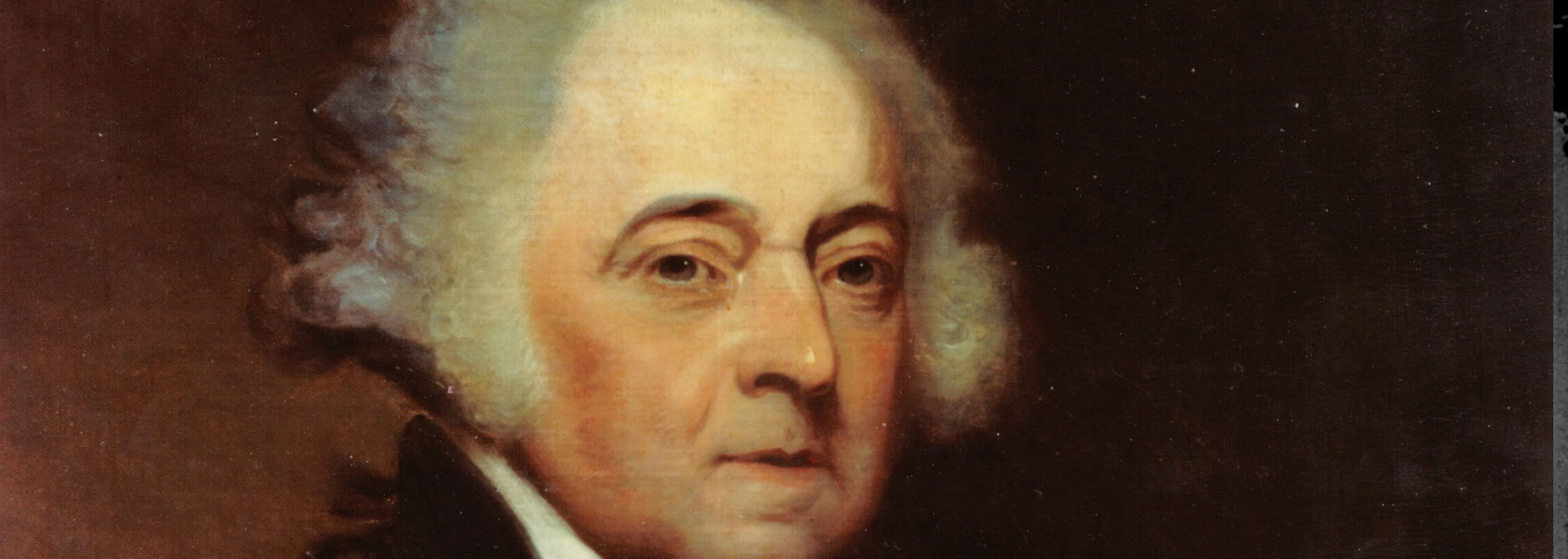
July is a pivotal month for America. It marks the culmination of many years’ labor to bring thirteen discordant colonies around one solemn purpose, united in the essentials of independence, self-government and liberty under law. It was on this day that the Continental Congress actually voted, without dissent, for independence, accepting the resolution proposed by Richard Henry Lee back on June 7. Two days later, the day we now observe to mark the occasion, those gathered approved the Declaration drafted by Jefferson and presented to the Congress by its principal author (Jefferson), alongside John Adams, Benjamin Franklin, Roger Sherman and Robert Livingston. At the center of this difficult task, at nearly every phase, was the tenacious John Adams of Massachusetts. It is perhaps not an overstatement to say that he truly was the driving force behind independence. Prodding, pushing, resolving, shouting above the din of opposition, John Adams deployed all of his energies and abilities to persuade his fellow colonists that nothing less than a complete and total independence is our future.

Free men and women, not only enjoying our God-given liberties, but exercising our moral obligations to keep them was the vision of Adams and those who stood in defiance of tyranny on this day, two hundred and thirty-seven years ago. It was a repudiation of permanent servitude to a distant authoritarian government, subsisting on what it deigns to allow us. It was an advance beyond the old, failed system of absolute monarchs who dictated the terms of life and death to subjects. It was also a summons to restore the rights and obligations of a people already free to stand on their own, free in their lives, property and persons…a freedom given, not by the approval of government, but by the Creator and Supreme Lawgiver.

It would be another son of Massachusetts, President Calvin Coolidge, who would offer a fitting tribute to this tireless and brave champion of ordered liberty. Delivered in Cambridge, July 3, 1925, to commemorate John Adams’ nomination of George Washington as commander of the Army, Coolidge said,

“I suppose if we were to pick any two men out of that gathering, to be set down as something other than politicians, Washington and sturdy old John Adams would be well toward the top of the polling. Though they approached the matter from utterly different angles, they were both led by the sagacity of great politicians to the same conclusion. To both, the crisis was essentially national. A nation must be created to deal with it…All this we look back upon as illumined statesmanship. But statesmanship is nothing more than good, sound politics, tested and proven. That is what it was when John Adams conceived the great strategy of calling a man of the South to the chief command. A more provincial man might have dreamed of Massachusetts, aided by the other colonies, taking and holding the lead and garnering the lion’s share of glory. But Adams was planning in terms of a nation, not of provinces…It was a stroke of political genius that Adams, soul of Puritanic idealism, should have moved the adoption of the army by Congress and the selection of Washington as commander in chief.

“…Let it ever be set down to the glory of Massachusetts that John Adams made George Washington Commander in Chief of the Continental Armies and John Marshall Chief Justice of the United States. Destiny could have done no more.”

It was Adams, at this critical juncture, who placed the righteous prospects of a United States before his own ambitions, the narrow passions of the moment or the instant gratification of anyone’s ambitions, and carried the day triumphant for the self-determination of every one of us down to modern time. The bold action taken by Adams exemplifies that our independence rests on character, the selfless sacrifice of his and every generation, to ensure that true freedom continues.
Image

On the Human Race and America’s Source of Exceptionalism

At the NATO Summit in Strasbourg, France, back in 2009, the current assessment of what makes America exceptional was summarized this way, “I believe in American exceptionalism, just as I suspect that the Brits believe in British exceptionalism and the Greeks believe in Greek exceptionalism.” This familiar statement from four years not only misses the point, perhaps even intentionally, but also repudiates the profound distinction.

Outsiders mistake it for arrogance, as if humanity itself does not struggle with hubris, envy or selfish ambition. In purely material terms, America has made possible an unprecedented standard of living, a presence felt globally, and a recurring willingness to aid those in need anywhere in the world. In moral and spiritual terms, the Founders, by studying the ideas of those who came before them, discovered that a system of self-government, protecting the individual by strictly limiting the powers of the State, rather than the reverse, was the basis for a free and fair society. Up to then, the norm had been to empower rulers over individuals, to secure the State. The people revolved around government. Now the balance was returned to recognizing the individual as sovereign while restraining government power. This discovery wrought exceptional results, even with all the obstructions, setbacks and difficulties Americans have encountered in a short two hundred and forty years.

It is in this way, by restoring the ideals of self-government to the foundation of society, that America found they were the exception to the way the rest of the world chose to work. This is American exceptionalism: adopting a set of ideals that all who come here must share if liberty is to remain for everyone. Those ideals must also be infused with hard work to find opportunity and exercise the responsibilities of independence. Those unfamiliar with our optimistic ideals, accept defeat when faced with the slightest resistance of circumstances. Millions around the world languish in real need and emptiness because of this lack of faith in people to govern themselves. Sovereignty resides in the few at the top with privileges doled out and taken back when it suits. Humanity shares this test everywhere. We are no different. It is in America, though, that a deliberate choice has been made to depart from this oppressive and wasteful system of controls, embracing instead the higher ideal of independence with responsibility.

Calvin Coolidge saw this impasse and explained it in 1923 this way,

“There are two broad theories which have held sway in the world. They have developed with the development of the [human] race. One is the system of class and caste, of a claim of divine right of rulers by inheritance — a system where the individual is nothing and the government is all supreme…

     “There is another system with which every American should be familiar, a system of equality and of freedom, not without the claim of divine right, but recognizing that such right reposes in the people; a system where the individual is clothed with inalienable rights, the people are supreme, the government is their agent. Under this conception there is real freedom, real independence, and grave personal responsibility. The rulers look to the people. Their authority is the public will, ascertained in accordance with law. There will be the least possible interference with private affairs. Realizing that it is people who support the government and not the government which supports the people, there will be no resort to paternalism. Under such institutions there may appear to be a lack of machine-like efficiency, but there will be no lack of character. Private initiative will be stimulated. Self-reliance and self-control will be increased. Society will remain a living organism sustaining hope and progress, content to extend its dominion not by conquest but by service. Such is the system of self-government, the orderly rule of the people, carrying within itself a remedy for its own disorders and the power of self-perpetuation. This is the ideal of America.

     “No one would say that existence under these conditions is effortless. Independence is exceedingly exacting, self-control is arduous, self-government is difficult. Always there is the temptation that some element of these should be surrendered in exchange for security and ease [emphasis added]. The appeal to passion and prejudice always lies in this direction. The proposal to despoil others of their possessions is a manifestation of the same spirit. This is reason that to certain of our native-born, and more often to our foreign-born, the American Republic proves a disappointment. They thought that self-government meant the absence of all restraint, that independence meant living without work, and that freedom was the privilege of doing what they wanted to do. It has been a hard lesson for them to learn that self-government is still government, that the rule of the people does not mean absence of authority, that independence means self-support, and that, complete freedom means complete obedience to law. They are disappointed more than ever when they learn, as ever they do, that these are so, not because they have been decreed by some body of men, but that they are so by the very nature of things, and all the governments in the world are powerless to change them.

     “Here again it is perfectly obvious that if the American system is to be cast aside there is only the one other system which can be adopted. The call of the old life of ignorance, of fear, of superstition, of every savage instinct is all toward the old system. The call of the new life of learning, of courage, of enlightened reason, of faith, of religion, is all toward the new system” (quoted from “Calvin Coolidge: His Ideals of Citizenship As Revealed Through His Speeches and Writings” by Edward E. Whiting, Boston: W. A. Wilde, 1924, pp.20-23).

                           Image

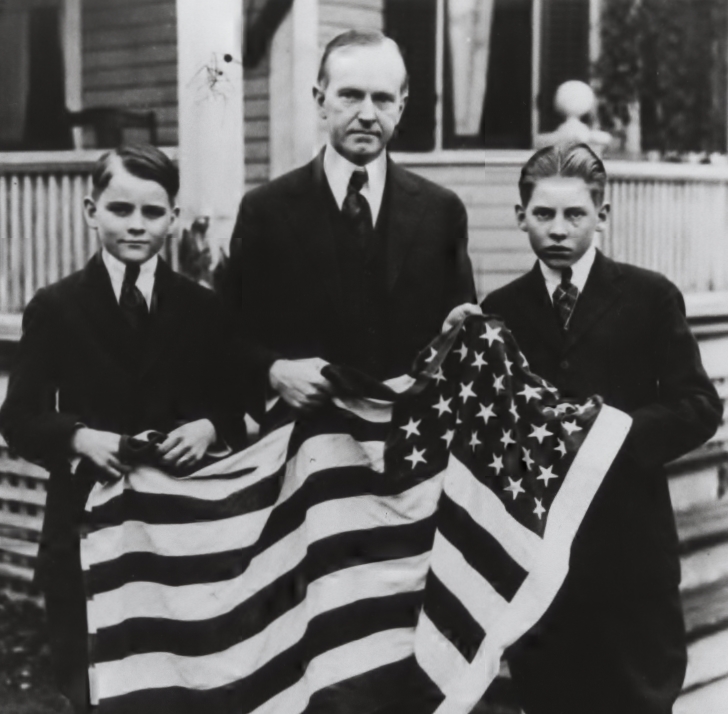
On Flag Day

Image

Reflecting on the significance of the flag a couple days in advance, the former President had these stirring thoughts to offer on Friday, June 12, 1931,

“National Flag Day has been observed for some years by official direction on June 14. It is the anniversary of the adoption by the Congress of the flag of the United States. We do honor to the Stars and Stripes as the emblem of our country and the symbol of all that our patriotism means.

     “The stars and the red, white and blue colors have a significance of their own, but when combined and arranged into the flag of our nation they take on a new significance which no other form or color can convey. We identify the flag with almost everything we hold dear on earth. It represents our peace and security, our civil and political liberty, our freedom of religious worship, our family, our friends, our home. We see in it the great multitude of blessings, of rights and privileges, that make up our country.

     “But when we look at our flag and behold it emblazoned with all our rights we must remember that it is equally a symbol of our duties. Every glory that we associate with it is the result of duty alone. A yearly contemplation of the meaning of our flag strengthens and purifies the national conscience.”

                         Image

Image

Governor Coolidge raising the flag with members of the Washington Senators team at Fenway Park, Boston, Massachusetts. General Clarence R. Edwards and others stand with salute.