On Patriotism

Image

Yesterday marked twelve years since the despicable attacks against the innocent thousands at their jobs in the World Trade Center Towers, the Pentagon and against the passengers of Flights 175, 11, 77, and 93. The depth of hatred for this country by those who withhold freedom from their own people and choose death as a weapon against all who oppose them, is unfathomable. There is no reforming it, there is no justifying it, there is no understanding it. There can be no conciliation with evil.

Many of us still remember the shock we felt from that day. Despite best efforts to the contrary, we are forever changed by it. But the way we responded as Americans deserves equal remembrance. We joined together, united in our common identity as Americans, comforting those in grief but resolute in who we are and what justice demanded be done. We flew the flag proudly, without shame or apology because we were not to blame for the wrongs inflicted among us. We knew America was the moral force for good in this world. It was not a blind refusal to see her faults, but it was not a psychotic inability to see the immense good America represented. It was the power of its ideals that rekindled a genuine and nationwide patriotism.

It was not long before a small percentage of the population — members of the modern Left — embarrassed and disgusted with this “corny” love for country, began a drumbeat that would not only discredit President Bush but dispirit and divide the nation again. The flag has long been offensive to them and so it ought to be intolerable to others, they intoned. For these unhappy souls there is nothing to love without complete and absolute perfection. It is no wonder they are so unhappy here. The appreciation of what is good and beautiful in this imperfect world must be quite lost on such sad people. Even with confronted with the only Perfection ever to visit earth, they reject Christ, ridiculing anyone who wears the name Christian.

It was clear patriotism had to be redefined if the Democrat Party was ever going to win another election. A simple love for country was too much to espouse for these discontented folks. Hillary Clinton stepped forward to laud true patriotism as dissent, the courage to see and criticize America’s faults. Howard Dean screamed the mantra that the flag belongs to everyone, not just Rush Limbaugh, despite the fact that the only persons burning it, cheering for its defeat and encouraging our enemies were Democrats like Dean. Of course, we recall Michelle Obama’s profession of pride in America only after electing her husband. Nothing remotely good or praiseworthy preceded this, apparently. Unprecedented liberty, opportunity, the individual exceptionalism that recurred for millions coming to America, our fight over slavery and the protection of civil rights, the story of our march from the political, religious and economic tyranny of the Old World did not count, it seems. Then there is the President’s distinction, when asked September 4 whether his credibility was on the line, between himself and America, saying, “My credibility is not on the line.  The international community’s credibility is on the line.  And America’s and Congress’s credibility is on the line.” So America has to fend for itself when it comes to credibility? The President has no role in upholding American credibility now? Patriotism should not be exclusive to any political party in this country. It speaks to how far the Democrat Party has strayed from its roots.

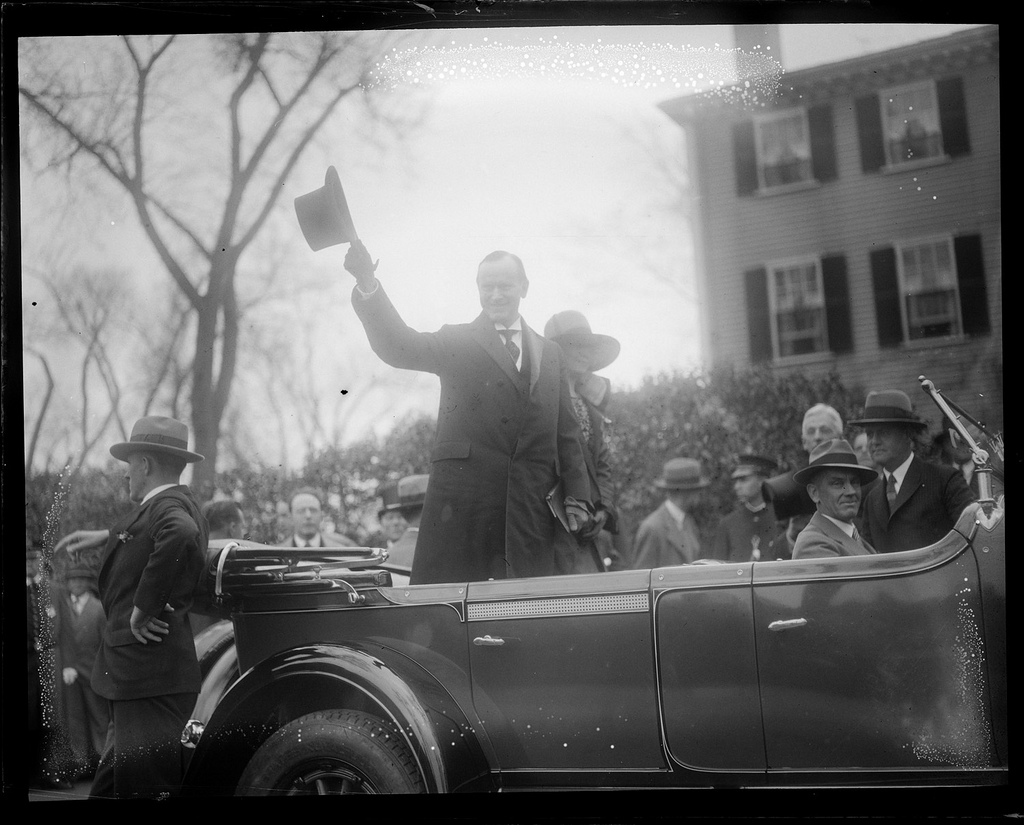
Patriotism was not so confused a concept to Coolidge.

For Calvin Coolidge, “[p]atriotism is easy to understand in America. It means looking out for yourself by looking out for your country. In no other nation on earth does this principle have such complete application…Patriotism does not mean a regard for some special section or attachment for some special interest, and a narrow prejudice against other sections and other interests; it means a love of the whole country.”

Coolidge did not live blissfully unaware of America’s short-comings, but neither did he insist all flaws be removed forthwith before disbursing love and admiration for his country. He always found a greater number of reasons existed to love, not hate, America. He refused to see only the negative. He lived in reality and as such knew patriotism inspires improvement through the pursuit of ideals. It has defined America’s entire history.

Coolidge would drive the point home when he said, “Not to know and appreciate the many excellent qualities of our own country constitutes an intellectual poverty which instead of being displayed with pride ought to be acknowledged with shame.” It is the systematic ostracism of showing our patriotism that should shame the modern Left. The love for America they refuse to understand or at least respect, exhibits a spirit not of enlightenment and objectivity but of closed-mindedness and intolerance. Coolidge expressed respect for our flag and what it represents even more frankly, when he said, “He who lives under it and is loyal to it is loyal to truth and justice everywhere. He who lives under it and is disloyal to it is a traitor to the human race everywhere.”

They would mock and scorn what Coolidge said next about encouraging patriotism, “We must eternally smite the rock of public conscience if the waters of patriotism are to pour forth. We must ever be ready to point out the success of our country as justification of our determination to support it.” Or, when he said to the National Education Association concerning American children, “patriotism is always to be taught.” Or, finally, when he spoke to immigrants in 1925, saying, “Our America with all that it represents of hope in the world is now and will be what you make it. Its institutions of religious liberty, of educational and economic opportunity, of constitutional rights, of the integrity of the law, are the most precious possessions of the human race. These do not emanate from the Government. Their abiding place is with the people. They come from the consecration of the father, the love of the mother, and the devotion of the children. They are the product of that honest, earnest, and tireless effort that goes into the rearing of the family altar and the making of the home of our country. They can have no stronger supporters, no more loyal defenders, than that great body of our citizenship which you represent.”

Image

On the Oath

Section 1 of Article II of the Constitution prescribes the oath each President is to promise and observe as he carries out the responsibilities of his office, ‘I do solemnly swear (or affirm) that I will faithfully execute the Office of President of the United States, and will to the best of my Ability, preserve, protect and defend the Constitution of the United States.’

When the occasion arose to succeed the President in the early hours of the morning on August 3, 1923, Coolidge did not have to consult a team of legal experts or “brainstorm” with Cabinet members over the telephone about what comes next. He simply consulted the Constitution which sat on his father’s bookshelf and found the oath to be taken by the President, the same he had affirmed over two years before. The answer, to anyone able to read and understand, was accessible simply by looking at the Constitution, our blueprint and road-map.

“Having found this form in the Constitution I had it set up on the typewriter and the oath was administered by my father in his capacity as a notary public, an office he had held for a great many years.”

When it came to the Constitution, Coolidge’s grasp of its power and clarity is no less essential a message for the current President than it has been for the previous forty-three,

…[T]he President exercises his authority in accordance with the Constitution and the law. He is truly the agent of the people, performing such functions as they have entrusted to him. The Constitution specifically vests him with the executive power. Some presidents have seemed to interpret that as an authorization to take any action which the Constitution, or perhaps the law, does not specifically prohibit. Others have considered that their powers extended only to such acts as were specifically authorized by the Constitution and the statutes…This has always seemed to me to be a hypothetical question, which it would be idle to attempt to determine in advance. It would appear to be the better practice to wait to decide each question on its merits as it arises…

Coolidge is not sanctioning an improvisational Presidency employing situational compliance with the Constitution and our laws as it suits the individual. He makes that plain with what he says in the very next paragraph.

For all ordinary occasions the specific powers assigned to the President will be found sufficient to provide for the welfare of the country. That is all he needs. All situations that arise are likely to be simplified, and many of them completely solved, by an application of the Constitution and the law. If what they require to be done, is done, there is no opportunity for criticism, and it would be seldom that anything better could be devised…by simply finding out what the law required (The Autobiography, pp.200-202, emphasis added).

Office holders today, whatever level of importance, would do well to take their oath with the same seriousness of mind and reverence for duty that Coolidge held for it.

6192828053_50c0a1fa2a_b CC in Andover

On What is Missing in Education

In all the discussion over the years concerning the deficiencies of modern education, from the improvement of testing standards, the adoption of new curricula, or even the construction of expansive facilities, the most fundamental component is missing. The purpose of education, for most of America’s existence, has been encouraging the student’s grasp of morality and sense of service to others. So it was for the last classically educated President in our history, Calvin Coolidge.

For all the concern over school shootings, sexual misconduct, drugs, violent outbursts, and other self-destructive behavior, the basics continue to be neglected as incapable of addressing the “complexity” of the issues. This is a refusal to live in reality. It is a decided effort to run from the hard decisions of maturity, allowing immature and unhealthy impulses to dictate both the lives of individuals and the governance of schools.

No one is born with perfect behavior, impeccable manners, or maturity. These qualities must be taught, for students absorb both the good and the bad. Cut out the moral core and there is no compass to help the individual discern good from evil values. Moreover, the young are no longer taught the most basic virtues of character:  self-control, temperance, kindness, forbearance, patience, charity, and diligence. Instead, moral instruction is ridiculed as an attempt to impose extreme codes of behavior or to establish a state religion. Animalistic behavior is regarded as normal, and any attempt to reaffirm essential standards of conduct is met with organized ostracism from accepted society by politically correct elites. In truth, character has nothing to do with a “separation of church and state” and everything to do with a good and healthy civilization.

We are failing our children egregiously.  The individual is treated as mere biological matter or, at best, mind without conscience, free to respond to any and every stimuli while simultaneously being devoid of a spiritual nature or the needs of the soul. Mere relay of information is not education. Transmitting data, shorn of any idea that truth exists and can be known objectively, does not fulfill a teacher’s obligation.

Coolidge said it best,

“Man is far more than intelligence. It is not only what men know but what they are disposed to do with that which they know that will determine the rise and fall of civilization…The realization of progress that has marked the history of the race, the overwhelming and irresistible power which human nature possesses to resist that which is evil and respond to that which is good, are a sufficient warrant for optimism. If this were not so, teaching would be a vain and useless thing, an ornament to be secured by a few, but useless to the multitude.”

Coolidge thought such a narrow base of informed and truly educated people was not right. Proper education reached as many as it could. Proper education did not abandon certain communities, specific demographics, or particular economic strata. It seems some today have surrendered the standards because too few live up to them. Hence, literacy continues to fall, historical awareness evaporates, and nothing is required of the inmates running the asylum.

Coolidge appealed to higher standards proven by decades of historical experience. People were not richer, wiser, better, or purer than they are now, but they knew the effort to aspire to standards was worth it. Aspiring to the ideal — a character formed and maintained through constant effort — was worthy not because perfection could be realized, but because good character is found in its pursuit.

Coolidge continues,

“Our country…has founded its institutions not on the weakness but on the strength of mankind. It undertakes to educate the individual because it knows his worth. It relies on him for support because it realizes his power…[T]he chief end of it all, the teaching of how to think and how to live, must never be forgotten.

     All this points to the same conclusion, the necessity of a foundation of liberal culture, and the requirement for broadening and increasing the amount of moral intellectual training to meet the increasing needs of a complicated civilization. Free schools and compulsory attendance are a new experience. No power of government can bring them to success. If they succeed, it will be through the genuine effort and support that can come only from the heart of the people themselves. It is this condition that makes the position of the teacher rise to such high importance.”

Without the moral and the spiritual to support and sustain the individual, all the “facts” and material stimuli of modernity will leave the student empty, ill-equipped for the potential life holds. It will squander the great inheritance due the next generation: the wisdom of those who thought great thoughts and did great deeds before us.

Image