“If the Federal Government should go out of existence, the common run of people would not detect the difference in the affairs of their daily life for a considerable length of time” — President Calvin Coolidge, “States Rights and National Unity,” given at the College of William and Mary in Williamsburg, Virginia, May 15, 1926.
As a perverse enthusiasm for the “Government Shutdown” pervades mainstream media coverage, the total mischaracterization of the issue is propagating confusion and fear, not clarity and sound information. The press, having long ago shed the veneer of objective journalism, is no longer upholding its obligation to arm people with accurate and honest information.
The issue is skewed from the outset as a picture of vast human suffering all caused by a callous, unfeeling opposition to the President and his Party’s agenda. Disagreement with that agenda, instead of the agenda itself, is blamed as the problem. In actuality, the problem is never connected to its real cause: the President’s own policies. The cause is never attributed to a Government that has overgrown its very limited and specific Constitutional role. The problem is those lousy Republicans who want Government to shut down and people to die because they want to see “Obamacare,” the law of the land, undone, or so goes the absurd mantra.
Temporarily furloughing those the Government already deems “non-essential” while keeping Congressional and Executive offices open is not a shutdown. Suspending the online stream of the National Zoo’s “Panda Cam” is not a shutdown. Closing the gates of a few parks is not a shutdown. It makes it appear all those indispensably wonderful services Government provides us are going away permanently. It is political manipulation designed to force people yet again to justify a vast, all-encompassing Government in their lives. To believe an apocalypse awaits via Government “shutdown” demands the ultimate credulity. Threatening to withhold military checks while entitlement programs still keep the checks mailing out does not even begin to approach the genuine shutdown this economy is already experiencing directly because of this President’s decisions.
Playing a game of smoke and mirrors, the President and Senate leadership would rather provoke more suffering especially as it helps advance their permanent campaign against Republicans. The focus is never on the 90 million Americans no longer in the work force because of this President’s agenda. The concern is only ever how does the latest Labor statistics make the President look?
The attention is never on the creation of one “unprecedented” crisis after another to force by legislation what would never be passed if calmly and deliberately vetted. The angst is only ever on how can we survive without Government?
The entire emphasis is turned on its head. The priority is not upon removing the obstacles to ingenuity, opportunity and individual freedom. The priority is ever only on keeping Government alive and growing by “revenue neutral” tax schemes, continuing resolutions, and an endless debt, $17 trillion and counting, which our great grandchildren will still be paying! Add to this “Obamacare” exemptions for Congress ordered by President Obama, the reaffirmation of “quantitative easing” by Chairman Bernanke and now even “shutdowns” are tools to threaten any attempt to restraint this Administration and its agenda for the rest of the country. It is the transfer of authority from a self-governing people to subjects serving an autocratic elite. The focus is all in the wrong direction. The questions should be: How is liberty faring? Are the people being served? How does life look for the people with inflation, massive unemployment and generational indebtedness? Can we survive with Government as it is now, unlimited and absolute?
While Government was significantly smaller in Coolidge’s time, the temptation to encroach on people’s lives was no less alluring. It was leadership that made the difference. Moral character, humble perspective and faith in the institutions and ideals that make America have no substitute when it comes to our leaders. There is nothing that can possibly replace the lack of these qualities in order to lead and lead responsibly. But there is also a fundamental, even natural limitation to any Government which tries to do too much. Opportunity’s door invariably closes whenever and wherever Government gets involved. Consequently, nature itself will rebel against this offense. That is what we are seeing in our time. This is why there remains cause for renewed confidence in our ideals not a lazy and pessimistic resignation to circumstances. The status quo in Washington has already lost. Not living in reality, however, the establishment led by President Obama, does not realize it…yet.
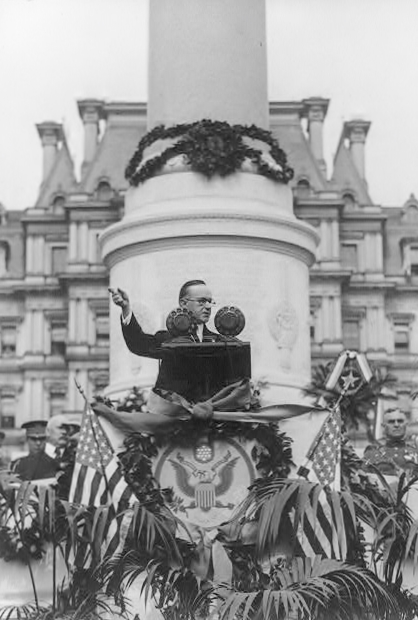
Speaking to those who came to honor their fellow, fallen veterans of the heroic First Division in the American Expeditionary Forces, President Coolidge reflected on the cause for which they fought, saying,
…I cannot let this occasion pass without expressing my most strong and emphatic commendation for the reverence which your words and actions constantly express for the liberty-giving provisions of the fundamental law of our land. You have supported the Constitution and the Flag which is its symbol, not only because it represents to you the homeland, but because you know it is the sole source of American freedom. You want your rights protected by the impartial judicial decisions of the courts where you will have a right to be heard and not be exposed to the irresponsible determination of partisan political action. You want to have your earnings and your property secure. You want a free and fair opportunity to conduct your own business and make your way in the world without danger of being overcome by a Government monopoly.
Such freedom is what we now desire and expect. Government fails when it assumes the life of the individual can best be managed from its halls and corridors. Coolidge went on to explain what happens when Government ventures into the people’s business,
When the Government goes into business it lays a tax on everybody else in that business, and uses the money that it collects from its competitors to establish a monopoly and drive them out of business. No one can compete. When the Government really starts into a line of business that door of opportunity is closed to the people. It has always been an American ideal that the door of opportunity should remain open.
Coolidge saw the road Government takes every time it asserts itself in people’s choices. Opportunity closes. Freedom contracts. It is this road we are now on, with destinations including a single-payer scheme for American healthcare promised by the Government and paid by the rest of us, including generations not yet born. This latest frenzy over “shutting down” the Government is but the latest attempt to distract with fear and obtain by coercion the desired result of greater control and more of the same from an autocratic few. If people will simply stop opposing this Administration then the crisis will evaporate and all our pain will go away, they claim. This President is counting on both ignorance and addiction to the need for Government.
Coolidge reminds us to distinguish between what seems essential from what actually is. When we view it this way, it becomes obvious that the Federal Government needs us, not we it. If Washington ceased to be tomorrow, we would survive. We would even do better than we think. The importance rests with the individual and then his local and state authorities. The Federal Government would not leave a gaping hole which none could fill. The people, exercising their own judgment and creative abilities, would fill that hole. In fact, we would witness the return of choices, opportunity and freedom to our lives impossible when Government tries to “help” us.
Coolidge kept his faith in the ultimate triumph of the people to retain their liberties. The truly intimidating challenges faced by Americans of every time, place and background vindicates his faith. The confidence he had bore no time constraints, it was a faith firmly placed in the strength of ideals we share even now. The assurance of their truth and power for good rests on the conviction not only treasured by Coolidge but by millions of those who build, from nothing, lives of success and quiet excellence without a Washington subsidy. It is the solemn charge of our generation to ensure that door of opportunity remains open.
 The Importance of the Obvious