
The authors of The Federalist: Hamilton by John Trumbull (after portrait done by Giuseppe Ceracchi in 1801)
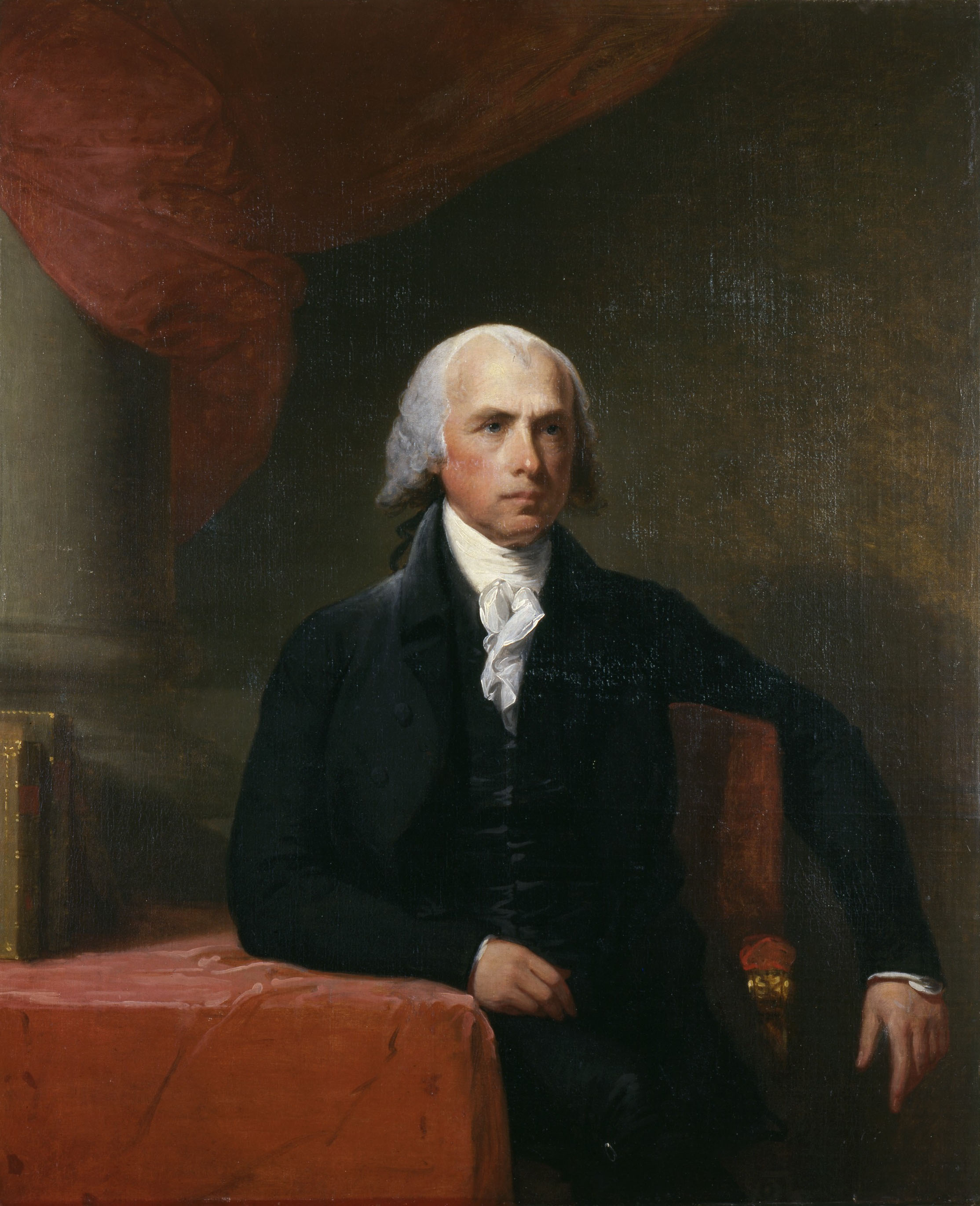
Madison by Gilbert Stuart completed in 1807

Jay by Gilbert Stuart, 1794
As the Framers considered the nature of Presidential power, discussed its scope, explained it in Federalist Numbers 69-70, and finally ratified its responsibilities, it quickly became obvious that it could not be relegated to a plurality of heads. The President must have the requisite energy to administer and execute the Constitution and laws of the nation. As Hamilton asserted in No. 70, “Energy in the executive is a leading character in the definition of good government.” The President’s authority must also be possessed by a single, unitary executive. If the other two branches can overrule his ability to appoint and remove officers in the Executive Branch, then no co-equal check exists on Congress or the courts and good government suffers.
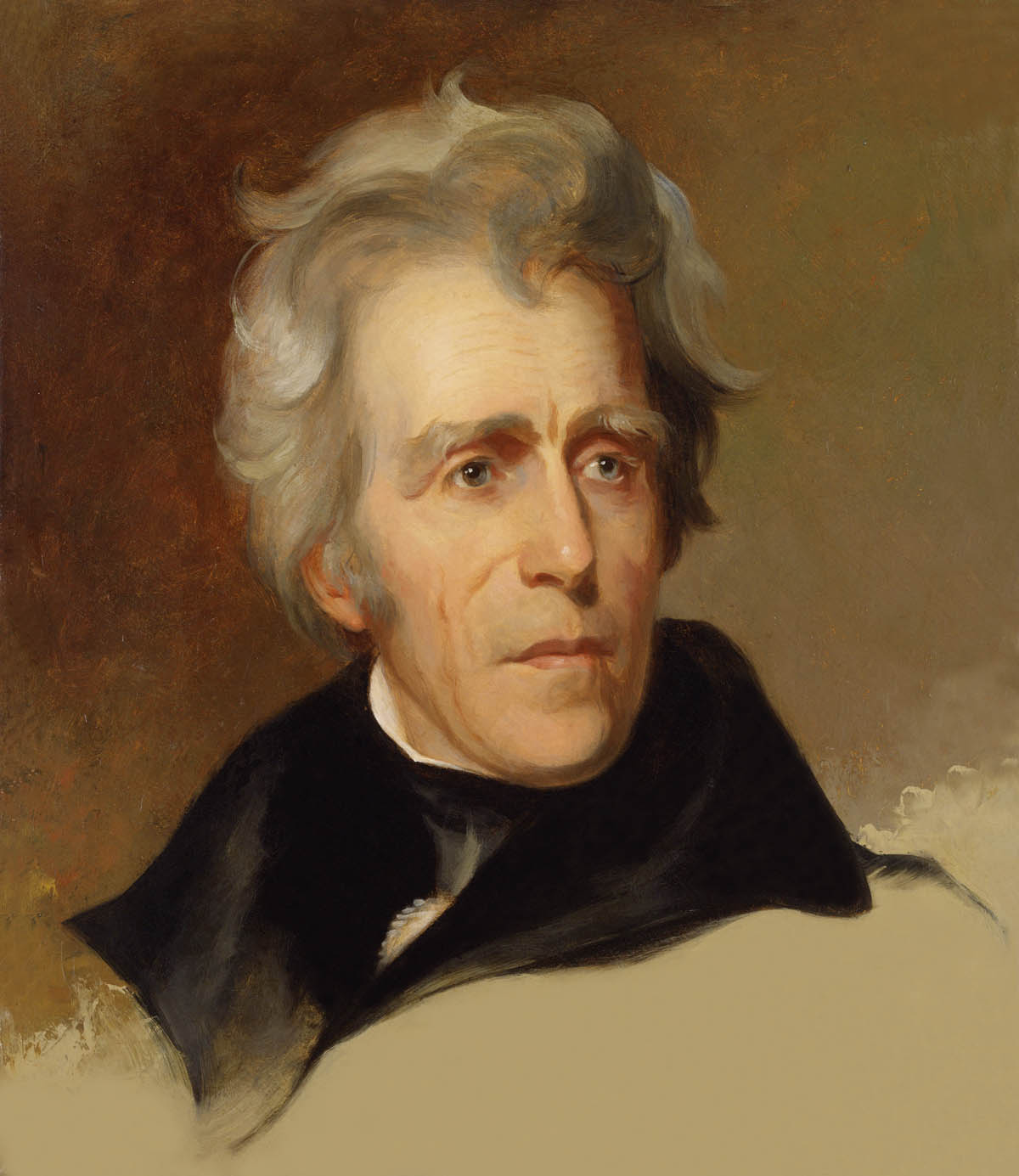
Andrew Jackson by Thomas Sully, 1845
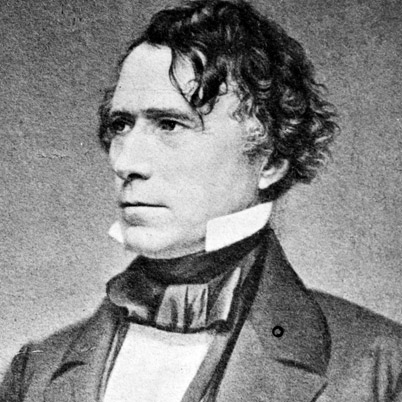
Franklin Pierce, who competes with Buchanan for the weakest spot among our Presidents
When Theodore Roosevelt looked back over presidential history, he identified two basic kinds of leadership: The Buchanan-Taft type, weak, “servant to Congress rather than of the people” and the Jackson-Lincoln type, strong, “subject only to the people” (Autobiography of Theodore Roosevelt, pp.200-1). Teddy, of course, included himself in the latter category of strong Presidents who acted affirmatively even when the Constitution did not expressly prohibit action. Roosevelt considered it legalistic and of the former type to act only where the Constitution has plainly spoken. It never seemed to occur to Teddy that the people the President directly represents speak through that founding document with even greater force than subsequent legislation or executive action, sometimes contradicting and always overruling conflicting use of power. When it came down to illustrating what Teddy Roosevelt meant when defining strength of leadership in a President, a fascinating discovery is made. Above all, Teddy meant complete authority over personnel of the Executive Branch, especially in the power to remove officers without the permission of Congress.
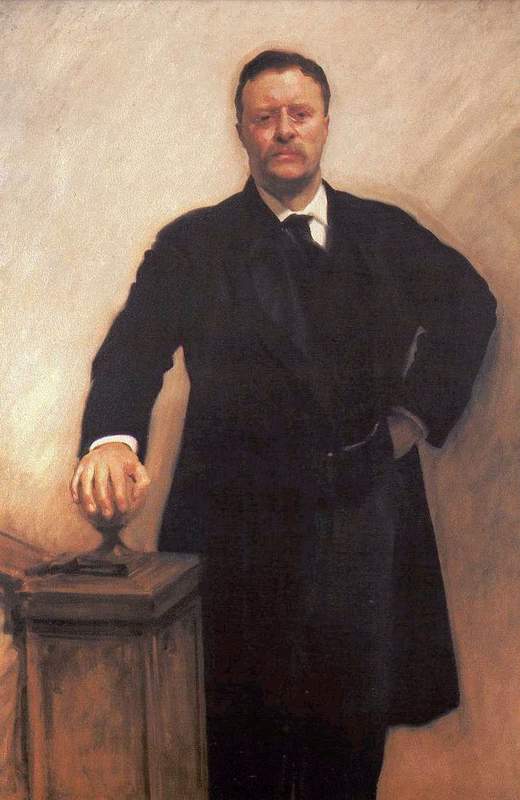
President Theodore Roosevelt by John Singer Sargent, 1903
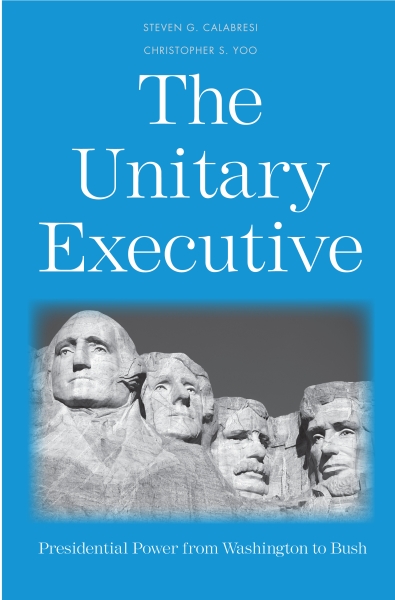
While some scholars, like Elmer E. Cornwell, Jr., in his essay “Coolidge and Presidential Leadership” (Public Opinion Quarterly 21, no.2 [1957]: 265-278, have completely overlooked this exercise of legitimate executive power in their assessment of Coolidge as a weak or strong President, others have not. In a much more comprehensive and scholarly treatment of the subject, Steven G. Calabresi and Christopher S. Yoo in The Unitary Executive: Presidential Power from Washington to Bush, a superb study is presented of the Founder’s vision of an energetic and comprehensive Executive authority placed in the hands of one man for four years. These two scholars affirm the words of the Article II in the Constitution, that “The executive Power shall be vested in a President of the United States.” This does not mean he shares that power with anyone. This does not mean he requires approval before removing personnel from his own co-equal Branch of government. When these scholars turn to Calvin Coolidge in chapter 30 of their work, one resounding conclusion becomes clear: the thirtieth president unquestionably exercised the full power inherent in his office.
Whether judging Coolidge by the words of Article II or the strong-weak standard of Theodore Roosevelt, “Silent Cal” emerges not as a weak leader of the Buchanan type but a strong President who fully exercised the authority vested in the Office, as the ample use of the veto power demonstrates. He is, in fact, fourth among Presidents (prior to FDR) with the most vetoes (50) of Congressional legislation behind Cleveland (584), Grant (93) and Theodore Roosevelt (82). This is all the more impressive given that Coolidge served only 5 years and seven months, averaging 1.34 a month over 67 months compared to 1.09 per month over 90 months for TR. Coolidge likewise saw the President’s role as one representing the people not Congress, observing in his Autobiography:
“The President has tended to become the champion of the people because he is held solely responsible for his acts, while in the Congress where responsibility is divided it has developed that there is much greater danger of arbitrary action. It has become therefore increasingly imperative that the President should resist any encroachment upon his constitutional powers” (p.233).

James Buchanan

Grover Cleveland
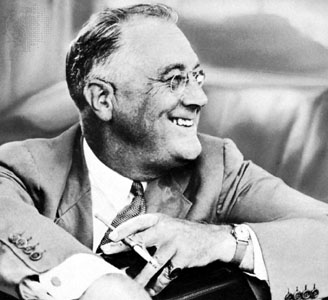
Franklin D. Roosevelt
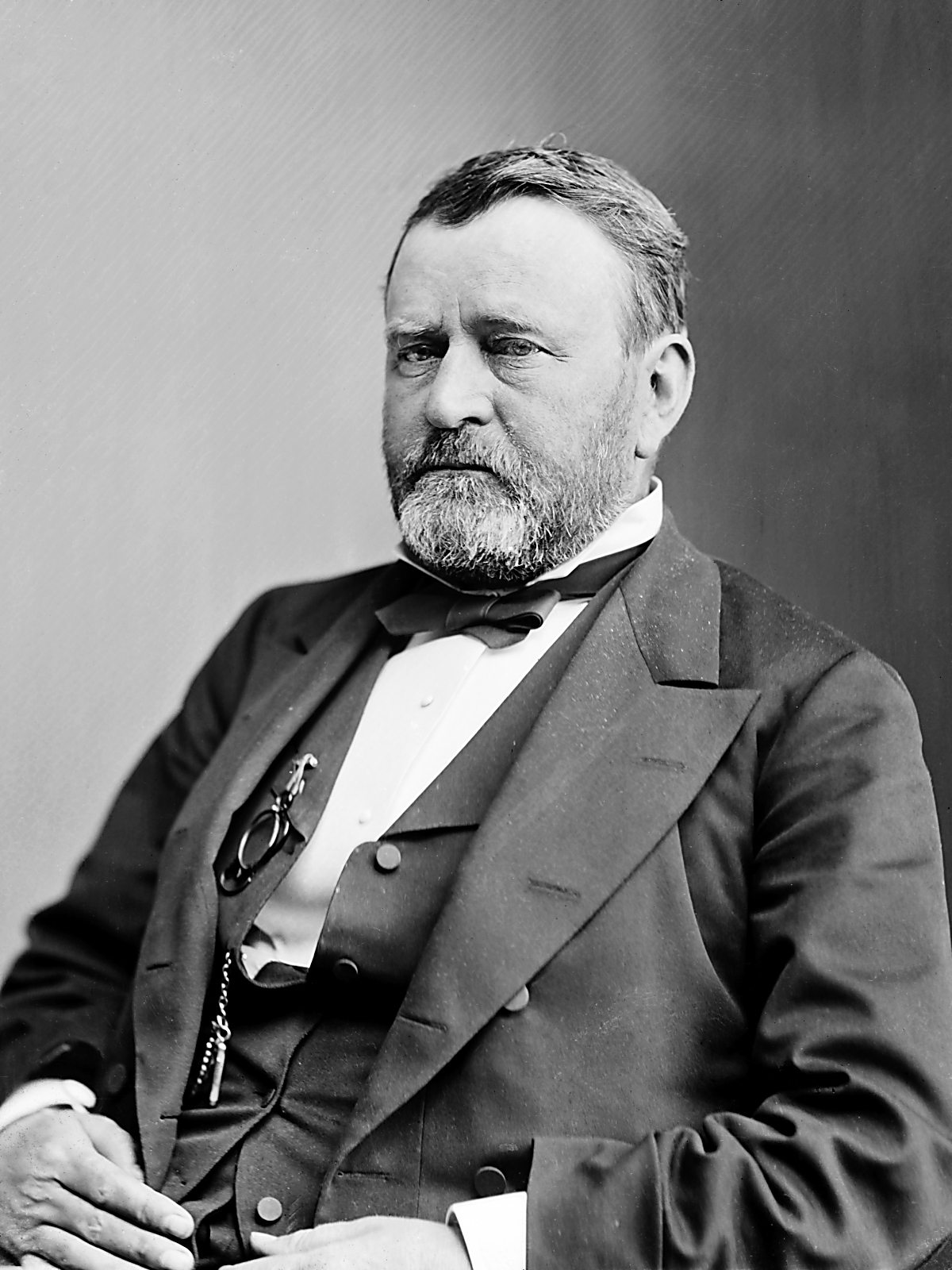
Ulysses S. Grant

William H. Taft, TR’s successor and loyal friend who turned into a political adversary after Taft’s disappointing term as President.
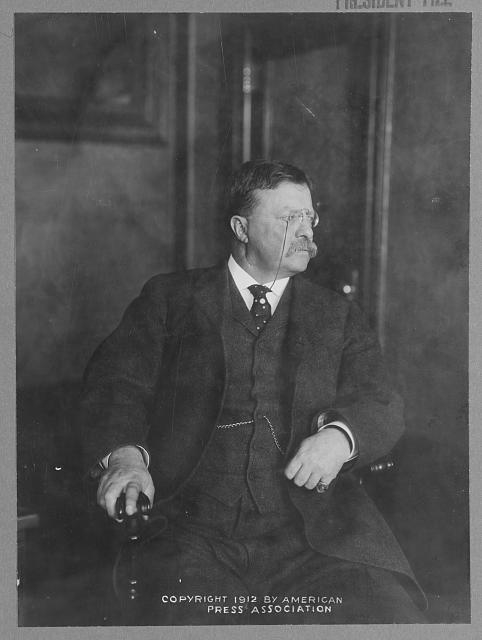
Teddy Roosevelt, the year he came back from retirement to run against his old friend, Taft, which split the G.O.P. and gave the victory to Woodrow Wilson, 1912
Coolidge as an administrator in command of the Executive Branch has few equals. His experience had prepared him for responsibilities that many of his predecessors found overwhelming. Yet, there was no doubting who was in control with Coolidge at the helm. He made it appear effortless but, as is apparent whenever a less qualified man occupies the White House, it is a supremely demanding burden.
Calabresi and Yoo outline eight instances of Coolidge’s exercise of unitary executive power:
1) In his use of the appointment power to direct the policy-making entities created by Congress as quasi-independent bodies, like the Tariff Commission. Coolidge made no attempt to conceal his authority over such agencies, appointing people who would reliably uphold administration policy, rather than defer to Congressional guidance. Even more remarkable is the fact that Congress never confronted him on it. They would have had he been the weak President historians have classified him to be.
2) In his collaboration with and emphasis on the role held by the Bureau of the Budget, carving out a role for it with General Herbert Lord that neither his predecessor nor Congress was prepared to assert on their own. Coolidge forced the issue of government economy to the front and center, demonstrating that it would be the President who directs, streamlines and watches over the budgeting process. The Executive departments would have to come to him, not Congress. He would bring a halt to the lack of continuity that had prevailed department by department in appealing to the Legislature for piecemeal requests. Coolidge ensured one consistent budget overseen by an energetic Executive would become standard procedure from then on.
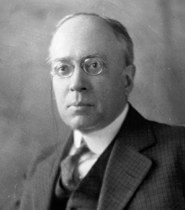
Coolidge’s Solicitor General, James M. Beck, 1921-1925
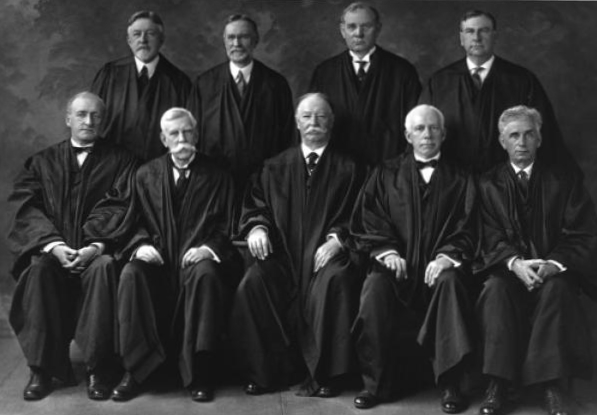
The Taft Court, 1925. Coolidge’s new appointment, Justice Harlan Stone, would join the majority in favor of a strong Executive Power against the three dissenters (Holmes, McReynolds and Brandeis), who favored Presidential deference to Congress.
3) In his oversight of government’s case in Myers v. United States, argued by his Solicitor General James M. Beck, in defense of the Presidential power to remove any member of the Executive Branch, regardless of Congressional legislation to the contrary. Postmaster Myers had been removed by President Wilson and as the case proceeded on appeals to the Supreme Court, the majority found firmly for the President’s legitimate removal power. Ironically it was Chief Justice Taft, writing the opinion for the majority, upheld the arguments presented by Coolidge’s Solicitor General while Coolidge never again faced a Congressional trespass on his authority. It was a resounding victory for unitary executive power.
4) In Coolidge’s deft handling of the Teapot Dome scandal and subsequent investigations by the Senate and the pair of special prosecutors he appointed. The choice of selecting honest and competent men from both parties, Republican Owen J. Roberts and Democrat Atlee Pomerene, leaving his door open while also staying clear of incessant interruption in what the prosecutors were doing accomplished much toward preserving a just outcome and a trustworthy Presidential authority upon which to hold the genuinely guilty accountable and move forward out of the mess into restored confidence and progress. His firm resistance to relent before the “mobs” wanting further resignations vindicated the President’s wisdom in the end. The power to remove officers would remain completely up to him. Secretary Denby and Attorney General Daugherty would leave but only on Coolidge’s terms, in accordance with the blind fairness of law, not because of presumed guilt or someone’s rush to judgment.
5) In Coolidge’s decisiveness rebuke of the Senate investigation of his Bureau of Internal Revenue in March 1924. One Senator, having an ax to grind against Secretary Mellon, had not only hired private investigators but was launching a public investigation with neither evidence of wrongdoing nor respect for the legal process, promising not to quit until something had been found. Coolidge, knowing justice does not operate this way, issued a sharp and effective reprimand of the Senate. It was no more their role to insert themselves in the operations of his jurisdiction than it was lawful to investigate until something is found without due process, without presumption of innocence, without evidence or cause other than political vengeance. It would not stand on his watch and all proceedings stopped at least until Mellon would again become a convenient target for making political points years later under F.D.R.’s Internal Revenue Service.
6) In Coolidge’s role to ensure that the “laws be faithfully executed” on Prohibition enforcement, he was certainly no worse than his contemporaries, Calabresi and Yoo observe. He was personally consistent, in contrast to Harding and numerous others in his own Cabinet, but that example of abstinence did not make enforcement any easier. Time would make the issue moot as Prohibition would succumb to its internal flaws so that any failure of will on the part of Coolidge or his administration hardly warrants unique condemnation for what was a much more widespread shortcoming of human nature and laws themselves. It is worth noting at this point that Coolidge was one of the few of this period to recognize that laws have very definite limits and are incapable, solely on their own, of fixing each and every social ill America faces. Prohibition was no different.
7) In Coolidge’s part implementing the Federal Radio Commission in 1927. The Radio Act, bringing continuity and regularity to a very young, disjointed and uncoordinated industry established an orderly process for the expansion of radio and soon all broadcasting along productive paths. Through competent use of the appointment power and endorsement of the provision that returned the FRC to Executive oversight after one year, under the Commerce Department, Coolidge left an abiding impression not only on the future of communications but on the Presidency itself. A weak President would have relegated these details to Congressional supervision, Coolidge did not.

James Monroe by Samuel Morse, 1819

The famous Doctrine attributed to President Monroe was actually written by his Secretary of State and future President, John Quincy Adams. Adams is depicted here in a posthumous portrait by G. P. A. Healy, 1858.
Finally, 8) In presiding over the removal of what was dubbed the Roosevelt Corollary of the Monroe Doctrine, Coolidge mapped out a new direction in foreign policy and the effective end of “Dollar Diplomacy.” By backing up his Secretary of State Kellogg, who threw out the Corollary, Coolidge made plain that the original restriction of European interventionism in the New World did not give the United States the “right to use the Monroe Doctrine to enforce Latin American good behavior.” The Doctrine applied to the rights and interests of the United States against European entanglements “not a lance” to be deployed against the nations of Latin and South America. It was, instead, “a shield” to protect us all from Europe’s machinations. As Calabresi and Yoo conclude, “The fact that Coolidge could superintend such a change of course attests to the strength of that president’s authority, not to its weakness” (p.272).


As we look back on another President’s Day, it is fitting to remember not only the names of Washington and Lincoln but also the other strong Presidents who led, not in times of war and violent conflict but, equally instructive, in times of peace and prosperity. It is important that in the standard we apply to our Presidents, whether it be the fidelity to his oath, the energy of his leadership, the wisdom of his use of authority, or some other measure, we keep an honest mind, open to the strength it took men like Coolidge to lead when and how they did. The solutions they applied and the problems they faced were no less difficult than for a Washington or Lincoln. Such a thought challenges the conventional wisdom but in so doing, we appreciate anew what can be learned from those who preceded us, including those lesser-known but no less forceful leaders, Presidents like Rutherford Hayes, Grover Cleveland or Calvin Coolidge.

Rutherford B. Hayes, 19th President from 1877-1881

Outgoing President Cleveland at the inauguration of incoming President McKinley as Chief Justice Melville Fuller administers the oath, March 1897.

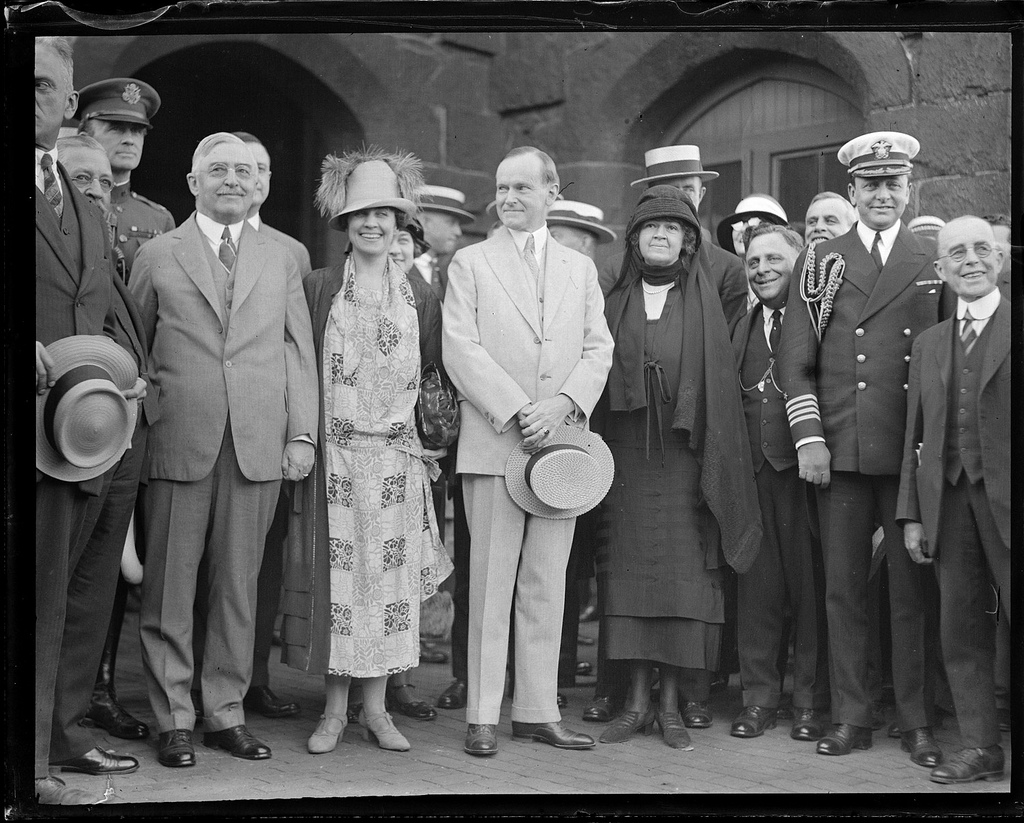
Calvin Coolidge, thirtieth President of the United States, 1923-1929


 The Importance of the Obvious