A Short Walk Through Coolidge Literature

                                                         Image

As we await Amity Shlaes’ long-anticipated “Coolidge” on Tuesday, I think back on the lengthy line of treatments he has received since Robert M. Washburn’s “First Biography” was printed in 1920. In 1923, when Washburn produced his revised 169-page biography under the same title, the President was given a copy to critique. Not one given to self-promotion, he had refused to allow his collection of speeches published as “Have Faith in Massachusetts” to be circulated during the 1920 campaign. But Washburn’s style caught his attention so much so that Coolidge was soon showing off the first chapter of the book to Bruce Barton, “Pretty good, isn’t it?” he proudly declared (Fuess 493). A number of the earliest efforts to both understand who Coolidge was and how to relate that to others fell short in the rush to the printers. Fellow Amherst alumni (like Robert A. Woods), fellow state legislators (like Roland Sawyer), relatives of friends (like Richard Scandrett, brother-in-law of Dwight Morrow) and Boston journalists (like Michael Hennessy and Edward E. Whiting) would all make attempts to capture their elusive subject for curious readers. Then there were those who knew him from childhood, like his former schoolteacher, Edward C. Carpenter, who wrote “The Boyhood Days of President Calvin Coolidge” in 1925. His secretary, C. Bascom Slemp, collected a broad range of the President’s comments on various subjects and organized them for publication as “The Mind of the President” in 1926. Neither vain nor pretentious, the President underscored his political consistency when he had an opportunity to mention the book during one of his bi-weekly press conferences on March 12, 1926, after a copy had been brought to him. “Glancing at it I see that it is very well indexed and there is topically arranged in the book things that I have said in relation to a great many subjects. I think your offices ought to provide each one of you with a copy of the book.” When the pressmen asked for his autograph in each copy, he dryly retorted, “Yes, I would be glad to, and whenever you want to know what my position is on any subject, if you will just glance at that index it will very quickly refer you to a place in the book where you can learn what I have said in relation to a very great many different subjects” (“The Talkative President,” p.27). Talk about consistency! His positions were not driven by popular sentiment.

There were also those who, like disgruntled Ike Hoover, had an ax to grind when it came to Coolidge. Their treatments tell us far more about the writer’s prejudices than they honestly reveal about their supposed subject. The efforts to discredit the man came quickly on the wings of his retirement, like with Duff Gilfond’s sarcastic lampoon, “The Rise of Saint Calvin,” (read in the fall of 1932 by the former President, Fuess p.463) Others, would follow in the steps of “New Deal” historians years later, who had to discredit Coolidge in order to validate the policies of his successors. As Jim Cooke has said, however, “friends don’t let friends read” William Allen White’s “Puritan in Babylon” without first reading Sheldon Stern’s essay on the Coolidge Stereotype (http://www.calvin-coolidge.org/william-allen-white.html). I don’t recommend wasting those precious hours of your life wading through White at all. Donald McCoy would channel the “approved history” when he, in “Quiet President,” discarded Coolidge’s political outlook as too simplistic and inept for what America needed (p.56). Apparently, for “New Deal” historians, what is needed is more government, more spending and less economic and political freedom. Thomas Silver has superbly dissected these unjust biases of historical reporting in his “Coolidge and the Historians.” In truth, “Silent Cal” speaks clearer and more directly to America’s needs than they will admit. Since President Reagan replaced Jefferson’s portrait with that of Coolidge’s, a renewal of appreciation for the man has been growing. Up to that time, the only worthwhile, full-length biography of Coolidge was by Claude M. Fuess entitled “Calvin Coolidge: The Man From Vermont,” written forty years before! Certainly, since that biography an accumulating body of work has been done by Edward C. Lathem, Howard Quint, Robert Ferrell and others to recover the truth about the man buried underneath a mountain of historical misinformation. The Calvin Coolidge Memorial Foundation has kept the fires burning through it all. The return of Coolidge’s writings and speeches to publication in no small way enables a renewal of appreciation for him and his accomplishments. The best introduction to Coolidge is found in his own words. “The Autobiography,” “Have Faith in Massachusetts,” “The Price of Freedom” and “Foundations of the Republic” are the greatest starting points to meet the man.

In the last forty years we have seen the work of a “great cloud of witnesses” including Marvin Stone, John Earl Haynes, Paul Johnson, Robert Sobel, Jerry Wallace, Hendrik Booraem V, J. R. Greene, David Pietrusza, John Derbyshire, Peter Hannaford, Jim Cooke and Amity Shlaes (among a multitude of others) who have and continue to help bring Coolidge and his principles out of the “silence” they have been held for far too long. To appreciate who he was and what he accomplished is not merely some abstract exercise or reactionary dream, it has direct bearing on our future. It furnishes us today with a proven course that, if implemented, charts the way out of enslaving debt and the institutionalized repression of our experiment in self-government began that summer of 1776.
Reagan on the Thirtieth President

When Reagan and Coolidge come up in the same sentence, it usually has something to do with Reagan’s placement of Coolidge’s portrait in the Cabinet Room shortly after Reagan’s inauguration in 1981. But not as well known is the radio program in which Reagan explained his reasons for recognizing the hidden worth of this predecessor. If the press corps had been tuning in during August of 1975, they might have better understood Reagan’s actions six years later. They might also have paused to consider what Coolidge accomplished, but then that could be asking too much. On this sixth day of February, Reagan’s one hundred and second birthday, here is an excerpt from that program entitled “Images,”

“Some day it might be worthwhile to find out how images are created–and even more worthwhile to learn how false images come into being…All of us have grown up accepting with little question certain images as accurate portraits of public figures–some living, some dead. Very seldom if ever do we ask if the images are true to the original. Even less so we question how the images were created. This is probably more true of Presidents in our country because of the intense spotlight which centers on their every move…One was Calvin Coolidge the dry, unexciting New Englander who is more often than not remembered as a lacklustre almost laughable figure who just happened to live in the White House for a while…Are these…images true or false? I’ll list a few facts & you can figure out the answer for yourself. Calvin Coolidge–the man H. L. Mencken said had been weaned on a pickle. Was he a kind of do nothing President in one of those lulls in our Nation’s history? If so we should have such lulls today. There was better than full employment–jobs were competing for workers. The cost of living went down 2.3%, the Federal budget was actually reduced and some of the National debt accumulated in WWI was paid off. During Silent Cal’s presidency the number of automobiles owned by Americans tripled and a great new industry, radio, went from $60 million in sales to $842 million. They laughed when Calvin Coolidge said ‘the business of America is business,’ but we had true peace & prosperity–those things we are promised so often but given so seldom…Well as I say you can make up your own mind about the images versus the man but maybe we ought to go back and see what they did that we aren’t doing. This is Ronald Reagan–Thanks for listening” (“Reagan In His Own Hand” pp.252-3). Image Image

On Greatness

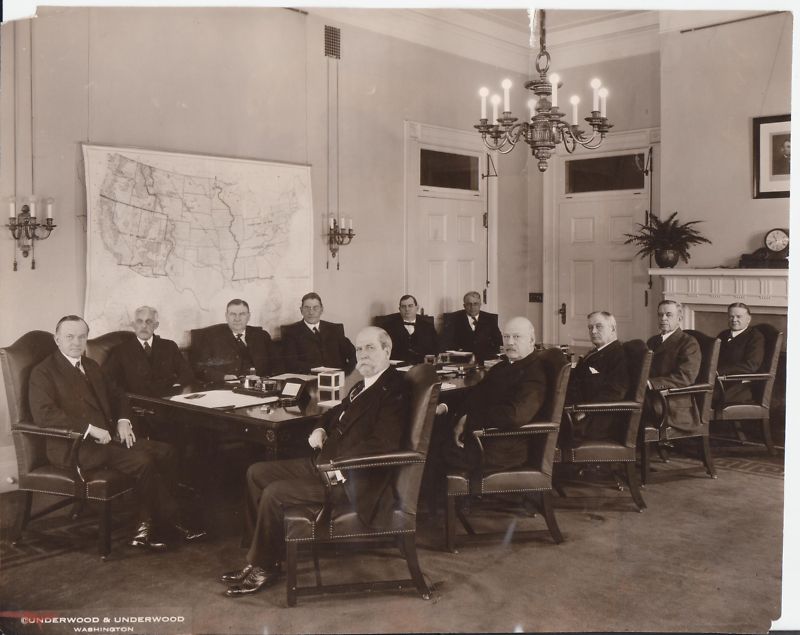
Much ridicule has been heaped upon the 1920s, the Coolidge Era in particular, for its utter lack of “great events” and “great men.” Those who claim such have a confused and backward sense of “greatness.” There were no costly wars, no dramatic upheavals of society, no expansive programs sent down from Washington for how we ought to improve ourselves. The country went about its business only marginally sensing government’s existence, let alone a need for its presence. The President did not insert himself into the daily affairs of Americans not only because it was unnecessary but also because he respected his role under the Constitution. His obligation, as Amity Shlaes has noted, was to restrain harmful measures, to check the abuses of executive and legislative power not to champion revolutionary agendas of his own (“The Forgotten Man,” p.18). He did so not from some overriding sense of his own importance but from a sober commitment to duty, for he also once declared, “It is a great advantage to a President, and a major source of safety to the country, for him to know that he is not a great man. When a man begins to feel that he is the only one who can lead in this republic, he is guilty of treason to the spirit of our institutions” (Autobiography, p. 173).Yet, his restraint, judgment and political wisdom make him a great man even now. “His ability to appraise men quickly on the first interview seemed uncanny” was an observation noticed by more than one of those with whom he would serve (Hubert Work, “Why He Did Not ‘Choose to Run,’ “ The Real Calvin Coolidge vol. 1.  Plymouth: CCMF, 1983,  p.27). He exercised it in the appointment and support of like-minded men of integrity and ability throughout his tenure. He listened to the suggestions of others but he kept his own counsel. In fact, his sound judgment and cool headedness helped avert more than one potential disaster, any one of which could have defined the decade. He did not engage in micro-managing the Departments as some Presidents do. To do so would not only undermine the confidence the people should have in their leaders but would trespass on the work belonging to others. If a person was not up to the job, as he told his Labor Secretary James Davis, he would have to find someone else who was. It was simply not his place to know all the details and get involved in the minutiae of the various departments. Coolidge understood his function was to delegate (and thus disburse, not consolidate) authority. Considering the record of collaboration with men like Mellon and Hughes, he deployed it with great success. Scandal could have overwhelmed the new Administration but it did not. When the demand for resignations by Denby and Daughtery were loudest, the President held immovably to the right course, which was fairness even to those suspected of wrongdoing until the process of law demanded action. He was not swayed by the mob mentality since it placed emotional satisfaction above true justice.

The great men who worked under him were not all of his choosing but he knew their worth and placed them where their talents could be best applied for the good of the country. Andrew Mellon is one of those stellar teammates with whom Coolidge had a unique affinity. But less is said about others like the “great statesman” (as Coolidge considered him, The Autobiography p. 118) Charles Evans Hughes. Hughes’ good sense was evident to him from the night Coolidge succeeded Harding through Hughes’ faithful service even after leaving the limelight of the State Department. The Secretary’s character and experience alleviated many a conflict that could have erupted into violence and discord from Japan to Latin America to Soviet Russia.

Attorney General John G. Sargent was another exemplar of what it means to have capably and quietly carried out what needs to be done without fanfare or need for applause. Sargent’s decency, sense of equity and life training formed the basis of what made him among the best qualified AGs ever to serve. Yet he is unjustly anonymous today. Other men, like Dwight Morrow and Henry Stimson, diffused volatile situations in Mexico and Nicaragua and the Philippines. These “unsung” great men are forgotten today not because of some failure to do enough but because the standard for greatness itself is not properly understood. Ultimately, it is a failing of education. As we live under an increasingly expanding Executive Branch, we would do well to recall the assessment of President Coolidge on the matter, “We have had too much government action, with attendant publicity, proposing to cure human illness which no government can cure and too much public opposition when there was nothing to oppose. The people want from both parties an effective and quiet conduct of public affairs” (November 11, 1930). The same quiet competence from men and women at all levels of public service is what is in order today.

Image

ImageImage