On Presidential Limits

The custom of two terms established by President Washington was faithfully preserved for one hundred and fifty-one years until the precedent was broken by Franklin Delano Roosevelt, winning his third term in 1940. Coolidge had been gone seven years by that time. F. D. R.  would be elected for a fourth term in 1944 and die in office the following April. The twenty-second Amendment was ratified in February 1951 in order to formally establish the original two-term limit as part of the Constitution.

Looking back on his five and a half years as President, Coolidge offered some enduring insights on the need for Presidential limits. This is not only exemplified by the term of office custom, which is now law, but the necessity to respect the Office, honor the limits of its power and guard against its delusory sense of greatness. This risk is not unique to the Presidency; one’s approach to authority on any level is just as prone to abuse and self-deception.

Coolidge, never buying the notion that he was a great man, held each responsibility with the humility of one who could handle what was expected of him without pretentiousness or “muscle-flexing.” He made the difficult look easy but his ability to lead came from discipline, training and perspective not arrogance or condescension. He had this to say about limits,

…[I]rrespective of the third-term policy, the presidential office is of such a nature that it is difficult to conceive how one man can successfully serve the country for a term of more than eight years.

     While I am in favor of continuing the long-established custom of the country in relation to a third term for a President, yet I do not think that the practice applies to one who has succeeded to part of a term as Vice President. Others might argue that it does, but I doubt if the country would so consider it…

     …A President should not only not be selfish, but he ought to avoid the appearance of selfishness. The people would not have confidence in a man that appeared to be grasping for office.

     It is difficult for men in high office to avoid the malady of self-delusion. They are always surrounded by worshipers. They are constantly, and for the most part sincerely, assured of their greatness.

     They live in an artificial atmosphere of adulation and exaltation which sooner or later impairs their judgment. They are in grave danger of becoming careless and arrogant.

     The chances of having wise and faithful public service are increased by a change in the presidential office after a moderate length of time.

     In the higher ranges of public service men appear to come forward to perform a certain duty. When it is performed their work is done. They usually find it impossible to readjust themselves in the thought of the people so as to pass on successfully to the solution of new public problems.

     An examination of the records of those Presidents who have served eight years will disclose that in almost every instance the latter part of their term has shown very little in the way of constructive accomplishment. They have often been clouded with grave disappointments.

     While I had a desire to be relieved of the pretensions and delusions of public life, it was not because of any attraction of pleasure or idleness.

     We draw our Presidents from the people. It is a wholesome thing for them to return to the people. I came from them. I wish to be one of them again…Our country does not believe in idleness. It honors hard work. I wanted to serve the country again as a private citizen.
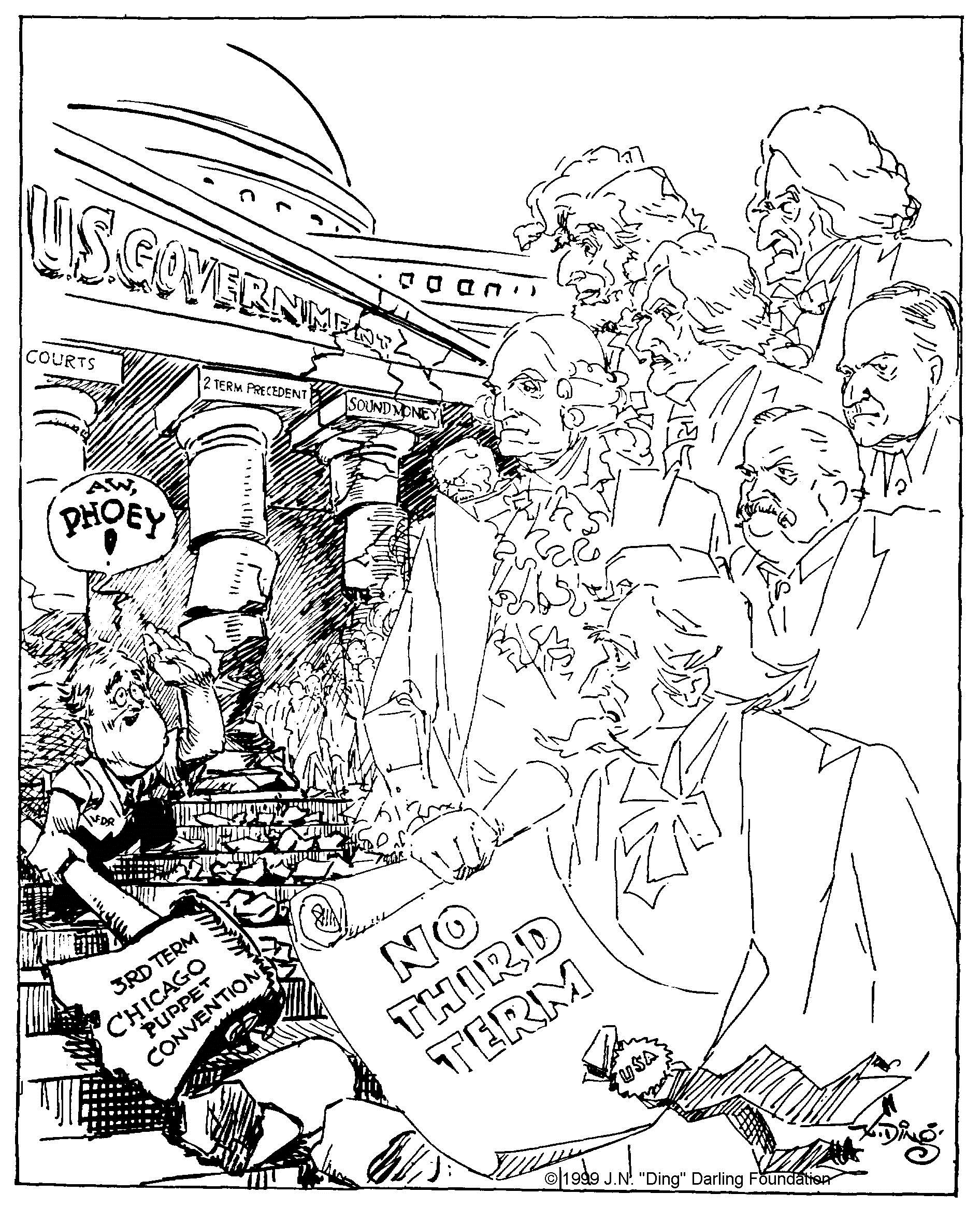
ImageIn this editorial depiction by J. N. “Ding” Darling entitled, “Just a whole lot of nobodies who never knew nothin’,” published October 15, 1940, the cartoonist conveys F. D. R.’s destructive disregard of our institutions and traditions. It is a suitable tribute that, among the “ghosts” of past Presidents arrayed against Roosevelt, Calvin Coolidge is conspicuously among them (L to R: Washington, Lincoln, Jefferson, Jackson, Cleveland and Coolidge stand in the foreground, with Theodore Roosevelt and the rest of those Presidents who have gone on, standing in the background). Coolidge’s warnings echo even now.

On Books and the Pursuit of Learning

This bookplate was designed by Timothy Cole in 1929 and features an intricate bell-shaped system of roots in which the Plymouth Homestead is depicted in Vermont. The scene includes both of Coolidge's famous white collies, Rob Roy and Prudence Prim. In the foreground, a fishing rod leans against a tree beside a basket, both accessories of his many fishing trips. The flag unfurls on either side of a portrait of George Washington, framing the simple scene above Coolidge's name.

This bookplate was designed by Timothy Cole in 1929 and features an intricate bell-shaped system of roots in which is depicted the Plymouth Homestead in Vermont. The scene includes both of Coolidge’s famous white collies, Rob Roy and Prudence Prim. In the foreground, a fishing rod leans against a tree beside a basket, both accessories of his many fishing trips. The flag unfurls on either side of a portrait of George Washington, framing the simple scene above Coolidge’s name.

What a man reads and the quality of books in his library says as much as any other witness could about his character. From youth, he translated Cicero’s Pro Archia Poeta, the defense of the poet Archias’ citizenship against false accusations. As a man, he translated Dante’s Inferno from Italian. He reveled in the wisdom imparted by the great texts of civilization. In “Calvin Coolidge: At Home in Northampton,” Susan Lewis Well, the author of that excellent little book, recounts:

     Coolidge read before falling asleep at night, and Grace told of the pile of books that were on his bedside table never to be disturbed. The Bible was always there plus the Letters, Lectures, and Addresses of Charles Edward Garman…and two paperback volumes of Paradise Lost. Even when traveling, Coolidge carried the two copies of Milton’s classic.

     Mrs. Coolidge remembered that his library was housed in one small five-shelved oak bookcase ‘with a sateen curtain in front.’ His collection numbered about one hundred books including his college texts plus a leather-bound set of Shakespeare’s plays, three Kipling novels, and a set of Hawthorne’s works. Grace admitted that he seldom bought a book, although friends and writers gave him volumes until they numbered about five thousand by the time his presidential term was over.

The exponential growth of his library was not the only outcome due to the generosity of friends. One of the greatest of friends, Frank W. Stearns, commissioned the design of a bookplate in 1926 for Coolidge’s personal library. By 1928, Stearns had finally secured Sidney L. Smith, a renowned engraver, to complete the task. Smith drew the original work with two panels, the lower window featured the signing of the Mayflower compact in 1620 while the upper window depicted the Homestead at Plymouth. Sadly, Smith fell ill and passed away the following year before cutting the design in copper for replication.

     Stearns, undeterred, approached Timothy Cole, a very successful craftsman from New York City who specialized in the almost “lost art” of wood engraving. Cole, building on the design of Smith, completed the distinct work shown above.

In a fascinating survey of the personal libraries of the Presidents, well-known collector and a devoted Antiquarian like President Coolidge, Abraham S. W. Rosenbach said this about the thirtieth president in 1934:

     Calvin Coolidge will probably go down in history as one of the wisest of the Presidents. He had the reputation of being extremely cautious and I have a presentation copy of his Life, by William Allen White which seems to corroborate this statement. It bears on the fly-leaf in the President’s writing: ‘Without recourse, Calvin Coolidge.’

Characteristically, Coolidge says more in two words than most of us say in paragraphs. Employing this legal phrase, Coolidge is refusing any responsibility or endorsement of White’s work. A wise position to take, as time only makes more evident where White’s book is concerned.

Mr. Rosenbach continues, however,

     Mr. Coolidge was interested in the news of the world. He read of the sale in London of the original manuscript of ‘Alice in Wonderland’ which I had purchased. On my return from abroad in May, 1928, the President asked me to lunch at the White House and to bring with me the manuscript. I found that ‘Alice in Wonderland’ was one of his favorite books, that he was interested in Shakespeare, that he liked to own good editions. He asked me details of the first publication of ‘Alice in Wonderland’ and I tried to explain to him that the first edition, issued in 1865, not being altogether to [Lewis] Carroll’s liking, was suppressed. ‘Suppressed,’ said the President, ‘I did not know there was anything off-color in Alice!’

Rosenbach wraps up his presentation on Coolidge by noting the collection the President accumulated during the White House years would find a welcome home back in Northampton, all forty cases worth (an estimated 4,000 volumes). The built-in bookcases Coolidge would discover upon moving into “The Beeches” enabled him to unpack and organize his vast collection of literary treasures. Not the relentless purchaser that President Jefferson was, Coolidge steadied his love for great books with his abiding sense of economy [from the Greek, oikonomia]. His discernment of human nature came from his grounding in classical literature. It was his informed taste combined with the generosity of friends and citizens across America that made this wise man’s library.

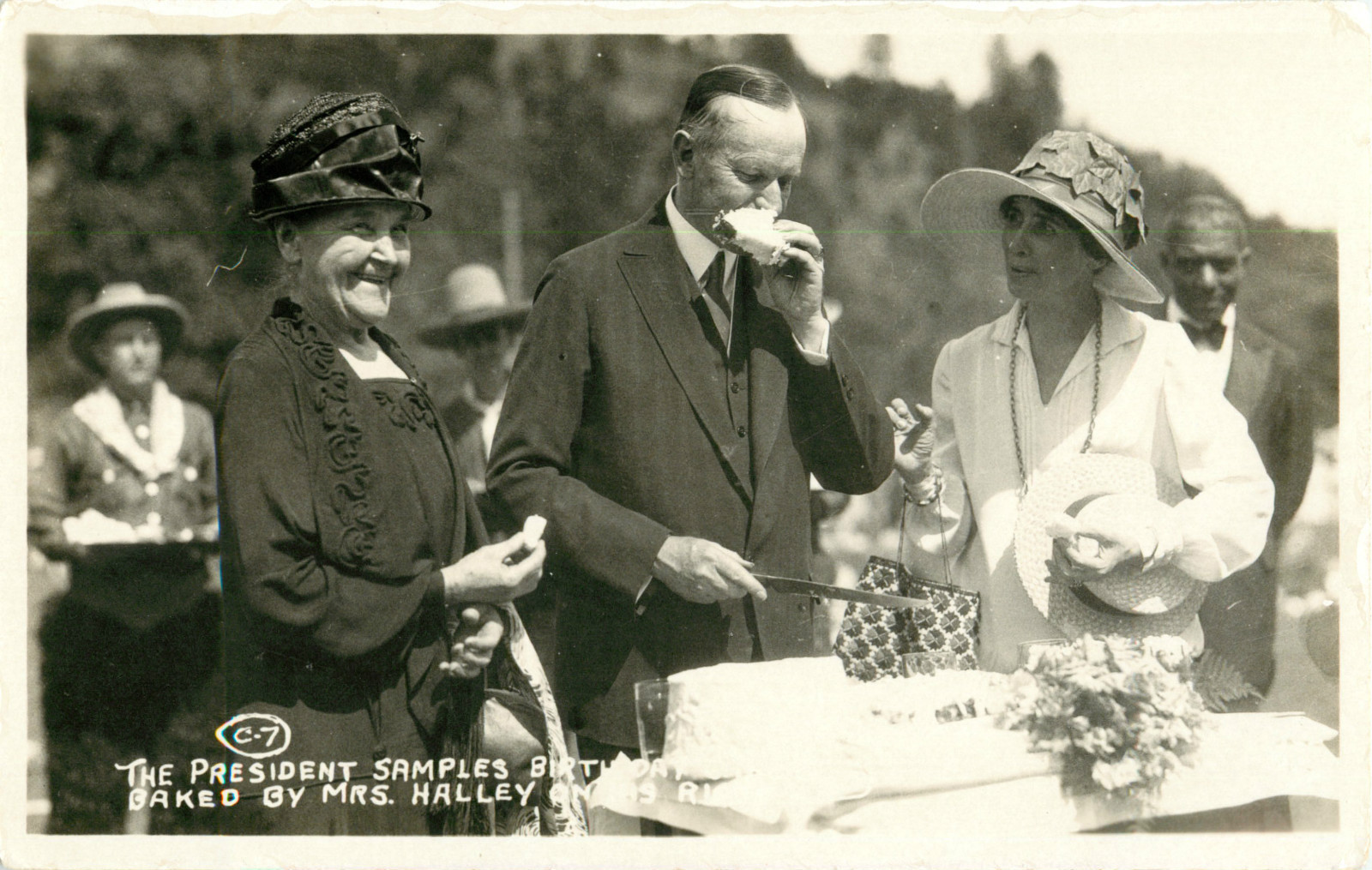
Happy Birthday, President Coolidge!

It is fitting that today we honor the only President who shares his birthday with that of our Nation. When he was born America was not yet one hundred years old, now she is two hundred and thirty-seven. It was during his lifetime that America first stepped into our modern world. Coolidge understood that simple principles, as are embodied in our Declaration, gave birth to greatness not the other way around. Moral power comes first. His quiet competence, his unshakable integrity, his wry sense of perspective, and his confidence in the American people continue to refresh and inspire many even now because no social or technological advancement can surpass them. These moral principles are incapable of obsolescence. His administration exemplified the timeless success of this truth. America is richer for the wealth of his example. For these reasons we honor him today. Happy Birthday, Mr. Coolidge!

CoolidgeCake