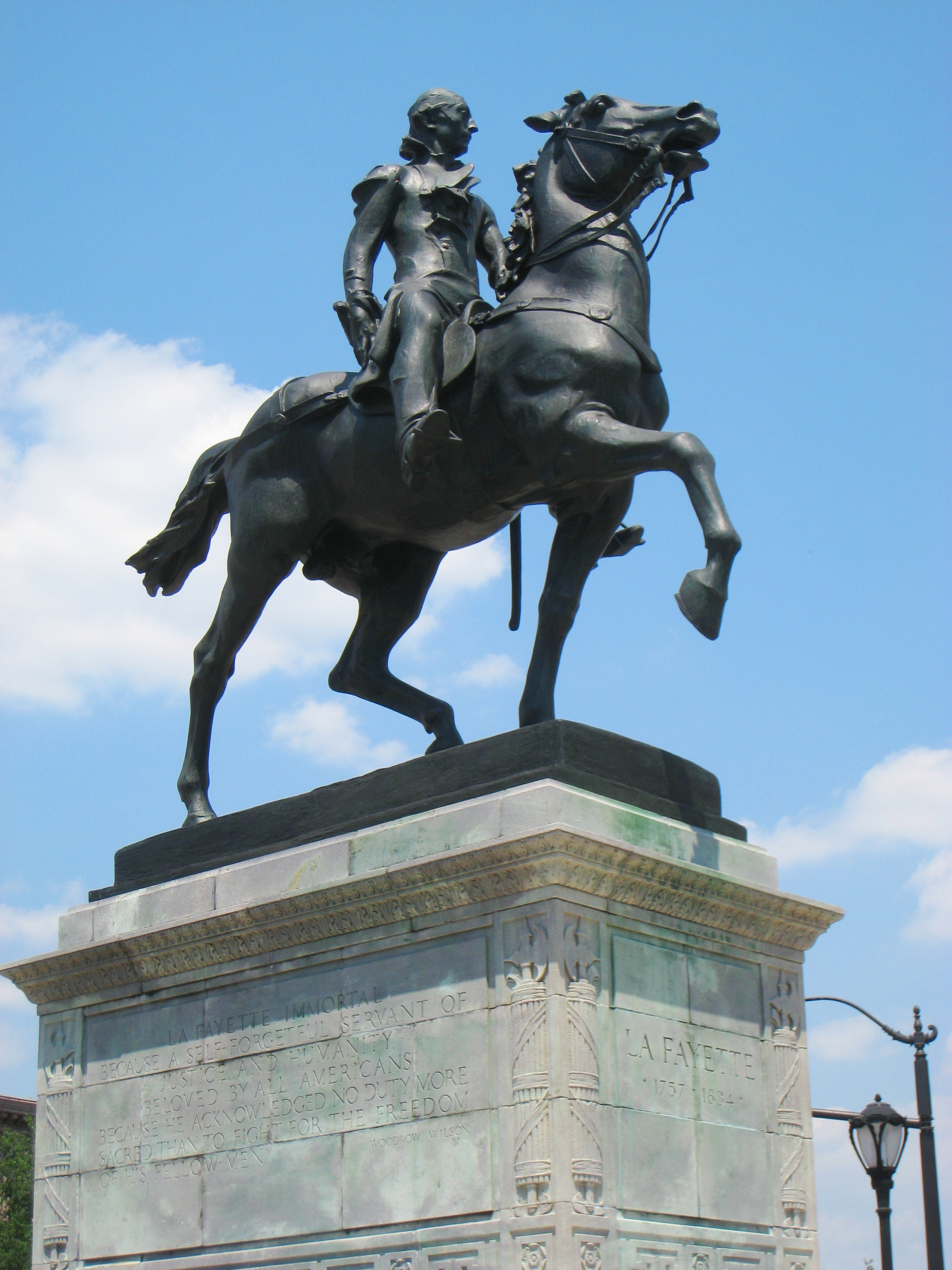
Tomorrow, September 6, marks two important occasions: the birthday of and official farewell to Lafayette by President John Quincy Adams during the French patriot’s last visit to America in 1825. President Coolidge, a century later, upon dedicating the monument to Lafayette placed in Baltimore, Maryland, observed that “[h]is picture to me seems always to have the enthusiasm and freshness of youth, moved with the high-minded and patriotic purpose of maturity. He displayed the same ambition for faithful service, whether he was leading his soldiers in the last charge for American liberty at Yorktown or rebuking the mob at Paris for its proposal to make him king. His part in the French Revolution is well known. He served the cause of ordered liberty in America; he was unwilling to serve any other cause in France…He represents a noble and courageous dedication to the service of freedom. He never sought for personal aggrandizement, but under heavy temptation remained loyal to the great Cause. He possessed a character that will abide with us through the generations. He loved his fellowmen, and believed in the ultimate triumph of self-government.”
As Coolidge continued to reflect upon the freedoms Lafayette fought to preserve in a constitutional republic, he surveys the substance of liberties protected by that document. Coolidge recognized also the deliberate limits placed on the government so that the rights of even the smallest minority — the individual — cannot be deprived of those protections by an ambitious, irresponsible majority.
Coolidge then turns to foreign affairs, hitting upon the true basis for sound foreign policy: guarding independence in our decisions and our interests. Respect, Coolidge shows, comes as a result of that tenaciously guarded independence; not as a product of surrendering it. Being afraid to lead, refusing to use America’s moral power for good, is not the route to successful foreign policy, in other words.
President Coolidge, decried as too provincial for the global burdens of the office, understood the situation far better than the “smartest of the smart” think they do now, as he declared what American foreign policy had been for its first one hundred and fifty years, “We have always guarded it [i.e., independence] with the utmost jealousy. We have sought to strengthen it with the Monroe Doctrine. We have refrained from treaties of offensive and defensive alliance. We have kept clear from political entanglements with other countries. Under this wise and sound policy America has been a country on the whole dedicated to peace, through honorable and disinterested relations with the other peoples of the earth. We have always been desirous not to participate in controversies, but to compose them,” that is, to bring calm back to each situation.
The result? “What a success this has brought to us at home, and what a place of respect and moral power it has gained for us abroad…” No wonder serious statesmen and genuine patriots are astonished at the pathetic equivocations and reckless display of weakness from our current leadership regarding Syria and everywhere else in the world.
Coolidge points to solid ground for future American foreign policy, “To continue to be independent we must continue to be whole-hearted American. We must direct our policies and lay our course with the sole consideration of serving our own people. We cannot become the partisans of one nation, or the opponents of another. Our domestic affairs should be entirely free from foreign interference, whether such attempt be made by those who are without or within our own territory. America is a large country…It has room within its borders for many races and many creeds. But it has no room for those who would place the interests of some other nation above the interests of our own nation.”
“I want to see America set the example to the world both in our domestic and foreign relations of magnanimity. We cannot make over…people…We must help them as they are, if we are to help them at all, I believe that we should help, not at the sacrifice of our independence, not for the support of imperialism, but to restore…a peaceful civilization. In that course lies the best guarantee of freedom. In that course lies the greatest honor which we can bestow upon the memory of Lafayette.”

 The Importance of the Obvious