Dedication of Bok Tower, February 1, 1929

President Coolidge standing beside Edward Bok. Is that the President smiling? Perhaps he is reading that mentions smiling at the absurdity of engendering class envy in this country.

President Coolidge standing beside Edward Bok. Is that the President smiling? Perhaps he is reading that phrase in the Dedication Address which mentions smiling at the absurdity of those who engender class envy in this country.

On their second visit to Florida near the close of his presidency (the first being en route to Havana the previous year), Calvin and Grace Coolidge came to Lake Wales to dedicate the Mountain Lake Sanctuary and Bok Singing Tower to the American people. Some of his reflections on that occasion are given here,

“These grounds which we are dedicating to-day are another extension of this rapidly developing movement: It has been designated as a sanctuary because within it people may temporarily escape from the pressure and affliction of the affairs of life and find that quiet and repose which comes from a closer communion with the beauties of nature. We have not secured the benefits which I have enumerated without being obliged to pay a price. The multiplicity and the swiftness of the events with which we are surrounded exhaust our nervous energy. The constant impact upon us of great throngs of people of itself produces a deadening fatigue. We have a special need for a sanctuary like this to which we can retreat for a time from the daily turmoil and have a place to rest and think under the quieting influence of nature and of nature’s God.

“It is not only through action, but through contemplation that people come to understand themselves. Man does not live by bread alone. This thought is expressed in the motto of the sanctuary in the words of John Burroughs: ‘I come here to find myself. It is so easy to get lost in the world.’ We are so thickly crowded with the forest of events that there is not only danger that we can not see the trees, but that we may lose our sense of direction. Under the influence of these beautiful surroundings we can pause unhampered while we find out where we are and whither we are going. Those who come here report the feeling of peace which they have experienced. In the expression of an ancient writer, it is a place to which to invite one’s soul, where one may see in the landscape and foliage, not what man has done, but what God has done…

L to R: First Lady Grace Coolidge, President Coolidge, Mrs. Mary Curtis Bok and Mr. Edward William Bok, February 1, 1929.

L to R: First Lady Grace Coolidge, President Coolidge, Mrs. Mary Louise Curtis Bok and Mr. Edward William Bok, February 1, 1929.

“The main purpose of this sanctuary and tower is to preach the gospel of beauty. Although they have been made possible through the generosity of Mr. Edward W. Bok, he does not wish them to be considered as a memorial or a monument. While it has been his purpose to give some expression here to his own love of the beautiful, in form, in color, and in sound, he has also sought to preserve the quiet majesty of the trees, increase the display of coloring in the flowers, and combine stone and marble in the graceful lines of the tower, all in a setting surrounded by green foliage and reflected in. sparkling waters over which the song of the nightingale will mingle with the music of the bells…

“This sanctuary and tower are not only endowed with a beauty of their own, but they are a representation of the beneficent spirit of the giver. They are another illustration that the men of wealth of the United States are not bent on the accumulation of money merely for its own sake, or that they may use it in selfish and ostentatious display. A most cursory examination of the facts would soon disclose that our country leads the world in its charities and endowments. It would be difficult to recall any line of endeavor capable of ministering to human welfare, not only in our own country but in many places abroad, which is not being helped by the generosity of our people of wealth. Not only that, but the charities of this Nation stand on a plane which is occupied by them alone. They have never been tainted with any effort to hold back the rising tide of a demand for the abolition of privilege and the establishment of equality, but have rather been the result of a sincere philanthropy. They have not come from any class consciousness; certainly, not from any class fear. They represent in all its beauty and purity the love of man and the desire to benefit the human race. We have a strong sense of trusteeship. While giving every credit to the genius of management, and holding strongly to the right of individual possessions, we realize that to a considerable extent, wealth is the creation of the people, and it is fitting; as in this case, that it should be expended for their material, intellectual, and moral development..

Dutch-born, Mr. Bok came to America at the age of six and worked his way up from a New York bakery to editor of the Ladies Home Journal for thirty years. The man had a life-long fascination with natural beauty and artistic expression. He accomplished much and gave much in return. Bok Singing Tower bequeaths that love for color, use of light and an appreciation for the artistic to all Americans.

Dutch-born, Mr. Bok came to America at the age of six and worked his way up from a New York bakery to editor of the Ladies Home Journal, where he served  for thirty years. The man had a life-long fascination with natural beauty and artistic expression. He accomplished much and gave much in return. Bok Singing Tower bequeaths that love for color, use of light and an appreciation for the artistic to all Americans.

“Gradually, for complete revolutions do not occur in a day, we have transferred our allegiance to the people. It is for them that our songs are made, our books are published, our pictures are painted, our public squares are adorned, our park systems are developed, and the art of the stage and the screen is created. While these things are done by individuals, this movement is ‘of the people, by the people, and for the people.’ It is no accident that this superb creation, which we are dedicating to-day, is the conception of a man whose only heritage was that of good breeding, an American by adoption, not by birth, who has felt the pinch of poverty, who has experienced the thrill of hard manual labor, and who has triumphed over many difficulties. Edward W. Bok is making this contribution in recognition of his loyalty to his sovereign, the people. It is another demonstration that when they are given the opportunity the people have the innate power to provide themselves with the wealth, the culture, the art, and the refinements that support an enlightened civilization. Now, therefore, in a spirit of thankfulness for the success of our institutions, which is here attested, and appreciation of the munificent generosity, which is here exhibited, in my capacity as President of the United States, I hereby dedicate this Mountain Lake Sanctuary and its Singing Tower and present them for visitation to the American people.” 

Bok_Tower

For more information, including a superb video about the Tower and Gardens, Coolidge’s dedication of it — and the importance of preserving it — at the Bok Tower website, under the “legacy” tab (https://boktowergardens.org/legacy/).

On the Will to Cut Expenditures

Who said, “The plan is to reduce the cost of Federal government operations by 25 per cent”?

Or, “We should plan to have a definitely balanced budget for the third year of recovery and from that time on seek a continuing reduction of the national debt”?

How about, “The Treasury is all right and we are balancing the budget — you needn’t worry”?

Or, finally, “It has taken courage for the Federal government to go into the ‘red’…But it has been worth it”?

If you guessed “Calvin Coolidge,” you would be wrong. It was Franklin Delano Roosevelt, between 1932 and 1938. As Bruce Barton pointed out, however, there was no further talk of economy after 1938. “The talk was about the preparation for war and, later, about the fine new world the war was going to usher in.”

Bruce Barton, whose 1953 article, "Unless It Hurts, It's No Good," is featured here.

Bruce Barton, whose 1953 article, “Unless It Hurts, It’s No Good,” is featured here.

Not only had 1931 seen the first budget deficit in twelve years, the debt stood at $21 billion by January 1933. When Roosevelt died in April 1945, the debt had ballooned to $233 billion. President Truman built upon that infamous legacy with another $32 billion of his own. Writing as a new President was taking office in 1953, Bruce Barton hastened to the point of his article: “Both of these presidents talked economy, but neither of them had any real heart for it. Neither of them was willing to do anything that would endanger the support of a pressure group in the next campaign.” Both were pandering to people, telling voters what they wanted to hear but never delivering anything more than eloquent words and good intentions. When the occasion called for it, the cuts promised in the heat of campaigns were too politically painful to make, risked the alienation of some support group somewhere and endangered electoral success in the future. They cared too much for the appearances and not enough for the substantial harm inflicted on people by the curtailment of growth and opportunity because of Government’s limitless spending habits. It is a lack of discipline, not bravery, that Government demonstrates when spending more than it has. Saying one thing and doing another, especially when one is the President of the United States, does not illustrate courage either, it exemplifies cowardice.

In contrast, Barton continues, “Calvin Coolidge cut the debt of his day by nearly 25 per cent. To disparage him is now the fashion. He is slurred over as a ‘do-nothing’ president, a national nonentity. Actually he was all guts.”

Before you snicker and chortle, dear reader, consider carefully Barton’s four examples substantiating that claim.

1. “As governor, he had the guts to break the Boston police strike. When Samuel Gompers, the country’s most powerful labor leader, demanded that the striking policemen be reinstated, Coolidge wired: ‘There is no right to strike against the public safety by anybody, anywhere, at any time.’ ” While it has often been incorrectly asserted that the danger had already passed and that Governor Coolidge took credit for something he did not do, this telegram might never have been sent and so cogently framed the heart of the issue had Coolidge not sent it. He was not the politician who runs from confrontation.

2. “He had the guts to veto the act passed by the members of both Houses of the Legislature raising their own salaries.” The veto, just like the telegram, did not have to be sent. Governor Coolidge could have joined the General Court that spring of 1919 with a wink and a nod, signing their $500 increase and saying nothing. Like trimming down state agencies from 120 to 19 departments, however, Governor Coolidge refused to simply “punt” difficult tasks to his successor, even when the law allowed for delay.

3. “As president, he had the guts to veto the first big farm subsidy, the McNary-Haugen Bill, on the grounds that the bill was not only an abuse of the taxing power, but also a sure path to overproduction.” The sharp language of both veto messages took everyone by surprise at the time, who considered Coolidge incapable of being riled about anything. He took on the issue firmly and ended attempts at government control of agriculture for the rest of his term. This is all the more incredible considering that two solid Republicans sponsored the bill, a large majority passed it twice and a very influential “Farm Bloc” wanted it to be law.

4. “He also killed the excessive soldiers’ bonus, since the veterans had already received a discharge bonus of 256 million dollars. Coolidge’s friends and foes agreed in predicting that such actions would kill him politically; yet the people gave him overwhelming re-election.” This, too, is stunning when, as it seems today, there is no price too high for veteran’s benefits.

Barton comes to the point, as America still stood at war-time levels of spending: it was time to reapply Coolidge’s courage, not merely echo the same empty words and pleasing promises. “History should teach us that you can’t slash without incurring the opposition of powerful pressure groups. That unless the slash hurts it isn’t any good.”

Coolidge put it this way, “Nothing is easier than spending the public money. It does not appear to belong to anybody. The temptation is overwhelming to bestow it on somebody.” Yet, ninety years ago, a reserved but courageous man from Vermont triumphed over that temptation, overcoming it not merely once or twice but repeatedly and consistently.

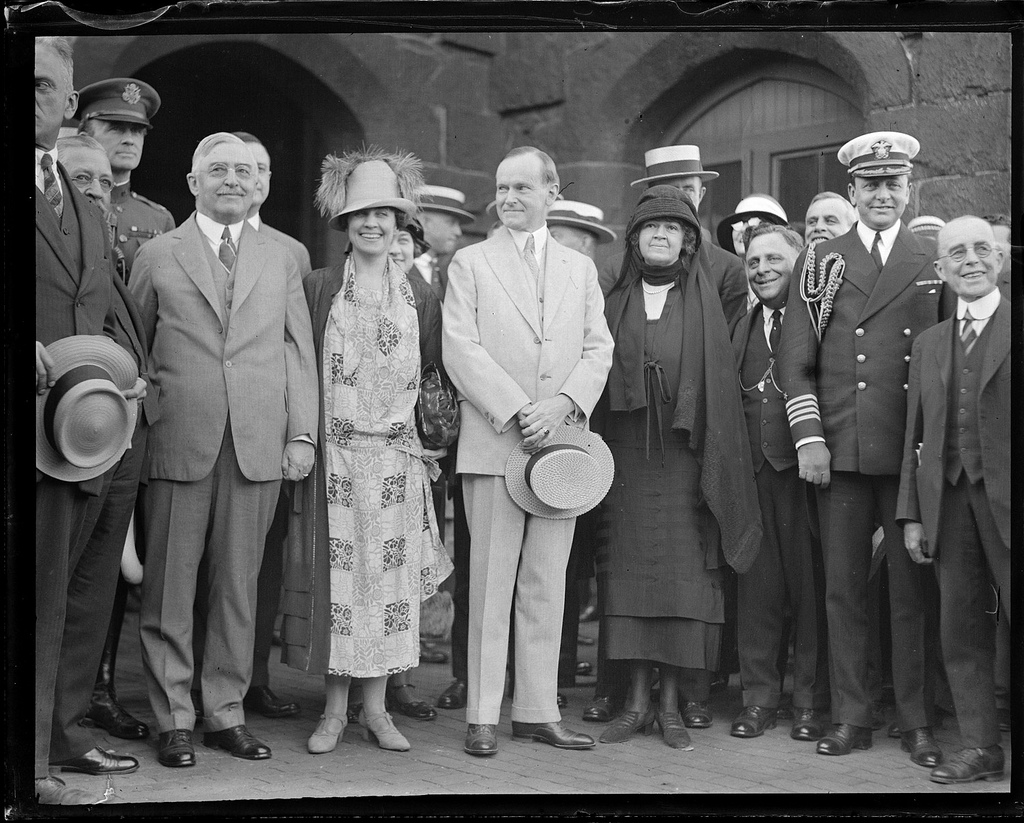
The Coolidges, among the crowd, at Salem train depot.

The Coolidges, among the crowd, at Salem, MA, train depot.

“I don’t think in all my experience, which has been very large…with proposals for spending money, I have ever had any proposal from anyone as to what could be done to save any money. Sometimes linked with the proposal for an immediate large expenditure is the suggestion that it ultimately will result in a saving…[T]hat is about the extent of the outside assistance I have had in that direction” — December 14, 1928.

“The appropriation of public money always is perfectly lovely until some one is asked to pay the bill. if we are to have a billion dollars of navy, half a billion of farm relief, four hundred millions of Mississippi flood control, two or three hundred millions of river and harbor improvements, two or three hundred millions of public buildings, hundreds of millions of good roads and other hundreds of millions of pensions, the people will have to furnish more revenue by paying more taxes. It is for them, through their Congress, to decide how far they wish to go” — August 4, 1930.

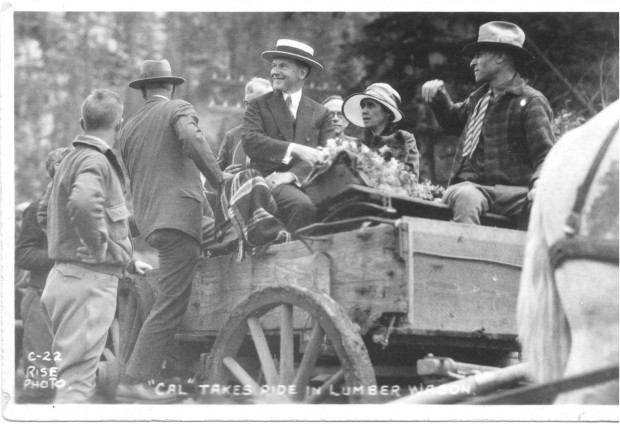
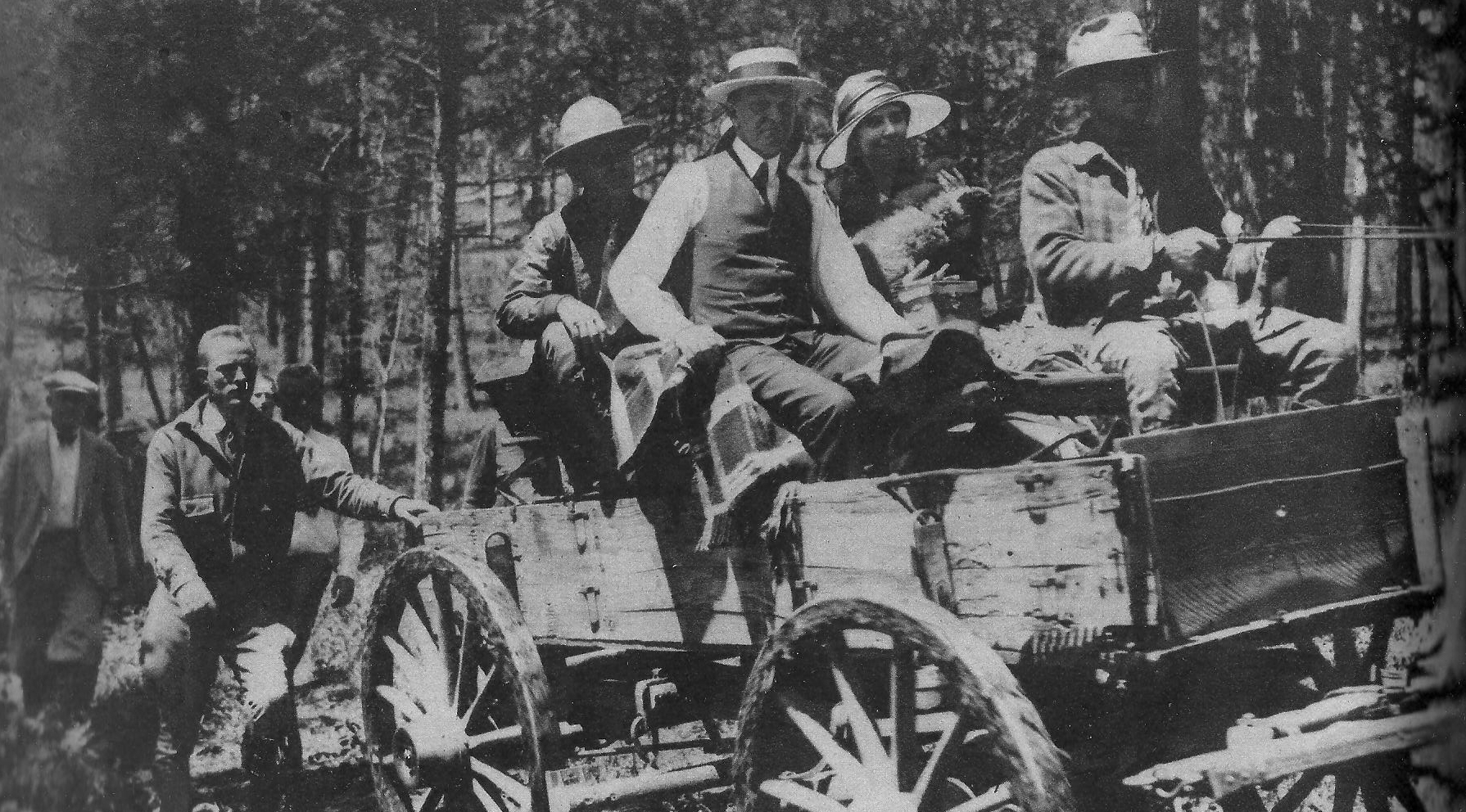
Wagon Ride in the Black Hills, South Dakota, 1927

Wagon Ride to the Game Lodge, South Dakota, 1927

President and Mrs. Coolidge getting settled in for their wagon ride to visit former Governor Samuel McKelvie, who lived in a cabin beside Slate Creek, South Dakota.

President and First Lady back aboard the lumber wagon after it got stuck along the trail en route to the Game Lodge. Calvin, it was remembered, got out and put his shoulder to the wagon, helping push it out of the ruts and back in motion. How many Presidents would have done that? Notice in the second picture he has removed his suit jacket, leaving it clean for their arrival.

President and First Lady back aboard the lumber wagon after it got stuck along the trail en route to Slate Creek. Calvin, it was remembered, got out and put his shoulder to the wagon, helping push it out of the ruts and back in motion. How many Presidents would have done that? Notice in the second picture he has removed his suit jacket, leaving it clean for their arrival. He could have been driven in a car, he chose to ride in the wagon.

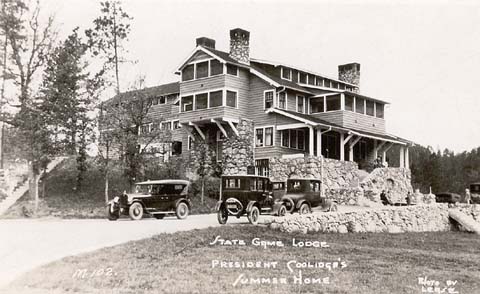
Their destination, the Game Lodge, Custer State Park in the Black Hills of South Dakota.

Their home that summer, the Game Lodge, Custer State Park, in the Black Hills of South Dakota.