On Taxes: Government Economy Maximizes Freedom

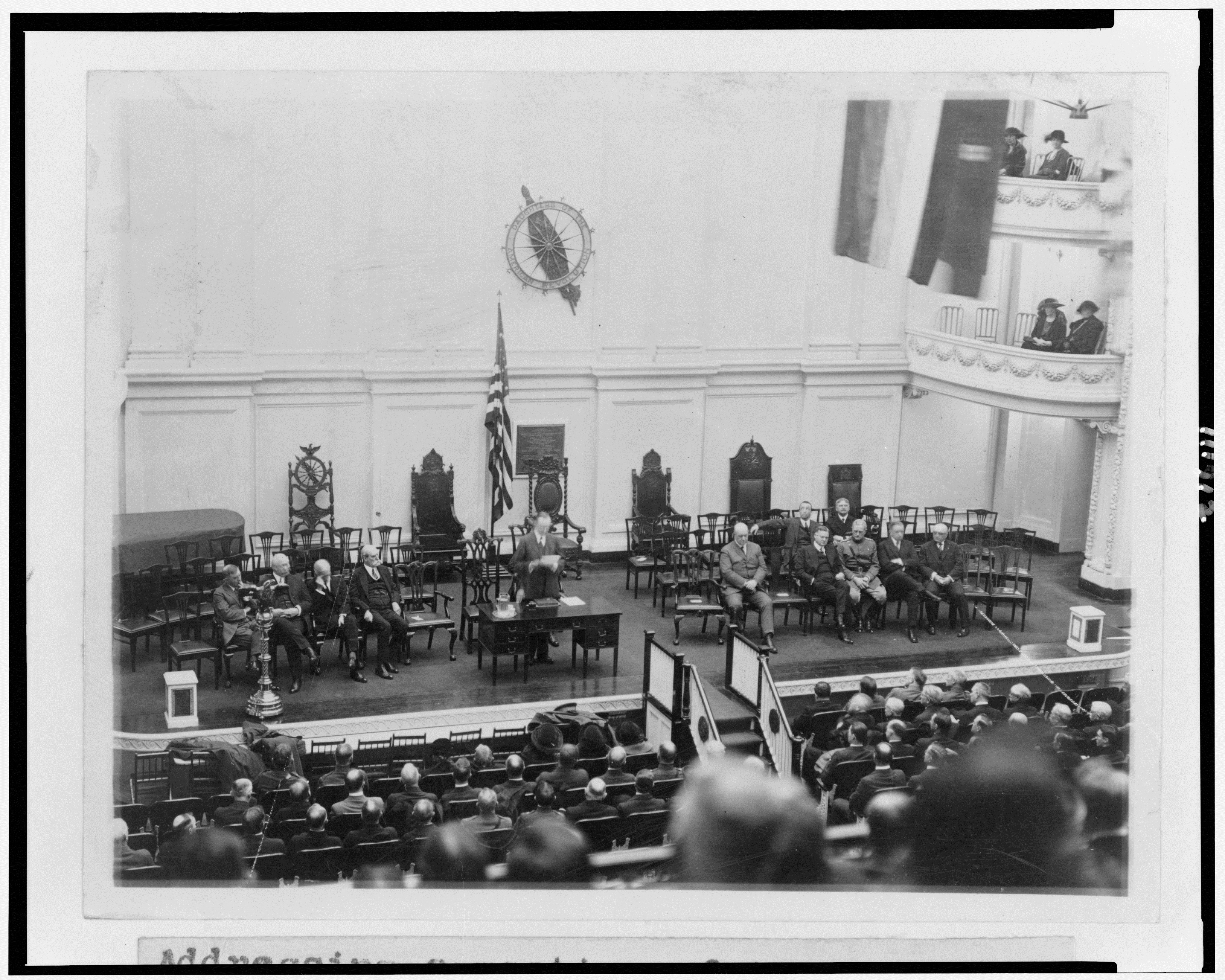
Coolidge speaks at the Budget Meeting in 1923

Coolidge speaks at the Budget Meeting in 1923

Glaringly absent from most of today’s training in political leadership is a straightforward connection to reality. For all too many, the money for each and every appropriation, political favor, or tax exacted will always be there upon demand. There is no realization that every time a tax goes up, someone has to work harder in order to pay it. Insulated from the outcomes of their own actions, most politicians fail to grasp what crushing price they inflict on the very people who create, work and struggle to produce in this country. Not so with Calvin Coolidge. Coolidge was instilled with a recognition of this inescapable truth from a very young age. It remained present in every act of his public life. “As I went about with my father when he collected taxes, I knew that when taxes were laid some one had to work to earn the money to pay them. I saw that a public debt was a burden on all the people in a community…” From this “good working knowledge of the practical side of government” Calvin understood that individual freedom and opportunity suffer in proportion to government taxation.

As Vice President, Coolidge knew that business is not the immortal “golden goose” to be raided infinitely by government whim. He knew this not as an academic abstraction or politician’s platitude but from working the country store back in Plymouth. “The business of the country, as a whole, is transacted on a small margin of profit,” he reminded his audience. The notion that profit was to be confiscated and “windfalls” penalized had even then been a fashionable demand during his youth. “The economic structure is one of great delicacy and sensitiveness. When taxes become too burdensome, either the price of commodities has to be raised to a point at which consumption is so diminished as greatly to curtail production, or so much of the returns from industry is required by the government that production becomes unprofitable and ceases for that reason. In either case there is depression, lack of employment, idleness of investment and of the wage-earner, with the long line of attendant want and suffering on the part of the people.” Then Coolidge zeroes in on the principle at stake, “After order and liberty, economy is one of the highest essentials of a free government.”

Experience confirmed the soundness of this precept time and again, as he would confirm, even more emphatically, two years later during his Inaugural Address, “The collection of any taxes which are not absolutely required, which do not beyond reasonable doubt contribute to the public welfare, is only a species of legalized larceny. Under this republic the rewards of industry belong to those who earn them. The only constitutional tax is the tax which ministers to public necessity. The property of the country belongs to the people of the country. Their title is absolute. They do not support any privileged class; they do not need to maintain great military forces; they ought not to be burdened with a great array of public employees…” Then, taking on the issue of punitive taxation directly, he said, “I am opposed to extremely high rates, because they produce little or no revenue, because they are bad for the country, and, finally, because they are wrong. We can not finance the country, we can not improve social conditions, through any system of injustice, even if we attempt to inflict it upon the rich. Those who suffer the most harm will be the poor.”

Keenly aware that “the power to tax is the power to destroy,” he summarized the essence of the matter at Memorial Continental Hall in June 1924, “A government which lays taxes on the people not required by urgent public necessity and sound public policy is not a protector of liberty, but an instrument of tyranny. It condemns the citizen to servitude. One of the first signs of the breaking down of a free government is a disregard by the taxing power of the right of the people to their own property. It makes little difference whether such a condition is brought about through will of a dictator, through the power of a military force, or through the pressure of a organized minority. The result is the same. Unless the people can enjoy that reasonable security in the possession of their property, which is guaranteed in the Constitution, against unreasonable taxation, freedom is at an end. The common man is restrained and hampered in his ability to secure food and clothing and shelter. His wages are decreased, his hours are lengthened. Against the recurring tendency in this direction there must be interposed the constant effort of an informed electorate and of patriotic public servants. The importance of a constant reiteration of these principles cannot be overestimated.”

On Pride in Our Armed Forces

Coolidge at the Tomb of the Unknown Soldier, November 1924

Coolidge lays a wreath at the Tomb of the Unknown Soldier with Secretary of War Davis and Secretary of the Navy Wilbur, November 1924

Looking back on the formal declaration of war and entrance into armed engagement against Germany on this day in 1917, Coolidge was filled with a genuine admiration for those members of the United States Army – and all who put on the uniform – who, serving so necessary a mission, represent something far more important than brute strength or militarism abroad. While so many nations around the world project military might for conquest, Americans pursue their ideals through service. Engineering, medicine, constitutional government have all been advanced here and around the world by those who have taken up the sacrifice of service in the Armed Forces. America’s proud military heritage reminds us that, when all has been said, it is law, not violent and unprincipled men, that reigns and peace cannot be achieved without a “preparation for national defense.” As if rescuing Europe were not enough proof, the relief dispatched by President Coolidge to help those suffering from the earthquake and tsunami which hit  Japan in September 1923 was testament enough to America’s commitment to the ways of peace not the march of militancy.

View from the Imperial Hotel, the only hotel to survive, of some of the destruction in Tokyo in 1923. It is estimated over 140,000 people died and yet Coolidge helped raise $12 million (what would be $165 million today) through the Red Cross for victims of the disaster.

View from the Imperial Hotel, the only hotel to survive, of some of the destruction in Tokyo in 1923. It is estimated over 140,000 people died and yet Coolidge helped raise $12 million (what would be $165 million today) through the Red Cross for victims of the disaster. One American Navy officer would be presented with the Medal of Honor by President Coolidge for his rescue of a woman trapped (with both legs broken) in the Grand Hotel, after carrying her to safety just before the building went up in flames.

After all, America’s military is not to be a repository for the thugs and miscreants or a social experiment for the advancement of abnormality. The Armed Forces comprise our sons and daughters, Americans who love their country and respond with courage and conviction when its institutions, traditions, and interests are under attack. These men and women voluntarily sacrifice everything because they know American liberties are worth such a price. This is why our leaders should adhere to the same careful regard for those institutions when they deploy precious lives to the defense of American interests, not on vague missions to save democracy, but to protect our people, their property and their interests. As the former President said on April 4, 1931,

“To those who recall how important the United States Army appeared on the 6th of April, 1917, this anniversary will seem a fitting time for the nation to give some thought to its military establishment. Human nature takes things for granted that have long existed. We forget that the constant effort and care of some one makes them so. In spite of all our other precautions, the peace we enjoy still has in it a large element of preparation for national defense. No self-respecting people desiring to live under a reign of law at home and abroad can afford to neglect their army.

“Public security depends to a large extent on the knowledge that the government has power to enforce its decrees.

“Our own Army is not entirely an instrument of war. It serves in peace. The Engineering Corps built the Panama Canal and supervises Mississippi flood control and river and harbor improvement. The Medical Corps overcame the scourge of yellow fever. For many years the War Department administered our insular possessions. The people can look on the past and present of their Army, its distinguished soldiers and its great accomplishments, with satisfaction and confidence. We have an Army that is not militaristic.”

Garden Party for Wounded Veterans on the White House lawn, May 21, 1925.

President and Mrs. Coolidge greeting veterans on the White House lawn, May 21, 1925.

Coolidge meets with military leadership at the White House, 1927

Commander-in-Chief Coolidge meets with military leadership, including the civilian head of the Army, the Secretary of War (and champion tennis player) Dwight Davis, at the White House, 1927. Secretary Davis stands directly behind the President’s right shoulder.

Happy April Fool’s Day!

President Coolidge’s Secret Service man, Colonel Edmund W. Starling, relates this amusing incident involving a bird and a cleverly prepared request to the Budget Director. As we will see, it was especially relished by someone known for his pranks around the White House, Mr. Coolidge.

“Dr. William A. Mann, director of the National Zoological Park, and an accomplished zoologist, was anxious to have a special grant of funds given his institution for research purposes. He and his subordinates expected to meet strong opposition from General Lord, the director of the budget, and some of the younger men cooked up an ingenious scheme. They took a luridly spectacular bird called the Malayan starling, a bird of bright yellow plumage with a black cape, and spent their lunch hours teaching him to ejaculate: ‘General Lord! What about that appropriation?’ The bird had a rich baritone voice of peculiarly piercing quality. It presently became expert. About this time a meeting of the government officials concerned with budgetary problems was arranged in the main building of the Smithsonian Institution. Vice President Dawes, General Lord, Senator Morrow, and the heads of some of the departments were there; so was President Coolidge–and so was this gorgeous Malayan starling. The bird was hung in a handsome wooden cage at a carefully chosen and most strategic point; just the point where General Lord was being introduced to the guests. After the general’s name had been repeated several times, the bird suddenly burst out in its ringing baritone voice:

‘General Lord! What about that appropriation?’

The President shook with laughter. General Lord, who thought he was being made a butt, was at first irritated, but when the situation was explained, he laughed, too–and the National Zoological Park got its appropriation” (Starling of the White House, p.230-1).

The Golden Myna (mino anais), an especially bright and vocal species of starling, which is likely what the Colonel called the "Malayan starling."

The Golden Myna (mino anais), an especially bright and vocal species of starling, is likely what the Colonel called the “Malayan starling.”