On Sports and Exercise

President Coolidge stood before those gathered at the National Conference on Outdoor Recreation, May 22, 1924, to address the importance of developing not only sound minds but also sound bodies. What made this possible, however, was not thanks to Washington’s involvement. It would never succeed to mandate or coerce fitness programs. It was going to come from taking advantage of the opportunities America’s liberty affords. He would observe the lifestyles of people had changed from those early days of settlement, when most worked outdoors and acquired the exercise of “active outdoor life in the open country.” Such was not so widespread anymore, Coolidge noted. However, “All of this makes it more necessary than ever that we should stimulate every possible interest in out of door health-giving recreation.” The President would emphatically remind his audience that this was not a responsibility of the Federal Government. “Necessarily they are largely local and individual, and to be helpful they must always be spontaneous.” There was no place for Washington telling people what to eat or how to exercise. To do so would defy freedom and undermine the very purpose of voluntary activity.

The conference should not expect him or any one else in the District to furnish the solutions. What the conference could do was bring private individuals together and coordinate their resources with ingenuity, exercising decisions at the local level for ways to restore the “natural balance of life” with both its physical and mental cultivation. For Coolidge, outdoor activities in all its forms — exercise, gardening, hunting, fishing and sports among so many others — afforded Americans the advantage of cherishing the wholesome in life. It knew no ethnic or racial bounds, it was a means to developing character, “a universal appeal.” Coolidge had seen men and women, of all backgrounds, work side by side during the War and that needed to continue in peace. Competitive sports — foremost baseball — afforded one such way to fully share in the identity of what America meant. While the rigors of training did not open participation in certain sports to the general public, such games “have no superior” when it came to “creating an interest which extends to every age and every class, for giving an opportunity for a few hours in the open air which will provide a change of scene, a new trend of thought, and the arousing of new enthusiasm for the great multitude of our people…”

If activities did not “represent an opportunity for a real betterment of the life of the people,” they were not worthy of America. They must “minister directly to the welfare of all our inhabitants.” The entertainment of ancient Greece and Rome, while they may have started on this ideal plane were, in the end, corrosive to the good and virtue of all people. Such could not be allowed a foothold in America’s pursuit of recreation. “It is altogether necessary that we keep our own amusements and recreations within that field which will be prophetic, not of destruction, but of development. it is characteristic of almost the entire American life that it has a most worthy regard for clean and manly sports. It has little appetite for that which is unwholesome or brutal.” Such ideals are what the moral experiment of America was all about.

Athletics and activity were a crucial resource to allocate and encourage, but it cannot be planned or enforced from a central government. It was up to the parents, civic-minded organizations, and volunteers in each neighborhood to foster a healthy balance of work and play. The supposed “High Priest of Big Business” (according to ignorant historians), President Coolidge, explained that balance as he continued speaking, “Our youth need instruction in how to play as much as they do in how to work. There are those who are engaged in our industries who need an opportunity for outdoor life and recreation no less than they need opportunity of employment. Side by side with the industrial plant should be the gymnasium and the athletic field. Along with the learning of a trade by which a livelihood is to be earned should go the learning of how to participate in the activities of recreation, by which life is made not only more enjoyable, but more rounded out and complete.”

As recreation, including sports from hunting to football, become less about the balance of good character in all people, and more about eradication of life’s risks, the good is being regulated away. When government is allowed to intervene in the name of public safety, to foster an environment of central management, ministering only to material gain, it deprives society of the intangible value of voluntary activities and outdoor exercise when and how individuals choose. Government, with all its good intentions, always fails to supply the needs of the soul and in the end, a people is left devoid of balance, empty, divided and dependent.

It was once understood by that man from Vermont that exercise and recreation “should be the means to acquainting all of us with the wonders and delights of this world in which we live, and of this country of which we are the joint inheritors. Through them we may teach our children true sportsmanship, right living, the love of being square, the sincere purpose to make our lives genuinely useful and helpful to our fellows…Our country is a land of cultured men and women. It is a land of agriculture, of industries, of schools, and of places of religious worship. It is a land of varied climes and scenery, of mountain and plain, of lake and river. It is the American heritage. We must make it a land of vision, a land of work, of sincere striving for the good, but we must add to all these, in order to round out the full stature of the people, an ample effort to make it a land of wholesome enjoyment and perennial gladness.”

Image

President Coolidge throwing the opening pitch in this 6-5 win by the Senators over the Yankees, April 22, 1924. Coolidge’s record stands at 3-1 for wins following opening pitches for the Senators. His only loss came from Boston beating Washington in 1928. As for the World Series, Coolidge threw first pitch for game one (1924), was present for games six and seven, and pitched again for game three in 1925. 1924 was the one and only championship for the National Capital to date.

                 Image

Vice President-elect Coolidge meeting the team captains in 1920’s Amherst versus Williams game.

Image

President Coolidge successfully hunting fowl in Georgia during his brief stay there in 1928.

               Image

Coolidge, in the summer of that same year, fishing on the Brule River in Wisconsin with the faithful Rob Roy and their guide John LaRock. Notice Coolidge’s aptly christened canoe.

Image

Ready to hit the slopes with the Coolidges…now for the snow…
On Federalism

Coolidge does not seem to have fully perceived the harm done by his youthful support for the Seventeenth Amendment, which stripped the influence of the states on the national government and removed the insulation of the Senate from the same popular impulses pressuring the House. In fact, how costly have been the consequences (in both obstructing good legislation and passing the bad) of so drastic a transformation to this unique body? The two houses of Congress were not intended by the Framers to serve the same purpose. The distinct differences between House and Senate were thrown away too hastily by those who did not thoroughly consider the costs of changing the constitutional design.

Despite his earlier support of the Senate’s alteration, Coolidge is unique among modern presidents for consistently holding a high regard for the Constitutional balance of federalism, defining a sufficient sphere of authority for the States, limiting the scope of national governance and preserving the responsibility of local decision-makers over their own affairs. By so doing, the balance of orderly liberty is kept. For Coolidge, this was more than pandering for votes. It was a necessary mechanism to ensure government remained limited especially in times of emergency. It was not to be bartered away but existed for just such occasions when the temptation was greatest to seize the reins from state or local authorities. The danger to people’s liberties was too great, even were he to exercise such powers cautiously. Coolidge knew that with the best of intentions, government would not remain limited for long even when the storm passed.

But for Coolidge, the threat of national overreach was not the only potential problem, the prospect that the States would abuse their authority was also very real. Remembering his experiences with State politics in Boston, Coolidge knew legislatures and municipalities could pass equally as reckless regulations against an individual’s freedoms. The restrictions imposed by Mayor Bloomberg of New York City and by Governor Hickenlooper of Colorado on “gun control” are but two examples of such abuses.

It was on the 150th anniversary of the Virginia Resolutions for Independence, that President Coolidge came to the College of William and Mary on May 15, 1926, summing up the value of that federalist balance with these words,

“While we ought to glory in the Union and remember that it is the source from which the States derive their chief title to fame, we must also recognize that the national administration is not and can not be adjusted to the needs of local government. It is too far away to be informed of local needs, too inaccessible to be responsive to local conditions. The States should not be induced by coercion or by favor to surrender the management of their own affairs. The Federal Government ought to resist the tendency to be loaded up with duties which the States should perform. It does not follow that because something ought to be done the National Government ought to do it. But, on the other hand, when the great body of public opinion of the Nation requires action the States ought to understand that unless they are responsive to such sentiment the national authority will be compelled to intervene. The doctrine of State rights is not a privilege to continue in wrong-doing but a privilege to be free from interference in well-doing. This Nation is bent on progress. It has determined on the policy of meting out justice between man and man. It has decided to extend the blessing of an enlightened humanity. Unless the States meet these requirements, the National Government reluctantly will be crowded into the position of enlarging its own authority at their expense. I want to see the policy adopted by the States of discharging their public functions so faithfully that instead of an extension on the part of the Federal Government there can be a contraction.”

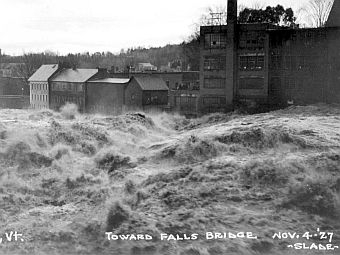
The following year would test this principle to its limits as floods would devastate first the Mississippi River Basin in April and then New England, including Coolidge’s beloved state of Vermont, in November. The damage came not only in the property destroyed but the lives lost. The most intense pressure fell on Coolidge to visit the areas, spearhead the effort to aid and rebuild and otherwise take decisive action. He deliberately held back. He dispatched Secretary Hoover to collaborate with state and local officials, not always successfully or deferentially. Those who do not understand our Constitutional system condemn Coolidge as “cold” and “unfeeling,” for his decision. They overlook the strength it took to withstand the urge to involve himself, especially when it concerned his home state. Principles mattered more. There would be no recovering the balance lost to local decision-making once he, the President, used powers he could not rightly claim. It was the burden of free people to exercise responsibilities over their lives and property, even when nature interjected. National Government was not there to spare folks from life’s consequences, however unpleasant the price.

The fight to grant flood relief would not subside quickly and while Coolidge kept much of the spending down, the drive to appropriate money, especially with an even larger surplus expected in 1928, was too much for both House and Senate to resist. Interestingly, the argument that convinced Coolidge to finally relent on a smaller relief bill was the fact that States and local governments were already paying into the sum being levied (Barry, ‘Rising Tide,’ p. 406). Federalism was working. The States and local authorities were taking responsibility for their own expenses. Had the Senate remained less constrained by public passions, as the Framers intended, it is not improbable that even the drastically reduced $296 million (which would become closer to $1 billion, in reality) flood relief measure could have been struck down before reaching the President’s desk.

Image

      The waters roaring through Springfield, Vermont in 1927

Image

              Forty foot deep floods along the waterfront of Cape Girardeau, Missouri, spring of 1927

Image

                     When the levees broke and the Mississippi flooded, it is estimated some 300,000

                     people were displaced in as many as ten states. Coolidge would not see their

                     freedoms eroded further with government’s good intentions supplanting local

                     oversight.

“Every dollar that we carelessly waste means that their life will be so much the more meager. Every dollar that we prudently save means that their life will be so much the more abundant. Economy is idealism in its most practical form” — President Coolidge, March 4, 1925

On Reuniting the States

On Reuniting the States

Return of the Confederate battle flags to Virginia, North Carolina and Texas on December 16, 1927. An earlier attempt by President Cleveland in 1887 met with successful opposition by the Grand Army of the Republic (Union veterans) as “trophies” of the War that should not be returned. It would be “treasonous” according to the large body of obstinate veterans.

President Theodore Roosevelt, through a careful coordination with Congress, restored a partial collection of battle flags to the Southern states in 1905, taking them from storage by the War Department in Washington.

Like so many old wounds, however, President Coolidge did not evade the controversy for fear that it would cost political support. Coolidge upheld just dealings toward all, whether it was the full citizenship for all tribes or fair honor due Southern Americans who fought just as valiantly as the Yankees did for principled reasons. It was overdue time to lay aside hostility, heal old grievances, and reestablish peace between Americans, North and South.

He recognized his duty included leadership by example to help reunite the country around the essentials we share as Americans. It would not be right to misuse a President’s influence by keeping us divided and at war with one another. He was as much an advocate of peace at home as he was abroad.