On the New Year

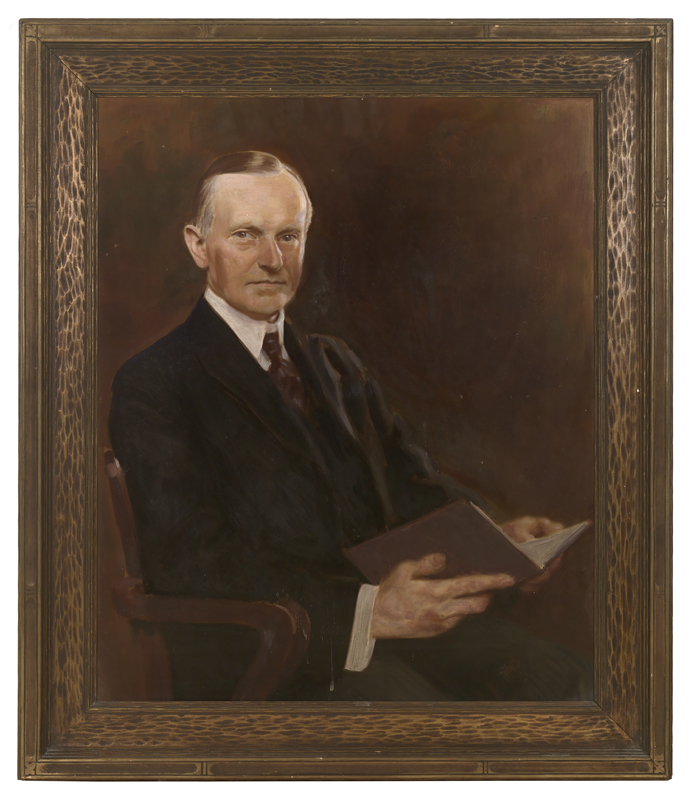
Anonymous portrait of Calvin Coolidge held in the Coolidge Room of Forbes Library in Northampton, Massachusetts.

Portrait of Calvin Coolidge (by an anonymous artist) held in the Coolidge Room of Forbes Library in Northampton, Massachusetts.

Looking back over the previous year while thinking ahead to the new year, Calvin Coolidge wrote these thoughts on December 31, 1930: “The year…has been a sharp reminder that men cannot escape from the command that they shall earn their bread by the sweat of their brow. We cannot for long reap when we have not sown. We cannot hold what we do not pay for. The law of service cannot be evaded or repealed. Nor is it yet in the power of man under any system of government he can adopt or any organization of society he can form to make this a perfect world.

“But the ability to make the best of things, to secure progress, to learn from adversity is not to be disparaged or ignored. The creative energy of nature is not diminished but increased by the fallow season. Mankind requires a time for taking stock, for recuperation, for gathering energy for the next advance.

“That is the significance of the new year. We take a new inventory to see what we have, we take new bearings to see where we are, we correct our conduct by new resolutions. After all due allowance for error and relapse, such a course guarantees improvement. Perhaps the best resolve is to live so that next year new resolutions will be unnecessary.”
On Getting Back to First Principles

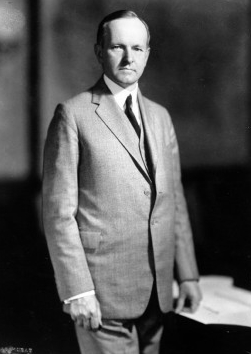
Calvin Coolidge standing the old Cabinet Room of the West Wing.

Calvin Coolidge standing in the old Cabinet Room, established by President Taft, on the West Wing of the White House.

“We always have the defeatists with us. Washington had them…Lincoln had them…Wilson had them during the war to such an extent that he found it necessary to turn over the conduct of important legislation to Republican leadership. We have them at the present time doing their best to capitalize distress and preaching the overthrow of our system of economics and government. It is these forces more than depression which render our condition critical.

“If we have the courage and vision to maintain our governmental and social structure we can meet all other problems. The forces of discord always work in an insidious way. They often attempt to conceal the peril of their unsound proposals under the claim that they are liberal. When that is analyzed it usually means that they intend to give away the money which someone else has earned. Such a process, once started, is bound to increase until it lands the country in universal bankruptcy and general disintegration. It is a time when the great body of our people of common sense should not be stampeded, but should stand firm. In spite of all declarations to the contrary, of the professions of platforms and candidates, the record of two generations discloses that the safety of the country lies in the success of the principles of the Republican Party” — former President Calvin Coolidge, September 10, 1932.

On Opening Presents Early

“Christmas was a sacrament observed with the exchange of gifts, when the stockings were hung, and the spruce tree was lighted in the symbol of Christian faith and love. While there was plenty of hard work, there was no lack of pleasurable diversion” (Calvin Coolidge, The Autobiography, p.30).

It was on this day eighty-eight years ago that the President’s eagerness for Christmas overcame his usual self-restraint. Though the Chief of Mails, Ira Smith, would not have said anything, it seems someone did — and told the newspapers. The next day, the story recounted that Coolidge not only ignored the “Don’t Open Until Christmas” injunction but, as was his custom, returned from his morning walk to visit the mail room for any “mails” that had come in for him. The story recounts that upon looking over the packages due to be sent to the White House, he saw two items with handwriting he recognized. Breaking into them, he was contented to see what each contained and could then go about the day’s work.

Biographers have noted Coolidge’s proclivity for sweets and snacks, the President regularly appearing in the White House kitchen or the Mail Room in order to investigate firsthand what was there: be it fruits and nuts, jams and pastries, anything from which he could munch. As he said in The Autobiography, “Almost everything than can be eaten comes. We always know what to do with that” (p.222).

It was as President Coolidge prepared to leave Washington for Christmas in 1928, exemplifying an exceptionally jovial spirit, that he informed the press he would be leaving on “Christmas Day, December 24.” When the room broke out in laughter, he followed with, “When is Christmas?” One of the journalists, completely unacquainted with his subject’s dry wit, answered seriously that the 24th was Christmas Eve. Coolidge, without skipping a beat, responded with a smile: “Well, I always tried to have Christmas on two days, the 24th and 25th, when I was a boy.”

Image