“The relationship between governments and the press has always been recognized as a matter of large importance. Wherever despotism abounds, the sources of public information are the first to be brought under its control. Wherever the cause of liberty is making its way, one of its highest accomplishments is the guarantee of the freedom of the press. It has always been realized, sometimes instinctively, oftentimes expressly, that truth and freedom are inseparable. An absolutism could never rest upon anything save a perverted and distorted view of human relationships and upon false standards set up and maintained by force. It has always found it necessary to attempt to dominate the entire field of education and instruction. It has thrived on ignorance. While it has sought to train the minds of a few, it has been largely with the purpose of attempting to give them a superior facility for misleading the many. Men have been educated under absolutism, not that they might bear witness to the truth, but that they might be the more ingenious advocates and defenders of false standards and hollow pretenses. This has always been the method of privilege, the method of class and caste, the method of master and slave” — Calvin Coolidge, addressing the American Society of Newspaper Editors, January 17, 1925. The full speech can be found in “Foundations of the Republic,” pp.183-190 or online at http://teachingamericanhistory.org/library/document/the-press-under-a-free-government/.
equality
Calvin Coolidge and Civil Rights—the Rest of the Story
Calvin Coolidge and Civil Rights—the Rest of the Story
Here is a great recap by David Pietrusza of what has gone unreported and even suppressed about Coolidge’s brave convictions on civil rights. Notice that in what is commonly perceived to be a past mired in racism (contrary to these “enlightened times”) Americans of all backgrounds were running for office, owning their own successful businesses, finding opportunity and realizing the potential of America’s ideals decades before the Civil Rights Act of 1964. Considering the past fifty years especially, have the benefits really outweighed the costs of government’s social experimentation? “Coolidge Prosperity” alone, aside from the leadership Coolidge demonstrated in the ways Mr. Pietrusza notes, did more for race relations than any of the “Great Society’s” loftiest promises.

President Coolidge Recognizing Thomas Lee
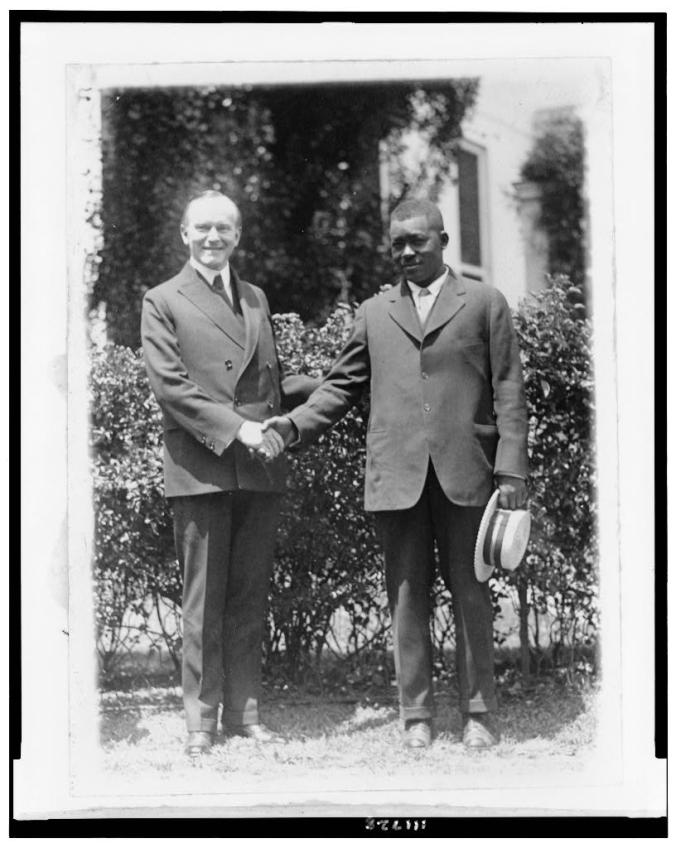
Tom Lee, working for a levee repair contractor along the Mississippi, was returning from Helena, Arkansas to Memphis, Tennessee, on the afternoon of May 8, 1925. Alone and operating the company’s motorboat, he came to Cow Island Bend 16 miles south of the city when he saw the steamboat M. E. Norman. Passing it on the left, he happened to look back a half-mile upriver to see the vessel had begun listing and the wheel had stopped. The steamboat suddenly capsized but Mr. Lee had already turned around, heading back to the scene.
The Norman was a 114 foot boat, included a crew of 10 and was bringing several engineers and their families out to enjoy the River while they dined and surveyed project sites along the riverbanks. Listening to lectures, most of the engineers were below decks at the time and when the Norman capsized it disoriented everyone, trapping most below. Mr. Lee made five trips to shore, saving 32 people.
Twenty days later, he was honored at the White House by President Coolidge for his quick thinking and heroic rescue. The people of Memphis have placed a Memorial to him in their city, which reads, in part: “He has a finer monument than this–an invisible one – a monument of kindliness, generosity, courage and bigness of heart – his good deeds were scattered everywhere that day and into eternity.” Here, the President is publicly respecting the selfless service of a brave American. The political fallout for so public an endorsement mattered not to him.
 The Importance of the Obvious