On Shutting Down Opportunity

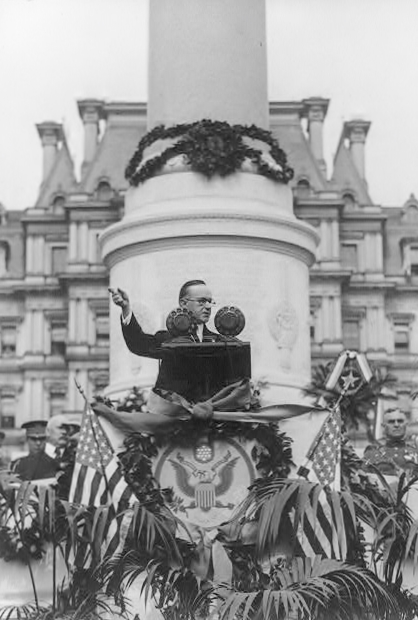
“If the Federal Government should go out of existence, the common run of people would not detect the difference in the affairs of their daily life for a considerable length of time” — President Calvin Coolidge, “States Rights and National Unity,” given at the College of William and Mary in Williamsburg, Virginia, May 15, 1926.

As a perverse enthusiasm for the “Government Shutdown” pervades mainstream media coverage, the total mischaracterization of the issue is propagating confusion and fear, not clarity and sound information. The press, having long ago shed the veneer of objective journalism, is no longer upholding its obligation to arm people with accurate and honest information.

The issue is skewed from the outset as a picture of vast human suffering all caused by a callous, unfeeling opposition to the President and his Party’s agenda. Disagreement with that agenda, instead of the agenda itself, is blamed as the problem. In actuality, the problem is never connected to its real cause: the President’s own policies. The cause is never attributed to a Government that has overgrown its very limited and specific Constitutional role. The problem is those lousy Republicans who want Government to shut down and people to die because they want to see “Obamacare,” the law of the land, undone, or so goes the absurd mantra.

Temporarily furloughing those the Government already deems “non-essential” while keeping Congressional and Executive offices open is not a shutdown. Suspending the online stream of the National Zoo’s “Panda Cam” is not a shutdown. Closing the gates of a few parks is not a shutdown. It makes it appear all those indispensably wonderful services Government provides us are going away permanently. It is political manipulation designed to force people yet again to justify a vast, all-encompassing Government in their lives. To believe an apocalypse awaits via Government “shutdown” demands the ultimate credulity. Threatening to withhold military checks while entitlement programs still keep the checks mailing out does not even begin to approach the genuine shutdown this economy is already experiencing directly because of this President’s decisions.

Playing a game of smoke and mirrors, the President and Senate leadership would rather provoke more suffering especially as it helps advance their permanent campaign against Republicans. The focus is never on the 90 million Americans no longer in the work force because of this President’s agenda. The concern is only ever how does the latest Labor statistics make the President look?

The attention is never on the creation of one “unprecedented” crisis after another to force by legislation what would never be passed if calmly and deliberately vetted.  The angst is only ever on how can we survive without Government?

The entire emphasis is turned on its head. The priority is not upon removing the obstacles to ingenuity, opportunity and individual freedom. The priority is ever only on keeping Government alive and growing by “revenue neutral” tax schemes, continuing resolutions, and an endless debt, $17 trillion and counting, which our great grandchildren will still be paying! Add to this “Obamacare” exemptions for Congress ordered by President Obama, the reaffirmation of “quantitative easing” by Chairman Bernanke and now even “shutdowns” are tools to threaten any attempt to restraint this Administration and its agenda for the rest of the country. It is the transfer of authority from a self-governing people to subjects serving an autocratic elite. The focus is all in the wrong direction. The questions should be: How is liberty faring? Are the people being served? How does life look for the people with inflation, massive unemployment and generational indebtedness? Can we survive with Government as it is now, unlimited and absolute?

While Government was significantly smaller in Coolidge’s time, the temptation to encroach on people’s lives was no less alluring. It was leadership that made the difference. Moral character, humble perspective and faith in the institutions and ideals that make America have no substitute when it comes to our leaders. There is nothing that can possibly replace the lack of these qualities in order to lead and lead responsibly. But there is also a fundamental, even natural limitation to any Government which tries to do too much. Opportunity’s door invariably closes whenever and wherever Government gets involved. Consequently, nature itself will rebel against this offense. That is what we are seeing in our time. This is why there remains cause for renewed confidence in our ideals not a lazy and pessimistic resignation to circumstances. The status quo in Washington has already lost. Not living in reality, however, the establishment led by President Obama, does not realize it…yet.

Speaking to those who came to honor their fellow, fallen veterans of the heroic First Division in the American Expeditionary Forces, President Coolidge reflected on the cause for which they fought, saying,

…I cannot let this occasion pass without expressing my most strong and emphatic commendation for the reverence which your words and actions constantly express for the liberty-giving provisions of the fundamental law of our land. You have supported the Constitution and the Flag which is its symbol, not only because it represents to you the homeland, but because you know it is the sole source of American freedom. You want your rights protected by the impartial judicial decisions of the courts where you will have a right to be heard and not be exposed to the irresponsible determination of partisan political action. You want to have your earnings and your property secure. You want a free and fair opportunity to conduct your own business and make your way in the world without danger of being overcome by a Government monopoly.

Such freedom is what we now desire and expect. Government fails when it assumes the life of the individual can best be managed from its halls and corridors. Coolidge went on to explain what happens when Government ventures into the people’s business,

When the Government goes into business it lays a tax on everybody else in that business, and uses the money that it collects from its competitors to establish a monopoly and drive them out of business. No one can compete. When the Government really starts into a line of business that door of opportunity is closed to the people. It has always been an American ideal that the door of opportunity should remain open.

Coolidge saw the road Government takes every time it asserts itself in people’s choices. Opportunity closes. Freedom contracts. It is this road we are now on, with destinations including a single-payer scheme for American healthcare promised by the Government and paid by the rest of us, including generations not yet born. This latest frenzy over “shutting down” the Government is but the latest attempt to distract with fear and obtain by coercion the desired result of greater control and more of the same from an autocratic few. If people will simply stop opposing this Administration then the crisis will evaporate and all our pain will go away, they claim. This President is counting on both ignorance and addiction to the need for Government.

Coolidge reminds us to distinguish between what seems essential from what actually is. When we view it this way, it becomes obvious that the Federal Government needs us, not we it. If Washington ceased to be tomorrow, we would survive. We would even do better than we think. The importance rests with the individual and then his local and state authorities. The Federal Government would not leave a gaping hole which none could fill. The people, exercising their own judgment and creative abilities, would fill that hole. In fact, we would witness the return of choices, opportunity and freedom to our lives impossible when Government tries to “help” us.

Coolidge kept his faith in the ultimate triumph of the people to retain their liberties. The truly intimidating challenges faced by Americans of every time, place and background vindicates his faith. The confidence he had bore no time constraints, it was a faith firmly placed in the strength of ideals we share even now. The assurance of their truth and power for good rests on the conviction not only treasured by Coolidge but by millions of those who build, from nothing, lives of success and quiet excellence without a Washington subsidy. It is the solemn charge of our generation to ensure that door of opportunity remains open.
Image

On Being Worthy of Freedom

Apprehensions over the future have always remained an ever-present concern for a wise and circumspect people. When Americans stop being concerned for the next generation, it will be because we are no longer free individuals. The prospects for freedom stand in greater doubt than perhaps they have for many years, but a lack of confidence in our system is only new to us, not to generations of Americans who came before us.

Any one of the hardships overcome by prior generations could have halted the experiment of self-government in its tracks. It has certainly had no shortage of critics who proclaimed “failure” and “defeat” only to be proven flatly wrong time and time again. Inequity and unfairness have been present in human history from the outset, but neither has had the power to prevent individuals of determination from accomplishing truly great things despite it. Our time is hardly the first to ask, “who is worthy of freedom?”

The Progressive Era produced an almost overwhelming array of reasons to change the way this country was established. It would answer our question with pessimism: the people were ultimately not to be trusted with freedom. It was an intelligent few who merited such power. Coolidge knew, on the other hand, freedom was safest in the hands of the people.

The charge that our system was both too wild and too unequal, compared to the “enlightened” societies of Europe, led to calls for regulation of human behavior on a scale never before known. The pursuit began to implement an efficient and intelligent approach to government that would mitigate risk, remove inequities and shepherd the people to progress.

These activists, predisposed to intense skepticism about capitalist systems, trusted government implicitly with greater and greater control. Enamored with a lopsided admiration for methods foreign to American ideals of law and liberty, these generally middle class intellectuals failed to appreciate the remarkable nature of our constitutional system. They overlooked the careful balance worked out by the Framers, infusing a disastrous measure of good intentions with a reckless accumulation of new laws.

They entrusted government with the power to supply the shortfalls of human nature with legislation. Each effort undervalued, even ignored, the unquantifiable worth of freedom. Government, endeavoring to be “smart” and “humane,” hurt those it proclaimed to help by robbing them of the dignity of free will, the moral judgment of those given sovereignty in our system.

Ours is a history of accomplishment and success because people were recognized not as subjects in service to the State but individuals whose value comes from a Divine Creator. Made in the image of God, it logically follows that the dreams, aspirations and abilities to create, construct and succeed are within every person’s power. It is that power now being denied our young people as unrealistic and unattainable. This is nothing more than the latest incarnation of those who denied Edison could harness light, the Wrights could fly and Ford could mobilize America.

The avoidable tragedy of all this is that it literally destroys the wholesome yearnings of millions for something better than marginal existence. Instead, the young are told to be content with mediocrity, cease the pursuit of success, and consign all future faith and hopes to Washington’s management. No less self-deluded than the Progressives of Coolidge’s day, this operation dehumanizes humanity. History proclaims it will ultimately fail but the cost to countless lives in the process can never be known.

Coolidge, grappling with these problems, said in 1923,

[T}he motive power of progress and reform has not come from the high and mighty but from the mass of the people…It is not the quantity of knowledge that is the chief glory of man…It is in the moral power to know the truth and respond to it, to resist evil and hold to that which is good, that is to be found the real dignity and worth, the chief strength, the chief greatness. This power, even in the humblest and the most unlettered, rises to a height which cannot be measured, which cannot be analyzed. It is this strength of the people which can never be ignored. Of course it would be folly to argue that the people cannot make political mistakes. They can and do make grave mistakes. They know it; they pay the penalty. But compared with the mistakes which have been made by every kind of autocracy they are unimportant…

…Unless the people struggle to help themselves, no one else will or can help them. It is out of such struggle that there comes the strongest evidence of their true independence and nobility, and there is struck off a rough and incomplete economic justice, and there develops a strong and rugged national character. It represents a spirit for which there could be no substitute. It justifies the claim that they are worthy to be free…

     …Civilization and freedom have come because they are an achievement, and it is human nature to achieve. Nothing else gives any permanent satisfaction. But most of all there is need of religion. From that source alone came freedom. Nothing else touches the soul of man. Nothing else justifies faith in the people.

Like the generation who saw beyond the narrow confines of subsistence imposed upon it by king and Parliament, it is time to refuse to participate in a supervised decline. Being taught to doubt our own judgment is merely a prelude to forfeiting the ability to make our own choices, to strive, to fail, to triumph — in short, to live free. If we are to be worthy of that freedom, we cannot surrender to this latest effort — however organized it is — to train out the moral ideals and intangible dreams of people.

Image

On Separate Classes

jb_jazz_coolidge_3_e

“There is yet another manifest disposition which has preyed on the weakness of the race from its infancy, denounced alike by the letter and the spirit of the Constitution, and repugnant to all that is American, the attempt to create class distinctions. In its full development this means the caste system, wherein such civilization as exists is rigidly set, and that elasticity so necessary for progress, and that recognition of equality which has been the aim and glory of our institutions, are destroyed and denied. Society to advance must be not a dead form but a living organism, plastic, inviting progress. There are no classes here. There are different occupations and different stations, certainly there can be no class of employer and employed. All true Americans are working for each other, exchanging the results of the efforts of hand and brain wrought through the unconsumed efforts of yesterday, which we call capital, all paying and being paid by each other, serving and being served. To do otherwise is to stand disgraced and alien to our institutions. This means that government must look at the part in light of the whole, that legislation must be directed not for private interest but for public welfare, and that thereby alone will each of our citizens find their greatest accomplishment and success” — Governor Calvin Coolidge, formally accepting Republican nomination as Vice-President, July 27, 1920.

More than ten years later, in the midst of economic downturn, Garet Garrett would echo the same point through his column in the Saturday Evening Post. In articles like, “There Goes Mine,” written in 1932, Garrett attacks the fallacy that economic classes are both fixed and permanent. He refers to the resentment during depressions of car ownership and how confidence in one’s ability to move upward from poverty to prosperity remains entirely within each person’s reach. Coolidge and Garrett both understood that liberty means opportunity, an opportunity that is not coincidental but directly due to our unique political and economic system as founded. Margaret Thatcher, the late British prime minister, grasped the significance of this truth better than have many Americans. She observed that when opportunity is maximized, class distinctions diminish and the disparity between “rich” and “poor” decreases, contrary to every economic “expert.”

As all three realized, however, the opposite holds true every time socialism is allowed to set policy, be it locally or nationally. For the Left, as Thatcher noted, it is better for the poor to stay poor “provided the rich were less rich.” Such a view summarizes modern liberalism. It is the Left’s animus against success and its vested interest in perpetual victim-hood which drive its agenda. It is never about rising to higher aspirations or striving for greater ideals. It is about exchanging our independence for the security they provide, a security of marginal existence.

Coolidge, Garett and Thatcher all knew what the Left denies to this day: policies that maximize individual opportunity remove class distinctions automatically and enable equality on the basis of each person’s determination and potential. Modern liberals would have us all equally poor, feeling guilty of ever rising above the marginal, dependent and miserable and call that “progress.” Incapable of fixing the problems Coolidge’s policies addressed, all that is left for modern liberalism is to keep the class warfare going, to provoke violence, and to project its failures onto those striving to heal and reunite us with the freedom of a truly classless society envisioned by our Framers.

Garet-Garrett margaret-thatcher