On Veteran’s Day

Tomorrow will mark not only the Armistice declared at the eleventh hour of the eleventh day of the eleventh month in 1918 (which ended four years of staggering loss and destruction inflicted by the First World War) but it also sets aside a day of honor to all of America’s veterans. President Coolidge, looking back in November 1928 over the first ten years following the return of peace, turned his attention to those who had left the safety of their homes and freedoms years before to risk all on the battlefields of Europe. He spoke, “Our first thought…is to acknowledge the obligation which the Nation owes to those who served in our forces afloat and ashore, which contributed the indispensable factor to the final victory. Although all our people became engaged in this conflict, some in furnishing money, some in producing food and clothing, some in making munitions, some in administering our Government, the place of honor will always be accorded to the men and women who wore the uniform of our country – the living and the dead.”
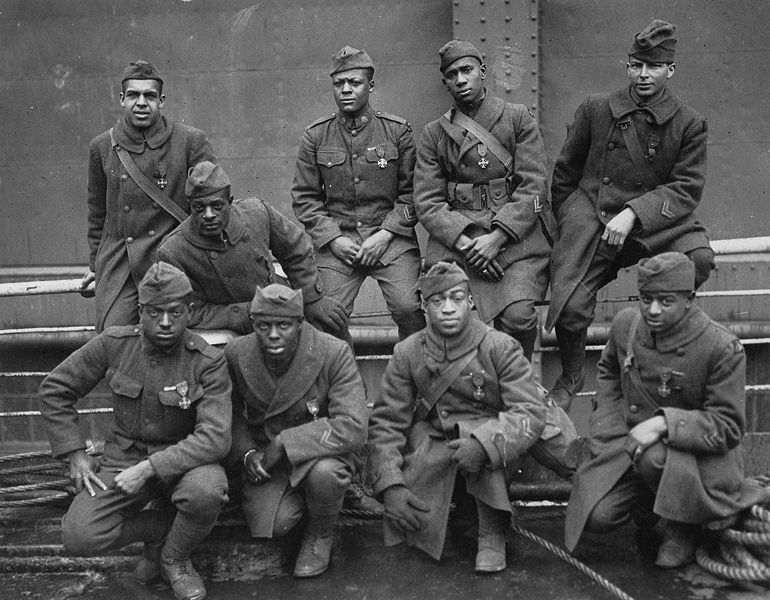
Members of the "Harlem Hellfighters," 369th Infantry, 1919. As Coolidge said on that November day in 1926, "Our armies could not be said to partake of any distinct racial characteristic...but they were all Americans in the defense of our common interests..."

Members of the “Harlem Hellfighters,” 369th Infantry, 1919. As Coolidge said on that November day in 1926, “Our armies could not be said to partake of any distinct racial characteristic…but they were all Americans in the defense of our common interests…”

Members of the 35th Division, marching through the Vosges Forest, France, 1919. They were predominantly comprised by men from Missouri and Kansas, to whom Coolidge offered recognition in dedicating the Liberty Memorial, 1926.

Members of the 35th Division, marching through the Vosges Forest, France, 1919. They were predominantly comprised of men from Missouri and Kansas, to whom Coolidge offered special recognition while dedicating the Liberty Memorial, 1926.

We are remiss if such honor is neglected in our generation but even more so if it is submissively suppressed and quietly denied. Such is not remaining true to our high estate as Americans. It is the epitome of ingratitude and injustice to condone the animosity some in our own land harbor against those who have worn the uniform. It was only natural that the first World War I memorial would be dedicated in November 1921, in the heartland itself, with Calvin Coolidge present. The people of Kansas City, Missouri, can proudly lay claim to this first in a nation of many exceptional firsts.

Image

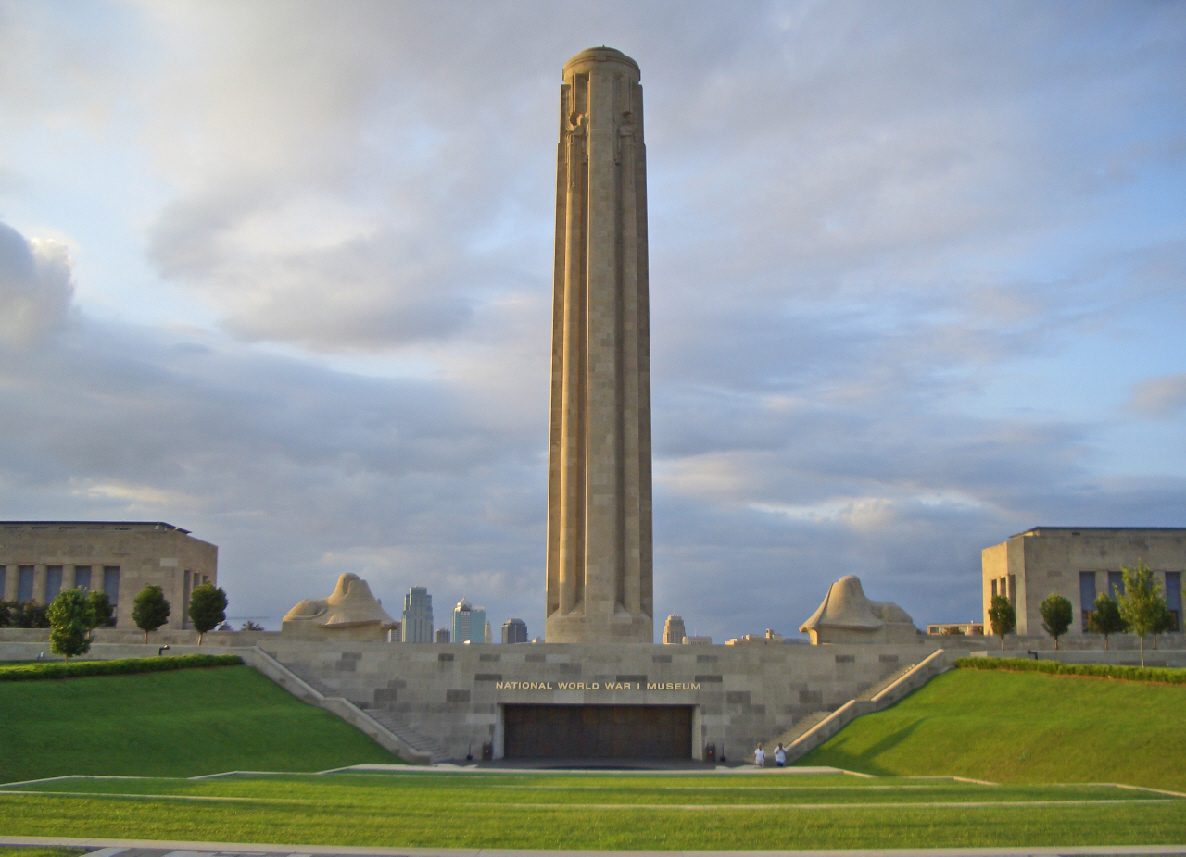
When the Liberty Memorial was completed five years later in 1926, President Coolidge went back to Kansas City to address the 150,000 persons gathered as millions more listened on the radio. Looking up at the 217 foot marker, the sight stirred him to say, “It is with a mingling of sentiments that we come to dedicate this memorial. Erected in memory of those who defended their homes and their freedom in the World War, it stands for service and all that service implies. Reverence for our dead, respect for our living, loyalty to our country, devotion to humanity, consecration to religion, all of these and much more is represented in this towering monument and its massive supports. It has not been raised to commemorate war and victory, but rather the results of war and victory, which are embodied in peace and liberty. In its impressive symbolism it pictures the story of that one increasing purpose declared by the poet [citing Tennyson] to mark all the forces of the past which finally converge in the spirit of America in order that our country as ‘the heir of all the ages, in the foremost files of time,’ may forever hold aloft the glowing hope of progress and peace to all humanity…”
Image

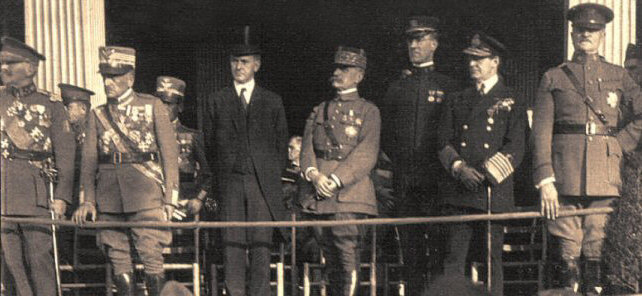
He would recall the august assembly five years before as he stood with General Pershing and those who led the armies of Europe, praising the ideals that prevailed in spite of that conflict’s effort to demolish them. The President continued, “Under no other flag are those who have served their country held in such high appreciation…Our admiration is boundless. It is no mere idle form; it is no shadow without reality, but a solid and substantial effort rising into the dignity of a sacrifice made by all the people that they might in some degree recognize and recompense those who have served in time of national peril. All veterans should know this and appreciate it, and they do. All citizens should know it and be proud of it, and they are.”

Coolidge, scanning not only the massive crowds gathered to observe the dedication on that day, but also looking ahead to what the future would bring, seemed to know such honor and service would not manifest automatically, it would demand renewed effort from later generations. He closed with a question, “If the American spirit fails, what hope has the world? In the hour of our triumph and power we can not escape the need for sober thought and consecrated action. These dead whom we here commemorate have placed their trust in us. Their living comrades have made their sacrifice in the belief that we would not fail. In the consciousness of that trust and that belief this memorial stands as our pledge to their faith, a holy testament that our country will continue to do its duty under the guidance of a Divine Providence.”
Image

On Reform

“Real reform does not begin with a law; it ends with a law. The attempt to dragoon the body when the need is to convince the soul will end only in revolt” — Calvin Coolidge, Adequate Brevity, p.87.

“Laws do not make reforms, reforms make laws. We cannot look to government. We must look to ourselves. We must stand not in the expectation of a reward but with a desire to serve. There will come out of government exactly what is put into it. Society gets about what it deserves. It is the part of educated men to know and recognize these principles and influences and knowing them to inform and warn their fellow countrymen. Politics is the process of action in public affairs. It is personal, it is individual, and nothing more. Destiny is in you” — “On the Nature of Politics” delivered in 1919, Have Faith in Massachusetts, pp.83-4.

“Under a system of popular government there will always be those who will seek for political preferment by clamoring for reform. While there is very little of this which is not sincere, there is a large portion that is not well informed. In my opinion very little of just criticism can attach to the theories and principles of our institutions. There is far more danger of harm than there is hope of good in any radical changes. We do need a better understanding and comprehension of them and a better knowledge of the foundations of government in general. Our forefathers came to certain conclusions and decided upon certain courses of action which have been a great blessing to the world. Before we can understand their conclusions we must go back and review the course which they followed. We must think the thoughts which they thought” — July 5, 1926, Philadelphia, The Messages and Papers of the Presidents, p.9583.

Image

On Political Strategy

While the White House has become ensnared in its own deceptive assurances regarding “Obamacare,” the agenda has decisively been brought to a halt. The strategy was not supposed to derail, certainly never like this. Washington as well as the rest of the country, including the Republican establishment, have had time to reflect upon their actions during the “shutdown,” the debt limit increase and the response to the filibuster led by Ted Cruz. Some have come home to their districts and visited with constituents on the political condition and where to go from here.

The answer, in truth, is typically not what much of the establishment claims it to be. Rather than recognize these circumstances as an opportunity to inform constituents (now that real people are suffering all across the country because of this destructive law) and then to provide principled leadership, leadership made possible by a handful of conservatives, far too many Republicans are rushing back to the “safety” of timidity and defeatism. The effort was “doomed to fail,” they echo, being embarrassed by Ted Cruz and those who engaged in such a vain hope of success because the votes were not “there.” Yet, see what has resulted from standing firm anyway! “Party unity” coupled with “civility” are what we need, they claim. We need to pick our fights, they assert. We need to agree on the “big votes” while not alienating independents. That strategy certainly worked well for our last presidential nominee.

No one back home is advocating disunity, incivility or selective opposition. These are strategies practiced by the establishment. This is where the divide originates. Instead, the disunity and incivility comes from senior leadership in both parties calling conservatives “wacko birds,” “terrorists” and “hijackers,” blaming the Tea Party movement for the failures of Washington.

We are the ones expected to “tone down our rhetoric” with a return to “civility” — which is simply another way of silencing dissent against the “normal” dysfunction of Washington. Our “rhetoric” is nothing more than reasonable opposition to the way Washington operates, with its lawless disregard and devotion to expediency. Our public gatherings, on the other hand, are clean, wholesome and respectful. We consistently leave the places we gather better than we found them. Contrast this with the coercive conduct of Park service authorities, condescension of Congressional and Executive branch officials and the destructiveness of “Occupy Wall Street” mobs.

We are the ones expected to rally for the good of the Party — while Senate and House leaders jettison any vestige of effort to stand for something non-negotiable whether the “votes are there” or not. It is the establishment that has publicly ostracized anyone bold enough to articulate our convictions.

We, on the other hand, are trying to preserve the Party’s principles rather than see them auctioned off by our representatives who believe their role is to bridge the differences and compromise with a deliberately destructive agenda. Liberty and the people are the ones who lose each time.

We are assured that the wise course is to pick our fights. We do not have the votes to get everything we want, it is noted. True, the Senate and White House are held by Democrats. But how powerful an impact one man, Senator Cruz, has had not only on strategy but the entire political situation. None of us are under the illusion that we can win every fight. We simply expect our “side” to fight.

By virtue of resisting the policies and ideology of government-run health care, without any incivility or divisiveness, conservatives have stopped the seemingly unstoppable momentum of the President and his Party, setting all of Washington on its heels. Now even Democrats are seeking a delay of the individual mandate. Conservatives changed the “rules of the game” because they stood on what is right, not on what was politically calculated to succeed. Everyone considered it a foregone conclusion they would accomplish nothing, including many on their own side. They accomplished more by standing for principles than anyone could have imagined. The results are still unfolding. In a very powerful way, they exemplified a strategy cherished by none other than Calvin Coolidge.

Coolidge explains in his Autobiography how vain and self-defeating were the efforts to politically outsmart the opposing side with some intricate calculation of timing and set of perceptions. Instead, he kept a very different principle. “There is only one form of political strategy in which I have any confidence, and that is to try to do the right thing and sometimes be able to succeed.” What motivated Coolidge to act was the force of right. The pursuit of what is right, rather than any grand scheme to oppose measures only when the support is there distinguishes those who adhere to principles from those who subsist on what is convenient at the moment. We fight because the cause is moral and good. We do not hold back until overwhelming support is already behind us among our peers. Leadership, as Coolidge maintained, requires the principled judgment of the representative, living up to one’s oath, executing the office “faithfully and impartially” in agreement with the Constitution and our laws. The uninformed voter does not relieve the representative from the duty of educating and leading with sound principles, just to avoid the risk of losing the next election.

Coolidge, whether as legislator, Governor or President, acted with firm reliance on doing what was right whatever the cost to him politically. He had no respect for the strategy that raises finger to the wind and votes for what has the least resistance and most support in polling. “Any one with a little experience can tell them in advance that the effect of action based on such motives will always be bad…That is the reason why those who seek popularity so seldom find it, while those who follow an informed conscience so often are astonished by a wide public approval.” Having a majority of votes no more justifies action than does transforming the entire country for a resentful minority. It is this strategy: simply doing what is right because it is right, whatever the political ramifications, that will ultimately vindicate those with the courage of convictions, who stood when it was hardest to do so. Meanwhile, those who have lived by the rule of expediency, gauging every word or act by its popularity, will find vain irrelevance as the price of compromise.

The victory of what is good and right only comes to those who fight for it. If we wait to fight the good fight another day over the issues that “really matter,” we will soon find so much territory has been relinquished to what is wrong that our last opportunity to oppose it when we should have is forever lost. As Coolidge understood, relying on anything less than the right, the honest and the true is no wise or sound strategy at all. Defeat is sure when we never step onto the field. Our confidence can only reside in defending the rightness of our principles be it popular or unpopular, entrusting the outcome, and our consciences, to God.

Image