“Born on the Fourth of July” by Sidney M. Milkis

“Born on the Fourth of July” by Sidney M. Milkis

The latest review of both Amity Shlaes’ Coolidge and Charles C. Johnson’s Why Coolidge Matters adds a welcome take to a renewed conversation of Calvin Coolidge. Mr. Milkis, well-known author and professor with the Miller Center of Public Affairs at the University of Virginia, has much to offer when it comes to the Progressive Era, the period generally classified from 1900 to 1929. In his critique of both books, Mr. Milkis presents the Coolidge neither author may envision but one that resembles the man described by David Greenberg, whose Calvin Coolidge, published in 2006, accepted too many of the assumptions handed down by Art Schlesinger and the New Deal gang. Greenberg unfortunately dug himself into a deeper hole with his 2011 piece further ridiculing Coolidge’s “naive faith in the gospel of productivity” as if Big Government has proven once and for all to be a reliable and permanent fixture of American life.

Mr. Milkis contributes a worthy opinion in the ongoing and overdue discussion about our thirtieth president. However, it is equally as important not to reinforce the same, old misrepresentations of what has, for far too long, been the accepted narrative regarding “Silenced Cal.” The fact that Ms. Shlaes and Mr. Johnson are questioning that narrative with meticulous research is not “revisionist” as much as it is a return to the rigorous standards of scholarship restored by Thomas Silver, popularized by Ronald Reagan, and now being revitalized by, among others, the authors Mr. Milkis has reviewed.

Mr. Greenberg and those who preceded him in defense of the New Deal have more to lose by seeing Coolidge’s principles reintroduced and expounded through the heavy lifting done by those he perceives to be on “the Right,” than they do repeating the tired shibboleth of his naivete and failure. Americans all can appreciate Coolidge not because he identified with this or that “political side” but because the principles he embodied were thoroughly and unabashedly true to the foundations of our exceptional system, declared, constituted and reaffirmed by our ancestors. As Coolidge expressed it on another occasion, “Whether one traces his Americanism back three centuries…or three years…is not half so important as whether his Americanism of to-day is real and genuine. No matter by what various crafts we came here, we are all now in the same boat.” His appeal to eternal truths of human nature and political experience should form ground on which we can all Americans can again be a united and prosperous people.
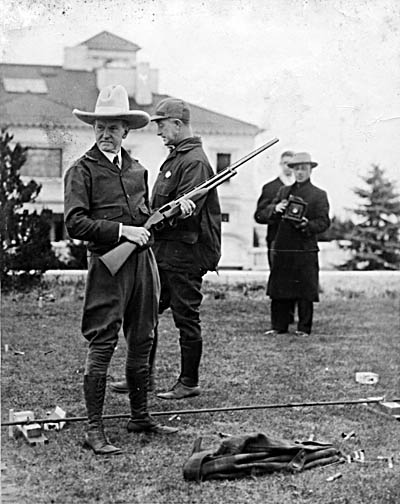
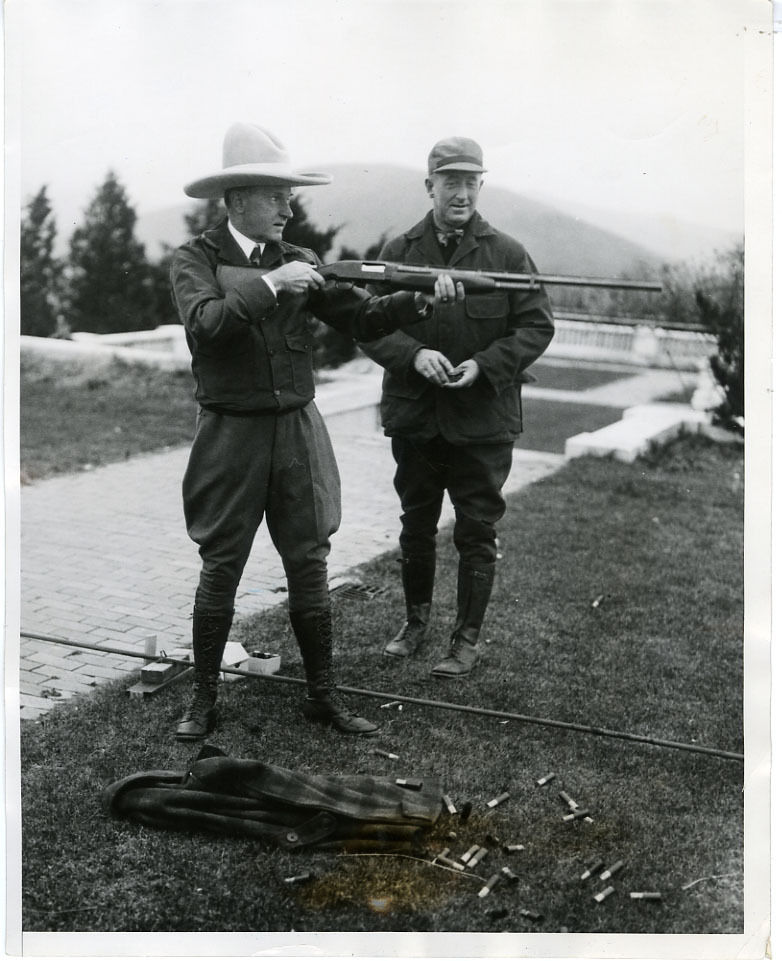
Near Afton, Virginia, December 1, 1928

Near Afton, Virginia, December 1, 1928

Originally considered as the location of the “summer White House” that year, Swannanoa Country Club, near Afton, became the site for the President’s and Mrs. Coolidge’s Thanksgiving stay in late November through early December 1928. Decked out in his ten gallon hat, presented to him by South Dakotans the summer of ’27, with his green mackinaw jacket given to him that summer by the people of Wisconsin, completed with a pair of hunting breeches and high-laced boots, Coolidge is ready for the next round of trapshooting.

Here Coolidge is back in Swannanoa from an unsuccessful quail hunt outside Stuarts Draft on December 1, trapshooting 19 out of 25 traps. It was on his way back from hunting that he noticed a young lady struggling under a heavy load as she walked up a steep hill. He ordered his driver to stop and the Secret Service accompanying him to offer the car, asking whether they could drive her wherever she needed to go. The young lady was so petrified that she ran down a side road and “escaped” the President’s kind gesture.

Nevertheless, the stay was enjoyed by both Coolidges and would eventually lead to his proposal the following year to set aside a country retreat for future Presidents that enabled them to escape from the world of Washington and, out in nature, reconnect to America and reality. While Swannanoa was suggested, President Coolidge chose a location closer to Washington and thus less costly to maintain, the hill country of Bluemont, fifty-five miles southeast of the nation’s capital.

Hoover dissatisfied with the limited fly-fishing prospects did not enjoy the site. As Mr. Carthon Davis notes in his fascinating piece on Coolidge’s stay here, neither did FDR, who selected a new spot in the Catochin Mountains of Maryland dubbed “Shangri-la,” renamed ten years later, “Camp David.” As Davis observes, however, it all started with the successful visit to this beautiful state in 1928, with Coolidge among the quail, traps and hospitality of Virginians.

CC in Swannanoa 1928

On Thanksgiving

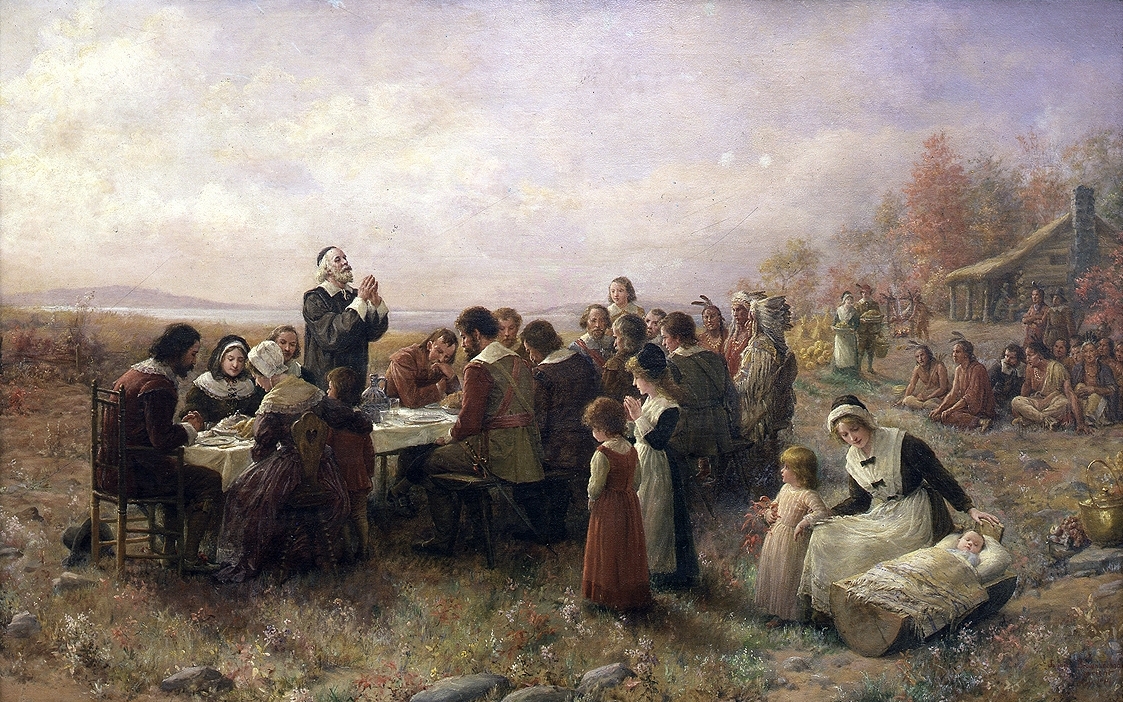
Jennie Bunscombe, "The First Thanksgiving," 1914

Jennie Bunscombe, “The First Thanksgiving,” 1914

“Thanksgiving is not only a holiday, it is a holy day. It is by no means enough to make it an occasion for recreation and feasting. Thanks are not to be returned merely to ourselves or to each other. The day is without significance unless it has a spiritual meaning. For more than three centuries our people have felt the need of celebrating the harvest time as a religious rite by offering thanks to the Creator for all their earthly blessings. There can be no true Thanksgiving without prayer.

“If at any time our rewards have seemed meager, we shall find our justification for Thanksgiving by carefully comparing what we have with what we deserve. The little band of Pilgrims who first established this institution on the shore by Plymouth Rock had no doubts. If their little colony of devoted souls, when exiled to a foreign wilderness by persecution, cut in half by disease, surrounded by hostility and threatened with famine, could give thanks how much more should this great nation, less deserving than the Pilgrims yet abounding in freedom, peace, security and plenty, now have the faith to return thanks to the author of all good and perfect gifts” — Calvin Coolidge, November 26, 1930

The Coolidge family, on Massasoit Street in Northampton, raising the flag, Thanksgiving Day, 1919

The Coolidge family, on Massasoit Street in Northampton, raising the flag, Thanksgiving Day, 1919