On Accounting for Coolidge Popularity

Image

It may come as a surprise that a coterie of critics, some members of the press and even a Party establishment existed in Coolidge’s day. They were hostile to the notion that one not of their number, lacking in sophistication or elite pedigree, could attain to the Presidency. Taken together they are what Charles Willis Thompson called, “The Intellectuals.” It is no different now for anyone with the courage and common sense to run for elective office independent of and without approval from the self-appointed political and cultural establishment. The Intellectuals had to reckon with Coolidge’s genuine and immense popularity. Henry Cabot Lodge, Republican Senator of Massachusetts, when told that Coolidge was being considered by some to lead the national ticket in 1920, sneered, “Nominate a man who lives in a two-family? Never!”

The fact that Coolidge, from his earliest years in state politics, consistently garnered more votes than any other Republican did. It was no secret that he secured more votes as Lieutenant Governor than his partner, Governor McCall, in the 1916 race. Even as the state went Democrat and Republicans lost their seats, Coolidge kept winning by greater and greater margins. “The Intellectuals,” chagrined at each electoral success, could not believe he was capable of winning the next time. Yet, win he did. In the presidential election of 1924, the man they had dismissed as a lightweight, local fad whom they would easily discard, perhaps along with Harding, went on to surpass challengers, secure a unanimous nomination and win an unprecedented landslide of 15.7 million voters in a three-way campaign, achieving what conventional wisdom said could never be done, especially after the outcome of 1912.

The Party elites had a clear champion in their midst but rather than rally to him, they maintained their skeptical alienation. He was not of them and never would be. Of course, he held an unshakable belief in party loyalty, not to simply secure office for himself or others but to advance principles he knew were right and tested true by human experience. The “secret” to his success lay not in the path of expediency, watering himself down to match what made him “electable” in the eyes of the “experts.” He required no pollster, no consultant, no speech writer to tell him what to believe. Decades before “Reagan Democrats,” the hard-working, patriotic, religious, “blue-collar” family men of manufacturing, service and industry were “Coolidge Democrats.” He earned their trust not through threats, manipulation, calculated promises, misinformation, pandering or even back-door dealing. His recipe for such stunning success, a genuine popularity and political success held all his life, was due to two simple qualities: “Simple words and straightforward acts” comprised Coolidge’s “magic” (Thompson, Presidents I’ve Known and Two Near Presidents, p.354). “The Intellectuals” never understood this. In the end, even as Coolidge walked away from office and continued to enjoy a level of popularity very few former Presidents have, the elites blamed it on the stupidity and simplicity of the American “masses.”

Thompson explained in 1929,

“As for the Mystery of 1924–the mystery of his election by a tremendous majority when so many towering geniuses had demonstrated that he hadn’t a chance–that too, was psychological. He was elected on that day in 1923 when he sent his first message to Congress. The country had heard language for many years. The unceasing, all-embracing sea of it had swollen until it reached high tide under Wilson…The country was apathetically resigned to a permanent government by language.

“Therefore, the first official word it heard from Coolidge was sensational. Not only was there no purple in the message, but there was no ratiocination, no argument, no stock official phrases. He told Congress what he thought would be for the good of the country and told it as briefly as he could. One of the things it wanted was economy. The burning question of that day, the soldier’s bonus, he treated in a single sentence, merely saying he was opposed to it; this at a time when the conventional attitude for politicians on the bonus question was astride the fence.

“The country rubbed its eyes. Here was a President of an entirely new kind. The country waited long enough to see if Coolidge meant what he said. He had just one session of Congress to prove it in. He did. Throughout that session he worked hard to get Congress to carry out the recommendations he had made…The country liked him immensely; it did after he had been President only a year…It liked Coolidge in 1923; it even made up its mind definitely that he was the kind of President it wanted. His first message to Congress fixed his popularity, and it increased until, to the astonishment of the politicians, they had to nominate him in obedience to a popular demand they did not understand and could not account for” (Thompson p.357).

Presidential Election of 1924 by county, showing Coolidge's very impressive support across the country. Securing 54% of the popular and 382 electoral votes to 136 (for Democrat Davis) and 13 (for Progressive La Follette), Coolidge shattered the conventional wisdom that he was both "unelectable" beyond Massachusetts and incapable of prevailing in a three-way race nationally. No one has ever done that before or since without throwing the election into the House (1824) or losing to the Democrat opponent (1912, 1992).

Presidential Election of 1924 by county, showing Coolidge’s very impressive support across the country. Securing 54% of the popular vote (15, 723,789 of 29 million votes cast) and 382 electoral votes (35 of 48 states, 71.9% of 531 electoral votes) to 136 (for Democrat Davis) and 13 (for Progressive La Follette), Coolidge shattered the conventional wisdom that he was both “unelectable” beyond Massachusetts and incapable of prevailing in a three-way race nationally. He even continued, as had begun in 1920, breaking  into the supposedly monolithic counties of the Democrat “Solid South” as well as the supposedly un-winnable Progressive West. No one has ever overwhelmed a Third Party challenge and a Democrat bloc before or since without throwing the election into the House (1824) or losing to the Democrats (1912, 1992).

Just as is the case now, the “talking heads” of media networks, the establishment of Party politics, and many of the gatekeepers of cultural trends revealed their utter insensibility to what Americans understood and felt about the country and its future. This institutionalized tone deafness swept them aside in 1924 and the foundations are already in place to do it again in the Congressional races of 2014. The “silent majority” of American politics led their leaders in 1924, and that same process is poised to happen again. Coolidge saw this as a vindication of the people’s sovereignty over their government. He was not threatened, as some are, by such an event. Coolidge would not even name a Vice President, leaving the delegates to make that decision, saying with a sparkle in his eye, “It did in 1920 and it picked a durned good man.”

Thompson continues,

“Throughout that campaign the Intellectuals were confident that even so stupid an electorate as the American one could not elect such a poor boob as Coolidge, and they never did account for the avalanche which swept him into office. Senator La Follette did emerge from under the avalanche long enough to offer a sort of explanation; he intimated that the sixteen millions who voted for Coolidge were bought up, and self-sacrificingly promised to go on working for the interest of these corrupted ‘masses’; but the Intellectuals didn’t accept that explanation, and finally concluded that it was just another proof of the incorrigible wrong-headedness of the electorate, or, as H. L. Mencken calls it, the ‘booberie’ ” (Thompson p.357).

The same effort by the elites to make sense of the current American groundswell of opposition to the direction its “leaders” are taking the country will follow much the same route, whether the issue be Chris Christie for President or new green cards for the nearly 12 million illegals living in the country. In the end, these elites will not acknowledge their deficiencies of vision or their failures to deserve leadership, they will blame the American voter for being too dumb to understand who and what is good for the country. The challenges we face, and they are supremely daunting, heading into these next two years will require the utmost involvement from the American people to become informed, take up their sovereign duty as participants not merely spectators in politics and perpetuate the republican ideals the Founders presciently secured. They did so not merely for themselves but for us and our children. Staying at home as so many did in 2012 ultimately hurts ourselves and the future of the country. Teaching the establishment a lesson by abstaining from our solemn duty to vote never reaches its intended purpose any more than is surrendering our dual system for a Third Party in 2016.

We simply need to better exercise our power to choose qualified leaders at the primaries, replacing those unfit for public trust. As Coolidge reminds us, our destiny rests in our own hands at the ballot box. If we shirk it there, we have no place to protest the stripping of our freedoms after the election by those we have directly or indirectly sustained in power. That is how serious the vote remains this year, of all years. The ideals the Founders fought to establish, held by subsequent leaders like Calvin Coolidge, are perpetuated not through the choice of an elite few, but through the determined will of an engaged American people.
On Unemployment Benefits

Back when unemployment insurance came with built-in incentives to get off the dole, compensation not to work was something to be overcome rather than expanded and extended indefinitely. Now in its fifth year of “temporary emergency benefits,” the administration is asking us yet again to equate economic growth with more money to those who are not working. Some who know better, like Senator Durbin and President Obama, expect us to believe that job creation does not lead to growth, prosperity and plenty for ourselves, our children and even the poorest among us. Instead, they want us to accept the notion that the engine of economic recovery resides in government redistributing money to whom it wishes. Equating unemployment benefits with economic growth is not only patently absurd but willfully ignorant, understanding neither how prosperity happens nor who works to earn it. It is not government who creates wealth but industrious people who make a profit through the work they do. The more profitable the enterprise, the greater the opportunity to employ more people and improve everyone’s lot. Calvin Coolidge identified the source of real benefits to all when he said, “It is the number at work, not the number out of work, that measures our business prosperity.”

To tell America that recovery occurs by enhancing the number of those not working is dishonest. It is a failure to inform people of the fundamental truths of economics. By obfuscation and distraction the Democrat leadership continues hurting the very people it claims to advocate. The truth could be easily understood but to explain it honestly would liberate those who rely on others, especially Washington, rather than themselves for better lives. “The problem of the wage earner,” as Coolidge explained it, “would be simplified by remembering he works not for money but for goods and services. Wages come out of production. The employer cannot get them permanently out of any other source. Wages are raised or lowered with production.” President Obama hopes we fail to see why taking from the wages of those who work to provide “benefits” to those who do not is never going to create jobs or increase opportunity.

Coolidge knew that a sound system of meeting unemployment is not so easily solved by the Democrat method of throwing money at the problem. “If unemployment insurance were like life and accident insurance the problem would be simple,” he observed. “Each would take what he wanted and pay for it. But it is generally proposed that the employer and the public treasury should pay part of the cost as in workmen’s compensation. If when unemployed he is to receive something he did not pay for, no one can say how that would affect the will of the wage earner to hold his place by doing his best. Evidently, the morale would be lowered.” Coolidge identified local institutions as the ones to assist the individual return to what he, on another occasion, called “normal,” the freedom of self-support. He rejected the falsehood that without National Government “help,” no help would be given to those in true need. “The duty,” at the local level, “to relieve unemployment is plain, but not even the unemployed have a right to what they do not earn. Charity is self-existent. Employer and employee are on a business, not a charitable relationship.” Remaining such enables greater opportunity for everyone, especially in depression.

Coolidge understood that what was ultimately being considered was not actually helping those who needed, it was about “government ownership,” exercising the power to make the decisions and direct the material means of life, death, prosperity and poverty as political considerations dictated. In contrast, the free enterprise makes opportunity for everyone with the industry and perseverance to improve one’s lot, bettering the lives of those around him or her. It is the means to feeding the hungry, clothing the naked, and raising life’s standards. “Healthy and normal employment consists of serving another for his personal satisfaction or profit. As the government is not personal, its proper business would be for those serving for its profit…If it is assumed that payment of wages will go on without work, that is not employment, but relief. Then no one should work. The government has never shown much aptitude for real business…The most free, progressive and satisfactory method ever devised for the equitable distribution of property is to permit the people to care for themselves by conducting their own business. They have more wisdom than any government.”

The eternal truth of that statement remains in force even now. The genuinely unprecedented success of the Coolidge Era was not something for which he ever took credit. He did not boast of contributing to the latest stellar job creation numbers because individual Americans accomplished them. Free individuals build prosperity. He simply “minded his own business,” removing the hindrances to the full and just reward for one’s labor neither resorting to the public treasury — the income of our neighbors — nor funding redistribution schemes rooted, then as now, in vague and destructive conceptions of equality.

Joseph E. Burgess copy of Ercole Cartotto original

On Life and Death

headstone

Elaborate state funerals, even for former Presidents, have become familiar events to many of us. These afford a formal and dignified occasion to honor the office and the man who once exercised such great responsibility, once at the head of the most powerful nation in the world. The deaths of Presidents Nixon in 1994, Reagan in 2004 and Ford in 2006 remind us of what modern Presidential funerals consist, combining the wishes of the family with the ceremonial observances expected for those who were once Chief Executives. The Air Force One used by President Nixon during his terms of office was deployed to bring the body from New York to California, to rest at the Nixon Library after an elaborate funeral including every Presidents Ford through Clinton, numerous foreign heads of state and other dignitaries. The Capitol Rotunda, on the other hand, has seen the bodies of former Presidents Reagan and Ford lie in state for multiple days preceding formal services at Washington’s National Cathedral attended by countless officials, presented with numerous eulogies and interred from there in their respective homes, the former in California and the latter in Michigan.

These ornate affairs underscore the prestige and glory of the Presidency but they also disclose something more profound about the character and outlook of the person being honored. As Todd W. Van Beck observes, “Death and funerals are mirrors of life styles and life attitudes. The death and funeral of Calvin Coolidge is no exception.” Van Beck elaborates, “For Calvin Coolidge life was being competent, dependable, and devoted. His was a unique life, and in his death and funeral we observe a ritual which reflects Coolidge’s modesty and simplicity. In the funeral of Calvin Coolidge, one sees balance between fame and dignity. ‘Do something, but don’t overdo it,’ is the Coolidge philosophy which is finally and forever played out at his funeral. Calvin Coolidge was a quiet man, and his departure from this life was consistent with the quiet manner in which he lived” (“The Death and Funeral of Calvin Coolidge,” The Real Calvin Coolidge, Plymouth, VT: Coolidge Memorial Foundation, 1988, pp.12ff).

The day after Coolidge’s passing, three very distinct decisions were made clear to a nation ready to express its sympathies to the family of a beloved President:

1. The place of the service would remain close to home. There would be no service in either Washington or Boston, no overdone pomp and ceremony subjecting the family to the national scene once again. To the last, no expensive or ostentatious affair would be charged to the country by Calvin Coolidge, even in death. He would be remembered not in the grand halls of government buildings but in a very personal house of worship, the sanctuary of the Edwards Congregational Church. He had returned to life as a private citizen and it was a wholesome thing that he remain such now in death.

Crowds gathered outside Edwards Congregational Church to remember Calvin Coolidge, January 7, 1933 (Courtesy of the Northampton Historical Society)

Crowds gathered outside Edwards Congregational Church to remember Calvin Coolidge, January 7, 1933 (Courtesy of the Northampton Historical Society)

2. The timetable of the service would remain short. From beginning to end, the schedule of events was very limited. This is incredible considering the number of dignitaries, including President and Mrs. Hoover, Chief Justice Hughes, Mrs. Eleanor Roosevelt, Vice President Curtis, Cabinet members, Governors, diplomats and many others. The weather and the crowds were also present in abundance that day. The outpouring of support extended out the door, into the streets as hundreds of sympathetic Americans stood in the rain. The crowds were so large that the Northampton police department soon lost control and traffic stood still. Nonetheless, the entire funeral service would be over in twenty minutes. It would not be a drawn-out ordeal but adhered to Coolidge’s brevity and sense of proportion.

Viewing of Calvin Coolidge, Edwards Congregational Church, Northampton, MA, morning of January 7, 1933.

Viewing of Calvin Coolidge, Edwards Congregational Church, Northampton, MA, morning of January 7, 1933 (Courtesy of Corbis).

3. The manner of the service would remain simple yet dignified. The body had lain in state but only for a short time on Friday evening and for one hour on Saturday morning, the morning of the funeral. The doors opened for the hundreds gathered to see Mr. Coolidge for the last time would be promptly closed after sixty minutes by 9:30AM. Dressed impeccably as in life, Coolidge’s body had been placed in a solid bronze casket handsomely crafted by the Boston Burial Case Company. At 9:45 the casket was closed and sealed, the floral arrangements surrounding the body put in order and everything prepared for the service which began at 10:40AM. Mrs. Coolidge, John and Florence arrived at a side entrance at 10:25, taking their seats at the front. Throughout, the Coolidges never demonstrated anything but perfect composure and dignified reserve.  Delayed slightly by the rain and crowds, the service began with Police Chief Bresnahan leading five of his officers into the building carrying the casket. The men solemnly conveyed the body of their distinguished townsman past the eleven honorary pall bearers standing in two ranks as the casket passed. The eleven were not famous in the conventional sense, but their greatness rested in their humble service to others, another trademark of Coolidge’s character and the quality of his friends. They were: Frank W. Stearns, Boston merchant; William F. Whiting, paper manufacturer of Holyoke; Clifford H. Lyman, Northampton merchant; Walter L. Stevens, Northampton attorney; Ralph W. Hemenway, Coolidge’s long-time law partner; William M. Butler, Coolidge’s 1924 campaign manager; R. B. Hills of Northampton; Homer C. Bliss, Mayor of Northampton; Charles F. Andrews, Treasurer of Amherst College; and Robert H. Trumbull, former Governor of Connecticut. It had been made clear there would be no eulogies. The occasion was not a time to multiply words of extended oratory. The service, directed by Reverend Albert Penner, would be much simpler. It would consist of music, including the hymn “Lead Kindly Light” and “O Love That Wilt Not Let Me Go” sung by the Edwards Quartet, prayers led by Reverend Penner and the reading of Scripture, including Psalms 46, 121, Romans 8, 2 Corinthians 5 and fittingly from Mr. Coolidge’s favorite book, the Gospel of John, chapter 14.

Northampton police try to keep the crowds clear of the procession outside Edwards Congregational Church, January 7, 1933

Northampton police try to keep the crowds clear of those bearing the casket outside Edwards Congregational Church, January 7, 1933

The Coolidge family was escorted out and those who had gathered gradually dispersed. After a brief pause at The Beeches, the funeral procession made the three and a half-hour journey to Plymouth Notch for the second and even simpler service at the gravesite. President Hoover wanted to also attend the gravesite service but Mrs. Coolidge persuaded him to return to Washington. By early afternoon the rain had turned to hail with ice and snow already carpeting the ground surrounding where Azro Johnson had dug the final resting place of Calvin Coolidge the day before.

Arriving around 4:30PM, as the last moments of light remained in the day, six U.S. Deputy Marshals carried the casket to the grave, placing it gently on the lowering device. Arrangements were quickly made and a canopy was erected to shield the family and the site from the elements. Another faithful friend of the family met the procession there, Willard D. Cabot, a Woodstock funeral director, who had helped bury not only the President’s father in 1926 but also his son, Calvin Jr., in 1924.

Children standing respectfully beside the grave of Calvin Coolidge, Plymouth Notch. Notice there is not yet a stone in place.

Children standing respectfully beside the grave of Calvin Coolidge, Plymouth Notch. Notice there is not yet a headstone in place.

Visitors to the gravesite, January 8, 1933 (Courtesy of Corbis)

Visitors to the gravesite, January 8, 1933 (Courtesy of Corbis)

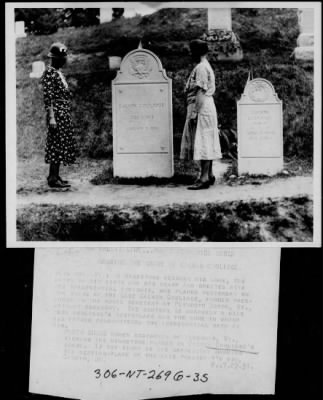
Women of Plymouth beside the newly placed headstone for Coolidge's grave. It is simply marked with the Presidential seal, his name with birth and death dates. Adrian Malloy, who had crafted the stone for their son, Calvin Jr., offered the same service to Mrs. Coolidge in honor of her husband, placing it for the Coolidge family on July 27, 1933.

Women of Plymouth beside the newly placed headstone for Coolidge’s grave, July 29, 1933. It is simply marked with the Presidential seal, his name with birth and death dates. Adrian Malloy, who had crafted the stone for their son, Calvin Jr., offered the same service to Mrs. Coolidge in honor of her husband, placing it here for the Coolidge family on July 27, 1933.

Given the sign to begin, Reverend Penner committed Coolidge’s body to burial and then read a Robert Richardson poem selected by Mrs. Coolidge,

“Warm summer sun, Shine kindly here.

“Warm southern wind, Blow softly here.

“Green sod above, Lie Light, lie light.

“Good night dear heart, Good night, good night.”

The Benediction was read and the service concluded. Florence Coolidge stepped forward to place a single red rose on her father-in-law’s casket (Van Beck p.24). It took less than five minutes but the growing number of those in attendance stood in respectful silence for some time. The playing of taps reminded everyone that a Commander-in-Chief was being remembered that day. As everyone departed from that solemn scene, most for the one hundred miles back to Northampton, Willard Cabot, Azro Johnson and a number of Coolidge’s Plymouth neighbors lowered their dear friend’s body into the earth and filled in the place where he would rest. It was a place beside his son and among five generations of his ancestors on the hillsides he loved so deeply.

The Coolidge family headstones stand in a row at the center of the picture, Plymouth cemetery, The Notch. "Here my dead lie pillowed on the loving breast of our everlasting hills" -- Calvin Coolidge

The Coolidge family headstones stand in a row at the center of the picture, Plymouth cemetery, The Notch. In order from L to R: John and Florence, Grace, Calvin and the smallest stone marks where Calvin Jr. rests. “Here my dead lie pillowed on the loving breast of our everlasting hills” — Calvin Coolidge