On Patriotism

Image

Yesterday marked twelve years since the despicable attacks against the innocent thousands at their jobs in the World Trade Center Towers, the Pentagon and against the passengers of Flights 175, 11, 77, and 93. The depth of hatred for this country by those who withhold freedom from their own people and choose death as a weapon against all who oppose them, is unfathomable. There is no reforming it, there is no justifying it, there is no understanding it. There can be no conciliation with evil.

Many of us still remember the shock we felt from that day. Despite best efforts to the contrary, we are forever changed by it. But the way we responded as Americans deserves equal remembrance. We joined together, united in our common identity as Americans, comforting those in grief but resolute in who we are and what justice demanded be done. We flew the flag proudly, without shame or apology because we were not to blame for the wrongs inflicted among us. We knew America was the moral force for good in this world. It was not a blind refusal to see her faults, but it was not a psychotic inability to see the immense good America represented. It was the power of its ideals that rekindled a genuine and nationwide patriotism.

It was not long before a small percentage of the population — members of the modern Left — embarrassed and disgusted with this “corny” love for country, began a drumbeat that would not only discredit President Bush but dispirit and divide the nation again. The flag has long been offensive to them and so it ought to be intolerable to others, they intoned. For these unhappy souls there is nothing to love without complete and absolute perfection. It is no wonder they are so unhappy here. The appreciation of what is good and beautiful in this imperfect world must be quite lost on such sad people. Even with confronted with the only Perfection ever to visit earth, they reject Christ, ridiculing anyone who wears the name Christian.

It was clear patriotism had to be redefined if the Democrat Party was ever going to win another election. A simple love for country was too much to espouse for these discontented folks. Hillary Clinton stepped forward to laud true patriotism as dissent, the courage to see and criticize America’s faults. Howard Dean screamed the mantra that the flag belongs to everyone, not just Rush Limbaugh, despite the fact that the only persons burning it, cheering for its defeat and encouraging our enemies were Democrats like Dean. Of course, we recall Michelle Obama’s profession of pride in America only after electing her husband. Nothing remotely good or praiseworthy preceded this, apparently. Unprecedented liberty, opportunity, the individual exceptionalism that recurred for millions coming to America, our fight over slavery and the protection of civil rights, the story of our march from the political, religious and economic tyranny of the Old World did not count, it seems. Then there is the President’s distinction, when asked September 4 whether his credibility was on the line, between himself and America, saying, “My credibility is not on the line.  The international community’s credibility is on the line.  And America’s and Congress’s credibility is on the line.” So America has to fend for itself when it comes to credibility? The President has no role in upholding American credibility now? Patriotism should not be exclusive to any political party in this country. It speaks to how far the Democrat Party has strayed from its roots.

Patriotism was not so confused a concept to Coolidge.

For Calvin Coolidge, “[p]atriotism is easy to understand in America. It means looking out for yourself by looking out for your country. In no other nation on earth does this principle have such complete application…Patriotism does not mean a regard for some special section or attachment for some special interest, and a narrow prejudice against other sections and other interests; it means a love of the whole country.”

Coolidge did not live blissfully unaware of America’s short-comings, but neither did he insist all flaws be removed forthwith before disbursing love and admiration for his country. He always found a greater number of reasons existed to love, not hate, America. He refused to see only the negative. He lived in reality and as such knew patriotism inspires improvement through the pursuit of ideals. It has defined America’s entire history.

Coolidge would drive the point home when he said, “Not to know and appreciate the many excellent qualities of our own country constitutes an intellectual poverty which instead of being displayed with pride ought to be acknowledged with shame.” It is the systematic ostracism of showing our patriotism that should shame the modern Left. The love for America they refuse to understand or at least respect, exhibits a spirit not of enlightenment and objectivity but of closed-mindedness and intolerance. Coolidge expressed respect for our flag and what it represents even more frankly, when he said, “He who lives under it and is loyal to it is loyal to truth and justice everywhere. He who lives under it and is disloyal to it is a traitor to the human race everywhere.”

They would mock and scorn what Coolidge said next about encouraging patriotism, “We must eternally smite the rock of public conscience if the waters of patriotism are to pour forth. We must ever be ready to point out the success of our country as justification of our determination to support it.” Or, when he said to the National Education Association concerning American children, “patriotism is always to be taught.” Or, finally, when he spoke to immigrants in 1925, saying, “Our America with all that it represents of hope in the world is now and will be what you make it. Its institutions of religious liberty, of educational and economic opportunity, of constitutional rights, of the integrity of the law, are the most precious possessions of the human race. These do not emanate from the Government. Their abiding place is with the people. They come from the consecration of the father, the love of the mother, and the devotion of the children. They are the product of that honest, earnest, and tireless effort that goes into the rearing of the family altar and the making of the home of our country. They can have no stronger supporters, no more loyal defenders, than that great body of our citizenship which you represent.”

Image

On Being Worthy of Freedom

Apprehensions over the future have always remained an ever-present concern for a wise and circumspect people. When Americans stop being concerned for the next generation, it will be because we are no longer free individuals. The prospects for freedom stand in greater doubt than perhaps they have for many years, but a lack of confidence in our system is only new to us, not to generations of Americans who came before us.

Any one of the hardships overcome by prior generations could have halted the experiment of self-government in its tracks. It has certainly had no shortage of critics who proclaimed “failure” and “defeat” only to be proven flatly wrong time and time again. Inequity and unfairness have been present in human history from the outset, but neither has had the power to prevent individuals of determination from accomplishing truly great things despite it. Our time is hardly the first to ask, “who is worthy of freedom?”

The Progressive Era produced an almost overwhelming array of reasons to change the way this country was established. It would answer our question with pessimism: the people were ultimately not to be trusted with freedom. It was an intelligent few who merited such power. Coolidge knew, on the other hand, freedom was safest in the hands of the people.

The charge that our system was both too wild and too unequal, compared to the “enlightened” societies of Europe, led to calls for regulation of human behavior on a scale never before known. The pursuit began to implement an efficient and intelligent approach to government that would mitigate risk, remove inequities and shepherd the people to progress.

These activists, predisposed to intense skepticism about capitalist systems, trusted government implicitly with greater and greater control. Enamored with a lopsided admiration for methods foreign to American ideals of law and liberty, these generally middle class intellectuals failed to appreciate the remarkable nature of our constitutional system. They overlooked the careful balance worked out by the Framers, infusing a disastrous measure of good intentions with a reckless accumulation of new laws.

They entrusted government with the power to supply the shortfalls of human nature with legislation. Each effort undervalued, even ignored, the unquantifiable worth of freedom. Government, endeavoring to be “smart” and “humane,” hurt those it proclaimed to help by robbing them of the dignity of free will, the moral judgment of those given sovereignty in our system.

Ours is a history of accomplishment and success because people were recognized not as subjects in service to the State but individuals whose value comes from a Divine Creator. Made in the image of God, it logically follows that the dreams, aspirations and abilities to create, construct and succeed are within every person’s power. It is that power now being denied our young people as unrealistic and unattainable. This is nothing more than the latest incarnation of those who denied Edison could harness light, the Wrights could fly and Ford could mobilize America.

The avoidable tragedy of all this is that it literally destroys the wholesome yearnings of millions for something better than marginal existence. Instead, the young are told to be content with mediocrity, cease the pursuit of success, and consign all future faith and hopes to Washington’s management. No less self-deluded than the Progressives of Coolidge’s day, this operation dehumanizes humanity. History proclaims it will ultimately fail but the cost to countless lives in the process can never be known.

Coolidge, grappling with these problems, said in 1923,

[T}he motive power of progress and reform has not come from the high and mighty but from the mass of the people…It is not the quantity of knowledge that is the chief glory of man…It is in the moral power to know the truth and respond to it, to resist evil and hold to that which is good, that is to be found the real dignity and worth, the chief strength, the chief greatness. This power, even in the humblest and the most unlettered, rises to a height which cannot be measured, which cannot be analyzed. It is this strength of the people which can never be ignored. Of course it would be folly to argue that the people cannot make political mistakes. They can and do make grave mistakes. They know it; they pay the penalty. But compared with the mistakes which have been made by every kind of autocracy they are unimportant…

…Unless the people struggle to help themselves, no one else will or can help them. It is out of such struggle that there comes the strongest evidence of their true independence and nobility, and there is struck off a rough and incomplete economic justice, and there develops a strong and rugged national character. It represents a spirit for which there could be no substitute. It justifies the claim that they are worthy to be free…

     …Civilization and freedom have come because they are an achievement, and it is human nature to achieve. Nothing else gives any permanent satisfaction. But most of all there is need of religion. From that source alone came freedom. Nothing else touches the soul of man. Nothing else justifies faith in the people.

Like the generation who saw beyond the narrow confines of subsistence imposed upon it by king and Parliament, it is time to refuse to participate in a supervised decline. Being taught to doubt our own judgment is merely a prelude to forfeiting the ability to make our own choices, to strive, to fail, to triumph — in short, to live free. If we are to be worthy of that freedom, we cannot surrender to this latest effort — however organized it is — to train out the moral ideals and intangible dreams of people.

Image

On Political Satire

Image

On January 4, 1928, Will Rogers, the era’s renowned cowboy comedian-columnist, led a radio hookup that featured participants all across the country, including the famous Al Jolson and the influential Paul Whiteman and his orchestra. It is interesting that both Jolson and Whiteman profoundly inspired many Americans (from Duke Ellington and Billie Holiday to Dick Clark and Bing Crosby) to launch their talents on the public stage. Whiteman was known as the “King of Jazz” while Jolson provided a sense of common identity and respect between minorities, immigrants and “Anglo-Saxons” through his black-face performances. Derided now, Jolson was loved across the demographics then. Will Rogers led this colorful gathering of talent to advertise Dodge automobiles.

As he continued the broadcast, in his characteristic drawl, he said, “Radio fans, I have a friend in Washington who on account of what the Automobiles have done for his Economy wants to speak to you, Mr. Coolidge, all right Mr. Coolidge go ahead…”

Rogers then employed a clever impersonation of the President’s “Vermont twang” and style of expression, ribbing Coolidge with this nonsensical series of comments:

     Ladies and Gentlemen, I am supposed to deliver a message every year on the condition of the country, I find the County as a WHOLE prosperous. I don’t mean by that, that the WHOLE country is prosperous, But as a WHOLE, its prosperous, That is its prosperous as a WHOLE. A WHOLE is not supposed to be prosperous, There is not a WHOLE lot of doubt about that…

Rogers, continuing to replicate Coolidge’s voice went on to political events in succinct and casual snippets, mentioning Mellon at Treasury, the Congress, “Smart Boy” Dwight Morrow and “Lindberg.” Rogers wrapped it up with a reference to Coolidge’s “I do not choose to run” statement from the previous year and how Prohibition was going.

All seemed fine until a few days later when Rogers dined at the home of Speaker Nicholas and his wife, Alice Roosevelt Longworth. To Rogers’ shock he learned of a New York Times piece chastising the comedian for “going too far” when it came to Presidential satire. He had even confused and angered some listeners who took issue with a President endorsing Dodge vehicles. Immediately, he sent a profuse letter of apology to both Mr. and Mrs. Coolidge, ending with the line with characteristic lack of punctuation, “If there ever was a sad Comedian, I am one, and I do ask all the forgiveness that its in your and Mrs. Coolidges power to give, Yours most respectfully, Will Rogers.”

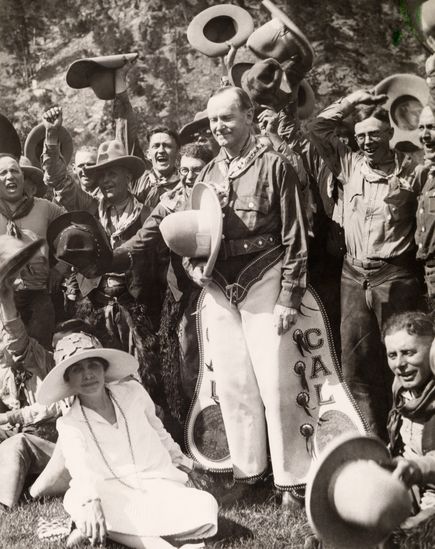
The President, who responded to criticism directed at him the previous year for wearing that silly cowboy outfit including customized chaps with, “It is good for people to laugh,” wrote this kind and sensible reply to the ashamed comedian:

     THE WHITE HOUSE

     Washington

                                                                                                      January 11, 1928

     My dear Mr. Rogers:-

     Your letter has just come to me. I hope it will cheer you up to know that I thought the matter of rather small consequence myself though the office was informed from several sources that I had been on the air. I wish to assure you that your note makes it all plain that you had no intention save harmless amusement.

     I hope you will not give the affair another troubled thought. I am well aware how nicely you have referred to me so many times.

                                                                                                      Cordially yours,

                                                                                                      Calvin Coolidge

As Lawrence E. Wikander, former Curator of the Coolidge Room at Forbes Library, has noted in his article, “Will Rogers and Calvin Coolidge” in The Real Calvin Coolidge, volume 13, “Even a slight acquaintance with the President would convince one that would not send such a warm letter if he were offended” (p.14). Yet that is exactly what biographers have done since 1939! Each seems oblivious to this letter and Coolidge’s explicit dismissal of any offense taken. Such is one of the many persistent Coolidge myths to continue in spite of the facts.

As Mr. Wikander points out, Rogers not only considered the matter closed…he would impersonate Coolidge again and in the coming years after the White House regularly chided Coolidge with public satire. They would meet in March of 1930 at the dedication of Coolidge Dam in Arizona and remain clearly on the warmest of terms.

This obscure incident of political satire from eighty-five years ago illustrates how far the culture has gone. Instead of continuing the progress evident in Coolidge’s day, the culture has become more restrictive, seemingly incapable of laughing at itself, “choosing” to take offense rather than embracing the healthy sense of proportion that events warrant.

It is forgotten what a long road of passionate political expression has been traversed in our country. When President Washington received Chief Justice Jay back from Great Britain following the negotiation of an unpopular treaty with the recently vanquished “Mother Country,” Jay observed he could travel back to the capital by the lights of likenesses of him burned in effigy. Everything from death threats to obscene acts were directed against President Bush, an experience shared by numerous Presidents before him.

Infinitely less has been done by the rodeo clown at the Missouri State Fair. Yet, in spite of the enthusiastic reaction from those who were in the audience…it is “racist,” “hateful” and “intolerant” to lampoon the President. Apparently he is to be held above criticism, however comedic. It is a grave loss to our liberty when political correctness is awarded the power to silence the most harmless of satirical performances while destroying the individual who utters anything not approved by government authorities. What is left of our freedom to express political opinion when satire is no longer allowed?

Image