“Silent Cal: A Public Role Model”

“Silent Cal: A Public Role Model”

This excellent piece by College Conservative Alex Uzarowicz defines in cogent terms why overlooking Coolidge and his accomplishments deprives us of the immense benefit of Coolidge’s humble example of service. It was a model Americans expected in 1928 and which is glaringly absent now. Coolidge’s platform resonates not only because it succeeded so well but because it demonstrated how our Founding principles work. The governing principles of “Silent Cal” remain a winning message going into 2016.

mapt06

On “The Farmer and the Nation,” Part 3

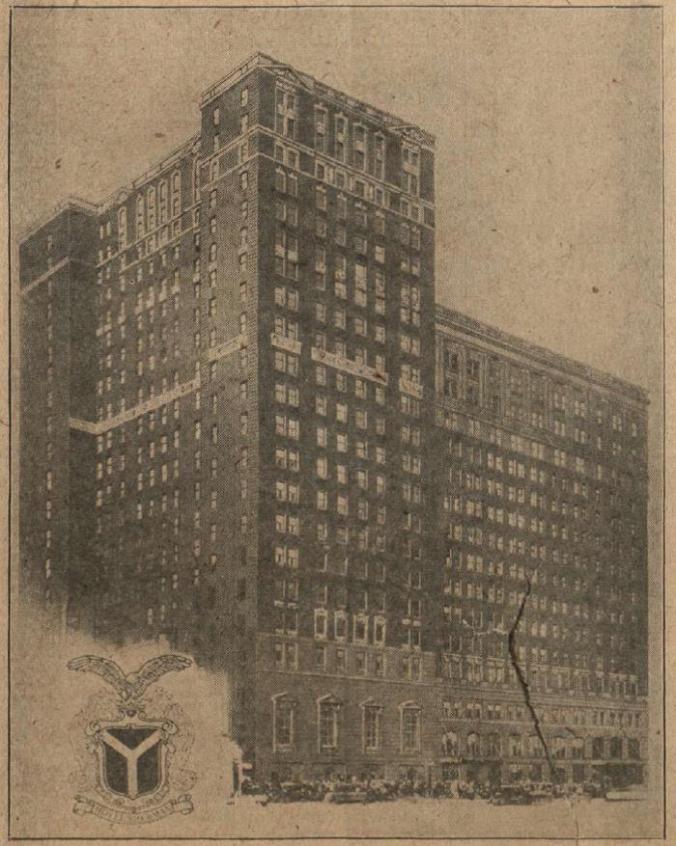
The Sherman Hotel in Chicago where President Coolidge delivered his address on the farmer and the nation, December 7, 1925.

The Sherman Hotel in Chicago where President Coolidge delivered his address on the farmer and the nation, December 7, 1925.

The American Farm Bureau Federation, meeting for its seventh convention in December 1925, had begun five years earlier to accomplish three objectives: (1) extending the terms of credit to allow farmers more time to market what they produce; (2) supporting a high protective tariff which guarded American markets from cheap imports; and (3) advancing a cooperative marketing method for individual farmers to manage ordinary surpluses.

After three years of legislative successes, the Federation chose new leadership in 1922, electing Oscar Bradfute, an Ohio rancher, who took the helm with a commitment to the cooperative approach against the price-fixing program advocated by tireless lobbyist George N. Peek and others. As President Bradfute introduced President Coolidge, he reminded the thousands overflowing the ballroom how important a statement on behalf of agriculture was being made. President Coolidge had traveled two thousand miles to reach the opening day of not merely a Midwestern farm meeting, but downtown Chicago, the headquarters of an organization at the center of all agricultural business. The audience, eager to hear what the President had come so far to say, would find themselves divided in two basic camps after his forty minute address. There were those who wanted immediate results through government price-fixing and those who were confident that America’s farmers, just as Coolidge had said, were best able to emerge on their own from depressed prices, debt and overproduction with the patience, independence and rugged determination that had defined the nation’s farms from the beginning.

The Coolidges are standing with Oscar Bradfute, to the President's left, in a picture taken in Chicago before Coolidge's address.

The Coolidges are standing with Oscar Bradfute, to the President’s left, in a picture taken in Chicago before Coolidge’s address.

Government-controlled price-fixing would only harness and undermine the farmer, not improve his circumstances. Changing tariff policy, which already provided immense help to agriculture, would likewise be a step backward not forward. If these would not work, what would, in President Coolidge’s estimation?

First, the President recognized the importance of turning capital loose so that farmers can obtain loans as participants of cooperatives. Cooperatives would cut out the middle men (distributors and marketers) standing between the farmer and the consumer, thereby liberating the transaction of goods with a lowered price and increased profit margin. Of course, distributors and advertisers played a role as well in the market but by freeing up capital and furnishing resources for “sound business advice,” farmers could better help themselves out of agriculture’s preventable difficulties. It was the reason why Coolidge had supported the Norbeck-Burtness bill in 1923 addressing crop and livestock diversification to help farmer’s avoid the cycle of overproduction, price decline and waste. It was also why Coolidge would support the Tincher bill in 1926 to supply $100 million in revolving loans to co-operatives. Connecting the producer with the consumer, supplying capital where it was most needed and efficiently used, did more to aid farmers than any government price-plan could yield.

Second, President Coolidge identified the important part co-operatives played in handling “accidental surpluses.” No real solution should be made into a crutch, to incentivize purposefully wasteful overproduction or subsidize reckless decision-making on the part of farmers. Only reducing production could solve excessive supplies of any given crop. No proposal could replace the initiative or judgment of the individual farmer. Co-operatives, handling roughly one-fifth of total agricultural produce annually, were there not to supplant the sense people were to exercise for themselves. The co-operative was there to help when weather bestowed higher yields than expected. The farmer was not to lean upon the co-operative as his permanent safety net, substituting its storage and resources for his own failure to sow, cultivate and reap wisely.

“To have agriculture worth anything, it must rest on an independent business basis. It can not at the same time be part private business and part Government business. I believe the Government ought to give it every assistance, but it ought to leave it as the support, the benefit, and the business of the people…Government ought not to undertake to control or direct, it should supplement and assist all efforts in this direction.” As Coolidge masterfully demonstrated throughout his Administration, the greatest help government can render starts by removing itself — the biggest obstruction to initiative and independence — from participation in the market. Coolidge was not the laissez-faire “purist” that New Deal revisionists later depicted him to be. He knew no market was absolutely free and that limited regulation was a Constitutional mechanism. But, he also understand that government power was wisely and very properly confined by the Founders so that problems found solutions from the people themselves, looking to one another, instead of Washington, for answers. Explaining the legislation he endorsed for agriculture, President Coolidge sided not with the “artificial support” of prices but with whatever rested firmly in “sound economic principles.” “The fundamental soundness” of the bill for co-operative marketing “rests on the principle that it is helping the farmer to help himself.”
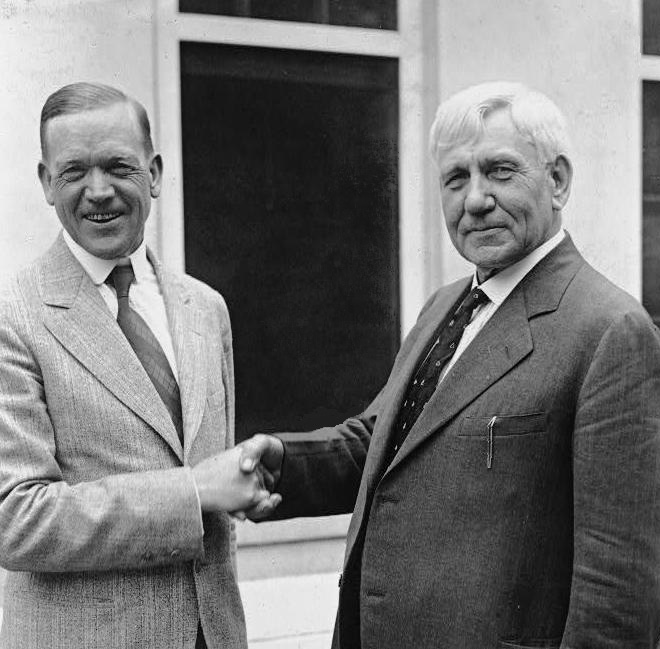
Charles L. McNary, of Oregon, and Gilbert N. Haugen, of Iowa, both Republicans, co-authored the bills bearing their names which advocated government mandating an "equalization fee," buying crops overproduced by American farmers to be resold at artificial prices on foreign markets.

Charles L. McNary, of Oregon, and Gilbert N. Haugen, of Iowa, both Republicans, co-authored the bills bearing their names which advocated government controls on agriculture, mandating an “equalization fee,” and buying crops overproduced by American farmers to be resold at artificial prices on foreign markets.

Maintaining this conviction did not come from a lack of sympathy for the difficulties the farmer faced. The exact opposite was true, especially for Coolidge. The responsibilities of leadership demanded something more than simply indulging the short-sighted and mistaken wishes of the electorate, however politically powerful the “Farm Bloc” proved to be. It was not leadership to follow the misled and uninformed. Agriculture needed to “consider the encouraging features of their situation” not deny them, perpetuating a perception of crisis. “Human nature is on their side,” the President reminded them. “We are all consumers of food.” As Coolidge recapped the rise and fall of prices since 1820, historical perspective made clear that farming continued to advance, even the setback of 1921 was temporary. Agriculture was going to see a return. It was not, as George N. Peek opined, an “us versus them” mentality where industry was concerned, like when he asked “[S]hall agriculture exist merely to feed the mouth of industry?” President Coolidge could not disagree more. The growth of industry meant the progress of agriculture because we all have to eat.
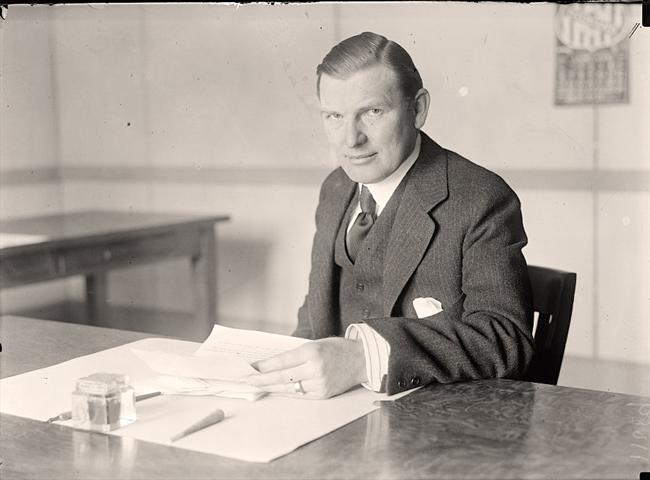
George N. Peek, President of Moline Plow Company and tireless lobbyist on behalf of government joining with corporations to fix agricultural prices. After Coolidge thwarted his efforts to make McNary-Haugen the law, Peek became a Democrat and eventually, a supporter of FDR's Agricultural Adjustment Act.

George N. Peek, President of Moline Plow Company and tireless lobbyist on behalf of government joining with corporations to fix agricultural prices. After Coolidge thwarted his efforts to make McNary-Haugen the law, Peek became a Democrat and, eventually, a supporter of FDR’s Agricultural Adjustment Act.

Our economy had not been built overnight. It was the result of incremental effort by every part of the Nation’s economy. As the other areas of economic endeavor prospered, what the farm produced would only increase exponentially to meet demand. At the head of it all would be the farms and ranches across America who would lead because everyone requires what they produce. After all, as the President reiterated, the farm is not only the source of food nor is it merely in the pursuit of material aims. “The ultimate result is…the making of people. Industry, thrift, and self-control are not sought because they create wealth, but because they create character. These are the prime product of the farm. We who have seen it, and lived it, we know.”

In that high and noble purpose, the farm reconnects and renews the Nation with both a “true relation to nature” and an individual’s importance to the Divine Plan at work in this world. The blessings afforded by the farm have included “the life of freedom and independence, of religious convictions and abiding character. In its past it has made and saved America and helped rescue the world.” With these astounding accomplishments, it was no exaggeration for Coolidge to see the time ahead for America as still brighter yet. In upholding these principles cultivated through life on the farm, the future “holds the supreme promise of human progress.”

As the President departed so hastily he forgot to grab his overcoat, the chilly reception to his principles would continue in a protracted battle long after he left the White House. Two days later, Southern delegates led by Alabama would unseat President Bradfute and elect Sam H. Thompson, an Illinois farmer who had taken part in much of the legislative fight to pass McNary-Haugen the previous year and wanted to expedite its passage into law now. Bradfute had upheld his promise to encourage co-operative marketing and resist government manipulation of prices, “equalization fees” and all the accessories for Federal control of agriculture. The President’s determined leadership, even when the pressure to surrender to the McNary-Haugen bill rose to deafening levels, Coolidge remained on course because he knew he was right and that the people would come to understand that. His second veto would be the last word on the matter until Hoover conceded with the creation of the Farm Board, superficial price-boosting and a revived “equalization fee.”
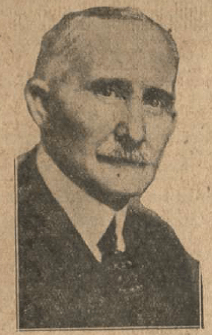
Newly elected President of the American Farm Bureau Federation, Sam H. Thompson, who would move to push McNary-Haugen all the way to President Coolidge's desk in 1927.

Newly elected President of the American Farm Bureau Federation, Sam H. Thompson, who would move to push McNary-Haugen all the way to President Coolidge’s desk in 1927.

For now, though, Coolidge fearlessly went into the arena, articulated the reasons why this popular trend toward government intervention in agriculture would fail, leaving the farmer worse under its provisions. Departing the room with his confident and unapologetic defense of rugged individualism and personal initiative still ringing in their ears, President Coolidge, a farmer, descended from a long line of farmers, walked from the Sherman Hotel a living confirmation that what he said was true: as long as agriculture maintains its independence from government’s attempts to “help.”
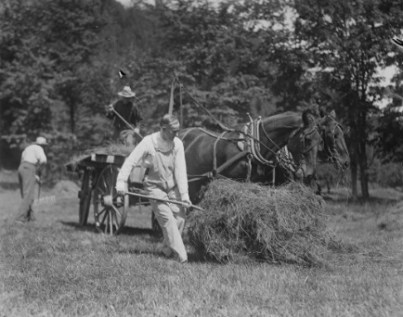
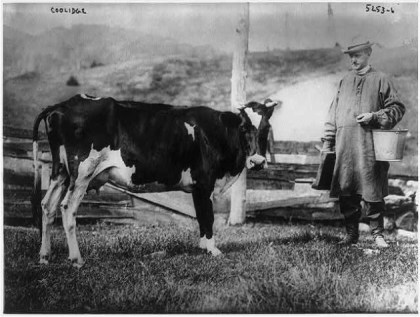
CC pitching haycalvin-coolidge-cow-e1359473649623DA-Vermont-Calvin-Coolidge-1920-family-farm-Vermont-9

Coolidge, Calvin. “The Farmer and the Nation,” December 7, 1925, cited in Foundations of the Republic. Honolulu: University Press of the Pacific, 2004.

Fite, Gilbert C. George N. Peek and the Fight for Farm Parity: A vivid story of the farmers’ campaign for agricultural equality and of the man who led it. Norman: University of Oklahoma Press, 1954.

Hansen, John Mark. Gaining Access: Congress and the Farm Lobby, 1919-1981. Chicago: University of Chicago, 1991.

Michigan Farm Bureau News, “Elect Sam Thompson President of American Farm Bureau,” http://archive.lib.msu.edu/DMC/MFN/1925/December%2018%201925.pdf.

On “The Farmer and the Nation,” Part 2

As President Coolidge stood before the thousands of lobbyists, farmers, ranchers and agricultural professionals gathered in Chicago, it was becoming increasingly evident that this was not what they wanted to hear. The President was answering their plea to Washington for special help with a firm “no.” Moreover, Coolidge was about to launch into a wealth of statistical data in order to counter the central assumption that government had to act to meet emergency conditions. No emergency existed. Coolidge knew that crises were notoriously disastrous environments to properly and carefully consider drastic legislation, whether it be for farmers, veterans or anyone else. Contrived calamities advance the interests of bureaucrats and lobbyists not the welfare of all the people.

American farmers were experiencing real improvement after the low point of 1921. General trends since 1900 were slowly, but surely, beginning to reach farm prices. Neither the Congress nor his Administration could accelerate that process so that market demand could be supplied to compensate for overproduction. Coolidge was not blindly proclaiming a return of pre-war levels of prosperity either. Such levels were beyond anyone’s reach now. The market furnished the only true value of what farmers had hastily overproduced. No partnership of government and corporate entities could neatly raise the value of one product to keep returns high and costs low, especially when the markets knew otherwise. Advocates of a government rescue seemed to feel that America was still stuck in 1921 and it was the responsibility of government and business to remove the consequences of poor decision-making on the part of farmers. Farming was hard enough, they claimed. It was for no lack of sympathy nor a denial of reality that Coolidge stuck to his guns and refused to succumb to the pressure that “crisis” compelled another unnecessary raid on the Public Treasury.

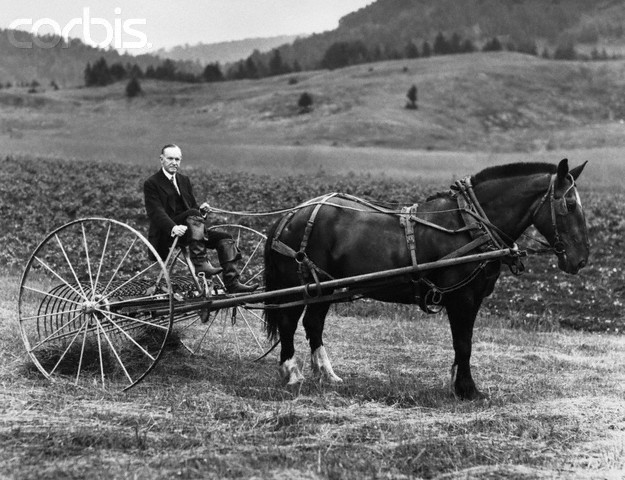
Former President at his Vermont family farm. He and his horse are ready to put the hay baler to work, July 1931.

Former President at his Vermont family farm. He and his horse are ready to put the hay baler to work, July 1931.

The advocates of government relief did not want to be bothered with the facts, though. This did not deter Coolidge from affirming what trends actually revealed: while rural populations were decreasing, production was going up. In fact, production had grown fifteen percent since 1910, a remarkable reality given that the economy had experienced four years of war, an economic depression and witnessed the move from a rural to predominantly urban population. “Fewer people but more production means each person on the farm will receive more.”

Production was but one part of the equation, Coolidge went on to say. Prices were at the heart of the controversy. However, prices were also going back up. No, they were not yet to where they had been before the war. Nothing, for that matter, was at it had been. When compared over a quarter of a century, though, what farmers were making had more than tripled to over $12 billion what sold for $3.5 billion in 1900. Farmers had seen a 350% increase in just two decades! Of course, commodities all across the spectrum had increased in value and the decline of 1921 hit hard, but purchasing power had exceeded even those hits to its worth. Agriculture was not in crisis. Depressed areas could be found, just as debt and taxes continued to burden farmers as well. President Coolidge, who knew directly what it was to struggle on the farm, reminded his audience that these were indicators not of permanent decline but demonstrated that agriculture was improving.

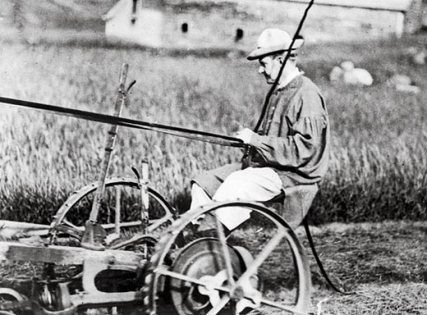
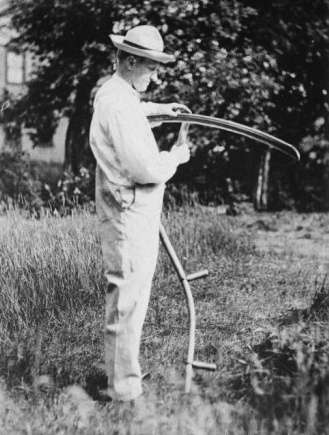
Coolidge sharpening a scythe in order to cut his grass.

Coolidge sharpening a scythe in order to cut his grass.

What medicine to administer depended on the condition of the patient. Farming was neither on a deathbed nor stricken in a sick room. Agriculture was rallying back toward full health. It was not there yet but the treatment, if given by government, would prove worse than the cure, Coolidge maintained. Even were the medicine coated in the garb of corporate partnership with government, experience taught President Coolidge how “dangerous” and destructive it would be to the freedom of the market. “No matter how it is disguised, the moment the Government engages in buying and selling, by that act it is fixing prices. Moreover, it would apparently destroy cooperative associations and all other market machinery, for no one can compete with the Government. Ultimately it would end the independence which the farmers of this country enjoy as a result of centuries of struggle and prevent the exercise of their own judgment and control in cultivating their land and marketing their produce.”

The President knew that however rationalized the government’s “alternative choice” is advertised, the result is always a removal of competition and establishment of one, sole provider — the Federal Government, forcing Americans to pay whatever it decides, however high or artificial a price. The costs are not merely economic ones, either. “Government control can not be divorced from political control.” The project may start innocently enough by insulating producers from low prices and bolstering superficially high values on what is sold. The agricultural policies of other nations, Coolidge pointed out, reveal that price fixing, once entrusted to government, cuts both ways. One of Europe’s great nations had already capped the price of farm labor far below what it was worth. America, were it to set out on that same course, would soon find that a government empowered to give can also take away.

Coolidge also understood that no government has the ability, even with “the best and the brightest,” to surgically adjust one price without seriously influencing all the other costs and components simultaneously operating in the market. The only way to prevent this ripple effect invariably led to the wholesale takeover of the economy by government. American agriculture would no longer be American. Government could not manage one small piece without assuming management of it all to ensure desired results for any length of time. “Unless we fix corresponding prices for other commodities, a high fixed price for agriculture would simply stimulate overproduction that would end in complete collapse.” Farmers realized, Coolidge asserted, “that even the United States Government is not strong enough, either directly or indirectly, to fix prices which would constantly guarantee success. They are opposed to submitting themselves to the control of a great Government bureaucracy. They prefer the sound policy of maintaining their freedom and their initiative as individuals, or to limit them only as they voluntarily form group associations. They do not wish to put the Government into the farming business.”

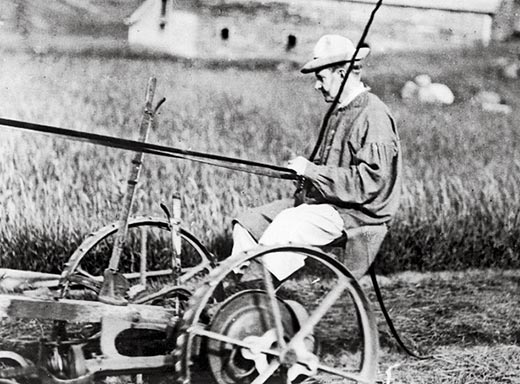
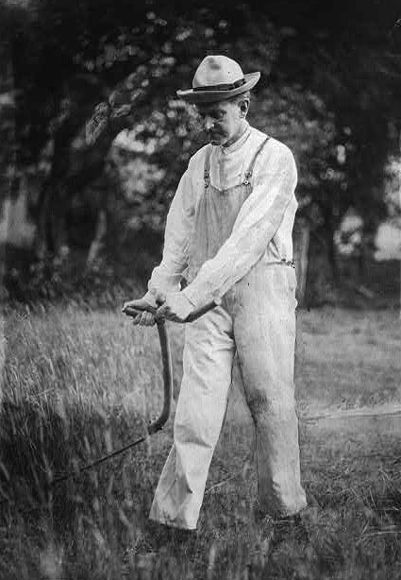
Coolidge working a scythe on one of his fields in Plymouth.

Coolidge working that scythe on one of his fields in Plymouth.

If Government price fixing was not the answer, what other option would address the farmer’s plight? The President turned to a discussion of tariff policy. Coolidge delved not into emotional rhetoric, anecdotal evidence or political pandering to accentuate the unfair deal foisted on the farmer. Instead, he cited the figures and invited everyone to “fact-check” him. If it was discovered that the tariff carried a disproportionate burden on agriculture, it needed to change.

If, however, upon examining the numbers, farmers obtained a high wall of protection from the costs of imported goods, the argument to change fell flat indeed. The facts confirmed that 88 percent of imported goods enter the country free of duty, are luxury items the farmer does not purchase or are paid by industry and commerce on behalf of the farmer. The vast majority, some eighty percent of what is imported free of duty, consists of agricultural goods. This leaves the farmer to pay a maximum of 12 percent for goods he never uses while the other sectors of business pay 36 percent on items “which do not benefit them.” The quantity paid by the farmer decreases even further when the actual expenditures of the average farm household are taken into account. In reality, a mere 1.3 percent of tariff costs falls to the farmer. If anyone is being disproportionately charged under tariff policy, it is anyone but the farmer.

Protection, more than a neutral policy yielded a positive good to agriculture. By exacting costs from foreign products, both the volume of imports and their dilution of American purchasing power was curtailed. It was because of the tariff that the standard of living continued, crop diversification was encouraged and home markets were protected. Because of the tariff employment was kept low and wages remained high. Protection for our own products and labor ensured that foreign competition did not supplant quality with quantity and qualified labor with cheap employment at home. Protection protects the farmer, already struggling as it was, to increase not only the strength of the dollar earned but the ability to employ more here at home, reaping the rewards of market prosperity as a whole. As Coolidge would confirm the service of America’s tariff policy unchanged, he declared, “Protection has contributed in our country to making employment plentiful with the highest wages and highest standards of living in the world, which is of inestimable benefit to both our agricultural and industrial population.” There was no need to redo the law making tariffs any more helpful to farmers than it was already proving to be.

As President Coolidge neared the close of his address, he finally offered what he saw as the soundest answers to the “farming problem.” In Part 3 of our overview, “Silent Cal” gives his take on what can be done in agriculture.

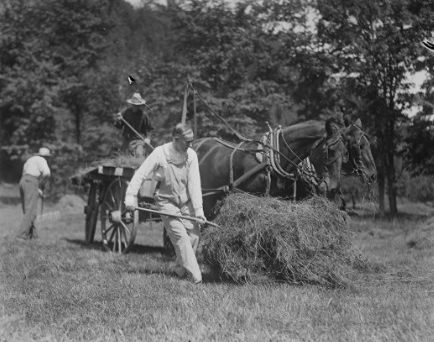
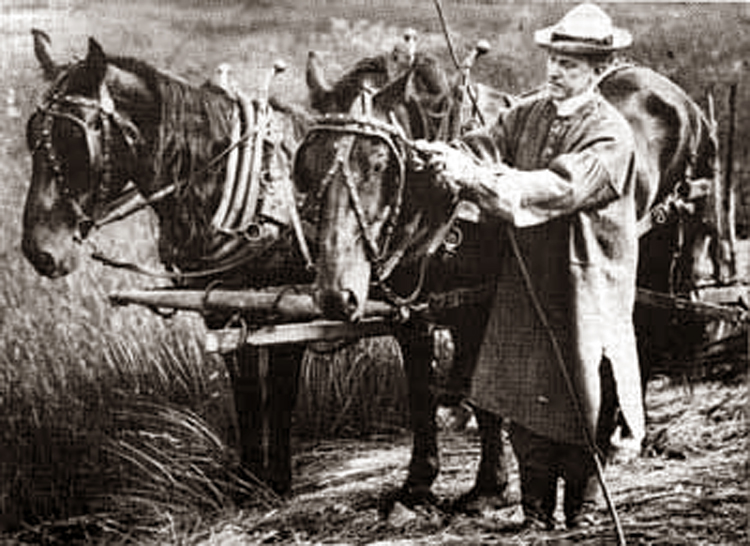
Then-Vice President Coolidge adjusting the gag swivel for one of his horses during work at the Notch, 1920.

Then-Vice President Coolidge adjusting the gag swivel for one of his horses during work at the Notch, 1920.