On the Jelly Roll

LeePingQuan

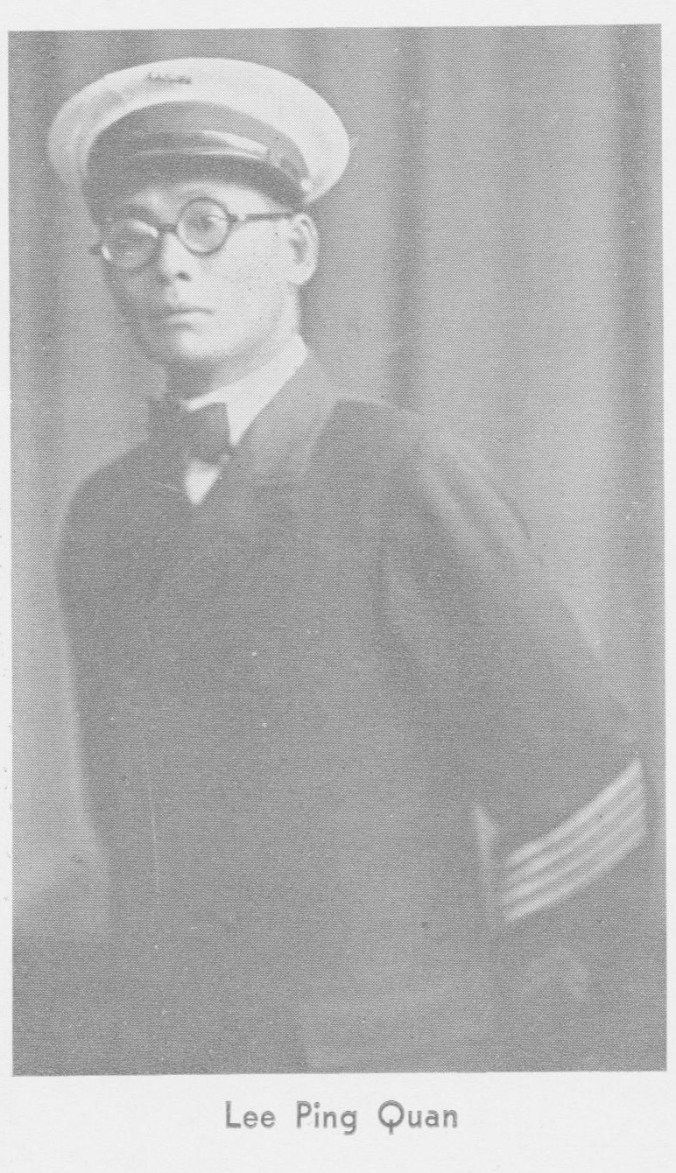
Chief Steward aboard the Mayflower, the Presidential yacht during the Coolidge Era, Lee Ping Quan (pronounced Chew-ahn) came from a family successful in both the art of cooking and the business of cooking supplies. Leaving China for the Philippines with his family, he would discover a passion for the preparation of cuisine from his uncle and come to the attention of the U.S. diplomatic team stationed at Manila. Lee would enter the U.S. Navy at age 20, earning renown over the next thirty years as a premier chef and diligent steward.

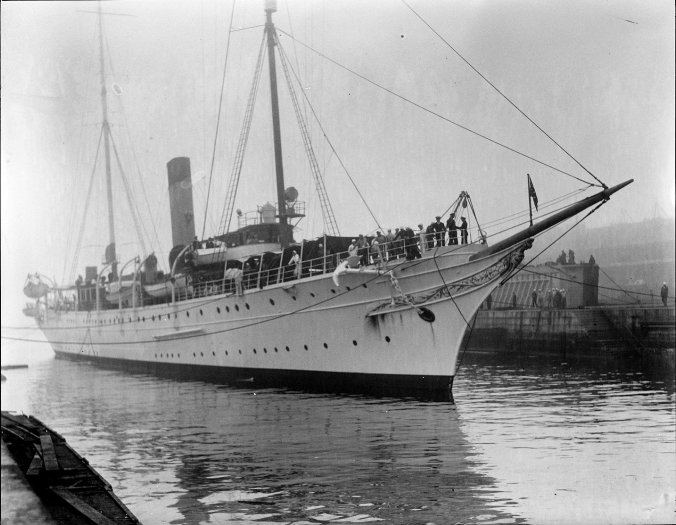
As the Chief Steward on the Mayflower, Lee would quickly learn the tastes of the many illustrious passengers who would travel aboard his ship. The Coolidges were among them and became Lee’s favorite Presidential couple. Through frequent interaction with the President, Lee discovered Cal’s resilient “sweet tooth,” a condition the skilled Master of the Galley regularly rewarded through the offerings on the menu.
12130122 mayflower 1928

The Mayflower, 1928. Photo credit: Library of Congress.

It was the Jelly Roll, as Lee prepared it, that became Coolidge’s #1 favorite. Lee even preserved the recipe in his charming 1938 book To a President’s Taste. The recipe, given below, was replicated by our household this past week for a birthday gathering and proved a remarkable dish. We see why Cal enjoyed it.

Lee Ping would leave the service in 1929 with the retirement of the Mayflower and achieve his lifelong dream: a restaurant of his own in New York City. The Coolidges remained proud of their dear friend’s success.

Here is the President’s favorite recipe:

The Jelly Roll

12 eggs                      4 tbsp. cream

8 oz sugar               2 tsp. vanilla

6 oz flour

Lee says: “Beat the eggs until stiff and add the sugar, cream and flour. Mix together; then add the vanilla. Place in two pans and bake in a slow oven for twenty minutes, then remove and cover with jelly or strawberry jam and roll. Cover with lemon icing and decorate to taste.”

While this would have been instinctive to Lee Ping, we found chilling the baked dough – before adding the jelly – for 30 minutes or so, enables the filling to be added without cracking or splitting the dough during the rolling stage. The icing (not glaze) helps “encase” and contain the contents for easy slicing. Chill then serve. Lastly, enjoy!

The dozen eggs give it a delightfully light consistency and a pleasant contrast with the fresh sweetness of the jelly and the mild tartness of the icing. Try it…it may prove to be the next favorite in your house.

On the Sap Bucket

image1

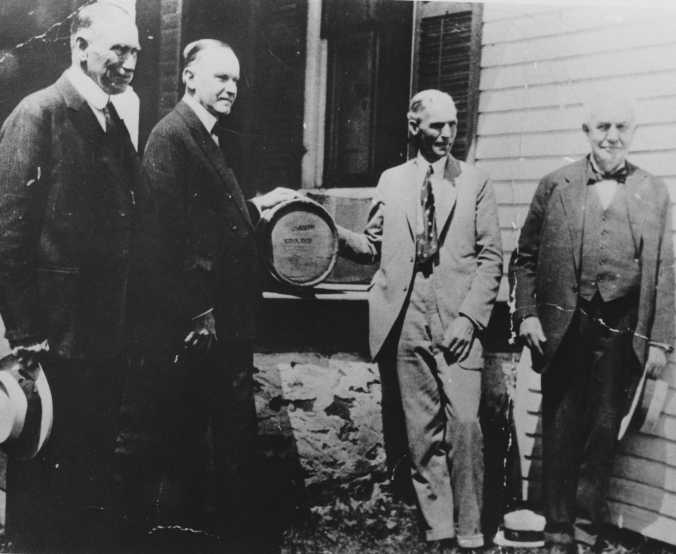
President Coolidge poses for the cameramen with his father, Henry Ford and Thomas Edison with the sap bucket beside the porch of the Homestead at Plymouth, August 19, 1924. Photo credit: Wayside Inn Archives.

When the “Vagabonds” (Henry Ford, Thomas Edison, and both Harvey and Russell Firestone) descended upon President Coolidge’s Homestead on this day (August 19) in 1924, a virtual town arrived with them: the support staff and 50-Ford auto caravan that took care of Ford and his crew while they “camped” up and down the Eastern seaboard. Only at Plymouth for barely an hour, Ford and company did not stay long but Coolidge was ready for them.

Over the previous five years Ford had become the leading collector in the country of Americana: the “relics” (as he called them) or memorabilia of regular folks drawn from everyday objects of the past. Ford loved history but not as it was too often taught in the schools – the emphasis on emperors, kings, and generals. Rather, to Ford, it was the anonymous men and women who labored in fields, mines, mills, and factories who carried history forward. This quest started for Ford when he learned in 1919 that his birthplace stood in the path of highway expansion. He relocated the home and began gathering a collection of furnishings that would form the nucleus of thousands of items by that summer of 1924.

henryfordcollector_inlinearticle_-thf126101

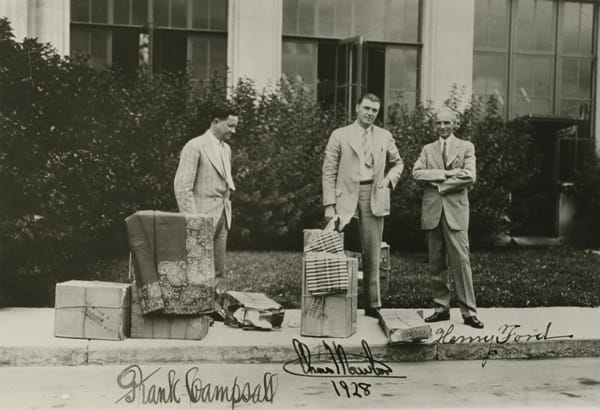
Henry Ford standing with a couple of his assistants (Frank Campbell and Charles Newton) as they receive items for the growing collection at Dearborn (1928). Photo credit: Ford Museum of American Innovation.

Not stopping with his birthplace, he restored the one-room schoolhouse he attended, the Scotch Settlement School, then Longfellow’s old Wayside Inn at Sudbury (Massachusetts) in 1923, and the Botsford Inn at Farmington (Michigan). By that summer of 1924, he was amassing a warehouse-sized collection at Dearborn and the President would contribute generously to its inventory: donating his cradle, first baby carriage, various kitchen items, and things from around the Homestead, including most famously, the 125-year-old wooden sap bucket used by his great great grandfather and Revolutionary War soldier, John Coolidge (1756-1822).

As Ford recounts, remembering in 1935,

“In company with Mr. Edison I visited Mr. Coolidge one summer day at his Vermont farm. I had always heard he was a taciturn man, but found him a man of most friendly conversation, free in the expression of his own opinions and interested in hearing the opinions of others. It was not long after our introduction that he had us out in the little cheese factory behind the farmhouse, where we were eating the cheese curd which we got by using whittled pieces of shingles as spoons. It was good American cheese.

“After we returned to the house Mr. Coolidge spoke about an old sap bucket which his grandfather had used, and offered it to me for our collection at Dearborn. Of course I was very happy to have such a gift and asked him to autograph the bucket. ‘Why, yes,’ he said, ‘we’ll all autograph it.’ So Mrs. Coolidge and Mr. Coolidge’s father and the President and Mr. Edison and the rest of the party autographed the sap bucket.

“Naturally we greatly prized that old wooden sap pail and took great pains to see that it arrived at Dearborn safely. It arrived in time for the addition of another signature to the list. It happened that the Prince of Wales was a luncheon guest at our house, and we told him the story of the bucket. He intimated that he would like to be on the bucket, too, and quickly added his signature.”

Prince-HenryEdselFord-1924

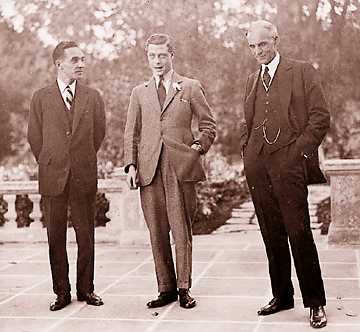
The Prince of Wales (center) on his October visit to Detroit with Henry (right) and son Edsel Ford (left). Photo credit: The Detroit News.

That royal visit occurred on October 14th coming after the Prince had already passed through Washington and met the Coolidge family for a quiet lunch at the White House on August 30th. They had just lost their youngest son the previous month. The Prince would return to America more than once and later meet his future wife there, American Wallis Simpson.

WaysideInn-Diaries

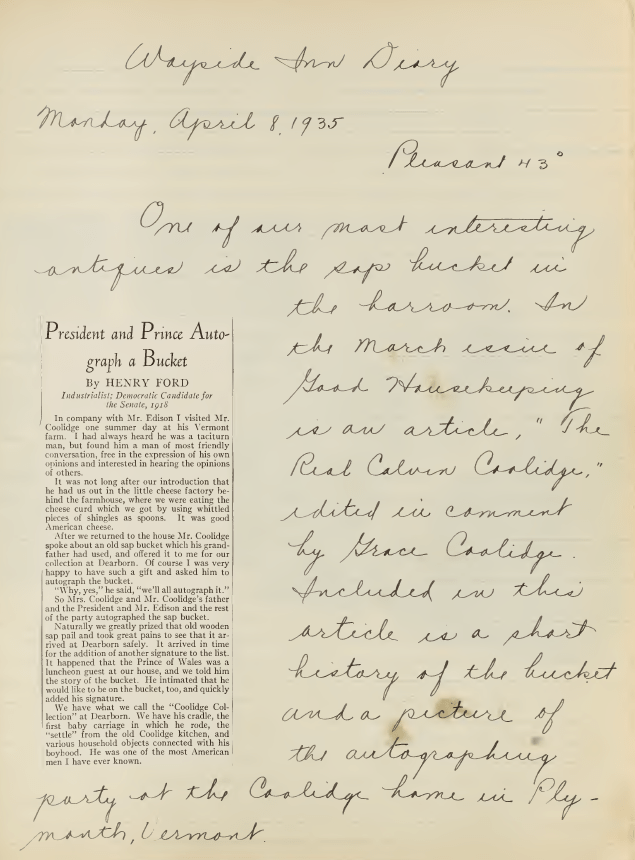
Page from the April 8, 1935 entry of the Wayside Inn Diary maintained through the years under Ford’s ownership.

The sap bucket, displayed all these years in the barroom of the Wayside Inn, is now on exhibit in partnership between the Inn and the Sudbury Historical Society in Massachusetts. The President’s inscription and all the autographs can still be clearly seen. If you are in the Sudbury area, be sure to check it out.

It is a fitting piece of Americana from an era before sheet metal and industrialization. It also bears observing that this great artifact from the founding generation comes from a family of quiet and unassuming public servants. As Ford would say, Coolidge “was one of the most American men I have ever known.” It is a legacy we honor when we emulate their example.


On Fishing

Before Throwback Thursday, sharing a little story for Trout Tuesday…perfect for a summer like this one when Colonel Starling helped win President Coolidge to the joy of fishing. Happy Fishing, everyone!

gouverneurmorris's avatarThe Importance of the Obvious

It was “Colonel” Starling, the head of the President’s Secret Service Detail, who encouraged Coolidge’s fascination with fishing. He had certainly fished before, growing up in Plymouth, but it was due to the Kentuckian’s influence that he became an avid fisherman, including practice in the art of fly fishing. It was during Coolidge’s famous summer of 1927 in South Dakota that Starling recounted the President’s experience with the Royal Coachman and the Black Gnat,

          “One of the first things he did was to admit to the newspapermen that he used worms to catch trout. This precipitated a hullabaloo, with all the fly fishermen in the region shouting that to use worms was unsportsmanlike. The controversy was silly–any fisherman will use worms rather than go home with an empty creel. But I planned to convert the President to flies if I could.

          “A few days later he was fishing…

View original post 496 more words