On the Mt. Rushmore That Might Have Been

The vision of Gutzon Borglum, the creator of the monument that carved Washington, Jefferson, Theodore Roosevelt and Lincoln into the side of Mt. Rushmore, was always larger than life. It would be during the Coolidge Era that the project would commence and mark the first of many dedications by none other than President Coolidge himself during his stay in the Black Hills in the summer of 1927.

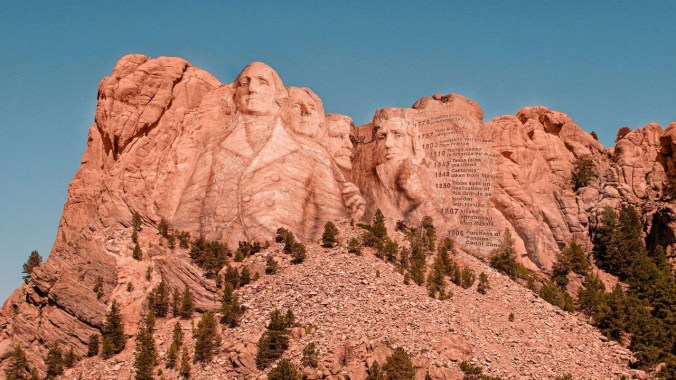
By that time the rough contours of Washington’s iconic image had already emerged from the rock but Borglum had even bigger plans for the entire site, as this digital image of the monument depicts. For the massive inscription with a timeline of key dates in America’s development meant to go alongside the portraits, Borglum had one writer in mind. At a time when there was no shortage of good wordsmiths, the one Guzton wanted for the entablature could bend with apparent ease the mighty power of words like few could. He had demonstrated the superlative ability to tersely and pithily say volumes in just a few short sentences..and to say it well. That man was, yet again, Calvin Coolidge.

He was to write brief descriptions of the key dates to be carved and did so but then the project hit a number of snags. Of course, there were challenges presented by the composition of the rock but other difficulties doomed Cal’s further involvement. The press failed to help matters by misreporting the content and scope of what was perhaps the greatest writing assignment for a memorial a President had ever been given. But it was Borglum’s revision and the media’s “correction” of Coolidge’s words (factual mistakes he had taken care not to make that Rushmore’s visionary introduced to the former President’s text) that convinced Cal to sign off before it got worse. He always did have a good sense about the merits of men and effort.

Found in the personal files of President Coolidge are the original words, as he wrote them, wonderfully recounted by Daniel J. Heisey in the 1987 issue of “The Real Calvin Coolidge.” Cal, writing with an emphasis on the four Presidents Borglum intended to feature on the Mount, begins with what started it all (both his birthday and America’s):

Declaration of Independence

1776 – Our Continental Congress Proclaimed to the World Jefferson’s Immortal Phrasing of the Right to Life, Liberty and the Pursuit of Happiness. By the Declaration of Independence Our Fathers Conceived a Nation Dedicated to the Preservation of Equal Human Rights.

Constitution

1787 – The People of the United States Led By Washington, Father of His Country, Framed the Constitution Under the Inspired Provisions of which We have Enjoyed the Blessings of Peace and Prosperity and Our Integrity as a Nation Has Been Maintained.

Louisiana Purchase

1803 – The Louisiana Purchase Doubled Our Area, Assured for US the Mississippi and Tributaries, Added to Our Resources, Started Territorial Expansion, Solidified the West, Increased Powers of Central Government and Determined Flexibility of the Constitution.

Florida

1819 – Cession of Florida By Spain, Followed by Monroe Doctrine in 1823.

Texas

1845 – Annexation of Independent Republic of Texas as Our Largest State, Realizing Dream of Sam Houston. Fixed Rio Grande as International Boundary, Protecting US from Foreign Influence. Brought Back into Union Many Colonists. Increased Solidarity of West.

Oregon

1846 – By Peaceful Agreement with Great Britain Northern Boundary of Oregon Area Fixed at Latitude 49°.

California

1848 – Acquisition of California and New Mexico from Mexico Following Proclamation of Peace Completed Pacific Shore Line to Match Atlantic.

Alaska

1867 – Purchase of Alaska First Acquisition of Exterior Territory.

Panama

1904 – Roosevelt Acquired Zone for and Began Construction of Panama Canal, Fulfilling Vision of Columbus and Giving US Short Water Route Between Eastern and Western Coasts.

Solidification Under Lincoln

(Date ?) Lincoln’s Great Ability and Humane Wisdom Preserved Our Nation and Brought About Its Rebirth and Solidification.

Here it is, Coolidge friends, the monument that might have been. Next time you go to Rushmore, give a thought to the silent influence of #30 and recall that not every man of granite can be seen on its face.
MonumentUSA6-1

Siena College US Presidents Survey, 2018

Picture4-652x437

Since 1982, about the time that Reagan had replaced the portrait in the Cabinet Room with that of Calvin Coolidge, Siena College in New York State has conducted a survey of various scholars and historians asking them to rate the Presidents of the United States along a broad range of factors and qualities. In what is the sixth and just released survey, 157 participants took part assessing the forty-four men who have served, ranking them along twenty categories of attributes, abilities and accomplishments on a scale of 1 (poor) to 5 (excellent). The results, for the first time in Siena rankings, have found George Washington in first place. Other findings are equally as surprising since the last survey in 2010.

No different from many of the surveys that have been done through the years by different institutions, this latest also reflects a number of assumptions in favor of those who have ostentatiously wielded Presidential power in the twentieth century. It is to be expected that those who have held the Office in the recent memory of any survey’s participants should hold a more pronounced place in the rankings. It is simply human nature to do so. This is partly what makes the Presidential rankings game so appealing because it offers this instructive mirror to our assessments and valuations of leadership. It is not so much history then as how history is interpreted and perceived at a given time. Taken together over the last thirty-seven years, the Siena rankings follow the interesting ebb and flow in several respects of the American electorate, with equally insightful deviations. The 1994 survey, the year Republicans took back the Congress after forty years of Democratic Party majorities, reflects that kind of reaction: downgrading a type of Republican perceived to be weak, middling, and passive (like Ford and Bush 41) while boosting activist Presidents in both parties (like Nixon and LBJ). Naturally, the most recent survey has seen boosts for those contemporary but increasingly reappraised Chief Executives, again Ford and even Carter in categories like Integrity. Taft’s ascendance in that category of the 2018 Survey is one of the most overdue surprises in the results.

None of the categories, as confirmed by Dr. Donald Levy, Director of the Siena College Research Institute, were defined for the participants, leaving each to define the terms for him or herself.

doris-ulmann-portrait-of-president-calvin-coolidge-[and]-------variant-portrait-of-coolidge-[ca -1924]

Photo by photographer Doris Ulmann, 1924.

When we zero in on three categories through the years: Luck, Integrity, and Avoid Crucial Mistakes, we find high marks for Calvin Coolidge. Much has been said over the years about “Coolidge Luck.” It baffled contemporaries. It was often an attempt to account for Coolidge’s remarkable ability to rise beyond numerous challenges and become one of the most popular Presidents in history, in defiance of just about every conventional precept believed necessary for life in politics. According to those norms, he never would have reached the White House let alone been elected in his own right or achieved so many policy goals once he got there. In that category, Coolidge has actually dropped in the rankings over time as recognition, we believe, of the realization that the results Cal attained were not merely due to sheer chance. Instead, they were the product of extensive preparation. As biographer Robert A. Woods would observe, “Calvin Coolidge went through a more consistent and complete preparation for the presidency than any previous incumbent of the office.” Coolidge himself would put it this way, humbly attributing his rise to a combination of unseen years of hard work that gave him the qualifications to be ready when the need for leadership came his way:

Surprisingly few men are lacking in capacity, but they fail because they are lacking in application. Either they never learn how to work, or, having learned, they are too indolent to apply themselves with the seriousness and the attention that is necessary to solve important problems.

Any reward that is worth having only comes to the industrious. The success which is made in any walk of life is measured almost exactly by the amount of hard work that is put into it…

Had I been chosen for the first place [in 1920], I could have accepted it only with a great deal of trepidation, but when the events of August, 1923, bestowed upon me the presidential office, I felt at once that power had been given me to administer it.

A correspondent for the Minneapolis Tribune connects his luck with both work and integrity when he wrote, “What is called Coolidge luck is the result of a character strong and sturdy, a New England conscience and will. He did not shine out, on account of excessive shyness, mistakenly thought to be reserve and coldness. Opportunity knocked — he was there, and all these qualities came out in splendor. Without the guide of precedent, taking the initiative in one of the most unusual and trying situations, he laid a course so representative of the common will that he apparently reached fame in a day. But conscience, virtue, and courage do not grow overnight.”

CC with fedora 1925

Like Coolidge’s integrity itself, his ranking in that category has remained solid. This is all the more impressive as others have moved around widely since 2010 and in the intervening years following 1982. It is also perhaps one of the most subjective categories in the Survey, especially since no standard definition has been presented for the participants by Siena College. Nevertheless, as firm as granite, Coolidge integrity, defined by Oxford English Dictionary, remains “whole and unified,” an undeviating practice of consistent honesty and moral uprightness.

The third category, Avoid Crucial Mistakes contains some of the most interesting rankings across the six surveys. Here, Washington has remained fixed at the top. It seems participants over the years agree with Calvin Coolidge that our first President never made a mistake. Coolidge began at #11 in 1982 but has come down in the estimation of participants since that time. Since Cal has not actually made any errors of judgment or embarrassing gaffes over the last forty years, this category is one of the most revelatory for drastic flux, not only for Coolidge but for Cleveland and Taft, Chief Executives who remain in the middle-of-the-pack overall but are experiencing noticeable shifts in perception since 1994.

CC-8-14-1923

Photo credit: Library of Congress.

When all has been said, we know this is by no means the final word on Presidential Rankings but it contributes new fuel (some might say, kindling) for the ongoing debate on good leadership and how we view it.

But, as indicated by Washington’s return to the top, this signals a step in the right direction for Presidents who embody greater principles than the unrestrained personalities who defined so much of the twentieth century. It is a move back to self-control and restraint in our leaders, a nod for Presidents who prioritized character above power and personal discipline over prestige. Washington set the pattern that Coolidge, Taft and Cleveland, among others, would follow, placing service over self and the betterment of the whole country against that of party or politics. It is thus encouraging to see a return to the fountainhead of these virtues and we look forward to seeing it continue. It is wholesome that the discussion keep going and we welcome the ongoing reappraisal of Presidential worth, holding this reminder always in view:

It is a great advantage to a President, and a major source of safety to the country, for him to know that he is not a great man. When a man begins to feel that he is the only one who can lead in this republic, he is guilty of treason to the spirit of our institutions.

Calvin Coolidge, Us President 1923