While the latest claim making the rounds of academic circles touts the return of a wealth gap between the richest and poorest not seen since… you guessed it, the time of Calvin Coolidge, namely the year 1928, it falls short of what is actually going on now and what was happening then. The case of Picketty, Saez and Zucman, relying on a couple statistics on which to build an entire template of interpretation, omits the full picture in order to make their argument. Predating the welfare state, as Burtless observes, and discounting the role of a very different governmental social and tax policy in place today, the claim stripped of its scholarly veneer falls more into the realm of policy recommendation, even historical wishful thinking, than an accurate comparison to the supposedly greedy, wasteful and vapid “Gatsby” Twenties.
The following charts illustrate a fuller sense of the people behind America’s wealth in the Twenties. It was the last time a sustained growth was paired with fiscal discipline and the combination made for an exceptional progress reaching into even the poorest neighborhoods in the land.
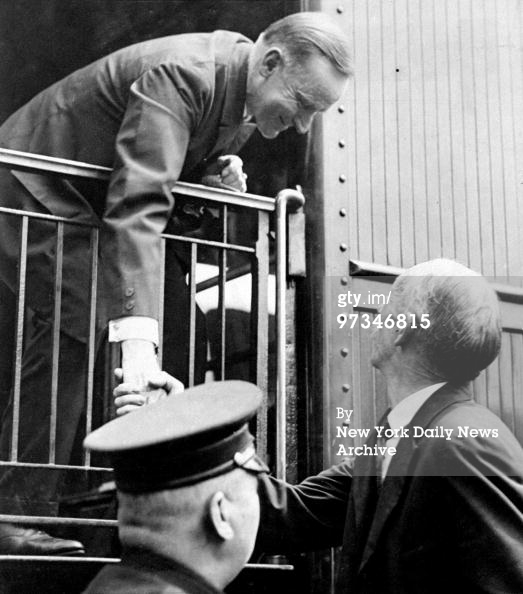
Coolidge shaking hands with a fellow citizen, as he boards a train for New York, February 3, 1924. Courtesy of Getty Images.
Coolidge, ever aptly, places this key distinction between then and now, in perspective. The wealth of America belonged to the people. It was not a flagrantly rich few exploiting the Ninety-Nine percent, it was a nation of owners, millions experiencing opportunity and higher living standards than Americans had ever known before. It was no less real because more regular folks were buying stocks on margin or engaging in installment purchases as the decade came to a close. Coolidge’s constructive economy enabled less money be taken for government, and more kept in the hands of people to save, produce, risk, and consume, as they saw fit. Just as the roar of the decade began to ramp up, he declared, “Our country is an exceedingly good example of the fact that if production be encouraged and increased, then distribution fairly well takes care of itself. Other countries, by their actions in stopping production, in penalizing industry and economy, and rewarding indolence and extravagance, have been able to bring about a very general and equal distribution of misery, but no other country ever approached ours in the equal and general distribution of prosperity” (June 19, 1923). By 1928, in his last annual message, he would note without hyperbole, “The country is in the midst of an era of prosperity more extensive and of peace more permanent than it has ever before experienced. But, having reached this position, we should not fail to comprehend that it can be easily lost…The end of government is to keep open the opportunity for a more abundant life. Peace and prosperity are not finalities; they are only methods. It is easy under their influence for a nation to become selfish and degenerate. This test has come to the United States. Our country has been provided with the resources with which it can enlarge its intellectual, moral and spiritual life. The issue is in the hands of the people.” Finally, in retirement, Coolidge maintained the soundness of ownership by the people, writing in 1932, “If there is anything to criticize about the property rights of this country it does not seem that it can be claimed they have been too exclusive. Whatever advantages they carry have been open to all the people. When we examine the development of modern business we find the great corporations. But they are no longer the property of a few large stockholders. They are divided up into shares so numerous as to be beyond comprehension, by which the people at large can and do become owners and partners in these enterprises…” The Twenties had proven the proliferation of ownership to levels not known before. This work would continue but only after many hard years learning the truth of Coolidge’s warning in 1928: the spiritual and moral must come first. Responsibility accompanies prosperity.
To compare the gap between rich and poor, closing in Coolidge’s day, to the widening distance underway now hardly defines how dire conditions are — inferring we are in for another decade like those obviously disastrous and failed Twenties (wink, wink). We all know it is bad now, Saez seems to say, but it is simply a throwback to those despicable Twenties when the “filthy rich” owned everything off the backs of the “regular guy.” Saez and company conveniently avoid the high tax burden progressively placed upon those comprising the top quarter of income earners while the lowest incomes paid little or nothing at all. Never mind that this latest criticism of the wealth gap implicitly blames the Obama administration. To paint with so broad a brush about the past, leaving out essential particulars, is but the latest attempt to malign the genuine accomplishments of the Coolidge Era with a prejudiced correlation to our current situation. It may be a comforting reaffirmation to academia, but it is hardly a faithful appraisal of what Burtless, Steinbaum, Samuelson, and many more, know the Coolidge years teach.
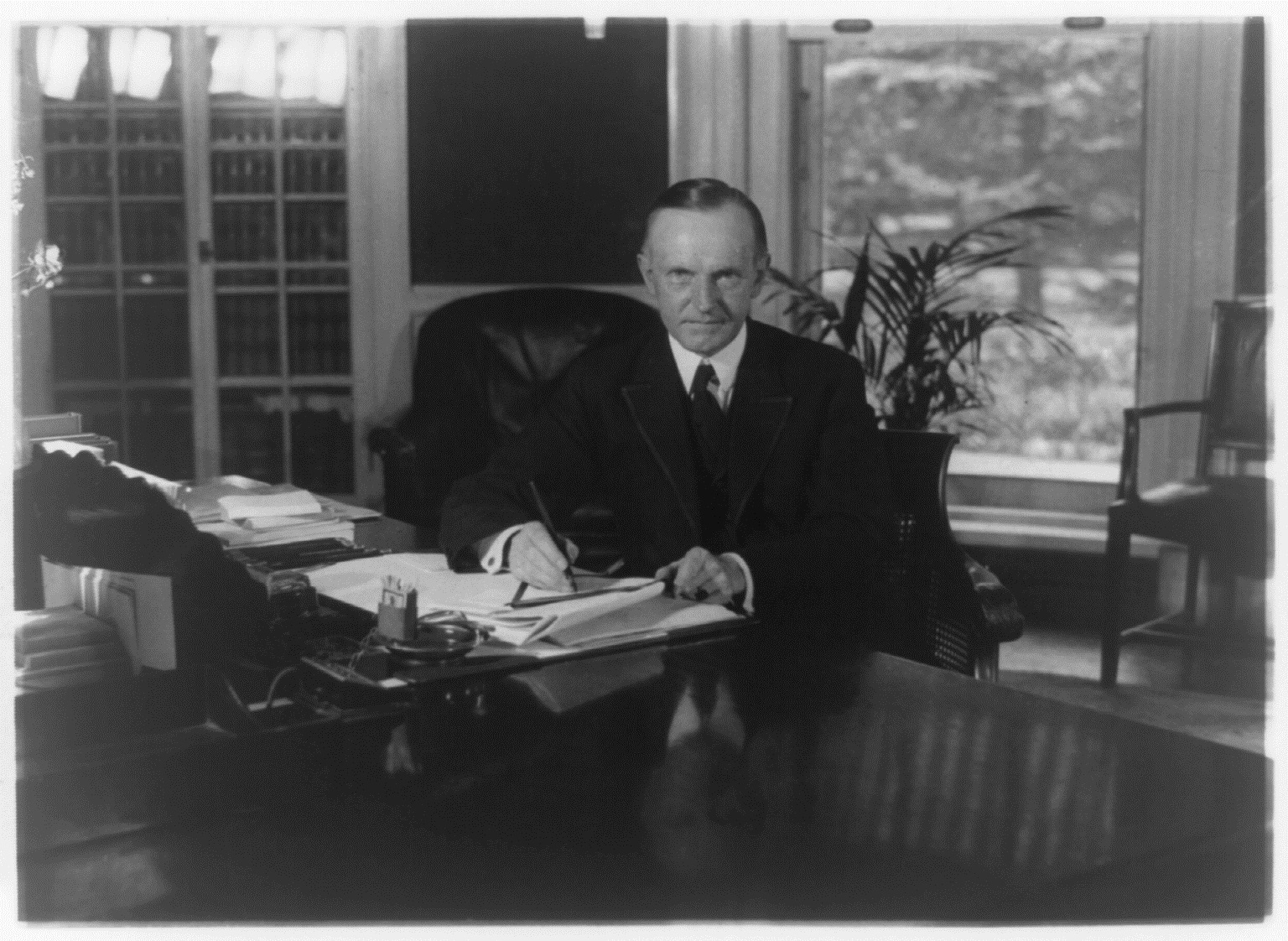
The President working at his desk, August 1923.

 The Importance of the Obvious