On Bigotry

CC portrait by Underwood 001

“Our country has many elements in its population, many different modes of thinking and living, all of which are striving in their own way to be loyal to the high ideals worthy of the crown of American citizenship. It is fundamental of our institutions that they seek to guarantee to all our inhabitants the right to live their own lives under the protection of the public law. This does not include any license to injure others materially, physically, morally, to incite revolution, or to violate the established customs which have long had the sanction of enlightened society.

But it does mean the full right to liberty and equality before the law without distinction of race or creed. This condition can not be granted to others, or enjoyed by ourselves, except by the application of the principle of broadest tolerance. Bigotry is only another name for slavery. It reduces to serfdom not only those against whom it is directed, but also those who seek to apply it. An enlarged freedom can only be secured by the application of the golden rule. No other utterance ever presented such a practical rule of life” — President Calvin Coolidge, Third Annual Message, December 8, 1925 (Supplement to The Messages and Papers of the Presidents, p.9537).


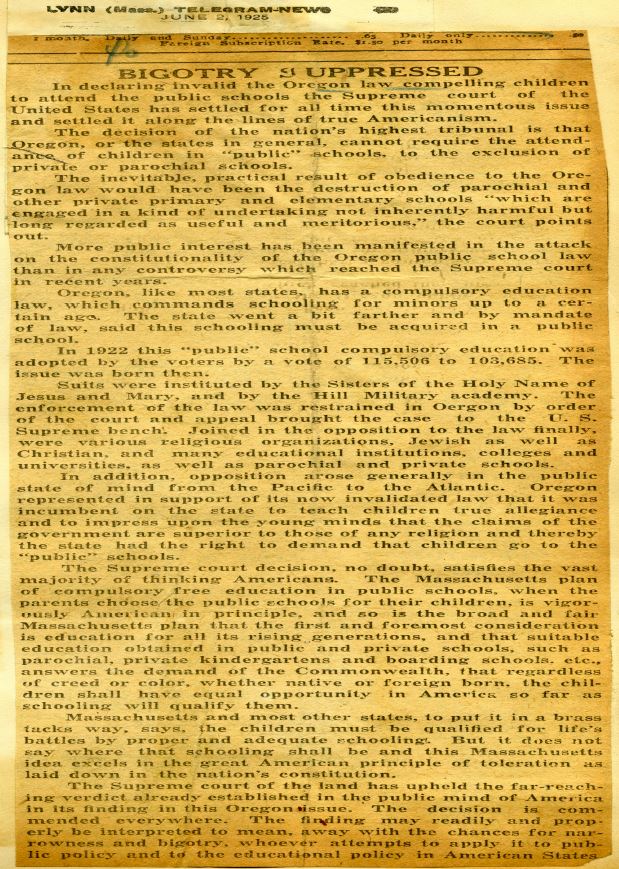
News piece appearing in the Lynn Telegraph-News from the same year as Coolidge's words here.

News piece appearing in the Lynn Telegraph-News from the same year as Coolidge’s words above. Courtesy of the Catholic University of America.

On School Choice and the Federal Role in Education

Calvin Coolidge, November 1921

Calvin Coolidge, November 1921

It is interesting to note that a number of states are considering a significant, and I would add, overdue change to the funding of education — giving the funds to parents. This raises the question of what would Coolidge think? We do not have to wonder very much, he told us.

When President Coolidge took up his predecessor’s call for a Cabinet-level Department of Education, he did not envision the pervasive reach of Washington into the daily operation, assignment of students, selection of curricula or the countless ways in which dollars from the Public Treasury purchase increasingly centralized control. In fact, he made it clear he opposed such a development. All these concerns were the responsibility of each state and local district unhampered to innovate, tailor its work to the needs of the students, parents and neighborhood, freed to not simply relate trivia but instill character and what made good citizenship. What he had in mind was not the current federal Department of Education, but rather a kind of information desk, where Americans all across the country could go to learn better methods, teaching techniques, and obtain help through the insight of others’ experiences in order to facilitate not the needs of Government but for Government to serve the needs of its employers, the American citizen and payer of taxes. This dovetailed with his belief in a Constitutional amendment to restrict child labor which, after approval by the Congress, fell short of the necessary two thirds of the states for ratification. Coolidge was not endorsing indolence among children, he pressed for both measures so that kids would not be forced to work the factories, mills and offices for their families, when they could instead be capitalizing on opportunities to educate themselves and thereby become better men and women, improved employers and employed, and more prepared for the work of tomorrow. While most of the country did not agree with either of his positions, however prescient his proposals were, most saw little harm coming from children learning a work ethic from early age, as his own boys did, Coolidge had a principled basis for his position.

He explained his views this way before the Convention of the National Education Association as it met in Washington, July 4, 1924,

“The encouragement and support of education is peculiarly the function of the several states. While the political units of the district, the township, and the county should not fail to make whatever contribution they are able, nevertheless, since the wealth and resources of the different communities vary, while the needs of the youth for education in the rich city and in the poor country are exactly the same, and the obligations of society toward them are exactly the same, it is proper that the state treasury should be called on to supply the needed deficiency. The state must contribute, set the standard, and provide supervision, if society is to discharge its full duty, not only to the youth of the country, but even to itself.

     “The cause of education has long had the thoughtful solicitude of the National Government. While it is realized that it is a state affair rather than a national affair, nevertheless, it has provided by law, a Bureau of Education. It has not been thought wise to undertake to collect money from the various states into the National Treasury and distribute it again among the various states for the direct support of education. It seemed a better policy to leave their taxable resources to the states, and permit them to make their own assessments for the support of their own schools in their own way. But for a long time the cause of education has been regarded as so important and so preeminently an American cause, that the National Government has sought to encourage it, scientifically to investigate its needs, and furnish information and advice for its constant advancement. Pending before the Congress is the report of a committee which proposes to establish a Department of Education and Relief, to be presided over by a cabinet officer. Bearing in mind that this does not mean any interference with the local control, but is rather an attempt to recognize and dignify the importance of educational effort, such proposal has my hearty endorsement and support…

     “While I believe that educators are under obligation to expend public funds economically, it seems obvious that the recent increase in expenses for this purpose is a most wise investment. It is impossible to conceive that there should be any increase in agricultural products in the production of manufactures, or any other increase in our material wealth, through ignorance. The reaction to using the resources of the country to develop the brains of the country through education has always been greatly to stimulate and increase the power of the people to produce.”

Outlining his thoughts before the Joint Session of Congress through his Annual Message the previous December, the President went further,

“Having in mind that education is peculiarly a local problem, and that it should always be pursued with the largest freedom of choice by students and parents, nevertheless, the Federal Government might well give the benefit of its counsel and encouragement more freely in this direction. If any one doubts the need of concerted action by the states of the nation for this purpose, it is only necessary to consider the appalling figures of illiteracy representing a condition which does not vary much in all parts of the Union. I do not favour the making of appropriations from the National Treasury to be expended directly on local education, but I do consider it a fundamental requirement of national activity which, accompanied by allied subjects of welfare, is worthy of a separate department and a place in the Cabinet. The humanitarian side of government should not be repressed, but should be cultivated.”
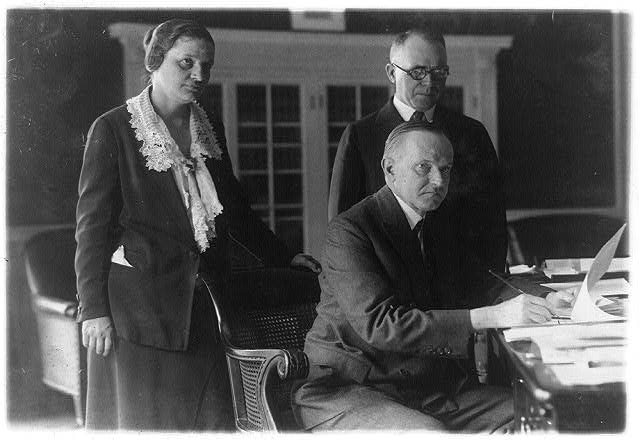
President Coolidge collaborating with Assistant Attorney General Mabel Willebrandt and Representative Israel M. Foster on child labor and education policy, June 7, 1924. Courtesy of the Library of Congress.

President Coolidge collaborating with Assistant Attorney General Mabel W. Willebrandt and Representative Israel M. Foster on child labor and education policy, June 7, 1924. Courtesy of the Library of Congress.

On Coolidge, Cleveland, Kipling, and Fish Stories

Courtesy of Fold3.com.

Cal, after the Presidency, indulging his love for fishing. Courtesy of Fold3.com.

“With worms you played more fairly with the trout. You offered him what he wanted most. You bet a worm and he wagered himself. If the trout lost, he usually had the worm, or most of it, not just a mouthful of deception to add bitterness to surrender. Fly-fishing, comparatively, was a cheap fraud in which the victim staked his all against an utterly inedible jigger that looked like something it wasn’t. The trout could not possibly gain anything; he could lose everything on nothing more estimable than vanity. The sole death-bed comfort he possibly could derive was the knowledge that he had been hooked by a purist. It is easy to understand why a politician might come to prefer flies” — Frederick Van de Water, In Defense of Worms and Other Angling Heresies (New York: Duell, Sloan and Pearce, 1949), pp.71-72.

“…[I]t perhaps adds to the spirit and emphasis of our dissent when we are told that fly-casting for trout is the only style of fishing worthy of cultivation, and that no other method ought to be undertaken by a true fisherman. This is one of the deplorable fishing affectations and pretenses which the sensible rank and file of the fraternity ought openly to expose and repudiate. Our irritation is greatly increased when we recall the fact that every one of these super-refined fly-casting dictators, when he fails to allure trout by his most scientific casts, will chase grasshoppers to the point of profuse perspiration, and turn over logs and stones with feverish anxiety in quest of worms and grubs, if haply he can with these save himself from empty-handedness. Neither his fine theories nor his exclusive faith in fly-casting so develops his self-denying heroism that he will turn his back upon fat and lazy trout that will not rise” — former President Grover Cleveland, “Some Fishing Pretenses and Affectations,” in Fishing and Hunting Sketches (New York: Outing Publishing, 1907), pp.122-123.

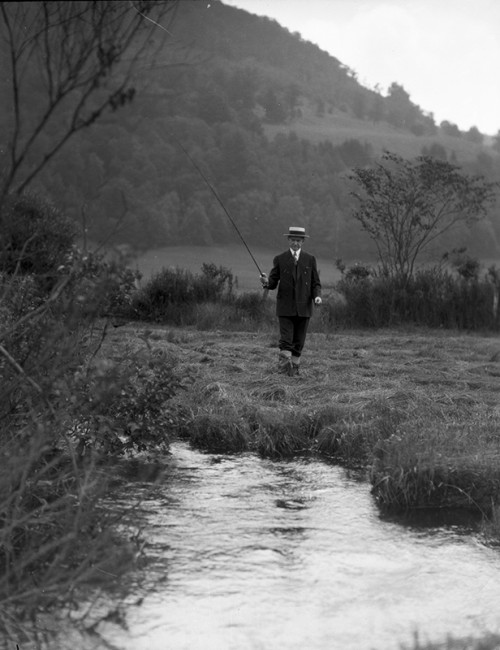
President Coolidge fishing one of his frequent spots.

President Coolidge fishing one of his frequented rivers. Courtesy of Yankee Magazine.

When it was discovered that the President used worms rather than flies when he went fishing in the Adirondacks, as he had done all his life, some “professional” fly-casters were appalled. It should be beneath the dignity of the President, they huffed. A few among the press even encouraged the sensationalism with stories recounting this supposed affront to the sport of fishing. Coolidge and his regular fishing partner, Secret Service man Edmund Starling (who introduced Cal to fly-fishing), knew better, as did most of those who practiced the noble sport. It was much ado about nothing for anyone aware of the joy and challenge found along countless streams, rivers and waterways. Bait fishing was the sport at its most fundamental, removed of all pretense or snobbery. It relied not on the sophistication of equipment or the scientific precision of the caster but on the simple gambit that occurs whenever human nature matches wits with fish. Through bait fishing, the challenger swimming at the other end of that line and rod was rewarded not with empty promises or mere guile and deception but with a return for its efforts, should it elude capture. This showed a natural respect for the fish as well as a human’s place in nature. Surrounded in the majesties of the outdoors, it only made common sense for men who lived simply, as Coolidge did, free of ostentation, vanity or the need to impress others, to fish consistently with that manner of life. It lived in step with nature not against it. Just as Frederick Van de Water and Grover Cleveland put it, the fly-caster may look down on bait fishing but when the best cast fails and the fish refuse to fall for the fly, all default to good bait. The simple forthrightness of this truth strips the veneer off a politician’s guarantees just as effectively as a fly-caster’s attitude of superiority over his method.

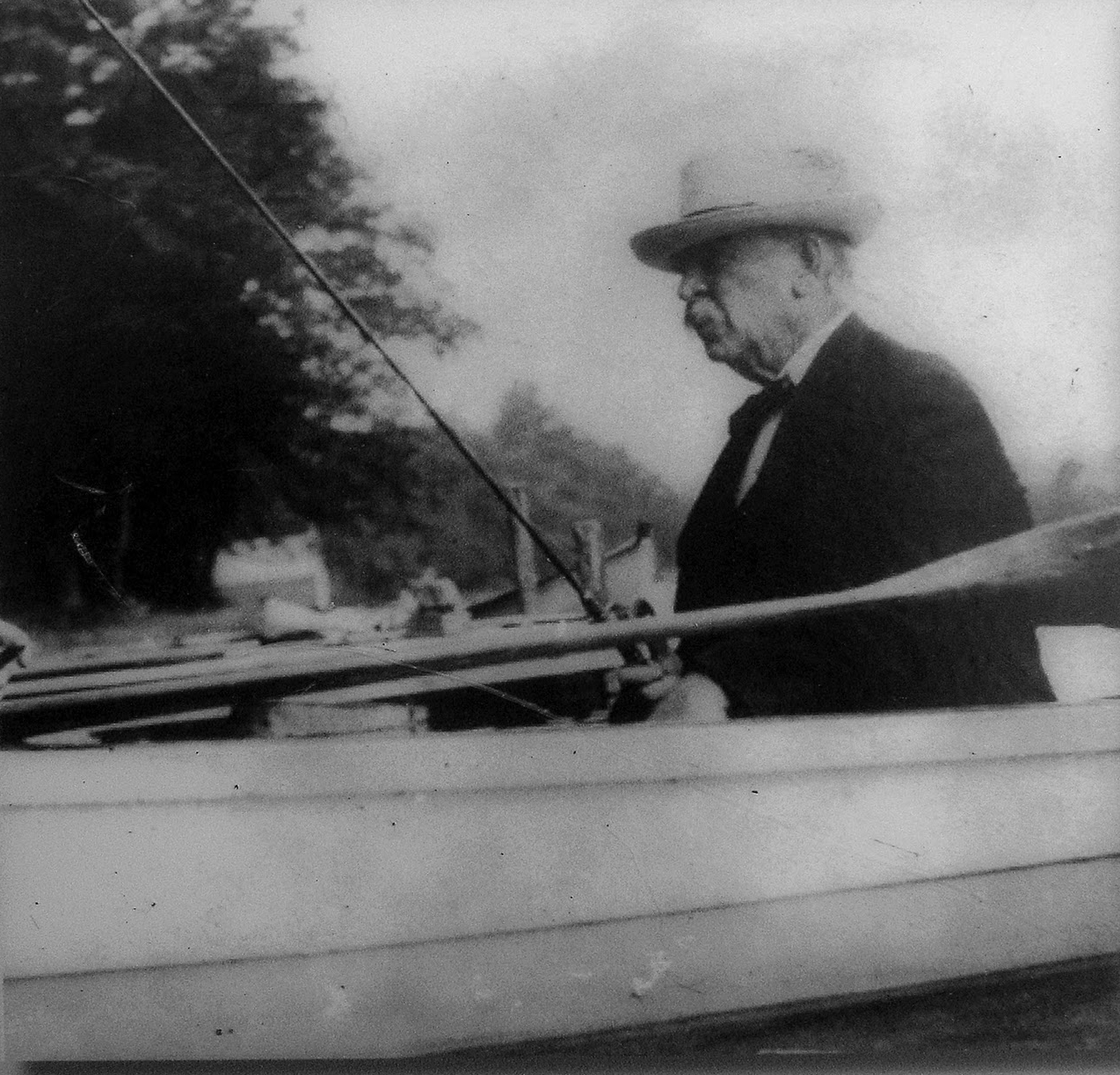
Former President Cleveland fishing one of his favorite spots.

Former President Cleveland fishing one of his favorite spots.

Mrs. Coolidge, in her Autobiography, recounts three favorite memories of her husband’s fishing experiences, the first of which revealed Mr. Coolidge’s previously untapped fascination with the art and sport. It started the summer of 1926 in the Adirondacks. She writes, “It was here that the President took up the serious business of fishing, and with the success which usually attends his efforts, for we served a fish course at luncheon every day.” Sometimes in search of pike or pickerel, he usually went fifteen miles away in the quest for trout. “Enthusiasm for the sport had so taken hold of him that at the close of the fishing season he was reluctant to give it up. He scanned the New York State fish and game laws and learned that while fishing was not permitted in the county in which we were living after the first of September, it was not prohibited in the adjoining county until Labor Day, a fact which was not known to the guide or to the caretaker of the camp, himself an ardent sportsman.” Here it was beneficial to know the gaming laws better than the experts did.

Her second favorite memory unfolded the next year as they stayed at the Game Lodge in the Black Hills of South Dakota. She narrates, “The President took a second summer course in fishing, which resulted in increasing skill. A kind neighbor gave him the exclusive privilege of fishing in a stream which ran through his farm, and many a delicious trout did he bring home for the family dinner. There was one experienced old fellow living in a certain hole, which he tried to attract with every sort of alluring bait, but the finny creature proved wary until in an unguarded moment, on the last day of fishing, curiosity got the best of him and he rose to investigate a salmon egg sandwiched between two worms, only to find himself impaled upon an ugly hook.”

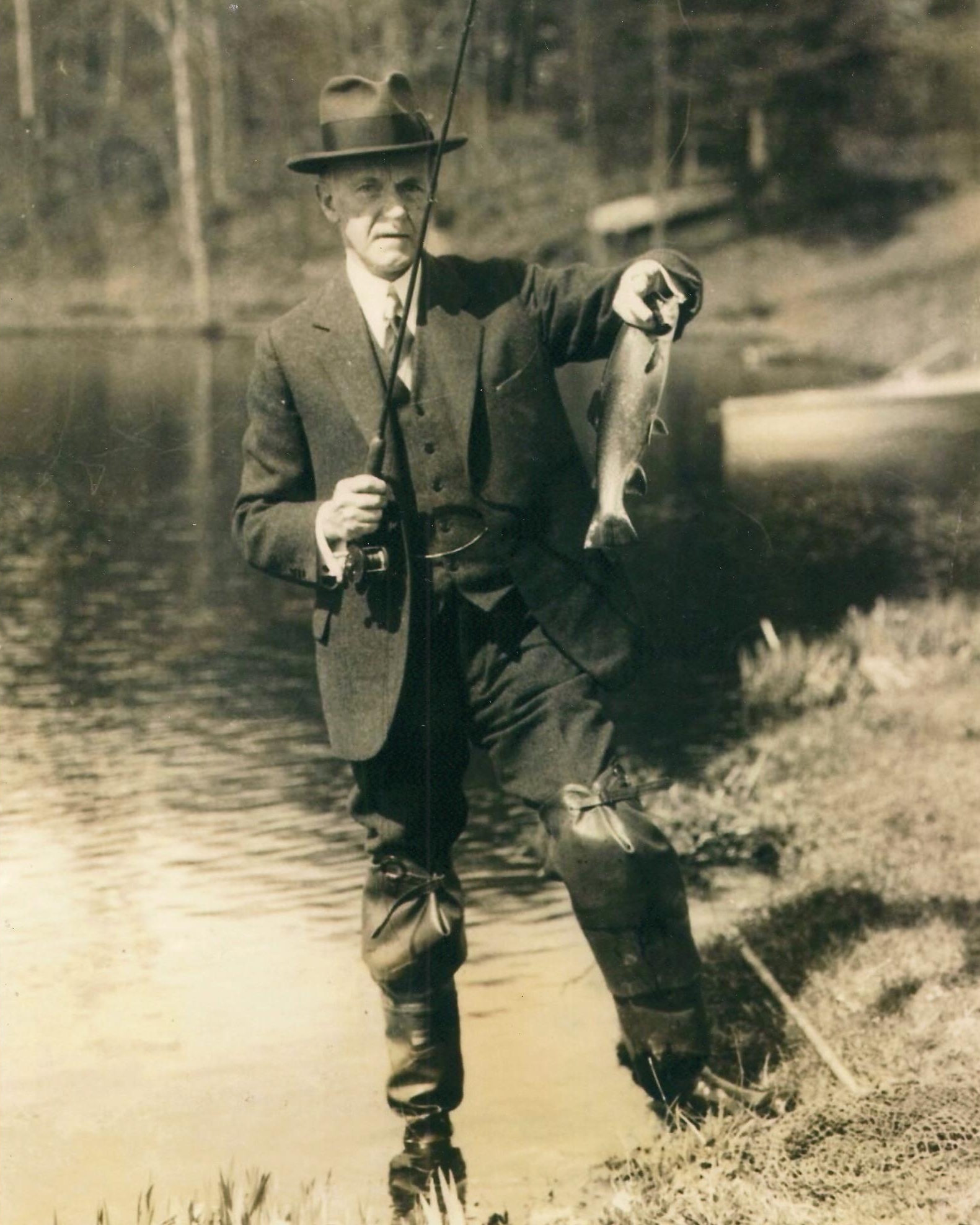
Coolidge held scrupulously to accurate fish stories. He made a point of displaying what he had caught, even documenting it for verification. Here he holds his latest catch up for visual confirmation.

Coolidge held scrupulously to accurate fish stories. He made a point of photographing what he had caught in order to have visual verification. Here he holds his latest catch up for confirmation.

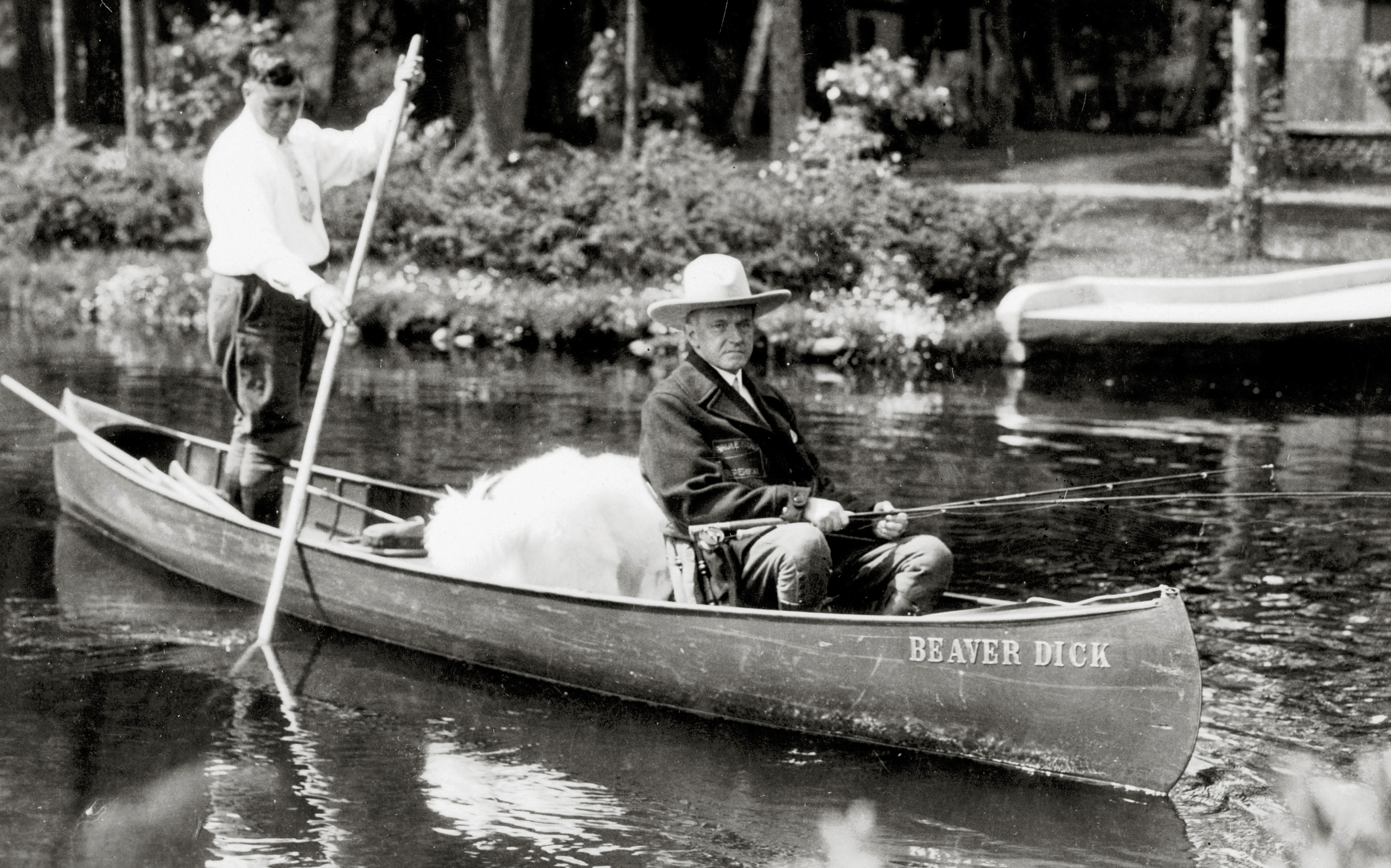
Her third memory came in their last summer before leaving the Presidency, as they stayed on the Brule River in Wisconsin. Their cottage, located on a small island, was accessible from a roughly hewn wooden bridge that spanned the two shores. It was underneath that bridge where President Coolidge met his toughest challenge yet, among “several large trout who were rather tame and looked to us for their daily food consisting of crumbs from the table.” A particular trout, a “very greedy one” (in Grace’s words) was named by the President. He called him ” ‘Danny Deever’ — ‘for,’ said he, ‘I’ll hang him in the morning.’ ” Referencing Kipling’s popular 1890 poem, Coolidge relished not only the play on words but also the dramatic personification of his piscatorial nemesis, as any admirer of literature can appreciate. In the trout’s case, despite repeated efforts to lure him up with “pretty flies” (notice Coolidge was no purist theoretician, using flies and bait as circumstances warranted), Grace kept Danny fed so well that the “hangin’ in the mornin’ ” never took place.

Coolidge, his dog Rob Roy, and his Brule River guide, John LaRock, 1928.

Coolidge, his dog Rob Roy, and his Brule River guide, John LaRock, 1928.

One wonders how many more fish stories might have been told had time and opportunity allowed Mr. Coolidge and his friend Starling to go on that great cross-country fishing expedition they had planned. One thing is sure: Cal would have brought the worms.

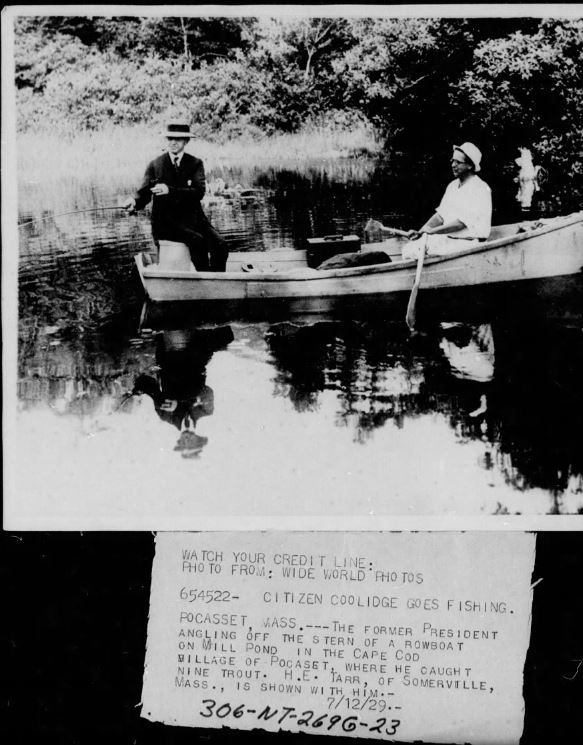
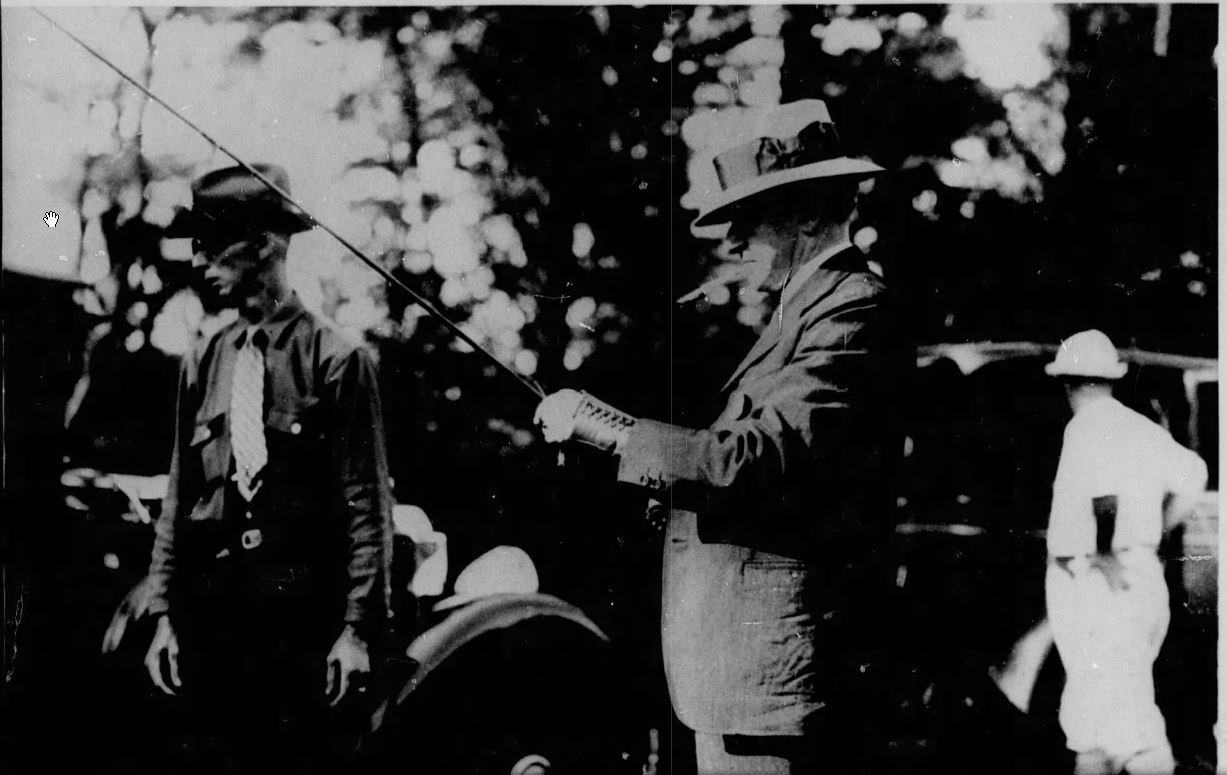
Coolidge preparing for trout, July 19, 1929.

Coolidge preparing for trout, July 12, 1929. Notice the wrist brace: He had sprained it earlier that year.