Check YouTube for our second of twenty “Best of Coolidge” Readings. Keep visiting here as more will come soon.
Coolidge’s Philosophy
On Properly Employing Presidential Rhetoric

“The words of the President have an enormous weight and ought not to be used indiscriminately” — Calvin Coolidge
Few have so fully understood and so wisely practiced the natural limits of the Presidency as did Calvin Coolidge. It is also ironic that as one of those relegated to the category of “weak” Chief Executives, Coolidge actually strengthened the prestige and power of the office by denying the full use of raw executive power. It was not simply that the President can do a thing but should he, especially when the Constitution, the laws, and fundamental rightness recognize the authority belongs to someone else. Both Mr. and Mrs. Coolidge grasped this lesson well, that the roles they bore required an emptying of the self, a kind of servitude to the Office, not simply a remaking of the job around their wishes, aspirations, personality. Certainly both left their indelible impressions on the Presidency and task of First Lady but their duty demanded something higher and nobler than mere individuals being selfish, self-absorbed or self-serving with their public obligations. The President once rebuked his son for casually expecting allowances would be made for him to arrive to dinner late in casual clothes. Not the son of the President, Cal firmly replied. For Coolidge, an adequate measure of formality, not ornate ceremony, befitted the office. Coolidge disagreed with his predecessor Jefferson that such matters as seating be left to perfect egalitarianism. The Office demanded something more, not to the point of the elaborate or ostentatious, but respectful of the dignity and caliber of the Presidency.
This was especially evident in the mark Coolidge left on how to effectively and prudently employ rhetoric. Being the last classically-educated President we have had, Coolidge deftly grasped the challenge of using official verbiage with the proper balance of clarity, brevity, and precision of timing. He knew the dangers of a constant stream of Presidential utterances, diluting the effectiveness of leadership and influence. He knew the threat of a constant praise that fed the President’s ego and would consciously deflate it to escape such a trap.
Above all, he resolved to use the power of words for good, instead of lighting fires of discontent and stirring revolution, he used the authority he had for good, for edification, for restoring peace after so many years of war, discord, deliberately fomented envy.
He explained his careful use of rhetoric, no easy task, cogently when he said,
“It would be exceedingly easy to set the country all by the ears and foment hatreds and jealousies, which, by destroying faith and confidence, would help nobody and harm everybody. The end would be the destruction of all progress. While every one knows that evils exist, there is yet sufficient good in the people to supply material for most of the comment that needs to be made. The only way I know to drive out evil from the country is by the constructive method of filling it with good. The country is better off tranquilly considering its blessings and merits, and earnestly striving to secure more of them, than it would be in nursing hostile bitterness about its deficiencies and faults.”
He was simply infusing the instruction of Romans 12:17-21 into national politics, which says,
“Repay no one evil for evil. Have regard for good things in the sight of all men. If it is possible, as much as depends on you, live peaceably with all men…[D]o not avenge yourselves, but rather give place to wrath; for it is written: ‘Vengeance is Mine, I will repay,’ says the Lord. Therefore ‘If your enemy is hungry, feed him; If he is thirsty, give him a drink; For in so doing you will heap coals of fire on his head.’ Do not be overcome by evil, but overcome evil with good.”
On Inaugurations
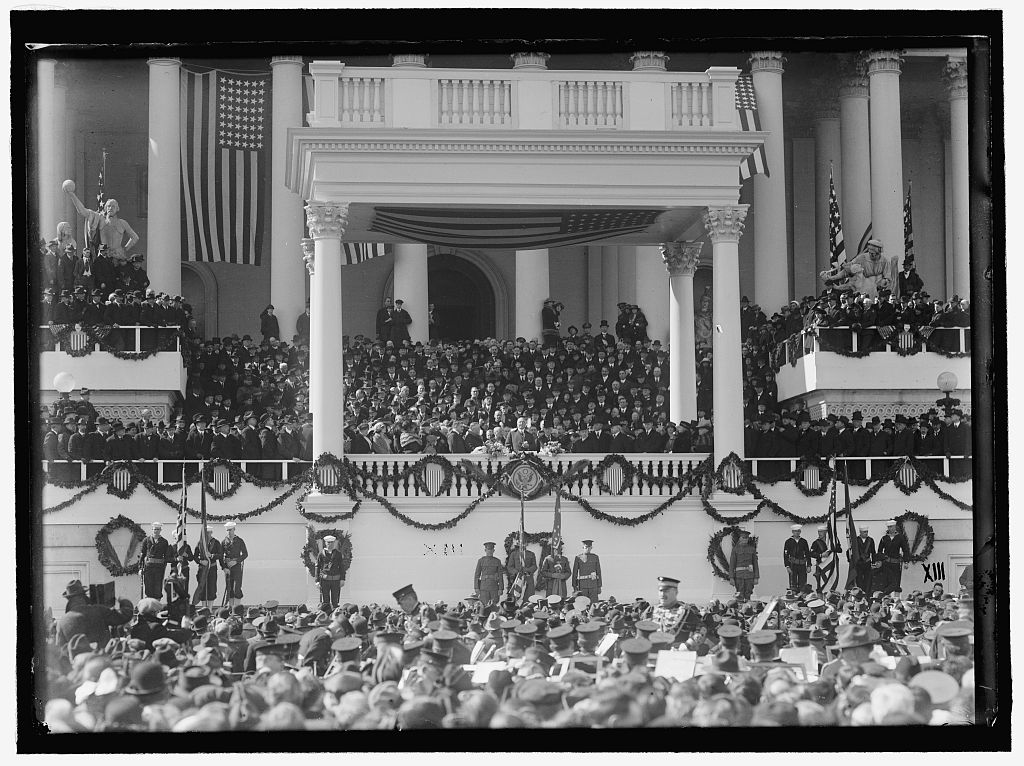
Inauguration Day, March 4, 1921. President Harding can be seen at center of the Inaugural Stand. Vice President Coolidge stands fifth in line of men in top hats to Harding’s left.
When Vice President-elect Calvin Coolidge took part in the ceremonies of March 4, 1921, the day every four years that marked Inauguration Day in this country for one hundred and forty-three years (until the Twentieth Amendment to the Constitution took effect in 1933), he came to the event an old hand to the process of ushering in new administrations. Prior to 1937, Vice Presidents were accorded their own swearing-in ceremony, yet Coolidge saw this as discordant with what should be an esteemed and seamless occasion not the disjointed one he found waiting for him on this day ninety-four years ago. His experience in Massachusetts had been ample training ground for what he would encounter in Washington and, having taken part in so many, he was certainly qualified to analyze the deficiencies of how government transitioned in the national capital. In fact, he found the pomp and circumstance of Federal ceremonies far less impressive than the dignity and respectability present throughout his own state’s inaugurations. He writes in 1929, “As I had already taken a leading part in seven inaugurations and witnessed four others in Massachusetts, the experience was not new to me, but I was struck by the lack of order and formality that prevailed. A part of the ceremony takes place in the Senate Chamber and a part on the east portico, which destroys all semblance of unity and continuity.”
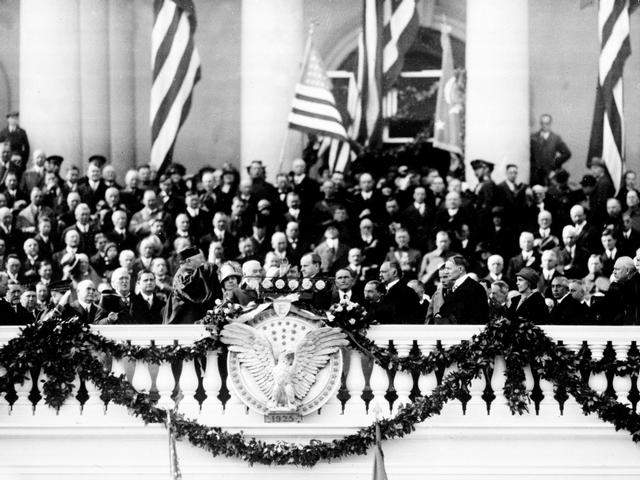
President Coolidge being administered the oath four years later, 1925. The Bible lay open to one of his favorite passages, John 1, which begins: “In the beginning was the Word, and the Word was with God, and the Word was God. He was in the beginning with God. All things were made through Him, and without Him nothing was made that was made. In Him was life, and the life was the light of men. And the light shines in the darkness, and the darkness did not comprehend it.”
He had served in every state office save school board by this time, been inaugurated every year from 1914 through 1920, and had watched the formal installation of Governor Walsh and others during those years. It was another expression of his regard for the importance the states hold in our system that Coolidge dwells on this otherwise overlooked point. Often enough we are absorbed in affairs on the national stage and the importance of our own state and local decisions lose due proportion. We await the President’s next move while what our governors are doing or can do is discounted as somehow less worthy of significance. We neglect our local government, expecting the slack to be taken up by someone at one of those agencies in the Beltway when it was likely up to us in the first place. We look too much upon the powerlessness we feel to effect good results from Washington when we could be realizing the power we have at home, right here in our own state, within our own counties, in our own neighborhoods, and on our own streets. We must take care lest we let government continue to slip out of our grasp and become nationalized in every way. If we do not, one day we will sit shackled with the realization that we could have kept our liberties if only we had insisted decisions remain closest to the people, governance be retained in our hands and self-control starts with self.
Coolidge would go on to be suddenly inaugurated in the middle of the night on August 3, 1923, as word came of the death of President Harding. Sworn in by his own father, a notary public, he would enjoy the distinction not only of being the first on that score but also the first to be sworn in by a former President, then-currently Chief Justice William H. Taft, on this day ninety years ago. It was the practice of Chief Justices White and Taft to recite the prescribed oath in the form of a question, requiring the President to but say, “I do” in commitment to official responsibilities. It is fitting that his final public oath should be so concisely administered, as if to underscore his consciousness of what waste in all its forms costs the people. All together Coolidge took part in ten inaugurations from the Massachusetts General Court all the way to President of the United States, completing a remarkable accumulation of experiences in public service.
For now, however, Vice President Coolidge was on a road of preparation that would take him through the unprecedented attendance in Cabinet meetings, presiding over the Senate, and getting to know the country through a speaking circuit that would span from Maine to California and the Twin Cities to Charleston. It was all equipping him for that solemn night in August 1923. This is why Coolidge focused so intently upon the duties of one office at a time, that he should acquit himself faithfully in small things lest Providence entrust him with greater things. Content to end public life as a small-town Representative, his character, ability, and trust reposed in him by ever-larger electorates raised him to higher and higher obligations. Who can say what mundane and seemingly inconsequential experiences we face now are not getting us ready for something far more important?
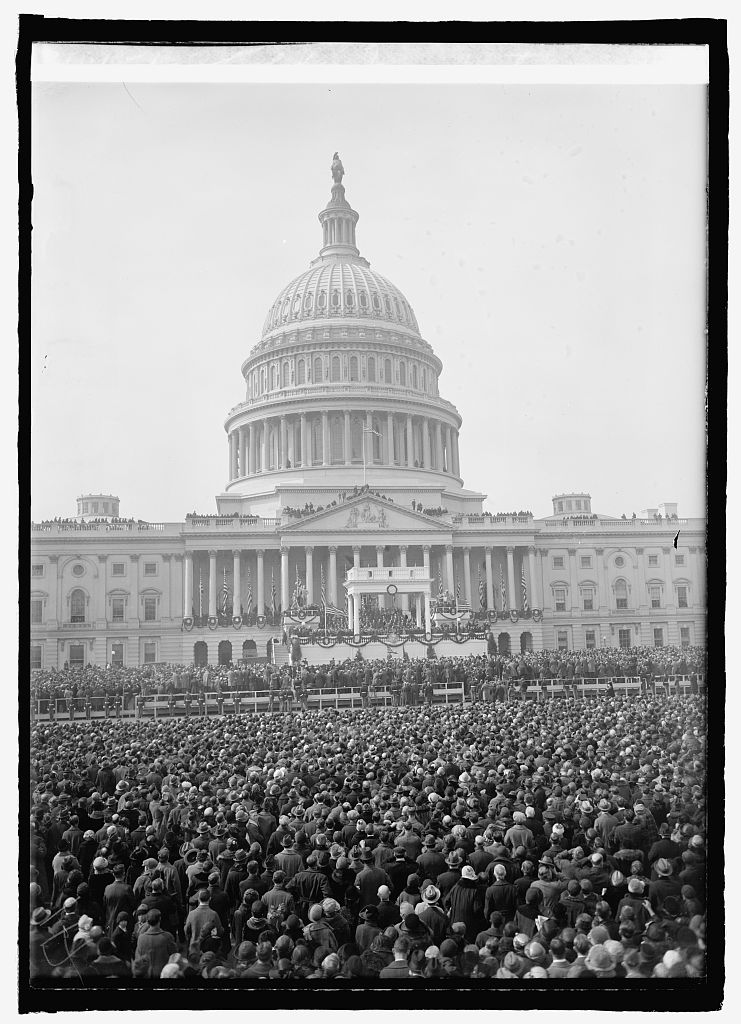
Inauguration Day, March 4, 1925, looking across the thousands gathered to witness the ceremony. Courtesy of the Library of Congress.
 The Importance of the Obvious