On Persistence

Former President Coolidge with Mrs. Coolidge, joined by the owners, operators and designers of Lakeside Inn in the 1930s. L to R: Mrs. F. W. Wentworth, architect Fred W. Wentworth, the Coolidges, Archie Hurlburt, manager of Lakeside, and Mr. and Mrs. Charles Edgerton. The Coolidges stayed in Mount Dora at the Inn from January to February 1930.

Former President Coolidge with Mrs. Coolidge, joined by the owners, operators and designers of Mount Dora’s Lakeside Inn in Florida during the 1930s. L to R: Mrs. F. W. Wentworth, architect Fred W. Wentworth, the Coolidges, Archie Hurlburt, manager of Lakeside, and Mr. and Mrs. Charles Edgerton. The Coolidges stayed in Mount Dora at the Inn from January to February 1930.

The quote featured below by Design Doctor was attributed to Calvin Coolidge for many years, and some still think he authored it. This is likely because it sounds like him, resembling his crisp, one could almost “machine-gun style” of expression. It was even attributed to McDonald’s founder, Ray Kroc, by “Dear Abby” in the 1990s.

The quote originally appeared in the 1910s as recurring filler for magazines and various publications. It is likely there that a young lawyer-legislator named Calvin Coolidge first saw it in print and from there saw it again in New York Life Insurance Company pamphlets, where he served on the Board, during the early 1930s. As for Mr. Kroc, who was but a young boy at that time, likely saw the old quote during any of his many jobs from Red Cross ambulance driver during the Great War to radio disc jockey for WGES. Whether these men ever saw the quote at all is immaterial. They lived its truth. They imbibed its power and turned its incisive observations into very real success. Coolidge would reach the pinnacle of world power in public office before he was sixty. Kroc, on the other hand, would not realize the extraordinary world-wide potential of McDonald’s until after his fiftieth birthday. Yet, both men understand and still exemplify the immense relevance of this statement.

Press On!

Nothing in the world can take the place of persistence.

Talent will not; unrewarded genius is almost a proverb.

Genius will not; the world is full of educated derelicts.

Persistence and Determination alone are omnipotent. The slogan “Press On” has solved and always will solve the problems of the human race.

On “1932”

Coolidge friends, take notice: scholar David Pietrusza’s next book is coming out in August, “1932: The Rise of Hitler and FDR.” We here remember that Coolidge was not merely the sole Republican candidate to defeat FDR as he rose to national office, he took a reluctant part in the campaign to defeat Roosevelt in 1932, reaffirming foundational principles as the bulwark against a spendthrift, cavalier approach to governance. Speaking to thousands gathered at Madison Square Garden, Cal had both resisted a movement to draft him for President again and an effort to recruit him for a more active role on Hoover’s behalf. He refused both for very principled reasons. As we know from years before, he was no fan of his successor and yet the lesser of two evils required he speak on behalf of Republican principles. It was his last public appearance. Coolidge, confessing to friend Henry Stoddard, already knew he was living in a time to which he no longer belonged. He would be gone by the next year. Yet, while life remained in him, he would exert himself one final time to speak of fundamentals.

Just as Mr. Pietrusza’s “1920” revealed a compelling account of the personalities and lessons of that Presidential election year, “1932” will not disappoint.

Coolidge addressing the multitude and millions more via radio, on Republican principles at Madison Square Garden in New York, October 11, 1932. Courtesy of Corbis.

Coolidge addressing the multitude and millions more via radio, on Republican principles at Madison Square Garden in New York, October 11, 1932. Courtesy of Corbis.

More Favorites from the Leslie Jones Collection

CC and GC rear of train

In August 1924, the Coolidges were comforted by the visit of long-time friendly faces from the days when both served in the Massachusetts General Court, Colonel and Mrs. Treadway. Now representing the first congressional district of their state, Colonel Treadway presents the gift of two custom-crafted hay rakes for the President to use on the Homestead.

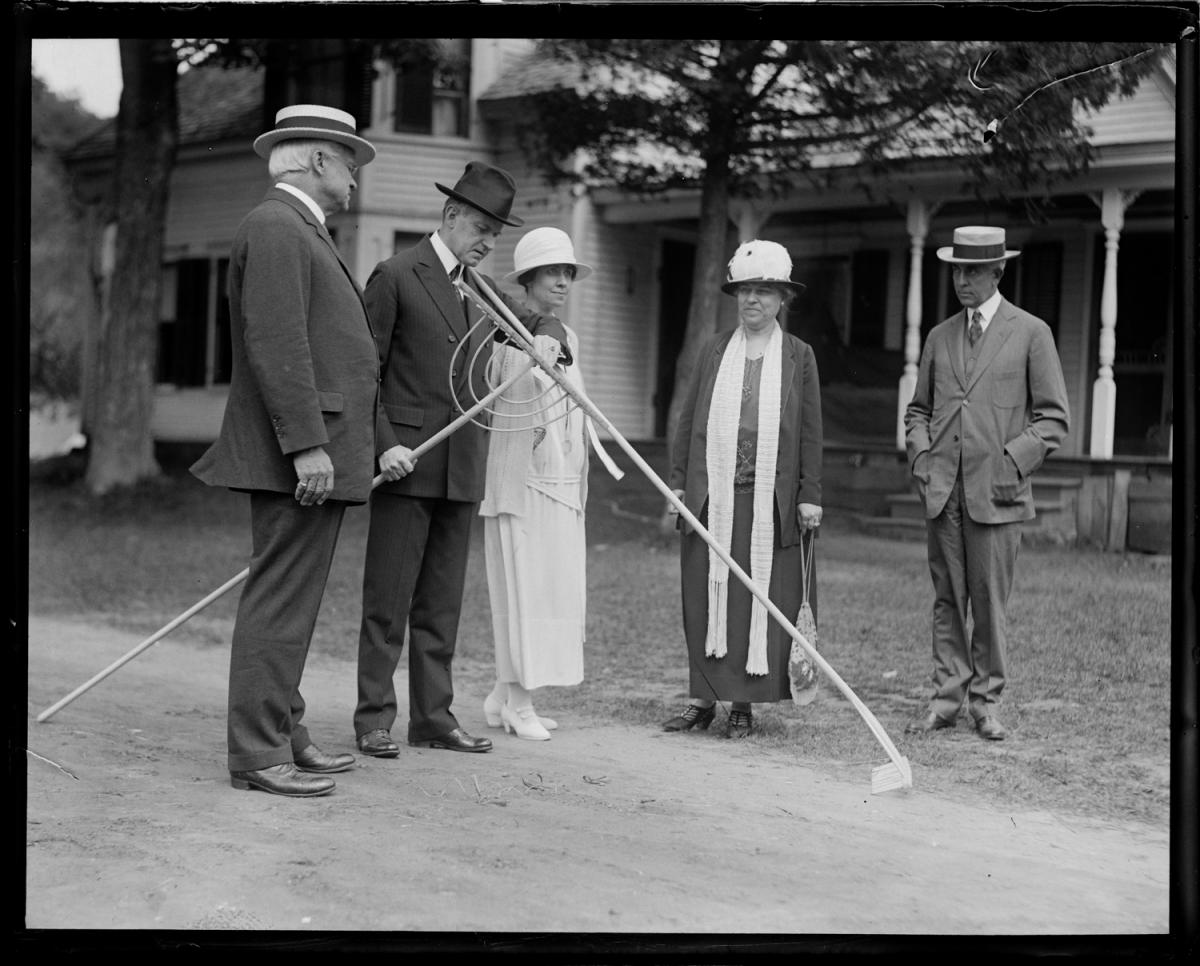
On August 18, 1924, the Coolidges were comforted after the death of their youngest son with the visit of long-time friendly faces from the Massachusetts General Court days, Colonel and Mrs. Treadway. Now representing the first congressional district of their state, Colonel Treadway presents the gift of two custom-crafted hay rakes  made for the President by Marshall W. Stedman of Tyringham, whose family had made rakes for four generations. While Coolidge was disappointed to learn that his father had finished all the raking before he arrived, he was glad to accept such kind expressions of regard. C. Bascom Slemp, secretary to the President, stands to the far right of the group.

President Coolidge examines the quality of the craftsmanship.

President Coolidge examines the quality of the craftsmanship. “These are very fine hand-made hickory rakes,” Mr. Treadway declared. “Ash,” replied Cal, carefully looking over the handles and crosspieces. “The teeth are hickory,” the President amended. He then expressed his thanks.

Coolidge gratefully receives them.

Coolidge gratefully receives them.

They enjoy a few good laughs from jokes told by Mr. Treadway.

They enjoy a few good laughs from jokes told by Mr. Treadway.

The Coolidges enjoy their visit with these friends from Stockbridge.

The Coolidges appreciate this visit from their friends all the way from Stockbridge.

Always considering himself a mere camera-man, Leslie Jones was among the best photojournalists of his era. He helped capture the times in which he lived. His rapport with Coolidge is evident not only through his presence at just about every stage of Cal's Presidency but especially at these quiet moments when the Coolidges could have sought absolute seclusion in their grief. Instead, they turned outward to serve others and include friends like the Treadways and Mr. Jones through it all. Most of the Leslie Jones Collection is digitized and made graciously available online at http://www.lesliejonesphotography.com.

Always considering himself a mere camera-man, Leslie Jones was among the best photojournalists of his era. He helped capture the times in which he lived. His rapport with Coolidge is evident not only through his presence at just about every stage of Cal’s Presidency but especially at these quiet moments when the Coolidges could have sought absolute seclusion in their grief. Instead, they turned outward to serve others and keep open hearts to friends like the Treadways and Mr. Jones through it all. Most of the Leslie Jones Collection is digitized and graciously made available online at http://www.lesliejonesphotography.com.