On Labor

“One of the greatest mysteries in the world is the success that lies in conscientious work…Our country does not believe in idleness. It honors hard work” — Calvin Coolidge, The Autobiography, p.100, 243. America cannot honor the worker and believe in indolence or sloth at the same time. Work is the prerogative of intelligence and measure of civilization, as Cal said, and no nation can embrace idleness and survive.

All future progress will belong to those who honor hard work. Decay and death await both individuals and nations who neglect effort, presuming its rewards will forever come by someone else’s labor. Lincoln knew no house could stand which adopts the regime that says, “You toil and work and earn bread and I’ll eat it. No matter in what shape it comes, whether from the mouth of a king who seeks to bestride the people of his own nation and live by the fruit of their labor or from one race of men as an apology (justification) for enslaving another race. It is the same tyrannical principle.” Embracing this ideology of laziness is the road back to despots and tyranny not forward to any semblance of the Founders’ vision of liberal progress.

gouverneurmorris's avatarThe Importance of the Obvious

In Robert A. Woods’ fascinating little book entitled, “The Preparation of Calvin Coolidge,” the author recounts the numerous ways Coolidge advanced American labor. Coolidge backed policies that improved conditions for everyone, not merely one interest group over that of another. Through cutting state executive government down from 120 agencies to 19, Coolidge enabled the people of Massachusetts to keep more of their wages every week for themselves instead of sending up increasing quantities in taxes to Boston. He supported the decrease of work hours because it helped those who worked…not simply those who led unions, even though, ironically, it originally had the firm opposition of organized manufacturers. Known for his principled stand for law and order, he not only backed Commissioner Curtis for refusing to reinstate 19 police officers after they led most of the department on strike in September 1919. Having become affiliated with the American Federation of Labor…

View original post 752 more words

On the National Memorial Association and Public Law 107

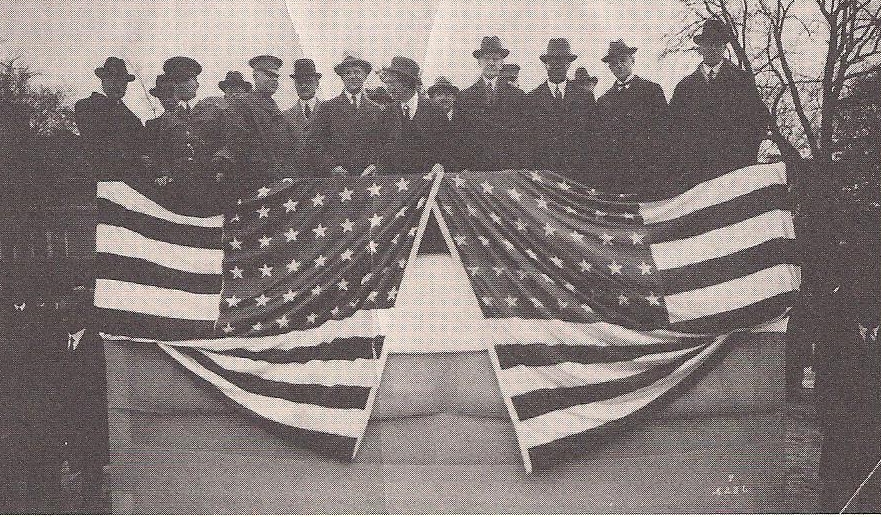
Gathering at the dedication of the hospital for veterans at Tuskegee, 1923. Then-Vice President Coolidge stands center above the flag to the right, to his left is Dr. Robert R. Moton, President of Tuskegee. Photo courtesy of Dan T. Williams, Archivist at Tuskegee University.

Gathering at the dedication of the hospital for veterans at Tuskegee, 1923. Then-Vice President Coolidge stands center above the flag to the right, to his left is Dr. Robert R. Moton, President of Tuskegee. Photo courtesy of Dan T. Williams, Archivist at Tuskegee University.

Many a social reform takes years to be implemented. Those deemed, in some places, outside the equal protection of the law have been known to wait for decades – sometimes centuries – all across human history before finally seeing a fair and just return recognized. We have written before here regarding three such instances during the Coolidge years alone. His era, collectively characterized as a hopelessly nativist period, actually furnishes valuable insight to the greatness of America’s ideals, not their repudiation. It is useful to study Coolidge and his time not with the arrogant blinders of moral superiority, denying our own ignorance and prejudices, but starting any study of human experience with genuine humility, without which we will fail to learn anything of importance. We will remain just as blind, if not more so, as we presume other generations to have been.

First, we have noted here that it was Coolidge who recognized the exceptional work being done at Tuskegee, the institution that would produce, as a whole, the finest tradesmen and airmen of World War II. It was Coolidge’s understanding of the potential of institutions like Tuskegee, Howard University, and others that brought his typically covert pressure – a pressure applied through subtle conversation in small meetings and the renowned clarity of his public speeches – to greatest effect. His six Annual Messages were his most direct opportunities at taking his whole agenda straight to the people via the platform aimed at Congress. He did not threaten or public malign but he applied pressure nonetheless with every nationally broadcast utterance. Within his first year he had secured generous appropriations to both institutions, and would see those amounts increase before leaving office.

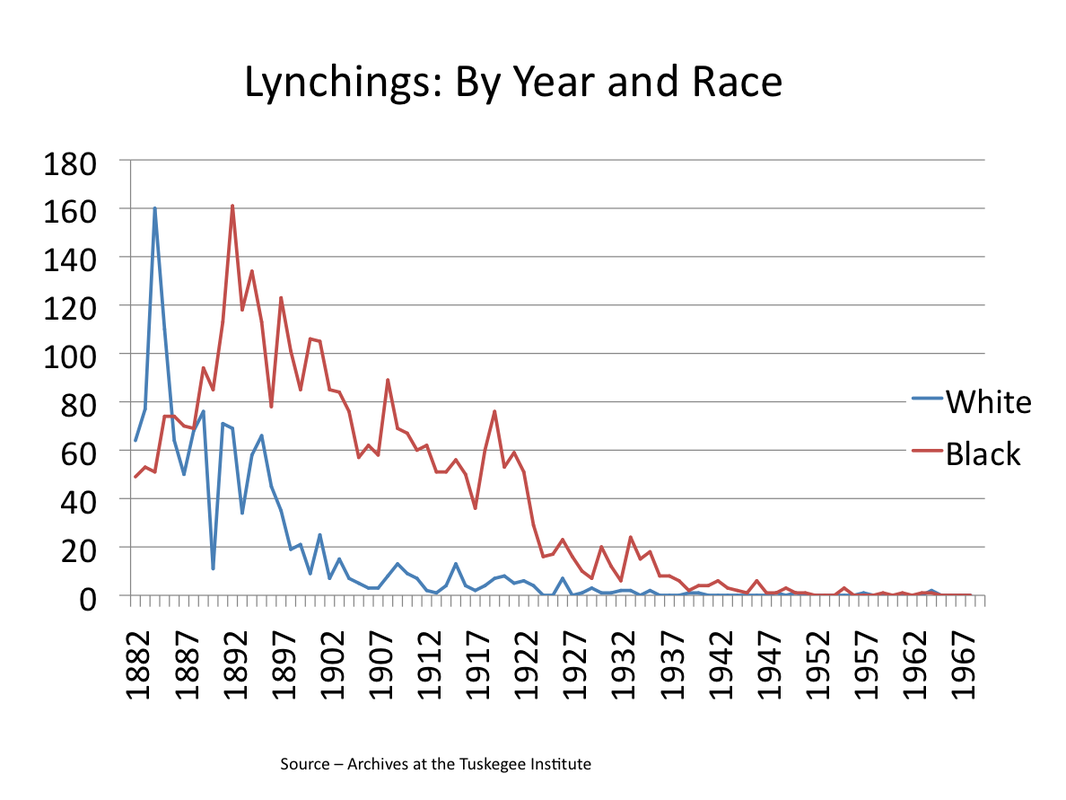
Lynching By Yr Chart

Second, while some accuse Coolidge of “dropping the ball” when it came to lynching, the record bears out that by the end of his term, he was the only one still seriously talking about its removal and criminalization under federal statute, as his final Annual Message confirms. Meanwhile, the number of lynchings continued to drop throughout the Coolidge years, no less due to the economic environment fostered by the President’s policies than by his regular insistence that Congress take up the matter again and finally address it. He persisted in reminding Congress every year for six years what it had failed to do in preventing another Democrat filibuster against it as happened back in 1922. Too intimidated by renewing legislative combat to reopen the issue, the Congress ignored the President’s position and no action was taken. It would serve as an ineradicable prick to the conscience in the years to come that a President of the United States had defended the rights of all people, as obligated under our Constitution and laws at a time when it was anything but politically beneficial to do so. Refusing to let the issue go away quietly, Coolidge was not silent on the race problem, even before audiences who remembered the violence in Omaha (where he condemned intolerance and bigotry before the American Legion), the struggle to properly provide care for black veterans at Tuskegee without prejudiced white management (where his involvement ensured black administrators, nurses, and doctors operated there independently for the first time), and the need to desegregate government facilities again, especially in the worst offenders at the Public Lands section, Census Bureau, Interior, Commerce, and Labor Departments, after the regression of the Wilson years (where departments found to have committed specific instances of segregation learned firsthand how fiery a temper Coolidge could unleash on perpetrators of such wrongs).

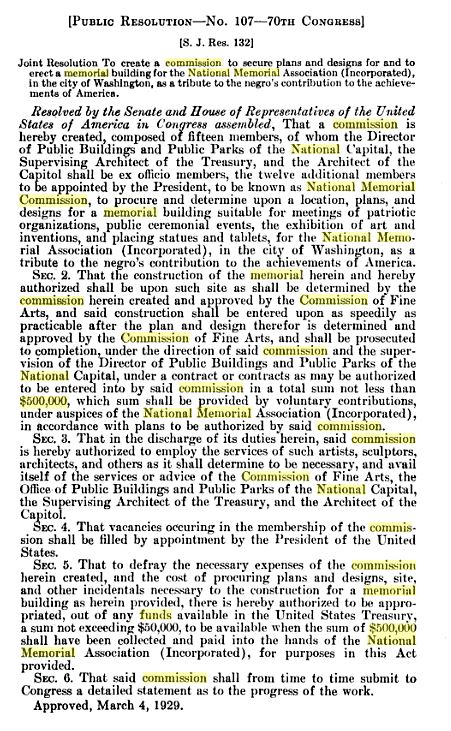
And third, Coolidge took the first step to finally recognize the contributions of black Americans to the country. A devoted group, known as the National Memorial Association, had been trying for fourteen years to secure this goal. It was Coolidge who became the first to do something about their quest. Having personally seen the bravery of veterans during the Great War, having honored one such veteran with a visit to the White House (“Harlem Hellfighter” Henry “Black Death” Johnson, whose deeds warranted the recognition that would finally come to him posthumously in 1996 and 2001), and having seen what strides were being achieved institutionally and economically through the hard fought march to equality by Frederick Douglass, Booker T. Washington, Robert R. Moton, Thomas Lee, Emmett J. Scott, A. Philip Randolph, James A. Cobb, Giles B. Jackson, Blanche Bruce, Maggie Walker, Georgia D. Johnson, “Duke” Ellington, Monroe Trotter, Hattie Brown, Mary Church Terrell, Bessie Smith, Mary Bethune Walker, Walter Cohen, Paul Revere Williams, William Matthews, George H. Woodson, George W. Carver, William Lewis, W. E. B. DuBois, Jefferson S. Coage, Arthur Brooks, John R. Hawkins, and countless others, Coolidge signed on his last day in office what became Public Law 107, which reads:

“That a commission is hereby created, composed of fifteen members…to be known as the National Memorial Commission, to procure and determine upon a location, plans, and designs for a memorial building suitable for meetings of patriotic organizations, public ceremonial events, the exhibition of art and inventions, and placing statues and tablets, for the National Memorial Association (Incorporated), in the city of Washington, as a tribute to the negro’s contribution to the achievements of America…”

The law went on to state that the Commission would be appropriated $50,000 from the Treasury after it raised $500,000 in private funds, reporting its progress, toward this goal, to Congress from time to time. Sadly, the Depression intervened and those funds were never raised thereby precluding the subsequent provision under the law from the public Treasury. It would not be until the 1960s that mention of this commission and its work would begin anew. It would take another forty years, when in 2003, President Bush signed a renewal of the law his Vermont predecessor had approved that the the resulting development of the Black History Museum would at last take shape, finally underway this year (as the video below depicts). Cal will likely not appear anywhere on the site of this Museum nor feature in any of the displays recognizing the historical achievements of Americans in realizing the contributions of so many to our experience in individual liberty and self-government. He nonetheless brought this long overdue recognition to life nearly nine decades ago. It all began with the brave step he took on March 4, 1929.

Public Law 107

When he could have left the whole business to his successor, he would not see it relegated to chance and ensured that at least the cause (as important as it was) would be championed, the law would be born, the commission created, and the money authorized. Blacks in America were no less worthy of the same honor that goes to whom it is due, no less deserving of the same rewards of full citizenship that came through the hard-fought march of generations, whatever their ancestral home, be they the Irish, the Chinese, the Japanese, the Italians, the Slavs, the Polish, or anyone else. As Coolidge put it to one audience, “Whether one traces his Americanism back three centuries to the Mayflower, or three years to the steerage, is not half so important as whether his Americanism of today is real and genuine. No matter by what various crafts we came here, we are all now in the same boat.” He took pains to ensure all Americans realized full participation in that shared experiment, that we could recognize each other as equals, fellow travelers, and that we could live together in peace and still live free. Cal’s actions throughout his public life, including this, among the last of his official acts as President, strove to see that the colorblind equality proclaimed in the Declaration and made possible by the Constitution be no less cherished in his day and time. It is the ideal America means to us all.

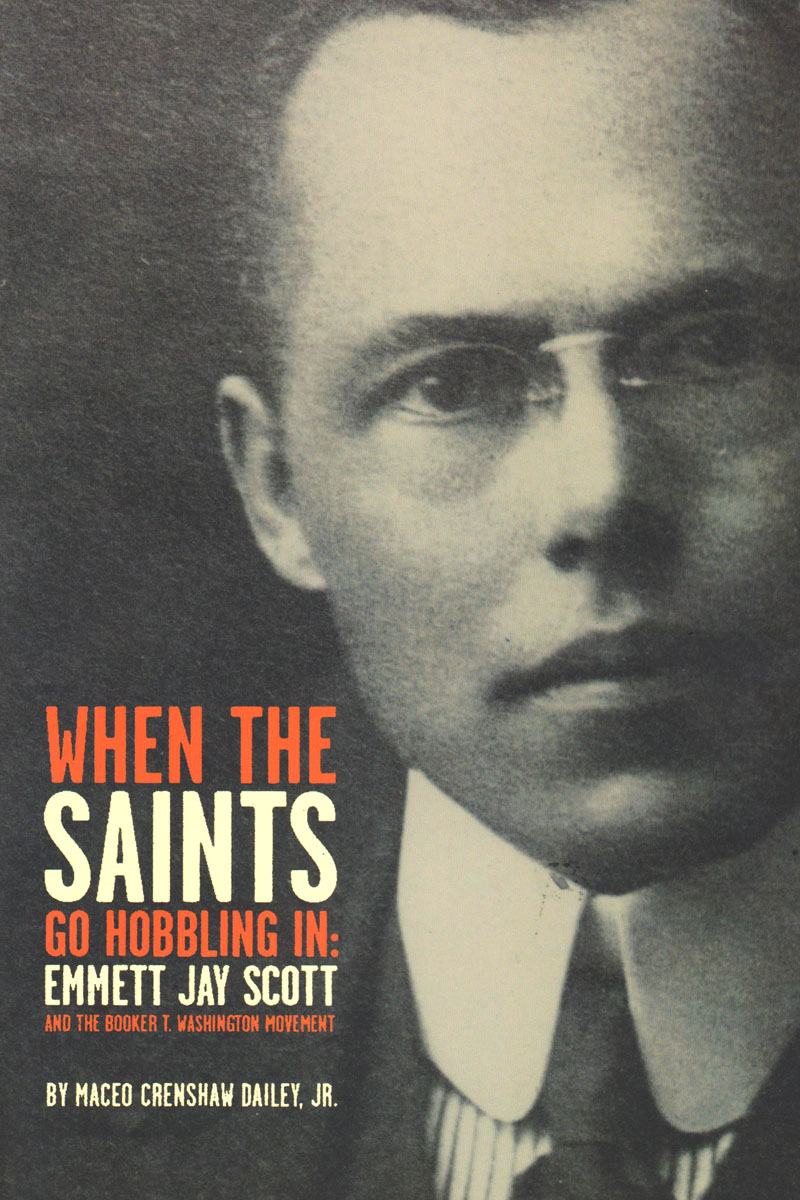
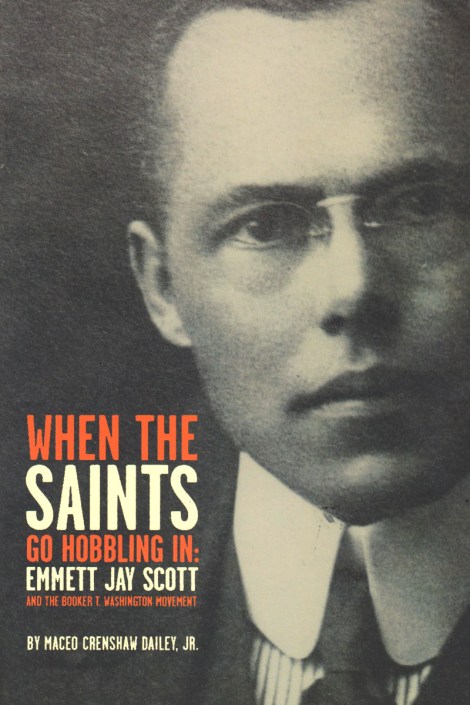
Coolidge in Maceo C. Dailey’s “When the Saints Go Hobbling In”

book3

This book is a collection of seven essays composed over the course of thirty years on Emmett J. Scott, the Booker T. Washington movement, and its often denigrated reputation among those who wear the name “scholar.” Dr. Dailey’s lifelong study of Scott, from his biographical dissertation of Scott’s life at Howard University to his more recent writing in journals like Business History Review, equip him to supply a seriously neglected area of historical study. Rebuking the biased tone and outright hostility to Washington and Scott in academia, with their deeply-ingrained refusal to understand them on their own terms, it reminds us that the same tactic has been launched against Coolidge, the contemporary of these two men. Approaching these individuals with a superimposed caricature derived through second hand sources, authors have executed the very same kind of historical hatchet job that has dominated Coolidge historiography as well.

While many academics have come to their task with a conclusion to be forced rather than discovered, even among black historians, Dr. Dailey restores that proper role of intellectual skepticism to challenge the narrative, test received judgments, and overturn the notion that the Tuskegee experiment has nothing to contribute to real solutions on race relations or the civil rights debate. Rather than accepting the prejudicial, even vague, categorization of these leaders as “Uncle Toms” or “accommodationists,” Dailey returns to the deeds, writings, and terms which they used to speak for themselves: “constructionalists.”

In so doing, it illustrates how similar the goals for racial uplift were with Coolidge, who just like Booker T. Washington, believed in the dignity of work, doing the day’s task well, and focusing on the exercise of the liberties of ownership, education of the whole person, entrepreneurship, and service rather than merely criticizing institutions or agitating for political power. Washington, Scott, and Coolidge understood that full political recognition and social equality – already declared in the Constitution and our founding documents – though not fully realized, would come (and were coming) through the industry, character, and judgment of people engaging in commerce, building neighborhoods from the bottom up, and demonstrating the progress of civilization even among those less than three generations before had been slaves. The first object, they knew, was to free the mind of prejudices and obstacles to advancement, and then to get busy exercising the business of independence rather than expecting others to recognize it for them (Washington’s Up From Slavery, written in 1901, sounds remarkably Coolidgean when talking about labor, the artificial versus essential, service, and tolerance, pp.73, 84, 93, 131, 148, 155, 161-2, 165, 182, 188, 312, 208, 220, 223-4, 249, 258, 318). Even Washington’s famous phrase to “cast buckets where you are” (p.219) conveyed the same message of individual responsibility for improvement to which Coolidge appealed, for all people, all his life.

As with any good historian, Dr. Dailey’s essays illustrate his growth as a thinker over the years. Starting from so hostile a position to Washington and Coolidge, it is not surprising that one his earliest essays, “Calvin Coolidge’s Afro-American Connection,” omits a fuller treatment of the Coolidge record and even leaves the reader wondering how this commended the Washington movement at all. That essay, while failing to report a more complete picture in regard to the Coolidge record, still helps supply a gap so wide in race studies of the 1920s that just about anything reported is beneficial to better understand the times and the people. However, as we noted, Dailey does not do justice to Coolidge, faulting him for his reliance on the leaders of Tuskegee at the expense of others in the black community. Dr. Dailey accepts James Weldon Johnson’s incorrect observation that Coolidge, after meeting with him at the White House, seems never to have seen a Negro before, let alone collaborated with them. While that 1923 meeting unfortunately defines subsequent opinions of Coolidge on issues relating to blacks, it is not true. Coolidge, as Dailey notes, recognized fellow Amherst graduate and lone black student, William H. Lewis’ talents early in school. Lewis would later meet with and advise Coolidge after reaching the Presidency and as a liaison between Cal and W. E. B. DuBois, helped secure Dubois’ appointment as the minister plenipotentiary to Liberia, to address Afro-American affairs. DuBois’ quick resignation from that post in disgust at “the system” speaks more to his disdain for working out practical solutions beyond simply finding flaws in the way things were than it besmirches Coolidge, who readily looked outside Tuskegee for able problem-solvers.

Regrettably, Dailey, by accepting James W. Johnson’s hardly unbiased assessment of Cal, overlooks a longstanding collaboration with and support for influential blacks beyond the Tuskegee sphere. Senator Coolidge rendered crucial support for the Boston firebrand Monroe Trotter in 1915, casting the necessary vote to prevent reconsideration of the Boston ban on showing Birth of A Nation, D. W. Griffith’s racist film, despite it being a project openly praised by President Wilson. Coolidge would go on to meet, as President, with Trotter and listen to advice from such diverse views as A, Philip Randolph, members of the Associated Negro Press and the NAACP. His quiet manner in these meetings, speaking little and promising nothing, while a mystery to many a petitioner, illustrated his way of receiving everyone. It was not an expression of ambivalence or indifference to the audience. It manifested the old adage of one being best able to listen when not talking. As Vice President, he would travel to Atlanta, the heart of the Old South, for the Southern Tariff Congress, and speak to and meet with members of the black community during his visit there. The community in Atlanta, centered around Auburn Avenue, where Dailey notes, operated the largest concentration of black businesses anywhere in the country (166-167). When the time came to act, as it did against lynching, in favor of appointment of qualified men and women to public posts, against confirmed instances of departmental segregation and bigotry, and in favor of greater political representation, through party delegations and candidates like Dr. Roberts of Harlem, Cal proves to be one of the most conscientious advocates blacks had in the 1920s.

All of this escapes inclusion in Dailey’s view of Coolidge, however. It is never mentioned that while the Democrat Party, devastated by its approval of the Klan, tried in vain to live that legacy down without alienating its support base in 1924 tried in vain to project the conflict onto Coolidge. While Democrats and Progressives wrangled in a battle of words, Coolidge simply met with the very groups the Klan was targeting without ever providing the rhetorical fuel and free publicity his opponents were seeking. While some endorsed Cal to discredit his campaign, he went to black baseball games in the D.C. area, addressed Howard University, met with black entrepreneurs, collaborated with Emmett J. Scott and William Matthews, held interviews with black journalists, even hostile ones like the regular columnist “Hezekiah” of Philadelphia, drew upon the administrative talents of Mrs. Mary Bethune, Mrs. Hallie Brown, the grassroots work by the ladies of the National League of Republican Colored Women, kept naming blacks to federal offices from Judge James A. Cobb to Customs Collector Walter Cohen to the first ever all-black diplomatic team dispatched to study and report on conditions in the Virgin Islands. It never seems to occur to “scholars” that Coolidge’s tax reduction and constructive economy programs were as much civil rights achievements as anything more overt. By enabling people to work more for themselves and less for government, it would furnish the environment that was the boom of the 20s, enhancing opportunities, not merely for whites but for everybody to a level never experienced before. Moreover, this came at the culmination of a quarter century that had seen incredible advancement, by every measure, in property ownership, wealth creation, and raised standards of living felt by blacks, realizing what being free meant. It was a time of vibrant institution building and construction of culture, commerce, and churches that had been non-existent three generations before. All this and more never makes it into the “official” narrative but it belongs there right beside Coolidge’s other accomplishments in tax and debt reduction as well as flood relief, air and radio development, and reforms in the judicial system.

Dailey’s book renders a substantial service to an area of study misunderstood from downright neglect for far too long. It does not bridge the gap but it certainly supplies crucial building materials upon which to reach a fuller view of the importance of the Washington movement and Coolidge’s contributions toward racial healing and progress as Americans together.

We give this book 3 1/2 stars.