On Mr. Morrow

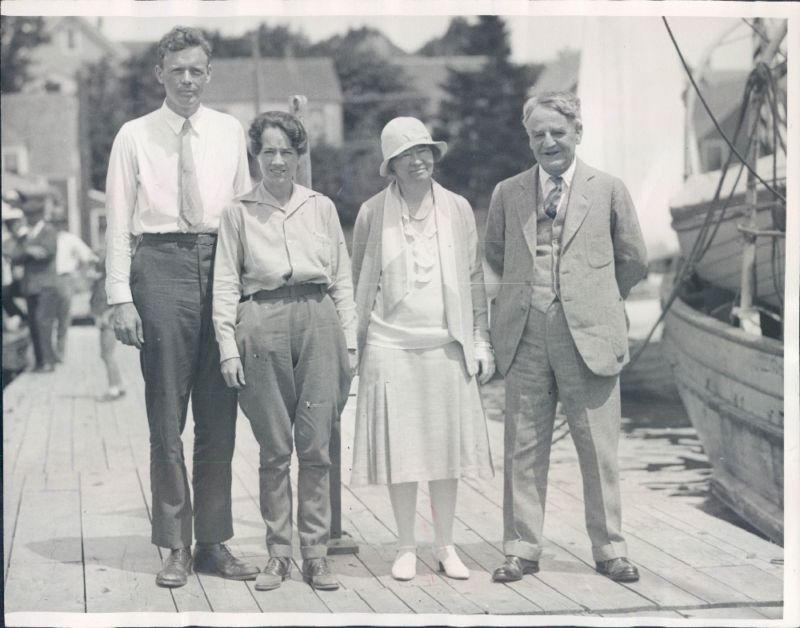
Mr. and Mrs. Morrow (right) and Charles and Anne Morrow Lindbergh (left), pictured in early 1931, shortly before Mr. Morrow's death.

Mr. and Mrs. Morrow (right) and Charles and Anne Morrow Lindbergh (left), pictured in early 1931, shortly before Mr. Morrow’s death.

West Virginia Public Broadcasting has a short tribute to one of the best men in the Coolidge administration, Ambassador Dwight W. Morrow. Mr. Morrow would become an incredible resource to the successful resolution of more than one difficult problem in the 1920s. He began interaction with Calvin Coolidge at their college, Amherst, in the 1890s. While Cal would go on to local practice in Northampton and Morrow to more illustrious work in New York at JP Morgan, he was finally persuaded by Frank W. Stearns, following Coolidge’s election as Governor of Massachusetts, that Morrow (not Stearns) was the crazy one for failing to see earlier what potential his classmate (Coolidge) possessed, a potential that could take him to the White House.

When Coolidge rose to that very office in August 1923, it seemed that Morrow would not have an opportunity to render much service to his friend. Offering his help wherever needed, Coolidge would not tap Morrow until the tough situation over air power and flight technology (stirred unnecessarily into a political issue by Billy Mitchell) needed someone with the talents Morrow could bring to bear. He chaired the board that studied the problem and whose report of recommendations became the Air Commerce Act of 1926, shrewdly preempting by two weeks the report from another committee that was set to radically bureaucratize the Air Corps and defend Mitchell’s misbehavior. Morrow was there to help Coolidge emerge out of that controversy and it would not be long before the President would look to him again for an even greater mission: Mexico. Appointed as Ambassador to Mexico, Morrow came to the knotted array of issues with both a skill for meticulous mastery of the legal details but also the disarming and humble personality for which he was known. He approached the conflict as few do in diplomacy with a love for its people and a dedication to the central principles at stake. He won them over with his sincere curiosity and boyish enthusiasm and consequently resolved both the constitutional impasse and the religious war that could have, in the hands of a lesser man, driven the United States and Mexico into military confrontation, as had happened in previous administrations.

It came as an incredible shock to Mr. and Mrs. Coolidge when, just as Morrow was beginning what promised to be an exceptional term of service in the Senate, Cal’s former Ambassador died at the age of fifty-eight, October 5, 1931, leaving behind his devoted wife and a loving family of three daughters, one son, and a growing number of grandchildren. His son-in-law, Charles Lindbergh, already having made history with his solo crossing of the Atlantic, would go on to make aviation history together with one of his daughters, Anne, by traveling — and surveying — the world via plane.

It was a severe blow to Coolidge, especially, to lose so dear a friend and for America to lose so stellar a public servant.

Dwight W. Morrow. Courtesy of the Library of Congress.
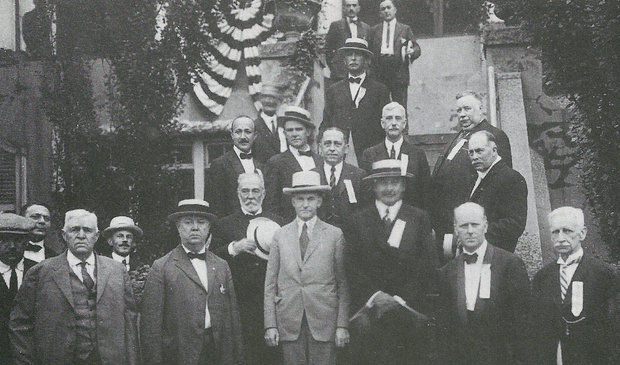
Courtesy of the Library of Congress.
On Celebrating the Payment of Debt and the Restraint of Spending

Vice President Calvin Coolidge with citizens of Elizabeth, New Jersey, July 1, 1922. Courtesy of the Elizabeth Public Library.

Vice President Calvin Coolidge with citizens of Elizabeth, New Jersey, July 1, 1922. Courtesy of the Elizabeth Public Library.

As public discussion turns to the tax plans of Presidential candidates and even to budget negotiations ahead this month, how about we also include spending discipline and debt payment as central components to any real discourse on policy? Calvin Coolidge made a point of repeatedly celebrating the accomplishment that combines real debt payment with spending reductions – whether one is an individual, a household, or a government. For Coolidge, tax cuts were secondary to debt payment and spending discipline. Plenty of people want to talk about the former and far less about the latter two. As Coolidge would say two years after this photo was taken,

“The prosperity of the people is intimately bound up with the financial policy of the Government. A considerable but disorganized number of people exist who are willing to talk about economy in public expenditure. There are a very few who, in addition to talking about it, are willing to act and vote for the actual practice of economy. But spread all over the land there are thousands upon thousands of organizations ceaselessly clamoring and agitating for government action that would increase the burden upon the taxpayer by increasing the cost of government. To my mind, the practice of public economy and insistence upon its rigid and drastic enforcement is a prime necessity of the people of the United States. In fact, the necessity is world-wide. That nation which demonstrates that it has sufficient self-control to adopt this course will immediately become the leader in the financial world. That leadership is easily within American grasp. But to secure it requires prompt action and constant vigilance.”

He knew any genuine solution to economic turmoil had to confront, sooner or later, the harsh conditions that debts not paid and expenditures flagrantly indulged inflict on people. The end will only be worse the longer we delay that day of painful but necessary reckoning in America. Here is Coolidge recognizing the people of the city of Elizabeth, New Jersey, for making the tough decisions and exercising the discipline required to pay off 50% of its debt. All this forty-three years after an earlier generation had declared bankruptcy, mistakenly believing the fiscal situation to be an irretrievable loss. The road back was not achieved by creating a constant climate of emergency whereby they could cover their procrastination with meaningless resolutions that did nothing but put off the real day of hard choices to some unknown time in the future. The way back toward solvency came by making their day the day of reckoning, not leaving the mess to get sorted out after they were gone. If we are ever to see a light at the end of our fiscal tunnel, it will demand the same kind of determination and courage that Coolidge’s generation had.

Coolidge Coming in New Book

McClanahan cover

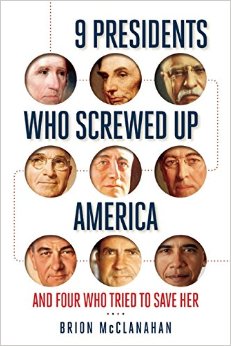
Coming on February 8, 2016, is a new book from well-known historian and author, Brion McClanahan entitled 9 Presidents Who Screwed Up America: And Four Who Tried to Save Her. Mr. McClanahan is the author of The Politically Incorrect Guide to the Founding Fathers, The Founding Fathers Guide to the Constitution, and co-author with Clyde Wilson of Forgotten Conservatives in American History among other great titles.

We can all identify the nine but guess who ranks among the four? Pre-Order your copy today!