On Style

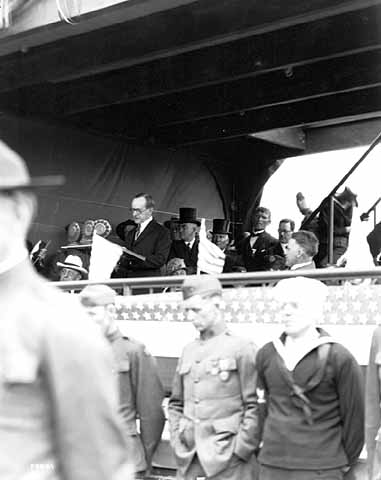
President Coolidge speaking at the Minnesota state fairgrounds in St. Paul, June 8, 1925.

President Coolidge speaking at the Minnesota state fairgrounds in St. Paul, June 8, 1925.

Coolidge was the first to declare he was “not conscious of having any particular style” about his writings. So when The New York Times’ correspondent assigned to cover Washington, Charles Willis Thompson, wrote a piece on Coolidge’s distinctive style as a writer, Cal wrote from the White House on the day following its publication: “If I have any [style], it is undoubtedly due to my training in the construction of legal papers, where it is necessary in the framing of a contract, or the drawing of a pleading, to say what you mean and mean what you say in terms sufficiently clear and concise so that your adversary will not be able to misinterpret them, or to divert the trial into a discussion of unimportant matters. The rule,” Coolidge pointed out, “is to state the case with as little diffusion as possible.” He accomplished exactly that. In fact, that was his defining characteristic as a writer. Coming out of the last generation that elaborately adorned every phrase with intricate eloquence, Coolidge decisively broke this contemporary tradition with his signature: the short, pithy sentence.

Whether he fully recognized it or not, he had a unique style. Correspondent Thompson studied this in careful detail through Coolidge’s thirty years in public life. Thompson presents his analysis of the Coolidge Style in Presidents I’ve Known and Two Near Presidents, published just as Cal was leaving the Presidency. Thompson writes, “From standpoint of style alone, Coolidge is one of the two most gifted men who have lived in the White House for two generations. He is, in fact, one of the very few Presidents who can be thought of as literary men. The difference between him and such a stylist as Woodrow Wilson is that he used his style only as a tool and not as an ornament; he only used it when there would be some advantage in using it. In this, as a literary man, he somewhat resembled Lincoln. To hear people talk you would think Lincoln never opened his mouth without uttering a Gettysburg Address. The truth is that nearly all Lincoln’s public utterances are just as trite and commonplace as Coolidge’s or Taft’s or McKinley’s or those of any other President.”

Thompson, after comparing a few of Cal’s predecessors, returns to style of the Vermonter. “His weapon is the short sentence, but anybody who gives his mind to it can acquire, though with difficulty, the use of the short sentence. The difference is that each of Coolidge’s short sentences, when he is producing a real composition and not merely giving commonplace voice to one of the perfunctory utterances his position calls for, is the distillation of a long process of thought. What another man might need a page to express can be set forth by Coolidge in a sentence of a dozen words and set forth completely, so that it does not need another syllable.”

Thompson, having studied him so closely, discovered he was not the drowsy illiterate the “Intelligentsia” assumed him to be. “Coolidge’s wide reading” did not govern him. “[H]e thinks for himself.” This was brought home potently with his scathing veto of the McNary-Haugen bills, forcing the Washington clique to cast about for some explanation for this remarkable phenomenon. It ran against the very caricature they had constructed of him in their own minds, “a colorless Coolidge…dull, passionless, uninspired, heavy-witted,” an impression imposed on him that could not be wrong. Could it? Thompson cites their delusion as “The Coolidge Myth,” the one fellow correspondent Frank R. Kent identified. But Kent was mistaken. “There was, indeed, a Coolidge myth…one he and men like him created; the myth of a book in the White House. And whenever, as in the McNary-Haugen veto, he did something out of character for a boob, they concluded, not that they had created a myth, but that the man they understood so perfectly had an unaccountable habit of refusing to stay put.”

Thompson mentions that while while Coolidge disagreed with him on the existence of a distinct style, Cal was simply being modest. Wherever he got it, the point was, Thompson affirmed, Coolidge had it. Thompson was even so bold as to counter Cal’s argument: If he acquired it from the practice of law, then all lawyers should be “masters of style.” Everyone knows they aren’t. But the former President stuck to his humble guns and Thompson remained undeterred in the conclusion that Calvin Coolidge possessed one of the most remarkable and underrated styles of any President. No one notices that, Thompson says, but it remains so nonetheless.

Little could anyone suspect that sixty years later a student and admirer of ol’ Cal would rediscover the incredible wealth to be mined from #30’s cogency of thought and talent as a communicator. Her name, Peggy Noonan, would help give direction to the voice of Ronald Reagan. She writes in What I Saw at the Revolution, about but one sample of Cal’s rich writing, “Calvin Coolidge’s [Inaugural] was clear as crystal and written with a kind of dry fluidity; it didn’t ask you to like it” (187). Such could describe most of what Coolidge wrote. When much of current rhetoric is seen desperately begging for approval, we come to a style that just says what it means and doesn’t apologize to the hearer or ask for anything. “Take it or leave it” runs through Coolidge’s style. Perhaps that quality, more than anything, is what makes him so refreshing today. By returning to this fountainhead of expression, a clarity we seriously need in our public and private discourse now, we not only find the original “Great Communicator” (hailing from Vermont not Illinois) but we learn what it means to think and speak in simple truths again.
On the Proper Use of Our Prosperity

John_Calvin_Coolidge,_Bain_bw_photo_portrait

“In the last fifty years we have had a material prosperity in this country the like of which was never beheld before. A prosperity which not only built up great industries, great transportation systems, great banks and a great commerce, but a prosperity under whose influence arts and sciences, education and charity flourished most abundantly. It was little wonder that men came to think that prosperity was the chief end of man and grew arrogant in the use of its power. It was little wonder that such a misunderstanding arose that one part of the community thought the owners and managers of our great industries were robbers, or that they thought some of the people meant to confiscate all property. It has been a costly investigation, but if we can arrive at a better understanding of our economic and social laws it will be worth all it cost…Let us frown upon greed and selfishness, but let us also condemn envy and uncharitableness. Let us have done with misunderstandings, let us strive to realize the dream of democracy bu a prosperity of industry that shall mean the prosperity of the people, by a strengthening of our material resources that shall mean a strengthening of our character, by a merchandising that has for its end manhood, and womanhood, the ideal of American Citizenship” — Calvin Coolidge, Boston, December 15, 1916 (emphasis added)

As we approach another Christmas, we find Coolidge was speaking of that season not for its material largesse or the mere accumulation of things that America represents to many. Instead, he was referring to that state of mind he later mentioned Christmas actually is: the gathering and harnessing of those material things which develop the soul and mature the character, the ingredients that equip us to better serve those around us (through whatever work we do) and keep kindled in ourselves the indestructible, life-giving, and transformational love Christ offers. “To know,” as Dickens put it, “how to keep Christmas well” not only one day of the year but all the days of the year.

“From Cincinnatus to Caesar: The Devolution of the American Presidency” by Clyde Wilson

GW portrait

Distinguished Professor Emeritus at the University of South Carolina and well-known author Clyde Wilson has produced an interesting piece at The Imaginative Conservative. Dr. Wilson has written widely on politics and history, particular emphasizing the Southern conservative traditions in Jefferson and Calhoun. While we disagree on some of his assessments of Calhoun in the conservative pantheon, Wilson has some fascinating thoughts to offer on how far removed the low-key Executive power was in the views of the Founders as opposed to what it has become. It is now a true devolution from its great function in our Constitutional Republic as embodied in the example of Cincinnatus, the old Roman consul given dictatorial powers to serve who, when the crisis was resolved, laid down that authority and returned to private life on his farm. Instead we are living a much more recent incarnation of Caesar, whose seemingly unending power (aided by Congress) has stripped the original vision that partnered co-equal authority between the President, the States (through the Senate), and the House, and creating something of a celebrity-protector over an Empire.

While we must point out that while it is true that the veto power was used sparingly in the early years, a Unitary Executive was a concept firmly believed and given active definition from Washington onward, as Calabresi and Yoo substantiate. It was not merely the invention of a recalcitrant Andrew Johnson. While Jackson, Lincoln, both Roosevelts, and Kennedy have all contributed over time to various elements now tied together in Caesar, a substantial part built up around them afterward by a fawning media, it was not until “Bush Minor” (in Dr. Wilson’s view) that everything came together into the Imperator, “able to do almost anything with only the merest murmurs of dissent from the Congress or the public.” Dr. Wilson does make a persuasive point that for all the charges laid at the feet of Jackson and Lincoln for expanding Presidential power, their actions did not immediately cement into permanent precedent, as the Grant presidency returned much of the Office to its normal and original proportions in the 1870s. While TR invoked the celebrity status of the Presidency, and FDR enjoyed the role as a father-figure over the Nation, it was Kennedy’s legacy, with all the fiction built around him after his death, that conceived the godlike authority we now see in Caesar.

"We'll soon know who's running this place," cartoon by "Ding" Darling. Courtesy of the University of Iowa.

“We’ll soon know who’s running this place,” cartoon by “Ding” Darling. Courtesy of the University of Iowa.

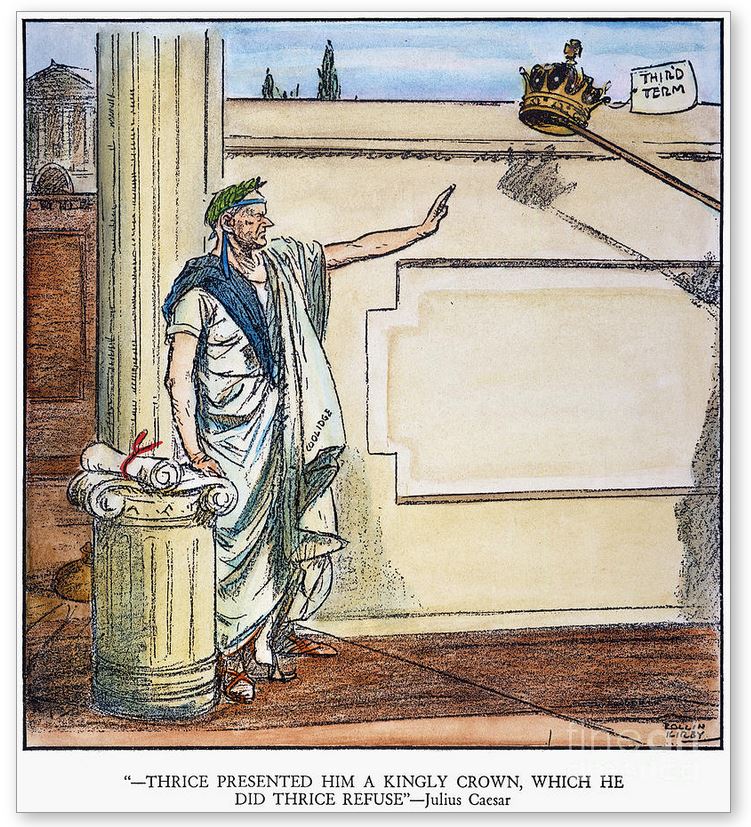
Where then might Coolidge fit into this paradigm? While Dr. Wilson offers no judgment on that score, we humbly propose that Cal belongs in the counter-tradition that worked to correct the abuses of his predecessors and restore the limited role of the Presidency as envisioned by the Constitution. Yet, he is not without a contribution to the Caesar we now have. Coolidge certainly maintained the strength of the Executive Office and held unquestionably to its legitimate powers to appoint, remove, veto, and employ the “Bully Pulpit,” embodying the role as the responsible representative of the People in a way Congress was not. In this way, Coolidge fits comfortably into the role formed by TR and Wilson while also repudiating the abuses of personally wielded and arbitrary authority they bequeathed. Instead, he returned authority to government by what the law said, not merely what he wanted. Coolidge thus forms a melding of these two poles of the spectrum, both drawing upon the assertiveness and the passiveness in the Executive. But then, even Cincinnatus was named a dictator so perhaps Dr. Wilson’s distinction is a little simplistic. Coolidge was a master of using administrative authority without appearing to do so at all. We argue this brings him closest to the tradition made by Washington, renewed under Grant, and re-popularized by Reagan, who never achieved the same level of results “Silent” Cal did. While Coolidge had a far keener sense of discernment than Grant and a much more polished instinct on public relations than Cleveland, these contribute to the tradition of servant-leadership like that of Cincinnatus, introduced by our first President. Coolidge was no weakling or place-holder for bigger, better leaders. He helped bring back to the Office its original scope in our Republic.

Political illustration depicting Coolidge, in the tradition of Roman republicans from Cincinnatus onward, after his steadfast refusal to extend his executive powers for another four years. Coolidge resolved instead to leave public office, lay down the mantle of authority and step out of the limelight for others chosen by the American people to succeed him. Cartoon by Rollin Kirby appearing in The New York World, March 24, 1928.

Political illustration depicting Coolidge, in the tradition of Roman republicans from Cincinnatus onward, after his steadfast refusal to extend his executive powers for another four years. Coolidge resolved instead to leave public office, lay down the mantle of authority and step out of the limelight for others chosen by the American people to succeed him. Cartoon by Rollin Kirby appearing in The New York World, March 24, 1928.

We must question whether Caesar is here to stay or merely vacationing until the electorate can decide they will not settle for mere window-dressing or good feelings in our officeholders. After all, Lincoln and Jackson were both decried as imperial Presidents in their times. Are we but marching through a phase to return to a Cincinnatus, where we demand more substance and actual results in those we select from among us to lead for a short time? Will we merely settle for a Reagan who can communicate the vision and offer much but (in the end) deliver little? Should we not be looking for a Coolidge, who promised nothing but delivered much? If Reagan failed, is a Coolidge even possible now? That is a question for another time. The point is this: are we now going to remain content with a line of Caesars, an incessant use of fraud, bribes, and manipulation of the mob to hold power? Are we prepared to hold our next President to that higher standard befitting a constitutional government and a free people? A standard cherished in the Cincinnatus tradition that brings servant-statesmen back once more?

6193348020_ca6a2a22b3_b Gov CC aint afraid of work on Arbor Day