D. C. McAllister at The Federalist has reminded us of the opportunity we still possess to choose a real conservative as President. She reminds us that the “Spirit of ’76” is merely asleep not dead and that the best embodiment of the principles Jefferson and Coolidge understood – freedom through limited government – is found in Ted Cruz. This is the original Anti-Establishment position, a position election year opportunists in the race for President do not grasp.
What this month brings, if it is to genuinely reawaken the “Spirit of ’76,” will have to take its inspiration from the reverence and honor demonstrated by those remembered in Calvin Coolidge’s speech at Bunker Hill, June 17, 1918. The irreverent, petty, and childish behavior of certain candidates are wholly unworthy of what duty summoned the patriots who fought there. It is cherishing what those men and their families held sacred, emulating their courage and commitment to principle, that will restore freedom and change the paradigm. It will never happen with coarse conduct, vulgar living, and immature examples however blusterous or braggadocious they be. Small men do not carry big ideals. The “Spirit of ’76,” as Coolidge boldly proclaims, lived in the hearts of the humble and in the minds of the principled.
Take a few moments to slowly and carefully read his words.

“The Death of General Warren at the Battle of Bunker Hill, June 17, 1775” by John Trumbull
Coolidge, ever the great communicator, began,
“Reverence is the measure not of others but of ourselves. This assemblage on the one hundred and forty-third anniversary of the Battle of Bunker Hill tells not only of the spirit of that day but of the spirit of to-day. What men worship that will they become. The heroes and holidays of a people which fascinate their soul reveal what they hold are the realities of life and mark out a line beyond which they will not retreat, but at which they will stand to overcome or die. They who reverence Bunker Hill will fight there. Your true patriot sees home and hearthstone in the welfare of his country.
“Rightly viewed, then, this day is set apart for an examination of ourselves by recounting the deeds of the men of long ago.”
Coolidge describes the battle,
“What was there in the events of the seventeenth day of June 1775, which holds the veneration of Americans and the increasing admiration of the world? There are the physical facts not too unimportant to be unworthy of reiteration even in the learned presence of an Historical Society. A detachment of men clad for the most part in the dress of their daily occupations, standing with bared heads and muskets grounded muzzle down in the twilight glow on Cambridge Common, heard Samuel Langdon, President of Harvard College, seek divine blessing on their cause and marched away in the darkness to a little eminence at Charlestown, where, ere the setting of another sun, much history was to be made and much glory lost and won. When a new dawn had lifted the mists of the Bay, the British, under General Howe, saw an intrenchment on Breed’s Hill, which must be taken or Boston abandoned. The works were exposed in the rear to attack from land and sea. This was disdained by the king’s soldiers in their contempt for the supposed fighting ability of the Americans. Leisurely, as on dress parade, they assembled for an assault that they thought was to be a demonstration of the uselessness of any armed resistance on the part of the Colonies. In splendid array they advanced late in the day. A few straggling shots and all was still behind the parapet. It was easier than they had expected. But when they reached a point where ‘tis said the men behind the intrenchments could see the whites of their eyes, they were met by a withering fire that tore their ranks asunder and sent them back in disorder, utterly routed by their despised foes. In time they form and advance again but the result is the same. The demonstration of superiority was not a success. For a third time they form, not now for dress parade, but for a hazardous assault. This time the result was different. The patriots had lost nothing of courage or determination but there was left scarcely one round of powder. They had no bayonets. Pouring in their last volley and still resisting with clubbed muskets, they retired slowly and in order from the field. So great was the British loss that there was no pursuit. The intensity of the battle is told by the loss of the Americans, out of about fifteen hundred engaged, of nearly twenty per cent, and of the British, out of some thirty-five hundred engaged, of nearly thirty-three per cent, all in one and one half hours.”
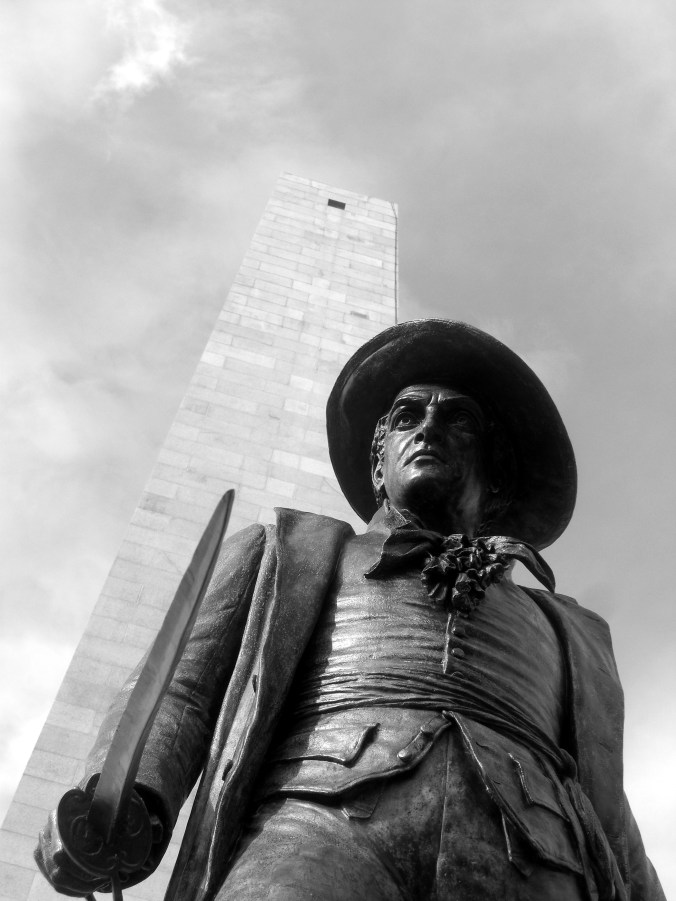
The Bunker Hill Monument with the statue of Dr. Warren which Coolidge references in this speech.
Coolidge continues,
“It was the story of brave men bravely led but insufficiently equipped. Their leader, Colonel Prescott, had walked the breastworks to show his men that the cannonade was not particularly dangerous. John Stark, bringing his company, in which were his Irish compatriots, across Charlestown Neck under the guns of the battleships, refused to quicken his step. His Major, Andrew McCleary, fell at the rail fence which he had held during the day. Dr. Joseph Warren, your own son of Roxbury, fell in the retreat, but the Americans, though picking off his officers, spared General Howe. They had fought the French under his brother.
“Such were some of the outstanding deeds of the day. But these were the deeds of men and the deeds of men always have an inward significance. In distant Philadelphia, on this very day, the Continental Congress had chosen as the Commander of their Army, General George Washington, a man whose clear vision looked into the realities of things and did not falter. On his way to the front four days later, dispatches reached him of the battle. He revealed the meaning of the day with one question, ‘Did the militia fight?’ Learning how those heroic men fought, he said, ‘Then the liberties of the Country are safe.’ No greater commentary has ever been made on the significance of Bunker Hill.”

Governor Coolidge a month after this speech, in Fairhaven, Massachusetts, July 1918. Courtesy of the National Archives and Records Administration.
Coolidge was not done; he draws more insight,
“We read events by what goes before and after. We think of Bunker Hill as the first real battle for independence, the prelude to the Revolution. Yet these were both after-thoughts. Independence Day was still more than a year away and then eight years from accomplishment. The Revolution cannot be said to have become established until the adoption of the Federal Constitution. No, on this June day, these were not the conscious objects sought. They were contending for the liberties of the country, they were not yet bent on establishing a new nation nor on recognizing that relationship between men which the modern world calls democracy. They were maintaining well their traditions, these sons of Londonderry, lovers of freedom and anxious for the fray, and these sons of the Puritans, whom Macaulay tells us humbly abased themselves in the dust before the Lord, but hesitated not to set their foot upon the neck of their king.
“It is the moral quality of the day that abides. It was the purpose of those plain garbed men behind the parapet that told whether they were savages bent on plunder, living under the law of the jungle, or sons of the morning bearing the light of civilization. The glorious revolution of 1688 was fading from memory. The English Government of that day rested upon privilege and corruption at the base, surmounted by a king bent on despotism, but fortunately too weak to accomplish any design either of good or ill. An empire still outwardly sound was rotting at the core. The privilege which had found Great Britain so complacent sought to establish itself over the Colonies. The purpose of the patriots was resistance to tyranny. Pitt and Burke and Lord Camden in England recognized this, and, loving liberty, approved the course of the Colonies. The Tories here, loving privilege, approved the course of the Royal Government. Bunker Hill meant that the Colonies would save themselves and saving themselves save the mother country for liberty. The war was not inevitable. Perhaps wars are never inevitable. But the conflict between freedom and privilege was inevitable. That it broke out in America rather than in England was accidental. Liberty, the rights of man against tyranny, the rights of kings, was in the air. One side must give way. There might have been a peaceful settlement by timely concessions such as the Reform Bill of England some fifty years later, or the Japanese reforms of our own times, but wanting that a collision was inevitable. Lacking a Bunker Hill there had been another Dunbar.”
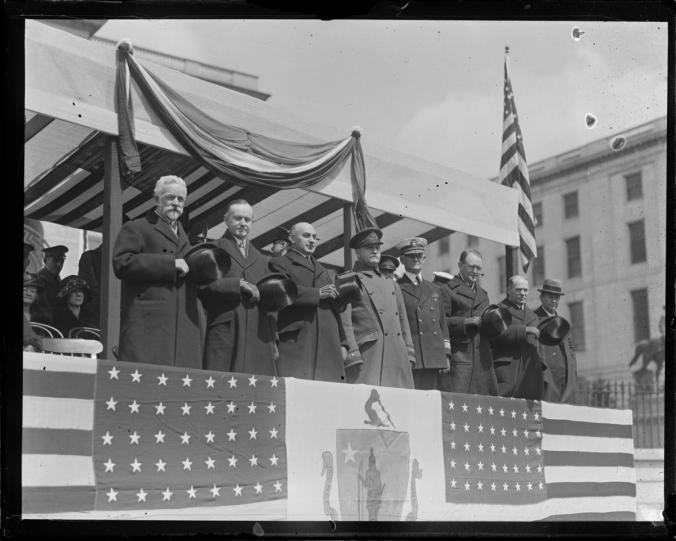
Governor Coolidge (second from left) with various state, local and federal officials in public ceremony, 1919.
This clash was not a confrontation over the margins, the brokering of power, who got what, and what deals could be made between parties. It was far more fundamental than that. Coolidge speaks plainly,
“The eighteenth century was the era of the development of political rights. It was the culmination of the ideas of the Renaissance. It was the putting into practice in government of the answer to the long pondered and much discussed question, ‘What is right?’ Custom was giving way at last to reason. Class and caste and place, all the distinctions based on appearance and accident were giving way before reality. Men turned from distinctions which were temporal to those which were eternal. The sovereignty of kings and the nobility of peers was swallowed up in the sovereignty and nobility of all men. The unequal in quantity became equal in quality.
“The successful solution of this problem was the crowning glory of a century and a half of America. It established for all time how men ought to act toward each other in the governmental relation. The rule of the people had begun.
“Bunker Hill had a deeper significance. It was an example of the great law of human progress and civilization. There has been much talk in recent years of the survival of the fittest and of efficiency. We are beginning to hear of the development of the super-man and the claim that he has of right dominion over the rest of his inferiors on earth. This philosophy denies the doctrine of equality and holds that government is not based on consent but on compulsion. It holds that the weak must serve the strong, which is the law of slavery, it applies the law of the animal world to mankind and puts science above morals. This sounds the call to the jungle. It is not an advance to the morning but a retreat to night. It is not the light of human reason but the darkness of the wisdom of the serpent.”
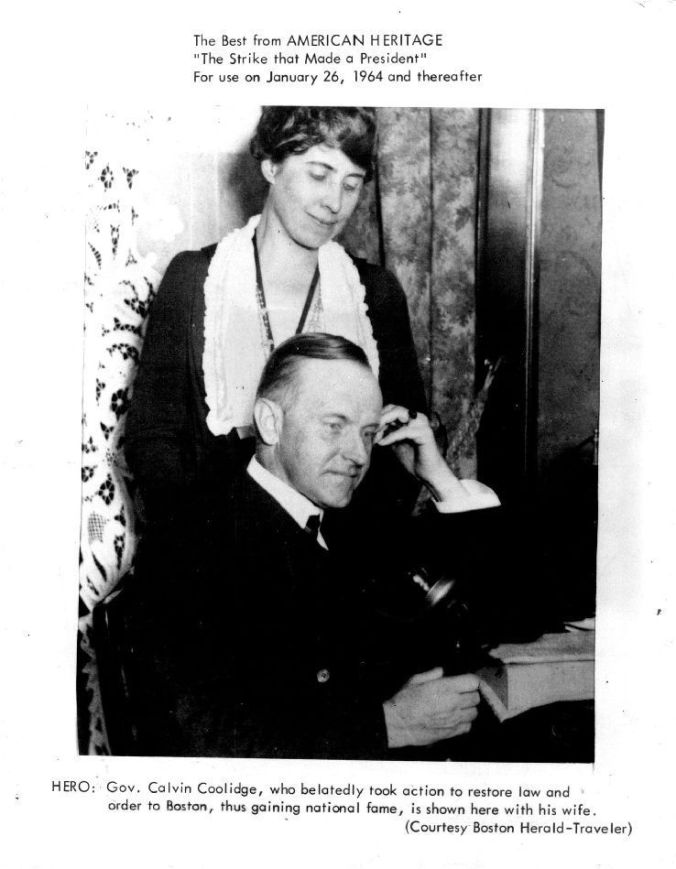
Coolidge explains the difference,
“The law of progress and civilization is not the law of the jungle. It is not an earthly law, it is a divine law. It does not mean the survival of the fittest, it means the sacrifice of the fittest. Any mother will give her life for her child. Men put the women and children in the lifeboats before they themselves will leave the sinking ship. John Hampden and Nathan Hale did not survive, nor did Lincoln, but Benedict Arnold did. The example above all others takes us back to Jerusalem some nineteen hundred years ago. The men of Bunker Hill were true disciples of civilization, because they were willing to sacrifice themselves to resist the evils and redeem the liberties of the British Empire. The proud shaft which rises over their battlefield and the bronze form of Joseph Warren in your square are not monuments to expediency or success, they are monuments to righteousness.
“This is the age-old story. Men are reading it again today — written in blood. The Prussian military despotism has abandoned the law of civilization for the law of barbarism. We could approve and join in the scramble to the jungle, or we could resist and sacrifice ourselves to save an erring nation. Not being beasts, but men, we choose the sacrifice.”
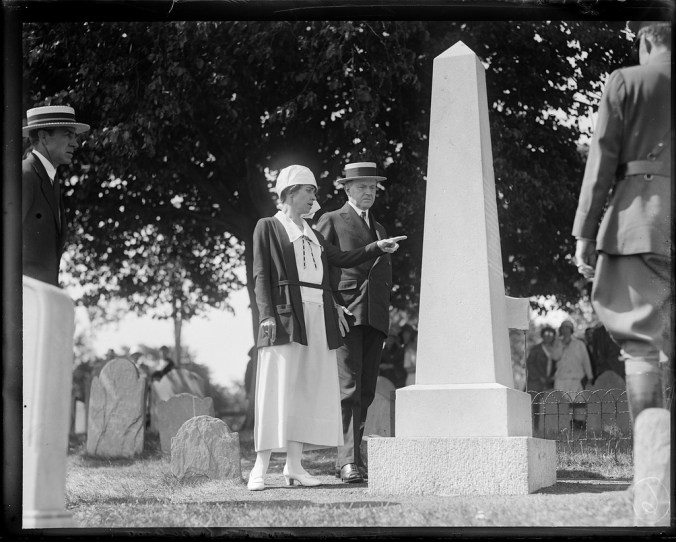
The Coolidges view the Bradford Memorial marker, Plymouth, Massachusetts.
Coolidge closes with this resounding thought,
“This brings us to the part that America is taking at the end of its second hundred and fifty years of existence. Is it not a part of that increasing purpose which the poet, the seer, tells us runs through the ages? Has not our Nation been raised up and strengthened, trained and prepared, to meet the great sacrifice that must be made now to save the world from despotism? We have heard much of our lack of preparation. We have been altogether lacking in preparation in a strict military sense. We had no vast forces of artillery or infantry, no large stores of munitions, few trained men. But let us not forget to pay proper respect to the preparation we did have, which was the result of long training and careful teaching. We had a mental, a moral, a spiritual training that fitted us equally with any other people to engage in this great contest which after all is a contest of ideas as well as of arms. We must never neglect the military preparation again, but we may as well recognize that we have had a preparation without which arms in our hands would very much resemble in purpose those now arrayed against us.
“Are we not realizing a noble destiny? The great Admiral who discovered America bore the significant name of Christopher. It has been pointed out that this name means Christ-bearer. Were not the men who stood at Bunker Hill bearing light to the world by their sacrifices? Are not the men of to-day, the entire Nation of to-day, living in accordance with the significance of that name, and by their service and sacrifice redeeming mankind from the forces that make for everlasting destruction? We seek no territory and no rewards. We give but do not take. We seek for a victory of our ideas. Our arms are but the means. America follows no such delusion as a place in the sun for the strong by the destruction of the weak. America seeks rather, by giving of her strength for the service of the weak, a place in eternity.”

The paradigm voters seek to change in their support of a vapid and vulgar braggart will only beget more of the vicious lawlessness it promises to overturn. Unless we come back to the same ideals that compelled the courageous, liberty-loving, and God-fearing men, women, and children of ’76, this hope for better change will evade us again. That generation two hundred years ago may have been under-prepared materially but not when it came to the spiritual and moral power necessary to overcome the steady retreat into darkness with the radiant light of principles. They understood that liberty is most vulnerable without the restraint of personal character. A rude and selfish people will inherit an arrogant and lawless ruler. A government by consent and a culture of law and order does not come without first obeying the most fundamental law ourselves: treating others as we would be treated according to the law of service.
The lure of the Tory mindset, resting as it did on the right to dominate others because of material privilege, held no illusions for the devout and liberty-loving people who fought and sacrificed at Bunker Hill. They stood fast, knowing how massive the odds were, because greater things were at stake. For them, success was discovered in one’s faithfulness to the task at hand, loving one’s neighbor, and walking humbly with God. It was not found in brandishing the ultimate insult, making the biggest claim, or bragging louder than anyone else. Their love for freedom necessitated the personal and practical self-government to stay free. One did not boast the way to greatness, one had to first prove worthy of trust. The blowhards and fakes of that day earned infamy. Honor came to those with consistency.
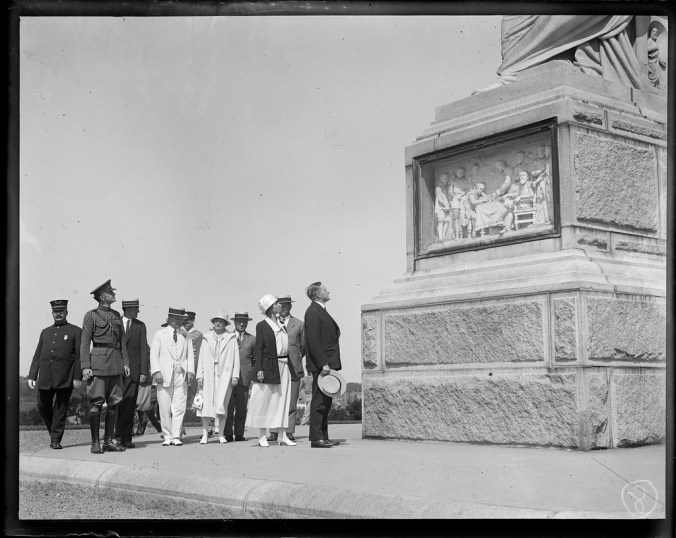
The Coolidges visit the Monument to the Pilgrims, Plymouth, Massachusetts. Courtesy of the Library of Congress.
Small men, who pride themselves on the strength they possess over others and the supremacy they exercise because they can, often survive, as Coolidge noted, but they do not elevate ideals, they do not raise standards, they do not strengthen faith, they do not serve but expect to be served when they attain power. We do not commemorate their acts of expediency and concession. We do not memorialize opportunists just as we do not revere big and brash claims, devoid of right deeds. Instead we honor those who sacrifice for that righteousness. It is in the sacrifice (speaking in actions) that we find an example worthy of greater trust and honor. It is this sacrificial ideal that kindled the spirit proven at Bunker Hill, later defended by Jefferson, and still later commended by Coolidge.
If we are to welcome the change that is coming it must rest on causes that are neither “light nor transient” just so we can feel good (at least for now) about ourselves and our country again. If the goal is self-esteem and any means will do, we are courting a greater threat to liberty than we realize. The road back will not come by repudiating a sense of reverence for the God who made liberty possible. We will not realize it by rejecting that most fundamental respect for each other as equals, the practice of that most basic human kindness toward one another, loving one’s neighbor as one’s self. Until then, the plummet we are experiencing will only accelerate toward a rule over the weak by the strong, a hierarchy of dominant personalities checked only by their own internal discretion, leaders who say and do because they can, and a culture that prides itself on how obscene and animalistic it can get.
All the while, the quiet heroism and exemplary devotion of the patriots at Bunker Hill beckon another hearing before it is too late. Coolidge challenges us: be “lovers of freedom,” as they were, “and anxious for the fray.”


 The Importance of the Obvious