
President Coolidge, second from left, beside Minnesota Governor and Mrs. Theodore Christiansen. First Lady Grace Coolidge, in white, stands to the far right on the train’s rear platform. July 1928.
When President Coolidge spoke of heroes at the dedication of an improved monument to Colonel William Colvill in the summer of 1928, he defined what made the heroic different from just another “glamor” attaching itself to “peril,” indistinguishable from common bandits and thieves: moral purpose and inspiration. Without goodness in good guys, heroism becomes no more uplifting or exemplary than a stickup on the highway or a cheap robbery at gunpoint.
He said: “Heroic deeds have about them an element of immortality. We stand in reverence before those who perform them and cherish their memory down through the ages because we recognize in them the manifestation of a spiritual life, the evidence of things not seen, a presence which was without beginning and is without end, a power that lifts men above the things of this earth into the realm of the divine. Except as we cherish a belief in these realities, we should have no requirement for heroic deeds and no reverence for those who do them.” Coolidge knew heroism existed not only in the person but the occasion. Without moral purpose and inspiration, the deeds and the individual engaged in them are cheap counterfeits of the real thing.
Such tributes befit authentic heroes like Colonel Colvill but they also offer something to be understood about our fictional heroes and heroines as well.
It is nothing new for cinema to attempt to reinvent, even destroy, its heroes and so the latest treatment of them in The Last Jedi is typical. What cheapens and denigrates heroes in this latest chapter of the Star Wars saga is that it fails to keep goodness and moral purpose in its good guys. There can be no immortality when characters who are supposed to earn our admiration and reverence hold innocent lives with contempt and disdain the repeated pleas for help from the oldest of friends. Heroes do not consider killing villains in their sleep either. These are not the actions of a good man, let alone anything approaching the heroic. Such is what Last Jedi‘s writer has done to Luke Skywalker. Rian Johnson did not stop there but irreverently presents to us a cast full of the self-centered, callous to suffering and loss, and indifferent to the innocent in need. This is something much more disturbing than some rebooted rendition of anti-hero heroes.
The sequels have illustrated in incandescently-disappointing fashion that they do not comprehend how to convey what it would be like to begin a story at Day One after evil has been vanquished and the good guys are triumphantly in charge. Thus, they revert to another Empire, another Death Star, another Emperor-Vader relationship, another retreat for the good guys. More revealing than the story-telling, however, is the politicization of Star Wars into another worn-out, tired social critique of current America. We are lost in a gutless moral equivalency so our great stories and the heroes who used to be within them need to be too.
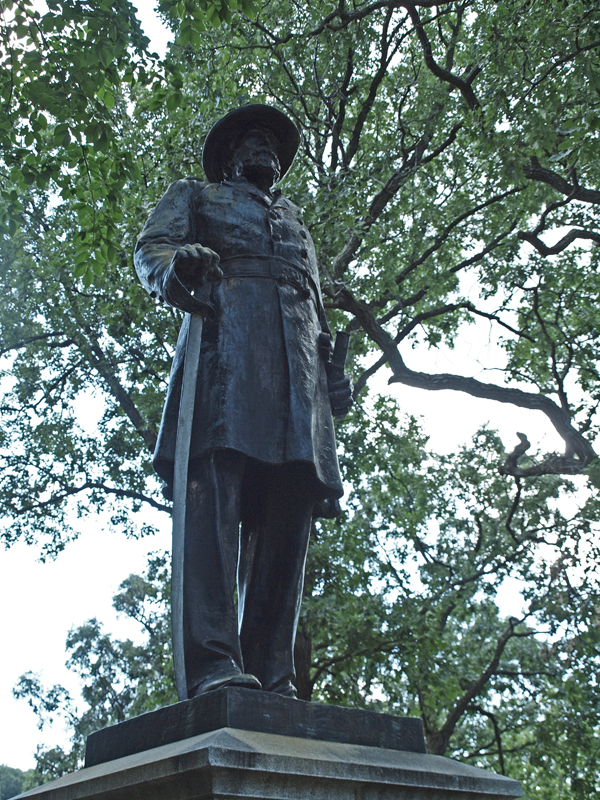
Colonel Colvill’s monument at Cannon Falls, Minnesota. Courtesy of the Cannon Falls Area Chamber of Commerce.
While Coolidge spoke of authentic heroes as those who accomplish morally inspiring deeds, another director celebrates his trite disregard for goodness by creating “good guys” who act just as insensitively with the lives of others as “bad guys” once did. Back when goodness motivated good guys, characters like Alec Guinness’ Obi-Wan Kenobi dashed to get involved and confront the evil face-to-face. Everyone else had to run just to keep up with their resolute determination. Doing nothing while friends plead for help and planets face total annihilation was unthinkable. If anyone had an excuse to hold a decades’ long pity-party over a faithless pupil, it was Obi-Wan Kenobi. When the call for help came, was he caught up in some juvenile, intransigent web of moral equivalency? Hardly! Saving what he loved summoned the very responsibility to fight what he hated, not endanger countless lives with some absurd postmodern fear that we become what we oppose by standing up to it.
In this new galaxy, only femininity endows emotional stability and exclusive rights to discretion. Masculinity is toxic and must be purged by the women who know so much better than the absurd men. In the end, however, both have botched it terribly on equally massive scales and we are left with neither gender having proven worthy of our confidence. Instead of celebrating this film as a cultural break-through, we are missing the deeper loss, being nonchalantly cast aside, when humanity – men and women – fail to honor its heroes by repudiating the very concept of heroism. When a society has given no place to the heroic, it cannot really comprehend the ideals that move worlds out of what is and closer to what ought to be, a glimpse of things eternal and heavenly.
Here is my review of a film that could have accomplished so much more than it did. If you don’t want spoilers, don’t read it.

The latest Dumpster Fire masquerading as a Star Wars film is neither a long time ago nor far, far away…It is right here in 2017 America and that is why it fails. It descends into little more than a pathetic diatribe of discontent at inequality in all its forms. It feeds the rage over income inequality in Canto Bight. It fills the supposed void of women and minorities in the galaxy. Yes, a galaxy full of all manner of life forms has a shortage of these…somehow. It attempts to cram the transcendent story of the originals (which spoke to everyone everywhere by not attempting to inflict a new definition of pain and suffering on the hapless viewer through the writer’s social justice crusade) into a cheap can of cliched lines papered over with prequel-like CGI and pointless action sequences.
This current infatuation with color and gender bleeds needlessly across the film; it validates why these were kept inconsequential in the originals. In the old days, mattered not it did, whether there was an equal ratio of “strong women” to “men” or an affirmative quota of minorities represented. The story was properly blind to all this. Lando was just one of the guys, whose place and purpose was actually pivotal to the story. Who can honestly say any of the new faces in this film carry half of his weight? Aunt Beru’s screen time may have been short but her role meant something strong and important to the arc of the narrative. In The Last Jedi, it is virtually an insult to expect the story to have arc at all, let alone require explanation of what we are watching. Apparently, for Rian Johnson, it thwarts the creative juices to indulge in such passé exercises as exposition or character growth. Viewers don’t need time to reason why, theirs is but to watch the old things die. That isn’t very reassuring.
Heroes, consistent with cinema’s ingrained hostility to them for decades now, are embodied yet again as morally confused, paralyzed by failure, and worthy of ignominious death. Icons have been so unceremoniously shoved out of the story at so fast a rate that R-2’s head should be spinning right now. That is not how the Force works. We had the Anti-Hero in Han Solo but as we saw his character develop, coming back at just the right time with a clear conviction all good men have for what is right. We could wink at the Anti-Hero persona because we knew it was all a show. Han was a hero in spite of it all, selflessly helping others in the path of sure destruction. Heroes succeeded at what they set out to do, they found a way. Han actually cared about people. His bluster of indifference was merely an act. Vice Admiral Holdo lets medical frigates disintegrate, other support vessels fall back and explode, and those vital transports get shot down until finally realizing something else can be done…but only after all but half a dozen transports are left, fleeing to Crait. Poe sacrifices half of those left on Crait to what purpose? Rose prevents Finn from knocking out the cannon that would have bought them all time. The average person – and this film is full of them – keeps making matters worse at the expense of other people’s lives. Heroes, on the other hand, distinguish between the choices others make and the personal burden to lay down their own lives not flippantly require it from others. Holdo finally recognizes this at the last moment.
The departure of Obi-Wan Kenobi’s pupil to the Dark Side did not plunge the old master into depressing layers of inert grief or self-flagellating despair. Heroes may encounter setbacks, betrayal, and even failure but they press on and overcome. Yoda could be reliably found at Dagobah when Luke needed him…both times. Failure did not cauterize the hero’s heart to a life-long obligation for others. Luke’s steadfast refusal to every plea for help by those he should still care most about – how could Kylo have soured those relationships too? – is not the behavior of a good man, let alone a hero.
Are we so wedded to justifying our cowardly escape from what is good and a weak cynicism toward heroes that we must remake them in our own image again and again and again? How arrogant we must be to keep making them just as lost and derelict in a world of moral equivalency as we are?
There was a time not long ago when heroes were revered as, foremost of all, good people who stared down life’s worst with courage and integrity on behalf of innocents in the path of evil. They kept faith when no one else would. They cared when all others turned away. As long as there was another innocent person out there, evil would have to face the hero before another life was needlessly lost. That was what made them worthy of respect and admiration. Last Jedi revels at euthanizing life faster than a Dr. Kevorkian clinic. Now the “good guys” are throwing living victims to the villains with glee. It has forgotten that heroes are first of all good people who love what is good and hate what is evil. The set who dominate the new generation of “leaders” convey nothing of this sensitivity. They freely sacrifice others’ lives with a disturbing obliviousness that does not bode well for whatever is left of this series. We are supposed to care about a cast of impatient boys and listless, but somehow empowered, women. We are supposed to glory in saving what we love, not fighting what we hate while spending lives faster than the gamers on Canto Bight. The irony of all those Rose had just relegated to potential slaughter seems lost on her. Hopefully, it is not lost on us.
The demographic glaringly absent – but whose kind is not welcome in this new galaxy – is the kind of confident men Alec Guinness’ Obi-Wan and Harrison Ford’s Han were. We are not allowed that privilege in Poe, Finn, and not really in Luke. J. J. Abrams perpetrated similar disdain for Han’s heroic place in Force Awakens. The women hesitate or derail the boys attempting to rise to the occasion. Listless leaderlessness abounds. Instead of wisdom and maturity, we have a collection of bumbling, conflicted amateurs. The First Order has better middle management than the Resistance, which thanks and absence of good men are now down to barely enough to fill the Falcon let alone a space cruiser.
Remember how young Luke had to practically race to keep up with Obi-Wan Kenobi’s rapid response to help the forces of good in A New Hope? Then, en route, an entire planet gets destroyed. Obi-Wan doesn’t slink away into a decades’ long pity party, does he? It hardens resolve to get out there and do what he can. Contrary to Rian Johnson’s notion that Luke’s arc as hero ended with Episode VI, people (even fictitious ones) don’t live that way. They keep developing. We are left to conclude our good guys have done nothing of consequence since Episode VI and we’re supposed to be okay with that. To stunt Luke’s growth, marginalize others, and commit still more to the outer rim of your quest for a new and different Star Wars is patently ridiculous. Johnson gutted the heroism of his best hero, something for which no hologram can compensate. This hostility to authentic heroism, paraded out as something novel, is getting old faster than the closing of a blast door.
Star Wars originally spoke with something far more substantial than a certain political point of view. Johnson’s denigration of it into yet another social justice bludgeon is going to reap more than he can possibly imagine. Viewers look in vain for anyone with a measure of mature judgment, moral integrity, and wise vision. Every sequence contains some social inadequacy feeling forced on the viewer’s consciousness. It stagnates with failure by almost every principal character in the film.
The flow of the story itself seems lost in space searching a direction. What is deemed important is later cast aside as irrelevant while peripheral threads are given center stage without a word why. As the director of this mess, Rian Johnson may feel the Force but he cannot control it.
Moreover, George Lucas understood story-telling in those originals. Rian Johnson seems committed to novelty not substance. Merely introducing the characters does not make them likeable. Even now, who really cares what happens to the cardboard cast of Last Jedi? Exposition and time taken to develop character were almost religiously denied. In Mr. Johnson’s neighborhood, we meet a host of faces content to be caricatures not characters. It is telling that entire action sequences and whole paper-thin roles could be cut out with no substantial impact on the outcome. With one exception, every time two original characters could have furnished exposition…Johnson felt it necessary to change the scene. Chewie and Luke meet again…time to leave. Luke and Leia begin talking…next scene. Even meeting the now deceased Snoke in person revealed nothing beyond who initiated those bizarre cyber dates between Kylo and Rey that brought the trio together. Who comes close to even rudimentary explanation for anything we are being inundated with as viewers? At least the cave in Empire had visualized its explanation. Rey’s cave encounter denies us the same courtesy. It feels more like a scene out of Pirates of the Caribbean than Star Wars. With the exception of Luke and Yoda, there seemed to be an aversion to any meaningful exposition anywhere.
It would not have been a cardinal sin against originality for Rian Johnson to have been guided less by the comics and spinoffs than the original trilogy. He should know there is already a wealth of unexplored material there. The alternative to Johnson’s wrecking ball approach is not slavish adherence to dry Jedi texts in Episodes 4-6 either. Perhaps he did not want to unlearn what he had learned from Mary Poppins or whomever inspired him to have Leia “Star Lord” herself through space (again with no explanation given or sought).
This was not the Star Wars we were looking for. But more than that, it was not the Star Wars it deserved to be. They might as well have shown us Chewbacca’s next vegan lunch with Vulcan engineers or picked up the Avengers to help crew the Millennium Falcon. Other than a few genuinely glittering scenes and another superb score by John Williams, the Last Jedi takes pride in its re-recreation of the series, but at what cost? Heroism is rapturously mocked and its unmarked graves trampled at almost every stage. The standup comedy routines and sarcasm in Last Jedi may appeal to millennials reared on late night programming but it becomes difficult to care when goodness and compassion, reverence and righteousness are expelled from this universe. So many are thrown away with nary the bat of an eye. Good men, not just eager boys, are jettisoned with the rest of the so-called garbage of the past. Rey may be our last hope in Episode IX. But, until men and women with good hearts, selfless courage, and moral purpose return to lead the story, I have a bad feeling about this.

 The Importance of the Obvious