“Why America Will Stay On Top”

“Why America Will Stay On Top”

Interviewing the ever-insightful scholar Paul Johnson, Brian M. Carney discusses why ideas matter more than people and how the World’s deepest thinkers have been anti-intellectuals. Johnson, who has explained the substance behind Coolidge’s record in “The Last Arcadia,” chapter 6 of his book Modern Times, keeps an enduring confidence that Americans will find a renewed strength from the power of its founding ideals. This unshakable faith in the people of the country to summon both the will and the work to clean up the mess left by a self-anointed ruling class of intellectuals is right at home with the full assurance Calvin Coolidge held toward Americans as a people. Our thirtieth president, the last to earn a classical education, would firmly agree with Mr. Johnson. In fact, Coolidge would likely find himself quite at home with the most profound philosopher of civilization (a distant second to Christ, of course), the plain, simple-living, anti-intellectual Socrates.
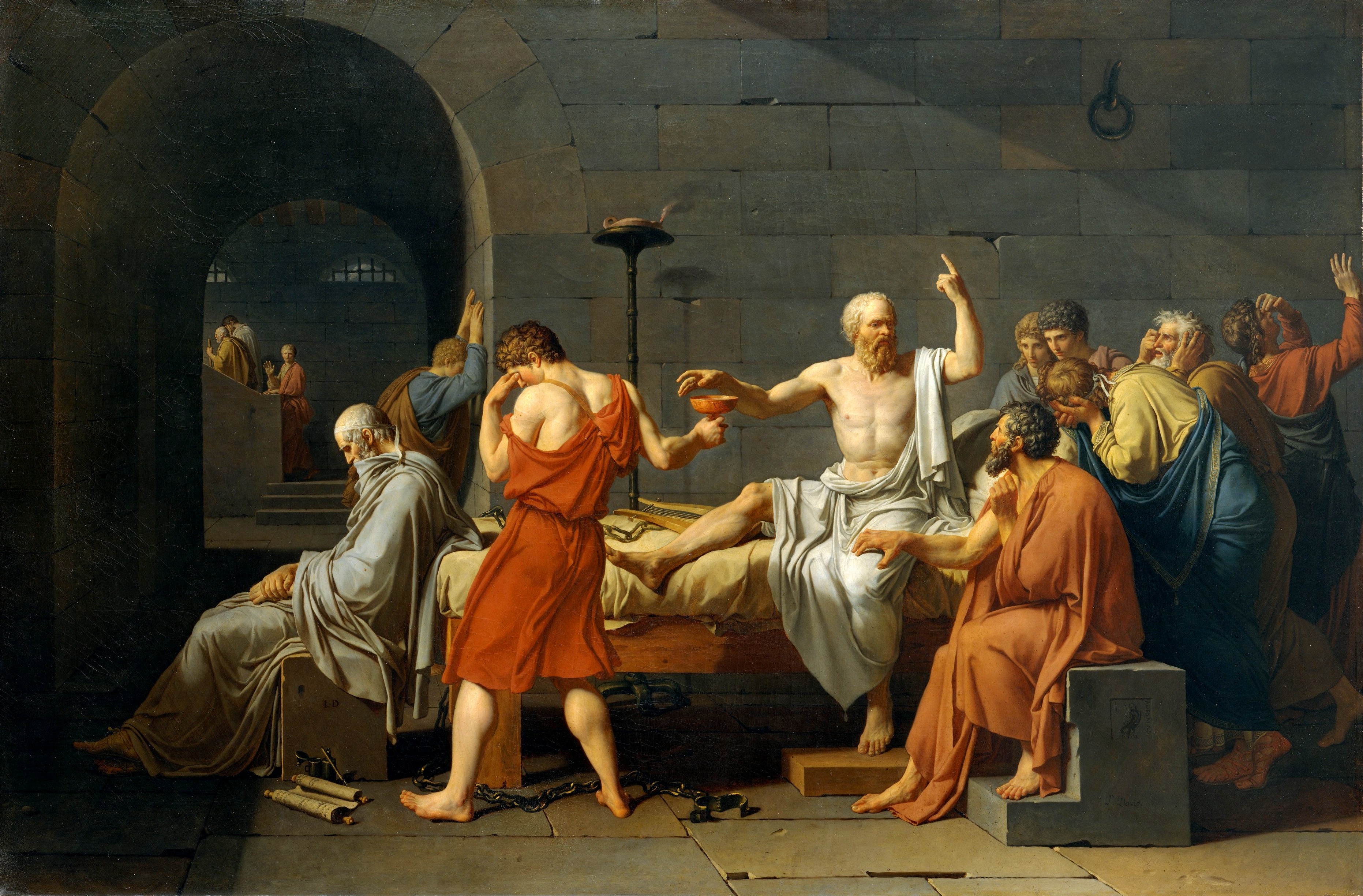
Jacques-Louis David's "Death of Socrates" depicting the ultimatum imposed on the philosopher to recant his ideas or be forced to drink hemlock. He continues to discourse on the truth of the eternal and spiritual. The painting dates from 1787, the year the Framers were thinking through the principles of sound, constitutional government.

Jacques-Louis David’s “Death of Socrates” depicting the ultimatum imposed on the philosopher to recant his ideas or be forced to drink hemlock. He continues to discourse on the truth of the eternal and spiritual. The painting dates from 1787, the year the Framers were thinking through the principles of sound, constitutional government.


“We do not need more of the things that are seen, we need more of the things that are unseen. It is on that side of life that it is desirable to put the emphasis at the present time. If that side be strengthened, the other side will take care of itself. It is that side which is the foundation of all else. If the foundation be firm, the superstructure will stand” — Calvin Coolidge, June 19, 1923, “The Things That Are Unseen,” delivered at Wheaton College, Norton, Massachusetts.

“We live in an age of science and of abounding accumulation of material things. These did not create our Declaration. Our Declaration created them. The things of the spirit come first. Unless we cling to that, all our material prosperity, overwhelming though it appear, will turn to a barren sceptre in our grasp” — July 5, 1926, spoken at the Sesquicentennial Stadium in Philadelphia.
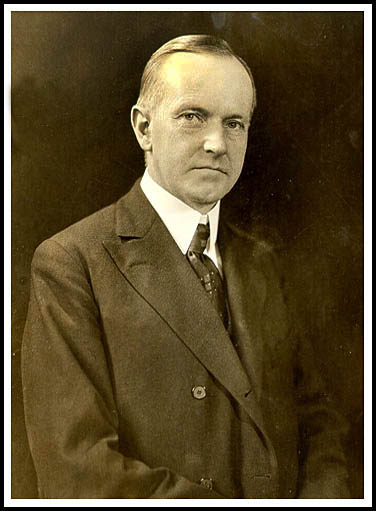
Coolidge-75

“Survey of the Presidents of the United States”

“Survey of the Presidents of the United States”

So many Presidential surveys through the years have been encumbered by the subjective biases of the participants rather than the objective standards of fidelity to one’s oath and faithful execution of the laws and Constitution. At long last Franklin’s Opus has conducted such a study with some very unexpected results…at least for the “consensus” in much of modern academia. Of Calvin Coolidge, they said,

“He understood not only the constitutional limits of the presidency and of the central government, but adhered to a strong policy of fiscal discipline and also understood the cultural underpinnings that made free government in America possible.” –Dr. Gary Gregg

“A man of supreme integrity and humility, ‘Silent Cal’ believed not only that the ‘business of the American people is business’ but also, as he said in the same speech, that peace, honor, and charity were the higher things of life. A fiscal conservative, he understood that the limitation of government was the foundation of individual liberty.” –Dr. Stephen Klugewicz

Check out where the Presidents rank (and how different Mount Rushmore would look) when the promises of the solemn oath they take are applied to their administrations. Rankings by others have proceeded with a presupposition against liberty and prosperity but toward centralized power and grand intentions. This time, the scholars on the panel look for who advanced our republican principles in office, not merely campaigned on them to secure support.

Check out Kai’s superb assessment of this research as well and, while there, spend some time learning more about Cal Coolidge.

“The Calvin Coolidge Presidential Foundation”

Here is an excellent recap of the first Coolidge Gala Dinner held last November. We look forward to many more to come. The fresh introduction to Calvin Coolidge for many who do not know who he is, what he accomplished and why he is important is thrilling to behold.

What a tremendous way to bring back our thirtieth President from an unjust “exile” by historians and to relearn the principles of limited government, engaged citizenship, and fiscal discipline by which he lived and led. These truths, along with many others, lack none of the necessity or power now than they did in his time. This is NOT out of some simplistic nostalgia about the “good old days” but rather strikes at something far more profound and fundamental: A government held to proper limits by a sovereign citizenry is the only foundation for social progress, economic opportunity and individual liberty.

In this period where so many assume “Big Government” is permanently here to handle every human contingency, we are inescapably bound by the reality of Coolidge’s precepts. As much as we may wish otherwise, we cannot indefinitely spend what we do not have just as we cannot reap what we have not sown, whether as individuals or nations. We have no more outgrown Coolidge’s belief in self-government, exemplified by such virtues as hard work, personal initiative and self-control, than the earth has outgrown a need for the sun.

As Mr. Cal Thomas, quoting his Presidential namesake, brings to our attention, “We can not continue to enjoy the result” of all our success “if we neglect and abandon the cause.”