
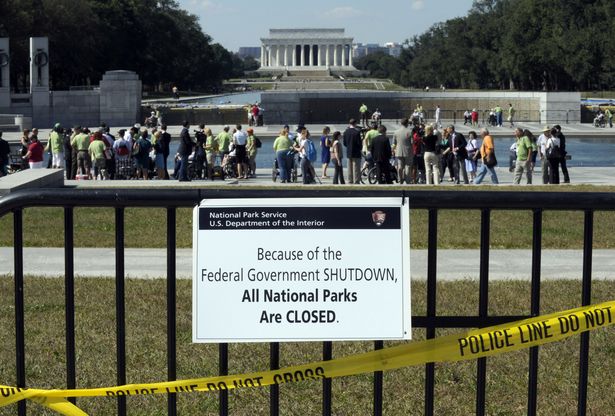
As events unfold across America’s most familiar parks, monuments and memorials, it is becoming increasingly obvious that we are witnessing a very deliberate theatrical display by the Obama administration. Whether denying the request to allow D-Day veterans the permission to see their own memorial in Washington or barricading the publicly-owned parking lots furnished for privately-owned sites like Mount Vernon, the result is anything but an honest mistake. It is evident closing sites normally open to the public 24/7 (after Park Service personnel go home) that this is not real. It is meant to convey a false perception of reality in order to score cheap political points against a Republican Party leadership that has willingly conceded everything to avert “shutdown.” Instead, the President and his Senate majority leader have rejected every proposal to fund, by separate legislation, every program but one: “Affordable” health care because of the obvious harm it is already inflicting on millions of Americans. Obama, having no interest in working out any solutions, demands full support for “Obamacare” or no one gets any funding and he will make sure it hurts.
This denial for funds even applies to the National Institute of Health, despite the Republican measure (with no strings attached) to keep research and treatment provided for children with cancer. Asked by reporters on Wednesday, “[I]f you can help one child with cancer, why wouldn’t you do it?” Democrat Majority Leader Harry Reid responded, “Why would we want to do that?”
Only in the artificial world of partisan showmanship does this kind of behavior on the part of Obama and his Party make sense. He is trying to create a perception of reality and no attempt to actually solve the problem is allowed, especially when it comes from those cootie-infested Republicans. Full funding for Obamacare or else kids will be denied cancer treatment, veterans will be refused access to their own memorials and privately owned properties will be barricaded…until all of you out there in this ungrateful country feel the pain of Government “shutdown.”
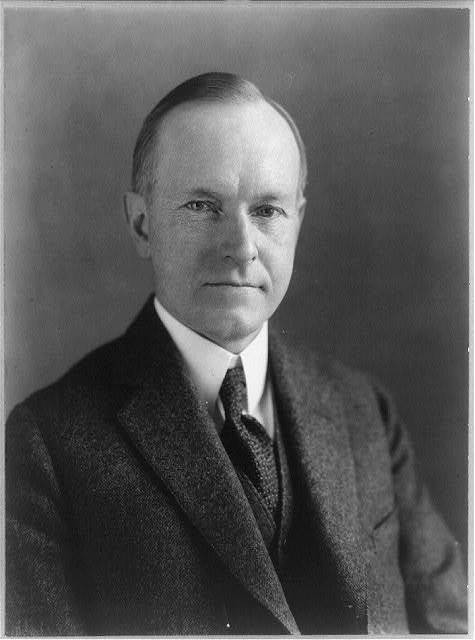
When Coolidge contemplated the true meaning of politics, he did not have much good to say about Washington, D.C. It was instructive, to be sure, but it was usually a lesson in what not to do rather than illustrative of the sound and noble purpose of statesmanship. To obtain guidance from politics as it ought to be, he had to return to the ancient principles of political philosophy learned from the Greeks. “Politics is not an end,” he would reiterate, “but a means. It is not a product, but a process. It is the art of government.” This current regime, however, has been weaned on Alinsky’s Rules for Radicals, the influence of Frank Marshall Davis and a host of other violent and hateful men and women. Politics is the end result for this group. This is not a politics Coolidge would have tolerated. It has become a seemingly endless chain of subterfuge, calculation and disregard for any law that blocks the selfish interests of this man’s ideology. The agenda trumps everything. Nothing is allowed to divert, detract or disparage what this one man wants done. Governing never enters the picture. It is only by perpetually politicizing every event for personal advantage that politics itself is corrupted from its original purpose as a “minister to civilization” with a “candid and sincere service.” Instead, it is the “counterfeit” and “false,” the “spurious presentment” or fake imagery that defines politics now, Coolidge had said. “So much emphasis has been placed upon the false that the significance of the true has been obscured and politics has come to convey the meaning of crafty and cunning selfishness.” The “mean” or lowest common denominator has become the central focus of political attentions. The “sordid” or shameful and sleazy character of politics, while distorting all sense of “true and dignified proportions” at present, can be defeated with a clear-headed and moral leadership.
Inspiring people to greater things is not gone. Though it be “obscured,” as Coolidge noted, it has not been eradicated. It is ready to come back with a righteous vengeance when honest and genuine leadership steps forward, rejecting the fraudulent snake oil salesmanship of this Administration and returning to a “sincerity and integrity of purpose” which comes from men and women, like us, who hold fast an “informed conscience.” “All the predominant political opinion of the nation which is worth cultivating is never impressed by decisions made for effect. Those who compose that body want responsible officeholders to try to find out what is best for the welfare of the people and do that…Pretense does not appeal to them…The people know a sham even when they seem to be trying to fool themselves and they cannot help having a wholesome respect for reality.” The staged political production Obama has orchestrated here to further a deliberately fake perception is no service to civilization. It is a repudiation of civilization for nothing more than concession to one man’s desires to instigate perpetual backlash against his enemies, force them to fund “Obamacare” in order to escape this and any future “shutdown” and cement a permanently uninformed electorate that will keep his vision for this country in power for decades to come.
We hold greater power than we realize to effect a far brighter outcome than this fate. Restoration remains in our hands. Every time we have united together and exercised that sovereignty over our Government, we ultimately prevail. It was true in the legislative triumphs after the 1995 “shutdown” as well as the 2010 election, winning control of the House. It was true in the defeat of gun control and even now in what is an incremental defeat of “Obamacare.” It may not yet appear victorious to us but greater are those who are with us than those who are with pretense and theatrics.
Coolidge, upon accepting his nomination to the Vice-Presidency in July 1920, declared, “All authority must be exercised by those to whom it is constitutionally entrusted, without dictation, and with responsibility only to those who have bestowed it, the people” (emphasis added). Coolidge embraced honesty. He knew that telling the truth, however much it challenged his listeners, served the good. He lived in reality, dealt straightforwardly with all and refused to manipulate people with deceitful fantasies for his benefit or the perceived gain of anyone else. When he reminded people, as he often did, to “work out salvation,” he was not engaging in callous platitudes or pollyannaish delusions, he was expecting nothing less than what Americans have proven is possible every day of our exceptional history.



 The Importance of the Obvious