Madison Project: Coolidge on Immigration

Madison Project: Coolidge on Immigration

This past May, the policy director of the Madison Project, Daniel Horowitz, took an important look at what Calvin Coolidge thought about immigration. As the pressure is on to overhaul current law on the matter, historical perspective from the man who took time to explain the purpose of restriction and its very real benefits to both Americans and those who want to come here, this short piece merits attention.

The President signing the Johnson-Reed Act, on the south lawn of the White House, May 26, 1924.

The President signing the Johnson-Reed Act, on the south lawn of the White House, May 26, 1924.

Included in Japanese Immigration by Raymond Leslie Buell. Boston: World Peace Foundation, 1924. Digitized at http://pds.lib.harvard.edu/pds/view/4009420?n=95&s=4&printThumbnails=no.
Included in Japanese Immigration by Raymond Leslie Buell. Boston: World Peace Foundation, 1924. Digitized at http://pds.lib.harvard.edu/pds/view/4009420?n=95&s=4&printThumbnails=no.

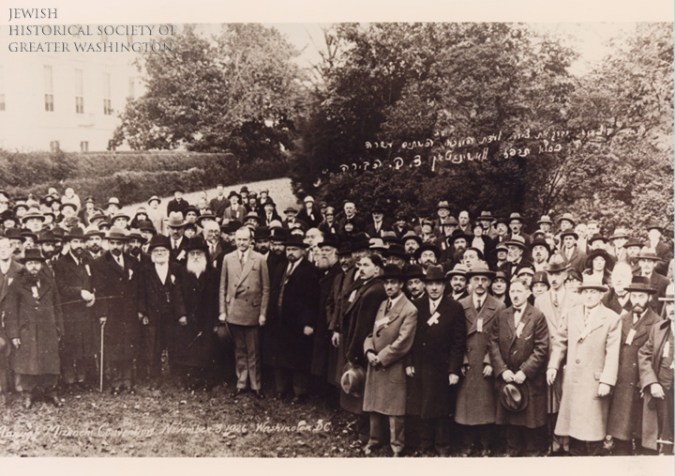
Meeting at the White House, 1926

Meeting at the White House, 1926

“I think — the best thing I can wish to the Jews in Palestine — is that they will get on — as well as they get on — over here” — Calvin Coolidge, 1926.


As a result of a mixture of hostility to Jewish settlement throughout Europe and the activities of the radical “Parushim,” of which Justice Brandeis was a leader, the move to establish homes in British Palestine gained momentum following the First World War. Most Americans, including Jewish Americans, had no interest in carving out a “Promised Land” in Palestine. Here President Coolidge is pictured with Orthodox Zionists. These men and women were working to establish a place where Jews from everywhere would live together as a nation. Rather than observe the principle: be at peace with all men so far as it depends on you, the movement sought to pull up roots and plant anew.  Coolidge’s statement, as the representative of America’s ideals, is a testament to this more excellent way here at home and in our relations abroad. The solution for the peace of the world was not in mandated Statehood but in exercising the obligations of citizenship here and wherever Jews already resided.

Photo part of a collection held by the Jewish Historical Society of Greater Washington.

Coolidge Meets Ezra Meeker, October 1924

Coolidge Meets Ezra Meeker, October 1924

Calvin Coolidge shakes hands with renowned pioneer, Ezra Meeker, who set out in an ox-driven cart with his wife and young son on the Oregon Trail across some 2,000 miles in 1852. Having made the trek again by covered wagon (1906-1908), automobile (1916) and finally by airplane (1924), he was flown to Washington, D.C. to meet President Coolidge. Here the legendary adventurer and entrepreneur stands at ninety-three years of age, ready to advocate air and highway travel to a President already on board with modern technology.