On Racial Equality and Opportunity

Image

More than twenty years before the Supreme Court mandated desegregated schools and forty years before the Civil Rights Act, blacks and whites were already moving toward a non-segregated existence throughout the country. Moreover, sound economic principles were helping everyone to experience opportunity and the results of upward mobility in America across the entire spectrum. Blacks, finding greater opportunities “voted with their feet,” and began the “Great Migration” to the North. Wages rose in both North and South, home ownership grew 300% percent in the 1920s among blacks. Lynchings plummeted and adjustment of one’s new neighbors, rough at first, adjusted on its own — without the need for government direction of social behavior. It was the incessant social policy of the 1930s and 1940s that retarded, even erased, the progress made in previous decades.

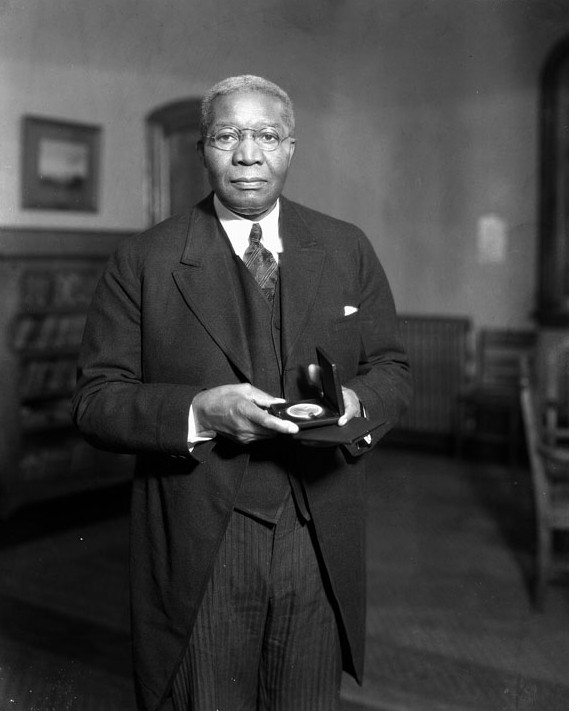
Dr. Moton of Tuskegee Institute studied the progress of his fellow blacks in America for many years, including the Coolidge Era, and he found conditions to be moving steadily toward voluntary desegregation as well as political and economic opportunity. Freedom and equality were marching hand in hand decades before federal involvement. He observed that in sixty years since emancipation, blacks owned 22 million acres of land across the country, 600,000 homeowners (a figure which would rise throughout the remainder of the decade) and ownership of 45,000 church buildings. Blacks owned and operated over 50,000 businesses with a combined capital value of more than $150 million ($2.1 million today), including banks and other “white collar” work. There were over 60,000 in professional fields, 44,000 school teachers and 400 newspaper and media publications operated by blacks. Literacy had dropped twenty percent and would continue to improve with “Coolidge Prosperity.”

Moton would summarize, “Still the Negro race is only in the infancy of its development, so that, if anything in its history could justify the sacrifice that has been made, it is this: that a race that has exhibited such wonderful capacities for advancement should have the restrictions of bondage removed and be given the opportunity in freedom to develop its powers to the utmost, not only for itself, but for the nation and for humanity. Any race that could produce a Frederick Douglass in the midst of slavery, and a Booker Washington in the aftermath of reconstruction has a just claim to the fullest opportunity for developments.”

Writing to Dr. Moton in August 1924, Calvin Coolidge would enthusiastically commend the tangible progress made over so short a timeframe, “My dear Dr. Moton…Only a few weeks ago, I had the pleasure, at the Commencement of Howard University, of reviewing briefly and inadequately the material evidences of the progress of the coloured people…I wish to tell you of the deep impression that was made upon me by my studies of the Negro race’s achievements. In the accumulation of wealth, establishment of material independence, and the assumption of a full and honorable part in the economic life of the nation, it may fairly be said that the coloured people themselves have already substantially solved these phases of their problem. If they will but go forward along the lines of their progress in recent decades, and under such leadership as your own and many others among their excellent organizations are affording, their future will be well cared for.”

We mark the fiftieth anniversary of Dr. King’s speech on steps of the Lincoln Memorial, echoing not only the actions of Dr. Moton, who spoke there in 1922, but the faith in America to hold true to its founding ideals. It was not government to do for us, it was not the solution to give place to either despair or perpetual animosity, it was for us to return to the foundation already laid by the Framers. It is a testament to America’s virtue that Moton and King conclude their speeches with mirroring themes. America is not the problem, its ideals furnish the solution and give a conscience for fairness and justice. By aspiring to those ideals, we renew our pride as American citizens, that “fair and goodly land,” as Moton calls it. As Moton, King and Coolidge looked out over the problems and possibilities of living together a united people, they each saw the answer not in advertising the services of government to fix the human heart, not in fueling class and racial inequities but in appealing to be better than we have been by reclaiming “a dream deeply rooted in the American dream.” A dream that traces back to a shared Creator who sees beyond the externals and non-essentials to the individual’s character and soul. That dream, championed by the Founders and commended by King, Moton and Coolidge point us not to the halls of Washington for answers but to our own love for our neighbor.
Image

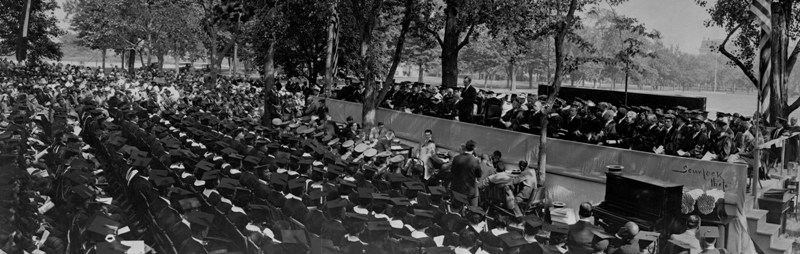
President Coolidge addressing Howard University, June 1924

On Separate Classes

jb_jazz_coolidge_3_e

“There is yet another manifest disposition which has preyed on the weakness of the race from its infancy, denounced alike by the letter and the spirit of the Constitution, and repugnant to all that is American, the attempt to create class distinctions. In its full development this means the caste system, wherein such civilization as exists is rigidly set, and that elasticity so necessary for progress, and that recognition of equality which has been the aim and glory of our institutions, are destroyed and denied. Society to advance must be not a dead form but a living organism, plastic, inviting progress. There are no classes here. There are different occupations and different stations, certainly there can be no class of employer and employed. All true Americans are working for each other, exchanging the results of the efforts of hand and brain wrought through the unconsumed efforts of yesterday, which we call capital, all paying and being paid by each other, serving and being served. To do otherwise is to stand disgraced and alien to our institutions. This means that government must look at the part in light of the whole, that legislation must be directed not for private interest but for public welfare, and that thereby alone will each of our citizens find their greatest accomplishment and success” — Governor Calvin Coolidge, formally accepting Republican nomination as Vice-President, July 27, 1920.

More than ten years later, in the midst of economic downturn, Garet Garrett would echo the same point through his column in the Saturday Evening Post. In articles like, “There Goes Mine,” written in 1932, Garrett attacks the fallacy that economic classes are both fixed and permanent. He refers to the resentment during depressions of car ownership and how confidence in one’s ability to move upward from poverty to prosperity remains entirely within each person’s reach. Coolidge and Garrett both understood that liberty means opportunity, an opportunity that is not coincidental but directly due to our unique political and economic system as founded. Margaret Thatcher, the late British prime minister, grasped the significance of this truth better than have many Americans. She observed that when opportunity is maximized, class distinctions diminish and the disparity between “rich” and “poor” decreases, contrary to every economic “expert.”

As all three realized, however, the opposite holds true every time socialism is allowed to set policy, be it locally or nationally. For the Left, as Thatcher noted, it is better for the poor to stay poor “provided the rich were less rich.” Such a view summarizes modern liberalism. It is the Left’s animus against success and its vested interest in perpetual victim-hood which drive its agenda. It is never about rising to higher aspirations or striving for greater ideals. It is about exchanging our independence for the security they provide, a security of marginal existence.

Coolidge, Garett and Thatcher all knew what the Left denies to this day: policies that maximize individual opportunity remove class distinctions automatically and enable equality on the basis of each person’s determination and potential. Modern liberals would have us all equally poor, feeling guilty of ever rising above the marginal, dependent and miserable and call that “progress.” Incapable of fixing the problems Coolidge’s policies addressed, all that is left for modern liberalism is to keep the class warfare going, to provoke violence, and to project its failures onto those striving to heal and reunite us with the freedom of a truly classless society envisioned by our Framers.

Garet-Garrett margaret-thatcher

On those Roaring Twenties

Image

Historian Paul Johnson


It is fitting that those who helped drive the Reagan Revolution forward humbly credit their inspiration to the shy, quiet man from Vermont, Calvin Coolidge. In a very real way he bequeathed the essential recipe for the successes of the 1980s. While the ingredients were not precisely followed in every respect, especially concerning the payment of debt, the principles contained such power that even Congressional spending could not slow it down.

President Reagan’s combination of political saavy, biting wit, unassuming competence and ability to cut through the complex and see the simple essence of an issue derived not merely from his life’s experiences, they found inspiration from his study of Coolidge. Reagan, after all, like several of the men and women who comprised his team of “revolutionaries,” first came to understand the world during the Coolidge Era and in the years shortly thereafter. The lessons “Silent Cal” taught in both word and action left abiding impressions on future Secretaries of the Treasury (Donald T. Regan) and Defense (Caspar Weinberger) and future Attorney General Edwin Meese III, along with many others.

Two scholars, in particular, were returning to Coolidge’s record in order to reassess his very real achievements. In 1982, Thomas B. Silver, in Coolidge and the Historians, would lead this effort and unearth most of the shoddy and partisan reporting against the thirtieth president and the 1920s. In 1984, Paul Johnson, in the sixth chapter of his Modern Times: The World from the Twenties to the Nineties, would roll back the shroud thrown over not only the genuine triumphs of the Roaring Twenties but also the legacy of Mr. Coolidge. As Mr. Johnson would reflect on this reserved and disciplined leader, he would not only find him to be “the most internally consistent and single-minded of modern American presidents” but he, like all of history’s great men, was not an intellectual. To Mr. Johnson, that is a very good thing because “[a]n intellectual is somebody who thinks ideas are more important than people.” Wilson and Hoover approached the world this way while Coolidge, and Reagan, did not. To Coolidge and Reagan, people were the preeminent focus of their policies. The “smartest ones in the room” miss that all-too-obvious truth. People were genuinely benefited by Coolidge’s leadership.

Johnson could accurately survey the Twenties not as an aberration of gross materialism or empty gains but as an unprecedented prosperity that was both “very widespread and very solid” (p.223). “It was,” Johnson corrects, a prosperity “more widely distributed than had been possible in any community of this size before, and it involved the acquisition, by tens of millions, of the elements of economic security which had hitherto been denied them throughout the whole of history. The growth was spectacular.”

As a direct result of Coolidge prosperity, national income jumped from $59.4 to $87.2 billion in eight years, with real per capita income climbing from $522 to $716. Millions of workers purchased insurance for the first time, a phenomenon of a healthy economy Obama is deliberately ignoring. Savings quadrupled during the decade. Ownership in fifty stocks or more reveals the vast majority were not “the rich,” but housekeepers, clerks, factory workers, merchants, electricians, mechanics and foremen. Union membership plummeted from just over 4 million at the outset of the 1920s to 2.5 million by 1932. As small and large businesses succeeded, people were able to provide holidays with pay, insurance coverage and pensions as well as other benefits, giving substance to Coolidge’s dictum that “large profits mean large payrolls” thereby making “collective action superfluous,” as Johnson observes (p.225). Home ownership skyrocketed to 11 million families by 1924.

Perhaps the most obvious index of prosperity could be seen in automobile ownership. What began as a novelty for just over 1 million Americans in 1914 (with less than 570,000 produced annually) exploded into 26 million owners with over 5.6 million autos produced annually by 1929. Air travel was fast becoming the normal mode for “regular” folks and classes were rapidly dissolving from upward mobility. In 1920 a meager $10 million was spent on radios. By 1929 that figure had surpassed $411 million, which was itself small compared to the $2.4 billion spent on electronic devices as a whole in the Twenties.

These years were not, as some would claim later, removed from an appreciation of the past. The expansion of education is “[p]erhaps the most important single development of the age” (Johnson 225). Spending on education increased four times what it was in 1910, from $426 million to $2.3 billion. But unlike today’s habit of throwing money at the problem, it brought results. Illiteracy actually went down over fifty-percent. A “persistent devotion to the classics,” with David Copperfield at the head of the list, defined the decade. Culture was reaching the homes of those who had once been the least connected Americans through reading clubs, youth orchestras and “historical conservation” movements that would restore sites like Colonial Williamsburg.

“The truth is the Twenties was the most fortunate decade in American history, even more fortunate than the equally prosperous 1950s decade, because in the Twenties the national cohesion brought about by relative affluence, the sudden cultural density and the expressive originality of ‘Americanism’ were new and exciting” (p.226).

The problem, as Mr. Johnson concludes, with the expansion of the Twenties was not that it was “philistine or socially immoral. The trouble was that it was transient. Had it endured, carrying with it in its train the less robust but still (at that time) striving economies of Europe, a global political transformation must have followed which would have rolled back the new forces of totalitarian compulsion, with their ruinous belief in social engineering, and gradually replaced them with a relationship between government and enterprise closer to that which Coolidge outlined…” More of the same policies would have prevented much of what followed in the 1930s and beyond. “[M]odern times would have” indeed “been vastly different and immeasurably happier.” The purpose served by Coolidge “minding his own business,” as he put March 1, 1929, was perhaps more a forecast of his successors than an introspection. If only Hoover had been listening more carefully. The downturn in 1929 would certainly have more closely resembled the depression of 1921 and, with the Harding-Coolidge recipe of “masterful inactivity,” have spared millions of lives the terrible suffering and avoidable loss brought on by Hoover’s spending and Roosevelt’s “New Deal.”