On the Importance of Budgeting

“To be confidential for a moment, I may confess that an invitation to make a speech is not the rarest experience that comes into a President’s life. But I listened with, I hope, proper politeness, down to the point where your spokesman started explaining that you were to devote an evening to the consideration of a budget. Then I began to take real interest, for the budget idea, I may admit, is a sort of obsession with me. I believe in budgets. I want other people to believe in them. I have had a small one to run my own home; and besides that, I am head of the organization that makes the greatest of all budgets–that of the United States Government. Do you wonder, then,, that at times I dream of balance sheets and sinking funds, and deficits, and tax rates, and all the rest?

     “Yes, I regard a good budget as among the noblest monuments of virtue. It is deserving of all emulation; but there are other topics that afford more obvious inspiration to popular oratory. So when I found that you actually wanted a budget speech, I felt a warming sense of gratitude…

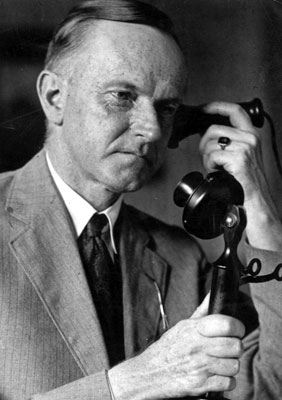
     “Nothing is finer than the open hand and the generous heart that prompt free and unselfish giving. But modern social science knows, also, that ill-directed charity is often directly responsible for encouragement of pauperism and mendicancy. The best service we can do for the needy and the unfortunate is to help them in such manner that their self-respect, their ability to help themselves, shall not be injured but augmented. Nobody is necessarily out merely because he is down. But, being down, nobody gets up again without honest effort of his own. The best help that benevolence and philanthropy can give is that which induces everybody to help himself” — Calvin Coolidge, speaking over the telephone from the White House to the Federation of Jewish Philanthropic Societies of New York City, October 26, 1924, as they listened together from the Hotel Pennsylvania.

317

On “Religion and the Republic”

Unveiling of the Equestrian Statute of circuit-riding missionary Francis Asbury, October 15, 1924. President Coolidge is seated, with back turned to the camera, directly behind the speaker.

Unveiling of the Equestrian Statute of circuit-riding Methodist missionary Francis Asbury, October 15, 1924. President Coolidge is seated, with back turned to the camera, directly behind the speaker.

When President Coolidge spoke on this day eighty-nine years ago, he reflected upon the circumstances of America’s making. Addressing those gathered in honor of one of the most dedicated missionary-circuit riders to America, the Methodist Francis Asbury, Coolidge recalled the great power of spiritual revival and religious renewal that set the stage for the political and economic freedom that followed. Our nation was not built on humanistic creeds, demanding a censorship of God, a silence of any public profession of Christ, or separation of religious belief from one’s public responsibilities. Our nation did not entrust its foundation stones to the Old World’s belief that man was his own final authority. Nor did America trust, as would France, Italy and many other nations, that the State, as the embodiment of that blind confidence, deserved omnipotent power to effect human perfection. On the contrary, Coolidge looking across the years concurred with those who were there at America’s making, “in the direction of the affairs of our country there has been an influence that had a broader vision, a greater wisdom and a wider purpose, than that of mortal man, which we can only ascribe to a Divine Providence.”

Religion informs our understanding of self-government. Religion makes freedom possible. It is what preserves the balance between liberty and tyranny. It was no demand for oppressive theocracy. It was the opposite of coerced belief systems, a deliberate protection of the individual conscience from government mandating what to believe and practice. It gives strength to culture and preserves a peace in society that no order of government can attain. This is why something so fundamental to America’s life and growth cannot be divided into secular and sacred. It was the spreading of religious truths that prefaced the fight for independence in the years that followed America’s “Great Awakening.” No man could honestly claim credit for these events. America owes its existence not simply to some great man, or committee of sages, but to Providential favor.

The experience of history teaches us that there are two, irreconcilable theories of government. Coolidge explains, “One rests on righteousness, the other rests on force. One appeals to reason, the other appeals to the sword. One is exemplified in a republic, the other is represented by a despotism.” Coolidge knew that a proper grasp of religious belief did not clash with logic, it made rationality possible. Faith was no “crutch for the masses,” it was the bedrock of sound living. Government, on the other hand, is blunt force. By keeping government clear of regulating what individuals must believe and worship, reason not force prevails. In this way, the conscience is preserved not in service to the State but to God, where it must remain. Just as Coolidge would reaffirm, America made its decision which theory of government would function here at its founding. Consequently, Coolidge could, without apology, declare, “Under our constitution America committed itself to the practical application of the rule of reason, with the power held in the hands of the people.” Not consigned to the malleable interests of government, “the work of religion” is done by the individual. “We cannot escape a personal responsibility for our own conduct. We cannot regard those as wise or safe counselors in public affairs who deny these principles and seek to support the theory that society can succeed when the individual fails.” No government can supplant the personal obligation of each one of us to live rightly. We are no more able to delegate our moral duties than government is to mandate its own redefined morality upon each individual. Making abortion or same-sex marriage legal does not make them moral. Forcing individuals to violate conscience may become law but it cannot be made righteous. Government cannot make moral what is immoral. Government cannot relieve one from the duties of conscience. Government cannot save the soul.

As President Coolidge concluded his dedication of the devout minister’s life and example, he considered all the hardships through which the missionary triumphed. His success was America in miniature. It served as a reminder that this nation, having faced some of the fiercest storms imaginable, emerges truer and better on the other side. The current troubles were not cause for despair or surrender. For, Coolidge noted, “[U]nderneath it all our country manifested then and has continued to manifest a high courage, a remarkable strength of spirit and an unusual ability, in a crisis, to choose the right course. Something has continued to guide the people.” That guide was not from human greatness or mortal ability but came by heeding “the still small voice,” the Divine authority that inspires men to carry on and live by “the word of truth” in the most violent storm. Such is necessary if the “contests of the day” are to be “preparations for victories on the morrow.” To all those detractors of America, Coolidge said, “America continues its own way unchallenged and unafraid. Above all attacks and all vicissitudes it has arisen calm and triumphant; not perfect, but marching on guided in its great decisions by the same spirit which guided Francis Asbury.” That spirit guides, not in the power of government to redefine morality, but in the conscience of the individual free to believe and practice its obligations without fear or hindrance. The individual, first committed to the truth, finds the ultimate source of strength and bulwark of fulfillment not in a “benevolent” despotism but in God through service. When the exercise of religion is left free from a grasping State, political and economic self-government follow. The strength of our Republic and the basis for its future continuance, will correspond to the strength of our religious faith, the reasoned belief in the truth.

On Columbus Day

Image

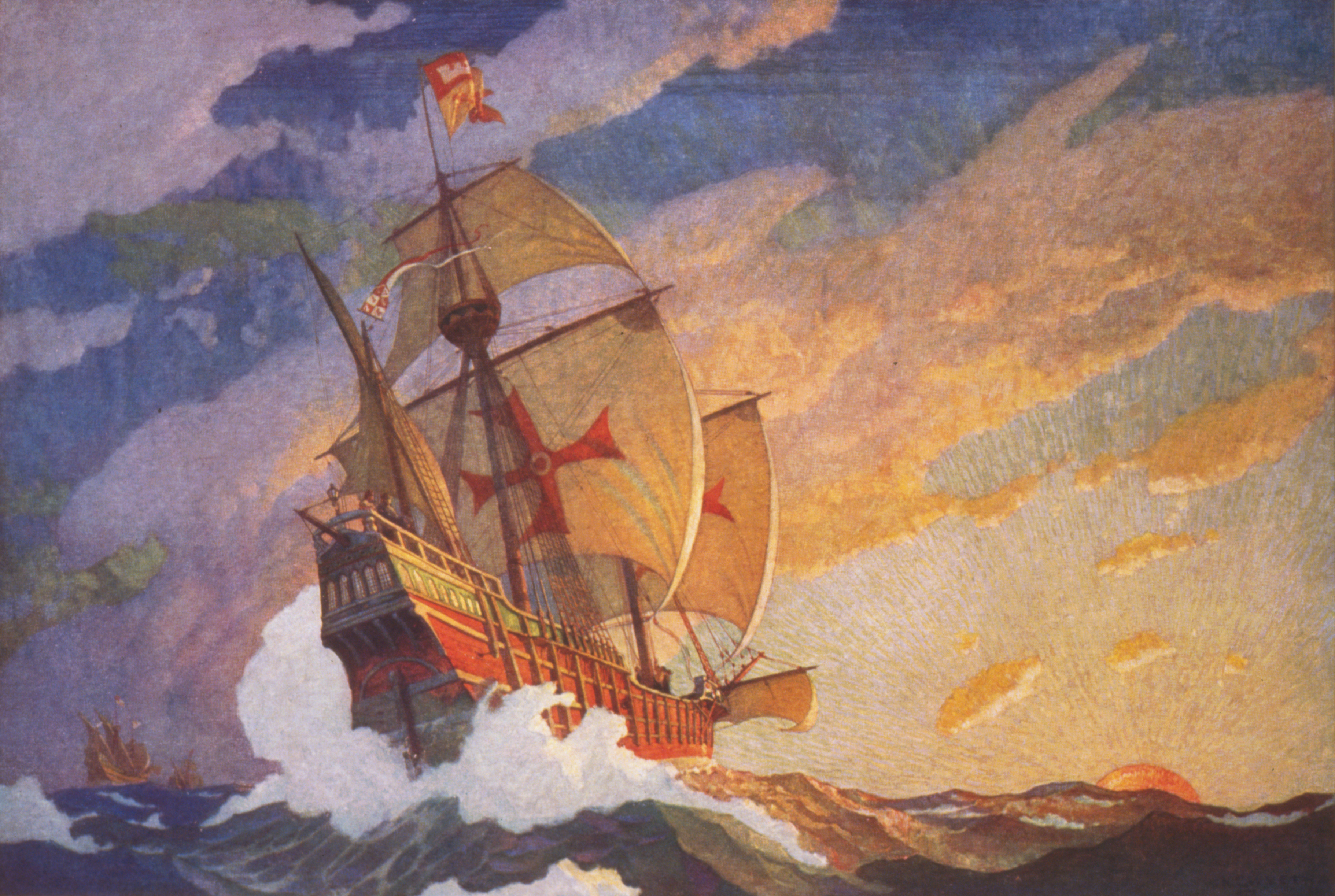
Few individuals in Western civilization have undergone as pervasive a demonization as Christopher Columbus. He has been designated the “poster boy” of all that is wrong with the West, in general, and America, in particular. He is blamed for Western racism and slavery (as if those policies are unique to dead white Europeans) because of his enslavement of the indigenous population, despite discovering a New World that would establish freedom as the governing ideal of human existence. He is blamed for Western Christendom because of his conversion of the natives, despite taking the first step toward what would become a haven of religious liberty and freedom of conscience in America. He is blamed for Western imperialism because of his accidental destruction (by an uncontrollable lack of immunity) of the various cultures with which he came in contact, despite introducing a New World that would form the greatest melting pot of diversity ever accomplished. It was nothing less than American opportunity and freedom, at the basis of our institutions, that made this possible. None of the good America has meant to human history and its unprecedented advancement would have happened without that first step into the dark unknown.

The same folks who discredit and ridicule men like Columbus for his failures not only defend the most violent thugs and genocidal regimes of this and the twentieth century — one need only recall the Western media’s adulation for Mao, Castro, Qaddafi and “Uncle Joe” Stalin — to recognize the double standard. The “blame America first” mentality illustrates the failure, not of America, but of human nature itself. The principles that formed America as the exception to the rule of human affairs is not at fault here. We honor our heroes not because they lack imperfections or never committed any wrongs. We honor men like Columbus because we revere and love what good they did accomplish. It is a respect for good above evil that merits our praise and admiration. Meanwhile, as Coolidge would say,

[I]t is a very hasty and ill-considered judgment to conclude that there is more bad than good in any one. We are all a combination of both elements. While we ought not to approve of the evil in ourselves or in others…The only perfect man ate and drank with publicans and sinners. It did not scandalize Him, it was some of those who were not perfect who were scandalized.

The politically correct demand for perfection is chasing an eternally elusive object. When the only subjects worthy of study are those who never violated the politically correct creed, we will have an extremely narrow, and uninformed, view of human nature. We may know much but without a full understanding of our nature, the good with the bad, it becomes a fantasy fixated on the reality we choose, not the reality which is.

Coolidge reminded those reading his daily column,

There is enough good in all of us to support the law of human fellowship. We shall be much more effective for good if we treat men not as they are but as they ought to be. If we judge ourselves only by our aspirations and every one else only by their conduct we shall reach a very false conclusion. When we have exhausted the possibilities of criticism on ourselves it will be time enough to apply it to others. The world needs high social standards and we should do our best to maintain them, but they should rest on the broad base of Christian charity. 

If the politically correct code sought to lift and inform the culture with higher standards, it would not mock the only Perfect Man Coolidge mentioned. Christ would be its greatest example. The hypocrisy evident in “blaming America first” is laid bare by this point. The offense of Columbus, in these folks’ eyes, is not what they claim it to be. His offense is helping to make America possible. The exploitation and oppression he perpetrated (meant to assign the full guilt we should all feel for being Americans) defines all we need to “know” about him. The good he did — not the first to arrive but the first to introduce the New World to the Old — is spoiled and negated by his sins against political correctness. Nothing but the evil he represents matters to such people because it fits the political agenda not honest historical perspective.

Ultimately, it is a denial of good itself. Truth learns from both the wrong examples and the right ones, honoring good where it can be found, even in flawed and imperfect people like Columbus. Pessimists and cynics may long for the “good old days” when Meso-American empires sacrificed their own human populations and chiefs, like Powhatan, consolidated power through war and genocide. But, if not for the Christian boy Chanco, murder would have continued unabated. Considering Americans were the first to appeal to higher ideals, ideals grounded in a moral conscience, Coolidge could rightly say of Columbus on October 11, 1930,

He is entitled to rank forever as the greatest of all explorers. But the glory of his exploit, great as it was, becomes almost unimportant when compared with its results. It marked the inception of the modern era. The minds of men were opened to new thoughts. The gold and silver of America gave a new trend to the life of Europe. The arts began to flourish. The people began to assert their rights. More colonies brought more trade. A new age appeared, great in captains, admirals, statesmen, poets and philosophers, and finally new nations dedicated to human freedom arose on this side of the Atlantic. These are partly the reasons why Christopher Columbus is entitled to be honored.

The substance for recognizing Columbus in this, the five hundred and twenty-first year since his discovery, resides not so much in what he personally did, or failed to do. It resides in the part he played in the opportunity to establish, for the first time, a place where people can live free to govern themselves, keep the rewards of their own work, and practice, unfettered, the obligations of their conscience before God and mankind.

Ships_of_Christopher_Columbus