Merry Christmas from the Coolidges

To the Boy Scouts, Lone Scouts, and 4-H Clubs

The White House, December 21, 1925

“As you are representatives of the organizations of the boys and girls of America who live in or are interested in the open country, with which I come into an official relation, I want to extend to all of you a Christmas greeting. It seems very short time ago that I was a boy and in the midst of farm life myself, helping to do the chores at the barn, working in the corn and potato fields, getting in the hay and in the springtime doing what most of you have never had the opportunity to see–making maple sugar.

     “I did not have any chance to profit by joining a Scout organization or a 4-H Club. That chance ought to be a great help to the boys and girls of the present day. It brings them into association with each other in a way where they learn to think not only of themselves, but of other people. It teaches them to be unselfish. It trains them to obedience and gives them self-control.

     “A very wise man gave us this motto–‘Do the duty that lies nearest you.’ It seems to be me that this is the plan of all your organizations. We need never fear that we shall not be called on to do great things in the future if we do small things well at present. It is the boys and girls who work hard at home that are sure to make the best record when they go away from home. It is the boys and girls who stand well up toward the head of the class at school that will be called on to hold the important places in political and business life when they go out into the world.

     “There is a time for play as well as a time for work. But even in play it is possible to cultivate the art of well-doing. Games are useful to train the eye, the hand and the muscles, and bring the body more completely under the control of the mind. When this is done, instead of being a waste of time, play becomes a means of education.

     “It is in all these ways that boys and girls are learning to be men and women, to be respectful to their parents, to be patriotic to their country and to be reverent to God. It is because of the great chance that American boys and girls have in all these directions that to them, more than to the youth of any other country, there should be a merry Christmas.

CALVIN COOLIDGE

On Campaigning as Vice President


Coolidges-Hardings

The Hardings & The Coolidges, Union Station, D. C.

The sharp differences between Presidents and their Vice Presidents seems one of the enduring constants in our Republic. There are usually distinct reasons for such differences, especially as elections come and go and campaigns are fought or lost on the strength of an often colorful pairing of personalities. It never fails to reveal a fascinating expression of the popular will in some way, either what it is or what it expects to be. We find that those who attempt some venture at too fast a pace, too far ahead or at odds with the popular will quickly discover how little control they wield over the helm. They are reminded how leadership is much more than an iron grip over destiny and how those at the top are often just as, if not more so, subject to the winds and tides of powers greater than themselves. The contrasts are many: Washington and Adams, Adams and Jefferson, Lincoln and Johnson, Garfield and Arthur, McKinley and Roosevelt, Harding and Coolidge, Coolidge and Dawes, and on the list goes.

There is never-ending appeal in the study of character and personality. We study not just to learn what was at a given point but to learn more about ourselves and what may be around the bend tomorrow. We not only love a good story but hasten to hear more of the manifold variety of human nature and human situations.

How leaders prepare the leadership around them is equally insightful. Some simply do not bother, seeming to think mortality or their own human limitations will never quite catch up and the current Mr. President can and must handle it all himself. Whether from a perception that one is indispensable or the situation, once started, becomes too critical to share the burden, these leaders often discover that their own limitations find them. The Office inescapably tests the quality of the materials that come to it. Some pass and others fail but all are measured. We tend to assume our Presidents (and some Vice Presidents) carry ample egos into office and rarely glimpse the humility that some sincerely bring with them or that others may encounter along the way.

The best leaders do not subscribe to the notion that the Vice President “earn his place,” as if he were being properly prepared for the responsibilities he needs through neglect. Treated like some greenhorn or boot who needs to find things out for himself — the hard way — Presidents are sometimes very unfair to their Vice Presidents. The best leaders do not set so obtuse a tone but never lose sight of the fact that the President was once a “newbie” as well. In fact, most Presidents have never “Presidented” before either. They would do well to remember that in their treatment of others. It comes from a cognizance that if circumstances place us somewhere, we owe it to others who come after us to share what we have learned and make things easier. Bitterness over our own poor treatment can make us callous to helping others. We punish those who come after us when we repeat the mistake inflicted on us. If one stands where I once stood, I can share my road map with him, knowing how lost and uncertain I felt in his place. Even the most talented individuals come to the office inexperienced. The best leaders do not make the road more difficult for those who come after them. Instead, they smooth the path for others. They take up service not self-aggrandizement.

Coolidge never forgot where he started and this improved the caliber of his leadership. It was the same whether the office was President of the state senate or President of the United States. The opportunities that had come to him were not resources to jealously hoard but gifts to generously bestow. Coming to Washington in the spring of 1921, they had one of the best couples on hand, ready to help, even though Thomas and Lois Marshall, the outgoing Vice President and his wife, had not received anything close to the kind help and ample support they would give to the Coolidges. The Marshalls broke the cycle, showing that victims of bad leadership need not replicate the wrong. Vice President Marshall would approach everything with the wry wit and good humor for which he was widely known. It was Marshall who coined many a proverb on the capitol city’s quirks and customs. He deserves greater regard than history remembers, which usually never happens at all. The Coolidges also had the Hardings, the President-elect and First Lady, who certainly had it in their power to be as indifferent as predecessors had almost always been toward the second man on the ticket. It was a landmark departure for Harding to actually include his “Veep” in the Cabinet and intend a wider scope for the office than it had before possessed. This was partly a response to Wilson’s remarkable refusal to include Marshall in the decision-making of the administration but it was no less praiseworthy on Harding’s part.

30733v 1921 Lodge CC T Marshall Union Station

Greeting the Coolidges at Union Station, 1921. Left to right: Senator Lodge, Grace and Calvin Coolidge, Thomas and Lois Marshall, and Coolidge’s personal secretary, Ted Clark. Photo credit: Library of Congress.

The death of Vice Presidents in office had taken on a kind of morbid tradition all its own, not only because the V. P. was, on occasion, significantly older but the job was the antithesis of a bright and glorious future. It was the most conspicuously thankless office in each new administration. There was no real power solicited and no authority to do much of anything, a humiliating vocation for those who had spent lifetimes in far more potent roles as governors, patronage bosses, Senators, Speakers of the House, committee chairmen, and so forth. Most of the time, few came to visit the Vice President and fewer cared.

With the death of President Harding in the summer of 1923, President Coolidge would succeed him but the office of Vice President would remain vacant for nineteen months, until the inauguration of Vice President Charles G. Dawes in March 1925. It would be the fourteenth time the office had been left vacant, though not for as long a duration as others. Again, we see another striking contrast and yet the same people who voted for Coolidge found in Dawes qualities equally as important and appealing. It was noted at the time that Dawes’ ancestor William, the renowned and more successful rider the night Paul Revere also set out to warn the colonists, later launched a grocery store with his son-in-law, John Coolidge, at Worcester. The genealogical links of the Dawes and Coolidge families found by Mary Spencer Paine in July 1924 became just one of the incredible twists found everywhere in history. It is part of what keeps bringing us back to its stories.

Even after losing his son in the summer of 1924, Coolidge did not merely sit back and depend upon Dawes to campaign for him. Grief had not driven Cal under a rock. He would help his Vice President with the campaign ahead, no doubt just as much in need of what was expected of him as Cal had been on the campaign trail in 1920. Some biographers find Coolidge’s letter to Dawes of August 2, 1924, odd, even perplexing but when kept in the perspective of what these two had faced already, it elucidates a great deal. It is Coolidge being himself and instead of leaving his V. P. to drift alone, he brings the brilliant businessman, retired General, and former Budget Bureau chief into his confidence. His thoughtfulness shines through the letter. His openness will no doubt surprise many who think Coolidge ever only said two words all his life. Cal, without arrogance or condescension, draws deeply from his own practical experience in campaigns, knowing it is turf, for all of Dawes’ abilities, that remains foreign and unfamiliar to him.

The White House

Washington

August 2, 1924

My dear General:

     Thinking you may have the same difficulty in writing a speech of acceptance that I had four years ago, I am going to venture to try to help you.

     The more simple you can keep it, the better you will like it. You have for your guide, of course, the Party’s platform, and you might get some suggestions out of my message to the Congress and the speeches that I have made since that time. If you keep as much as you can to an expression of general principles, rather than attempting to go into particular details of legislation, you will save yourself from a great deal of annoying criticism. More people will agree with you if you say we ought to have protection, than if you begin to discuss various schedules. More people will favor opposition to high surtaxes, than the adherence to specific rates.

     I know how irksome it is to attempt to restate what others have said, instead of having perfect freedom to branch out in any direction you might wish. But that is the penalty we have to pay for running in pairs. Should you think that I could possibly be of any help, do not fail to run down here any time, or communicate with me in other ways, always keeping in mind that my telegrams and telephones are public property.

     It may interest you to know that I was much pleased to learn the other day that I am kin to Manasseh Cutler, through the Rice family, and therefore kin to you. We are both kin to John Quincy Adams.

     With kindest regards to you and Mrs. Dawes, I am

Very truly yours,

Calvin Coolidge


P. S. Whenever you go anywhere, take Mrs. Dawes along.


Simultaneously, Dawes would be himself as well and despite a few rocky patches ahead would complement the ticket well, serve faithfully, and see things through to the finish line. They demonstrated, even with their divergent styles, the steady competence that brought both men together in service to the nation for a time.

Coolidge-Dawes-Aug1924

General Dawes visiting President Coolidge at the Homestead, Plymouth Notch, August 1924.

On the Bureau of Investigation

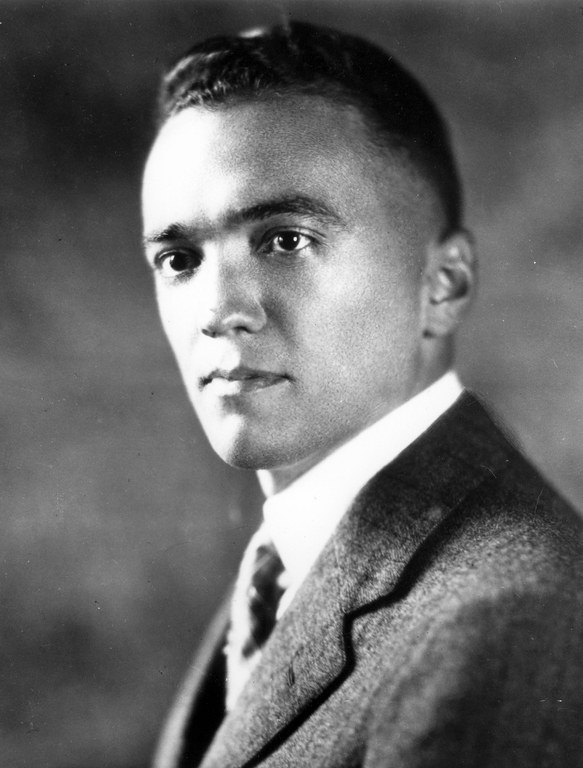
JEdgarHoover

J. Edgar Hoover, director of the Bureau of Investigation, 1924. Photo credit: Federal Bureau of Investigation.

The Bureau of Investigation has long labored on under a plethora of misconceptions from all sides through the years. Even friends get shot in the crossfire. Its record during the Coolidge administration often gets blurred with the tone and conduct of other administrations, before and after, and presents a confused picture blending time, space, and personalities together until few honestly know fact from fiction.

A favorite whipping post is the long-time director of the Bureau, J. Edgar Hoover, who usually receives the vitriol of his critics as the last and final word on all we need to know about the man and his legacy. But, what if there was more to the story?

The Bureau is part of the Department of Justice, and always has been. It was not entrusted under the law with Prohibition enforcement (which belonged to the Department of Treasury) nor was/is it tasked with protective services as if it were an extension of the White House Detail of the Secret Service. Local jurisdictions remained protected by local police departments not Bureau agents. The 20s and early 30s are incorrectly labeled as the “lawless years,” as if the burden of Prohibition enforcement fell solely on the Bureau’s shoulders. It simply did not. Though “federal” would not officially be part of its name until 1935, there was no blurring of its responsibilities. It was, just as its name suggests, entrusted with investigating federal crimes after the suspected acts are done.

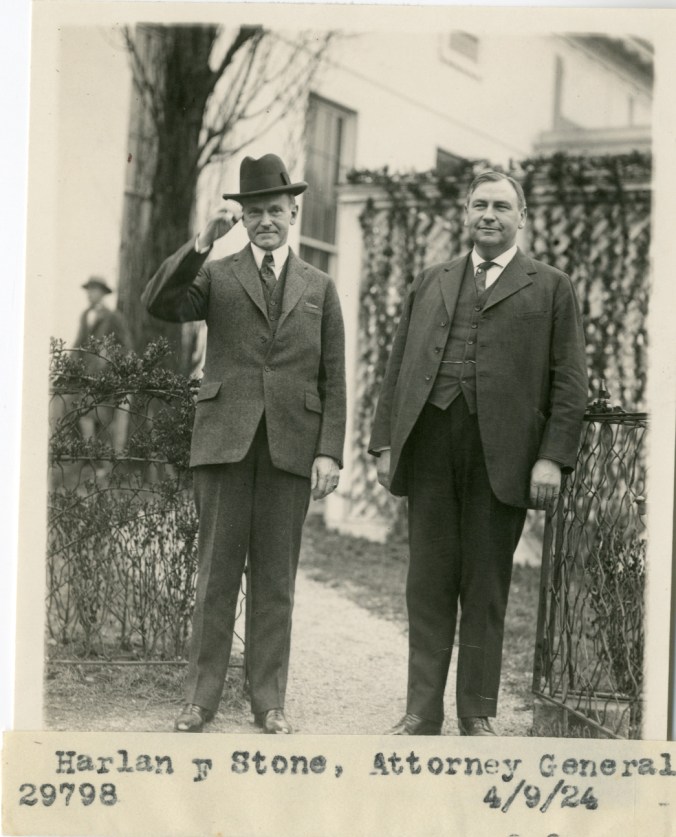
J. Edgar Hoover began with the Department in the Wilson administration. When Coolidge came aboard, and soon thereafter his new Attorney General, Harlan Fiske Stone, a genuinely different direction swept across the Bureau. It is known as the “great purge,” a sweep of personnel so expansive that it earns the name even now. It is typical that the old system of appointing political hacks and repaying long-time debts to friends had prevailed over the Department as a whole, and the Bureau in particular. Summoned to the office of Attorney General Stone, it appeared likely that J. Edgar would swiftly join his boss, William Burns, whose walking papers had been issued days before. A higher standard was expected of the Bureau than had guided in the past.

The “dollar-a-year” men had to go, the political appointees crowding the roster. Hoover had to be the one to wield the ax. J. Edgar immediately began clearing out hundreds of operatives positioned by campaign pledges among the Bureau’s 650 employees. This was no game of musical chairs either. Once dismissed, they were to remain out. By 1928, he had initiated a course of professional standards for every new agent entering the Bureau. That was not all, the entire mission of the Bureau was required to change. Stone, outlining it all in 1924, explained the Bureau’s new purpose. As Stone put it,

There is always the possibility that secret police may become a menace to free governments and free institutions because it carries with it the possibility of abuses of power that are not always quickly apprehended or understood…[The Bureau of Investigation is] a necessary instrument of law enforcement. But it is important that its activities be strictly limited to the performance of those functions for which it was created and that its agents themselves be not above the law or beyond its reach.

The Bureau would professionalize or be shut down. No more would political favors determine its personnel. It had to operate on the basis of competent knowledge of the law and “proven ability” to earn promotion. Hoover’s rapid response demonstrated that the young J. Edgar understood the Attorney General completely. Hoover also had unimpeachable recommendations, including that of the unquestionably honest Commerce Secretary, Herbert Hoover. That alone would not have spared him but as a result of his decisive actions, J. Edgar would be allowed to keep at it. But, lest we think this was some cunning attempt on the young director’s part to survive, he remained at it long after Stone had moved to the Supreme Court. Hoover was simply not the insidious monster he is made out to be by his partisan critics, the very voices who cemented the narrative of FBI history as a scapegoat for xenophobia and hysteria for decades. In truth, it is the critics who have relished when facts are confused and individual responsibility is kept at its murkiest. These critics revel in the darkness.

Coolidge-Stone-4-9-1924

Stone would continue to outline what the Bureau was, now with Coolidge in charge. The Bureau was not in the game of entrapment or political witch hunts. It had a solemn obligation under the law to remain an impartial investigator of facts not hearsay, or mere opinion:

[The] Bureau of Investigation is not concerned with political or other opinions of individuals. It is concerned only with their conduct and then only with such conduct as is forbidden by the laws of the United States. When a police system passes beyond these limits, it is dangerous to the proper administration of justice and to human liberty, which it should be our first concern to cherish.

As one of those best positioned to know truth from fiction, Hoover’s long-time lieutenant, “Deke” DeLoach wrote: “Hoover’s quick action convinced Stone that Hoover was serious about reforming the bureau, and he kept him on the job. Hoover stuck to Stone’s principles throughout his career, and in many ways the bureau that Hoover remade was a product of Stone.”

Predictably, Stone also gets stonewalled as far as his legacy is concerned. Yet, the same Stone who was not only Coolidge’s appointment for Attorney General also became Coolidge’s lone appointment to the Supreme Court while remaining the solid friend of Cal’s successor Herbert Hoover. The same Stone would become Frankllin D. Roosevelt’s appointment to Chief Justice in 1941 and sharply criticize not only the New Deal but also his old friend’s response to it, that of former President Herbert Hoover:

I think even more could be said about present tendencies to depart from traditional forms of democratic government under the Constitution. The steady absorption of power by the President, the failure of Congress to perform its legislative duties, the absence of debate in Congress, and of open public discussion of the public’s problems, the creation of drastic administrative procedures, without legislative definition and without provision for their review by courts, are, I believe, an even greater menace than the programs for whose advancement these sacrifices have been made.

Herbert Hoover would reap decisive repudiation for his line of attack, published as a book entitled The Challenge to Liberty in 1943. Stone, trying to spare him, had warned that the people were not in a place ready to receive such abstract sermonizing. The people would always get what they tolerated…and, as Coolidge put it, deserved.

The problem, as it always turns, relies on the quality of leadership. By that time, the people were prepared to accept the abuses done to traditional limits if it might yield a way out of the mess, a path freed of the current storm, be it Depression or World War. President Roosevelt’s leadership had set a tone and no court or law enforcement body could operate in defiance of the popular will, the people’s willingness to go where things had not before gone. It was not the Court’s place to lead the people by the nose any more than it was the Bureau’s job to prosecute individuals in search of a crime. Yet, they all had to operate beside or, in the Bureau’s case, constantly beneath, the direction set by the President. Yet, the Director had taken an official oath as well and only he would answer for his own violation of it. J. Edgar remained vigilant to his oath and obligation, keeping the ember alive started by Coolidge’s Attorney General Stone in 1924. Yet, J. Edgar Hoover knew (a fact former President Hoover was much less adept to grasp) that without a White House or popular sentiment solidly behind him, his would be a voice in the wilderness, and often a voice they would seek to silence, mischaracterize, and blame for the dereliction of others. Our impression of the man is still too often colored by the success with which they have tainted him and Coolidge’s housecleaning of the Justice Department.

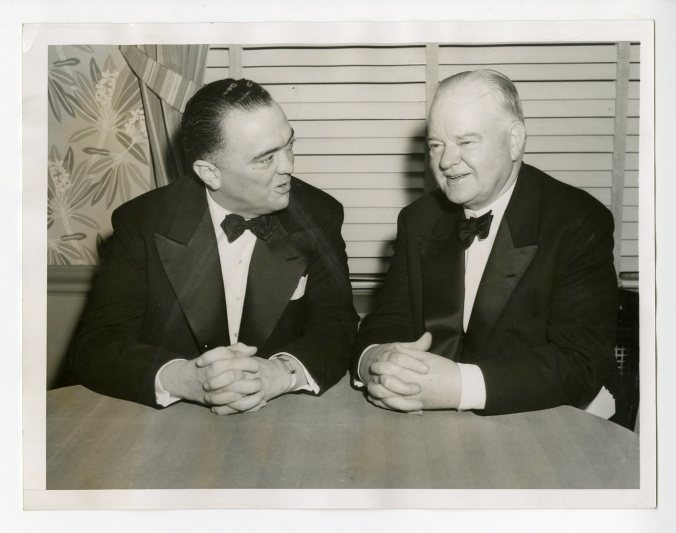
Hoovers-1944

Director J. Edgar Hoover (left) and former President Herbert Hoover (right), 1944. No relation by blood, they only happened to share the limelight for four decades. Photo credit: National Archives.