
The Mayflower Hotel, Washington, in 1925 (three years before this speech). Photo credit: Library of Congress.
Addressing the members of both the American Federation of Arts and the American Association of Museums gathered at what had already become an illustrious, historical location, the Mayflower Hotel in Washington, President Coolidge spoke:
Fellow Countrymen:
This joint meeting of The American Federation of Arts and The American Association of Museums indicates an increasing interest in our country in the spiritual side of life. While we have been devoted to the development of our material resources, as a nation ought to be which heeds the admonition to be diligent a business, we have not been neglectful of the higher things of life. In fact, I believe it can be demonstrated that the intellectual and moral awakening which characterized our people in their early experiences was the fore-runner and foundation of the remarkable era of development in which we now live. But on the midst of all the swift-moving events, we have an increasing need for inspiration. Men and women become conscious that they must seek for satisfaction in something more than worldly success. They are moved with a desire to rise above themselves. It is but natural, therefore, that we should turn to the field of art.
In its early inception the term “arts” embraced the whole realm of liberal culture. Our institutions of learning have perpetuated this idea in the degrees of bachelor of arts and master of arts. We have come to make a distinction, however, between arts intended to appeal primarily to the emotions and those designed to be of practical value. We refer to painting, sculpture, the adornments of architecture, music, poetry, and the drama as fine arts. More recently, we have designated the perfection and refinement of the design of articles fabricated by modern machinery as industrial arts. But, in a wider sense, the arts include all those manifestations of beauty created by man which broaden and enrich life. It is an attempt to transfer to others the highest and best thoughts which the race as experienced. The self-expression which it makes possible rises into the realm of the divine.

Artist Francis Davis Millet stands in his studio, 1900. An instrumental force in the creation of the American Federation of Arts proposed by Secretary of State Elihu Root in 1909, Millet would offer his studio for the AFA’s use in Washington. The first meeting, held on May 11th of that year, took place in facilities of the National Academy of Art in New York City but in a short time, they accepted Millet’s offer and met in his studio. Its board encompassed a rich cross-section of talent and professional ability, including Cecilia Beaux, Andrew Mellon, Homer Saint-Gaudens, Leila Mechlin and Charles Hutchinson among many others. The AFA would settle in the Octagon Building at 1741 New York Avenue, NW in DC relocating ultimately in 1927 to the Barr Building on 17th Street NW. Sadly, Millet would go down with the Titanic in 1912.
In recognition of these principles the American Federation of Arts was founded nearly 20 years ago. It has for its purpose not only the promotion of art for its own sake, but to relate it to the life of the people in such a way as to increase happiness and advance civilization. It places especial emphasis on the art of living.

Like the AFA, the American Association of Museums would begin in New York as well. Here, at the first meeting on the steps of the New York Botanical Society’s Museum, the founding members pose together on May 16. 1906, almost exactly three years before the creation of the AFA. The AAM would headquarter in Washington much later, however, moving to D. C. in 1923.
It is impossible to conjecture when the race first began to seek its happiness by creating forms of beauty. Very early, however, it gave expression to its desire for adornment in the making of the home. Architecture is very old. Art made very considerable strides in the early days of our own country. But in the commercial and industrial expansion which followed the discovery of gold in California and during the war period, the people had scarcely any opportunity for other things and art received little attention. When it revived in the latter part of the century it turned a great deal of attention to architecture. At the time Henry H. Richardson designed Trinity Church at Boston, he gave La Farge the opportunity to enhance its beauty with mural decorations. He was also an inspiration to the group to which Stanford White and Augustus Saint-Gaudens belonged. But it was the World’s Fair at Chicago in 1893, which gave a band of earnest and gifted artists the opportunity for expressing their ideals of beauty.

The “White City” incandescently on display during the World’s Fair in 1893.
The result was the White City. This made a profound impression on those who had the good fortune to visit it, and seemed to revive and inspire a desire for more beautiful surroundings which was nation-wide. A few years later came the Library of Congress, in the decoration of which Blashfield, Walker, Simmons, Cox, Melchers, and other mural artists cooperated under the supervision of Millet. Their murals were made an integral part of the design. That idea has been carried out since in many monumental public buildings throughout the country.
The Washington plan commission, with which the name of Senator James McMillan, of Michigan, will always be associated, was created, in 1901. It included such illustrious names as Burnham, McKim, Saint-Gaudens, and Olmsted. Its report not only pointed the way back to the original L’Enfant plan for the National Capital but started a national movement for a more orderly and artistic development of our cities. The elaborate plans now under way for the construction of public buildings, which will make Washington the most beautiful capital in the world, is one of the results of this movement. This stirring of a national art consciousness, the realization that there should be some medium for the expression and growth of this aroused interest in the finer things of life, probably had much to do with the inception of the Federation of Arts.
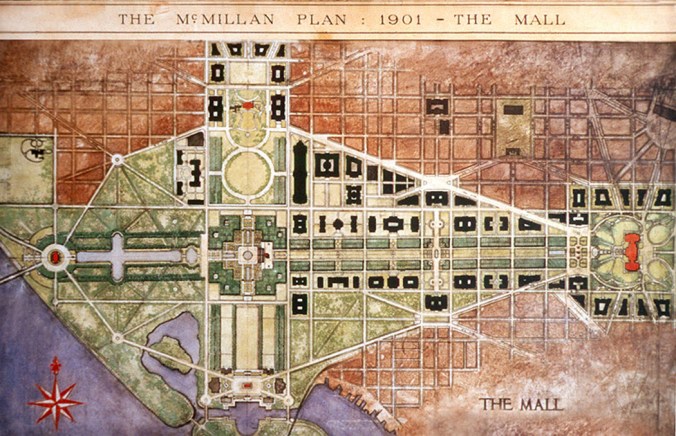
More than any other layout in modern time, the Macmillan Plan shaped (and continues to guide) an ordered and intentional beauty that sets Washington apart from other cities, which usually retain an often confused, meandering character of makeshift, organic growth. It was this Plan that conceived the beginnings of the Federal Triangle and the overhaul of federal buildings in the 1920s. Not all of it was constructed, including the gardens around the Washington Monument but it stands firmly among the same ideals that drove the movements for the AFA and AAM.
Ideas, at first rather indefinite, have been expanded and clarified, and your federation exists to-day – fruitful in good works – a most effective aid in the progress toward the ideal of beauty. Your 6,000 members, in addition to the more than 400 art museums and associations in affiliation, comprise a network of nation-wide influence. Your traveling exhibitions of art, including paintings, sculpture, prints, and examples of the industrial and decorative arts, have been displayed in communities in 40 States and in Canada this past winter. Most of the exhibits were provided by individuals or associations. To develop an appreciation of art you furnish typewritten lectures with lantern-slide illustrations. Your own publications, and others which you make available, are most helpful. Not only do you answer community appeals but you respond to the individual groping for art. As a striking example of how notable results have followed small beginnings, the story is told of a farmer’s request for a good picture of a Jersey heifer. The plea found response. Gradually an interest in real art was aroused in this man. Eventually, largely through his efforts, an art building was put up at the fair-grounds of his State. Other States have followed this example.

Andrew W. Mellon, whose idea of a National Gallery of Art would begin in the 1920s. The American Federation of Arts would help advance that dream too.

Conceptual designs for the future National Gallery of Art by Mellon’s architect, John Russell Pope, 1935.
Aid in the extension of your work has been given by various philanthropic endowments. One is interested in the elevation of industrial arts in America on the sound theory that beauty in commercial products is worth while, not only materially, but also aesthetically, and that it gives an opportunity to bring art into the home. Another appropriation had been made for the purpose of seeing if art can not be made a vital force in a typical community. A small western city has been selected for the experiment, and two artists are being sent there to ally themselves with its life. They will open a gallery and will encourage the growth of civic and home art in every possible way.
In the development of an artistic sense and in ministering to the love of the beautiful, we naturally have sought examples of art of other years and other countries, as well as those of our own period and country. The assembling of these treasures in museums not only has made them available to the public, but has afforded the opportunity for comparison and study.
There are museums devoted to history and to science, and, more recently, to the industries as well as to art. Hundreds of millions of dollars have been spent in land, buildings and equipment to accommodate collections of inestimable value. It is said that it costs somewhere in the neighborhood of $25,000,000 a year to operate and maintain them. What more natural than that those directly interested in this work should have wished to come together each year to exchange views and to establish cooperative relations. Such was the beginning, 22 years ago, of the American Association of Museums.
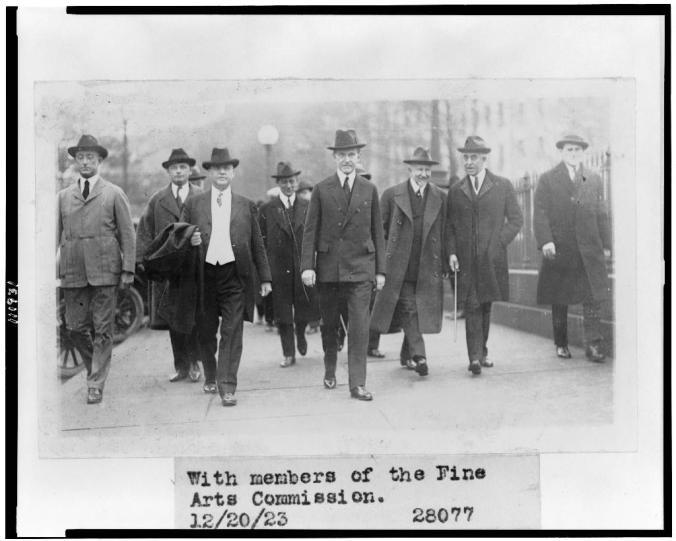
In 1923 a year-around headquarters was opened in Washington for the purpose of gathering and disseminating information of value in solving administrative and educational problems. Encouragement and aid have been given in the establishment of new museums, particularly those of the small-community type. To furnish facilities for nature study and to enhance the enjoyment of life out of doors, museums have been started in our National and State parks. Whatever may be done to increase museum facilities and to render their collections of more use to mankind as a most valuable service and deserves every encouragement.

Grant Wood’s American Gothic (1930), perhaps one of the most iconic — and long parodied paintings. As the AFA turned efforts from 1926 onward to bring art to the home and encourage local galleries across the country, it was the Little Gallery in Cedar Rapids, Iowa (directed by Edward Rowan with the help of his circle of artists — including Grant Wood) that became the first experiment in AFA’s mission through local institutions to blend together a civic-minded and artistic spirit: to expand, if you will, the access to and appreciation for art outside the great centers of the East — New York, Boston, Philadelphia, and Washington, D. C. It was again another evidence of Andrew Mellon’s generosity at work behind the scenes. The AFA was working mightily to demonstrate that America could more than hold its own when it came to the arts (not only in painting and sculpting or music and literature but also architecture and landscape design). The exchange program of French and American art in 1928, circulating the very year Coolidge gives this speech, demonstrated potently that it could no longer be claimed that the United States straggled behind Europe for talent; Instead, America was its equal in the arts.
The impetus given to city planning by the McMillan commission has carried that art and is practice a long way. Gradually civic pride has been stimulated to the point where well-kept streets and parks, fine public buildings, and private construction of a pleasing design, all developed with a thought to a harmonious whole, are considered essential to a modern community. Zoning laws, originated for the purpose of keeping industry from spreading through cities at random, and limitations placed on the height and character of buildings in recent years have brought about the development of a distinctive type of American business architecture. It has been much admired and praised by visitors from abroad. If clothes make the man – and certainly good dress gives one a sense of self-respect and poise – how much more is it true that clean, beautiful surroundings lend a moral tone to a community. Gradually we are getting rid of the squalor of the slums of our big cities and of the oppressive ugliness of some of the small towns.
It is especially the practical side of art that requires more emphasis. We need to put more effort into translating art into the daily life of the people. If we could surround ourselves with forms of beauty, the evil things of life would tend to disappear and our moral standards would be raised. Through our contact with the beautiful we see more of the truth and are brought into closer harmony with the infinite.

In partnership with WEAF out of New York, the American Federation of Arts began a very popular series of 15-minute radio talks on topics including the appreciation of painting and how to get the most out of visiting an art museum given by Homer Saint-Gaudens, son of the renowned sculptor and himself the Director of Carnegie Institute’s Art Museum in Pittsburgh. Leigh Hunt also contributed to the series.
Our country has reached a position where this is no longer a visionary desire but is becoming an actual reality. With general prosperity, with high wages, with reasonable hours of labor, has come both the means and the time to cultivate artistic spirit. Philanthropy has given the people access to all that is most beautiful in form and color. It is theirs without money and without price, if they will but go and possess it. Out of our agriculture, our commerce, and our industry, we can already see emerging a new spirit. The potential is becoming actual. Through science and invention, gradually but surely, we are banishing the drudgery of existence and bringing into every avenue of living a touch of the artistic. We are working out the ideal under which everyone will realize that they are artists, in their employment, in their recreation, and in their relations one with another. It is to this high calling that the members of your associations have dedicated themselves. The service which they are rendering is of inestimable value for the advancement of an enlightened civilization.
Submissions by (and of) some of the American Artists who participated in the International Sports in Art Exhibition held in conjunction with the 1928 Summer Olympics in Amsterdam in collaboration with the American Federation of Arts

Plaque of Cornell football player and head coach, Henry Schoelkopf by James Fraser

“Two Hunters” by E. Irving Couse

Portrait of William T. Aldrich and son by Charles Sidney Hopkinson

“Cathy” (the Cathedral of Learning at the University of Pittsburgh, the masterful design of Charles Klauder

The Commons Room inside the Cathedral of Learning – widely regarded as Klauder’s finest work.

Along with those who also submitted their work for the 1928 International Sports in Art Exhibition in Amsterdam was Hayley Lever, Australian-born but representing the United States. Here he is presenting a painting of the yacht Mayflower to President Coolidge and Captain Andrews at the White House, 1925.

Among the many artists from the U. S. in the sculpture category was Evelyn Batchelder, who presented a version of “Victory” like her 1926 work (‘The Spirit of Victory’) shown here.

 The Importance of the Obvious