On Observance and Action

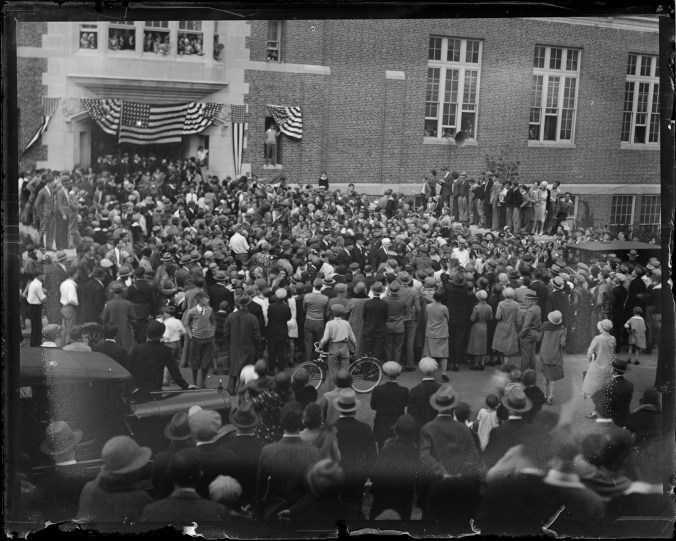
Watertown-HS-1930

…[T]he other thing we need to remember is the observance of the law. That ought to be fundamental, though I am afraid it is not in all respects. It is the only safeguard we have for our rights and for our liberties. I say the observance of the law. If we could secure that, almost all of the vexatious questions that face us at the present time would fade away with tomorrow’s sun.

So let us preach, insofar as we can, an observance of the law, not for the benefit of any supposed class, but again for the benefit of all the public and in order that we may bring about the greatest condition of prosperity and happiness to all our people. 

And an observance of the law means a government…not of men, but of laws. It means no dictation by one man, whatever his position may be, and it means no dictation by a million men, whatever position they may hold. 

It means always action under and according to the Constitution. And if we can establish that condition, then we Americans can maintain the authority of the law, and we can maintain the freedom of action that come from it, and we can carry our nation forward and ever forward into a better condition than ever before existed. 

— Calvin Coolidge, excerpt of an Address to the Home Market Club, May 14, 1920
On Duty, Variety, and Civilization

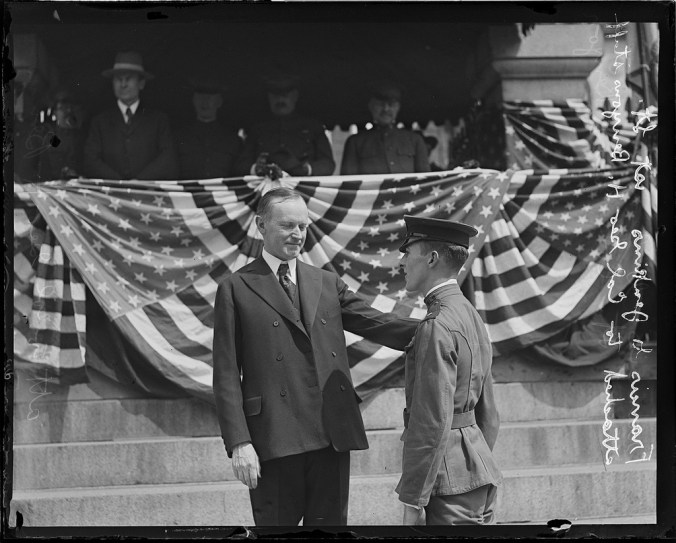
high school cadet Francis Jenkins Benyon staff 6-1920

Governor Coolidge, standing at the State House in Boston with high school cadet Francis Jenkins,  who served at the time on the staff of Colonel Benyon, June 1920. Photo credit: Leslie Jones Collection. 

We gain our progress in civilization not altogether from an assumed equality but to a great extent from variety. I said a moment ago that you had your profession, and others have their professions. Civilization and learning and science are so broad now that no one undertakes to comprehend them all, and it is an age of specialists, — it is an age of division of labor, and it is only as we work along lines of that kind that we are able to make any progress; and that has laid upon us a new burden that did not exist in generations that have gone before when each individual was self-sustaining and could take care of himself, and if he didn’t, it mattered very little to those who were about him.

It matters a great deal now, and that has put a new duty upon citizenship and one that must be realized and met and fulfilled, and we have not the privilege that we had then to refrain from carrying that occupation like your Society should day, ‘We will do not more work until something has been done in government or in economic relations that is to our satisfaction?’ 

You see what happens now when those who have cast their lot in transportation say, ‘We will refrain from doing the work that we are engaged to do.’ You can imagine what would happen if those who are engaged in agriculture would say, ‘There, we will stop our production until we have accomplished something by an exertion of a pressure of that kind, that we desire to accomplish either in a governmental way or in an economic way.’

That is not government — that is what they refer to as mass action. And unless we can carry our affairs orderly, peacefully, according to the laws of the land and under the Constitution, and each bearing the burden that the duty he has assumed puts on him to bear, we can’t sustain the kind of a civilization that we have chosen to make our own, it will break down and we shall find ourselves in a condition of anarchy on the one hand or of despotism on the other…

— Calvin Coolidge, excerpt of address to the Massachusetts Medical Society, June 9, 1920

On Discontent

6192820003_e362f1982a_b L Jones Collection_Penny for his Thoughts

Coolidge at home, Plymouth Notch, Vermont. Photo credit: Leslie Jones collection.

I am not unaware that there is a certain discontent that pervades all sorts and conditions of society. There is a kind of discontent that ought to be encouraged because it is the foundation of all progress and all advance in human development.

There are those that are not contented with the amount of education that they have, and they are therefore applying themselves in our schools and institutions of learning; and that is to the public advantage. 

There are those that are discontented with their general condition, think that they are not living the lives that they ought to live, and they are changing their methods of life, joining the church perhaps, and determining to live better in the future; that is for the advantage of the public. 

There are those that think they are not accomplishing enough from their efforts and they are determining that they will work a little harder in the future and do a little more and produce a little more and be more industrious than they have been in the past; that is a discontent that is for the public welfare. 

These sources of discontent are discontent with ourselves and wherever you find that as a condition, you have a foundation laid for the betterment of mankind. There is another kind of discontent that doesn’t look so encouraging; it is the discontent of those who want to profit without any effort; it is the discontent of those who want to control without any ownership, and to rule without legal authority and responsibility, and in this Nation of ours which we boast is made up of kings, they want to rule without being subjects; these are the people that are discontented with others, and that kind of discontent isn’t one on which you can base any progress or one on which we can expect the world to go forward…

— Calvin Coolidge, excerpt from an address before the Massachusetts Medical Society, June 9, 1920