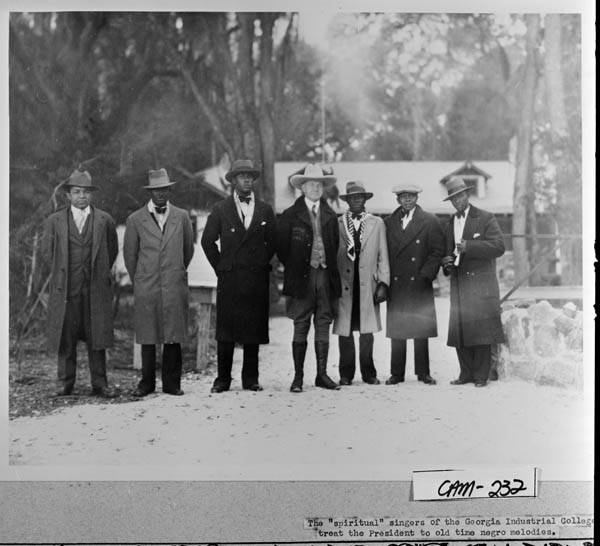
On Time and Place


athens

Men are always influenced by their environment. The life and history of each individual is what it is, in part, because of the surroundings into which he was born and lived. There is the corollary to this. The history of localities is what it is because of the character of the people who have lived there. The little promontory of Greece has a meaning for us, a place in history, that is born of the spirit of the people who dwelt there more than two thousand years ago. Caesar could not have been Caesar had his earthly lot been cast in the City of Pekin. Our own Lincoln, great as he was, would have been something far different had he been living in Paris in the days of the French Revolution. This locality has cast its influence over the people who have lived here and they in turn have wrought their character into its history. 

This valley [along the Ohio River], now the scene of so much industrial activity, so typically American, was beyond the frontier in the days of the Revolution. It was only after the peace had been declared, only after the Congress had by Ordinance provided for its well-being that settlers came here in profusion. They are of the stock that fought the Revolution. I believe it can safely be asserted that no body of men of equal numbers ever wrought so wisely or so effectively upon the history of mankind as the Revolutionary patriots of America and their descendants. They bequeathed a continent to freedom, showered a nation with untold riches and finally saved civilization. Such was the blood that settled here, American through and through. Wherever they go the world knows the influence they wield, what they have done, are doing, and will do. No people ever exhibited a like enterprise for business, or a like genius for government. Along this valley those powers have found full expression…

OH-river-valley

From this blood, from these surroundings, came that great American to whom this stately memorial was reared. There is that in the present condition of our country which admonishes us to remember William McKinley. He was wiser than his critics. He was gentler than his friends. He was firmer than his party. He found the nation depressed, and distraught, he brought it prosperity and contentment. He led the people not from afar off, where his influence could not be felt, but from near at hand, directing their course, but yet with them. It is little wonder that men loved him…He was American. He believed in America. He advocated first and last American policies. He established a thoroughly American system. Yet he was something more. He was the first to recognize that the Spanish War had made us a world power with world responsibilities. He was not a man to shirk responsibilities. He did not believe that his country, which he had seen rise to the sacrifice involved in the solution of a world problem, would shirk its responsibilities. He knew that this country which he had seen on so many occasions true to itself would not be false to any other people…

WM-memorial

William McKinley Memorial in Niles, Ohio

Nations do not stand still. They advance or they recede. America goes forward. It would have been in vain that this monument were built to a great son of Ohio, who had grown to hold in his vision a strong and righteous nation, desiring the welfare of humanity, if he were to have no like successor, no representative of kindred mind to take up and carry on the ever unfinished task of serving the world most by serving America best. Your hope is being realized, your faith is being justified. In the light of experience you build, and go on building, not merely for the past, but for the future, confident that as the succession has not failed it will not fail. As there have come those who have been raised up to serve the nation in time of need, so they come now, so they will come. In those who have in the past been honored here, in him who today is honored, this promise stands fulfilled. And what a grand fulfillment in William McKinley and Warren G. Harding…

It were enough to say of any man that his countrymen had chosen him the President of the United States of America. But to be chosen to that office by a majority of seven one half million votes is a distinction that never came to any other President. Of itself it has a deep significance. It means that President Harding represents the common aspirations, the general ideals, of his countrymen. There is that in him which responds to the universal impulse of humanity, which recognizes but one rank — the common brotherhood of all mankind. To have that is to be a great American. The world holds no greater praise. 

hardingbustniles2

President Warren Harding’s bust within the McKinley Memorial at Niles. Photo credit: PresidentsUSA.net.

It is this broad sympathy which is responsible for the most outstanding fact of the present administration, the marvelous personal affection in which the President is held by all those who come in contact with him, most especially marked in those, who, for a better term, we call the common people. This affection has grown from the day he was nominated until it has become a fashion among all classes. The people have seen him cheering with them at the ball park and the polo field, they have seen him enraptured in the presence of five thousand flag draped caskets bearing the remains of our soldiers who died overseas, and in mutual understanding of each other have found mutual love and affection. The open White House gates are but the symbol of the open heart of him who wishes his every approach open to the people. 

This disposition has been manifest in the coordinating harmony of all government activities. In fact the American government is now in contact with itself, in contact with our own people, and in contact with other nations. There is a harmony in the Cabinet and in the Congress, bred not of coercion but of cooperation. There has been established at Washington a government of the people…
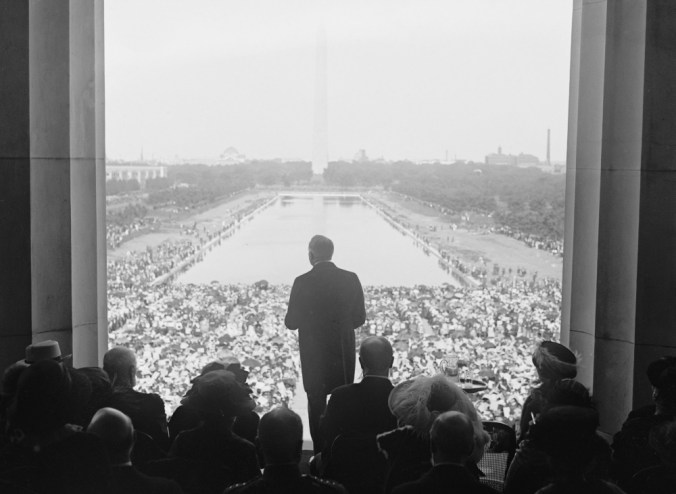
President Warren Harding (1865-1923) at the dedication Lincoln Memorial, June 30, 1922.

President Harding speaking at the Lincoln Memorial dedication, 1921.

In a series of statesmanlike addresses, to the Congress and the people, the President has laid out a wise course in relation to both foreign and domestic policy. That course is being followed to the great benefit of the nation at home and abroad. It is bringing about readjustment and realignment to a stabilized basis in our internal affairs and a restoration to respect and leadership in the world. The great obligations of government have been courageously taken up and will go firmly forward. There will be no recession. 

There are in this country, as in every other, two contending forces which, reduced to their lowest terms, represent reaction on one hand and revolution on the other. It is not unfair to characterize both as radical. President Harding leans neither to the reactionary line, nor to the revolutionary line, he holds to the rational line. If there shall be those who expect to see in him the development of a reactionary tendency they will meet disappointment. He will not only support the achievements of all truly humanitarian progress, but he will go forward on the firm foundation of realities. Whatever sacrifices may be necessary to maintain his ideals, that sacrifice he will continue to make. 
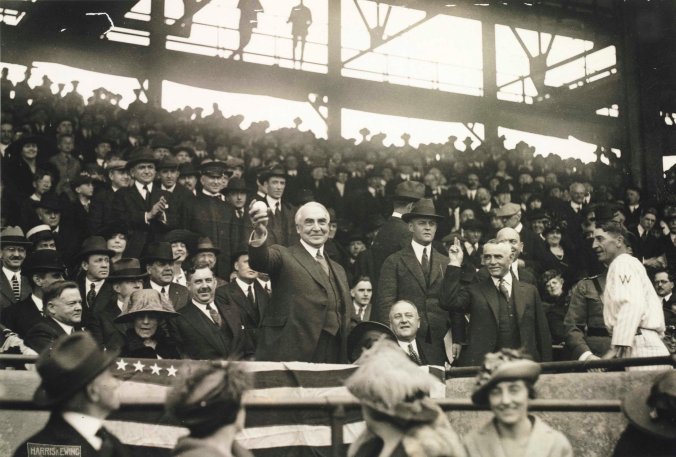
WGH-firstpitch

To such a leader, granted again by Providence, giving such wise counsel, inspiring such great confidence, accomplishing such results, holding the promise of such future benefits, we dedicate this day a memorial made in his likeness. But in what spirit do we dedicate it? How can we worthily consecrate it? How can we approach to that high standard here so nobly represented? There is but one method, already indicated, the price of continuing sacrifice. 

As these men whom we here honor have made their sacrifices for the public welfare so we, the people of the nation, must make ours. The great burden of the hour is not the needs of the people. They are not measurably greater than before the war. The burden of the hour is the needs of the government. It is that need which must be met by the people. It is not by adding to the requirements of government, but by taking from them, that the burdens of the people can be lightened. There are readjustments to be made. There is reconstruction to be done. There is restoration to be effected. From these the nation cannot escape. Each must bear his part. The appeal to duty never went unheeded by America. In this dedication, in this consecration, let us pledge ourselves, in private industry and public calling, to take up and discharge in the spirit of such great examples, every burden of civilization, every duty of Americans. 

The nation needs patience, pacification, and harmony, the world needs patience, pacification and harmony, under righteousness. Let us hallow the memory of him who so greatly desired these in the past by supporting the leadership of him who is so effectively establishing them in the present. 

— Calvin Coolidge, excerpts of the dedication of a bust of President Harding at the William McKinley Memorial in Niles, Ohio, June 18, 1921
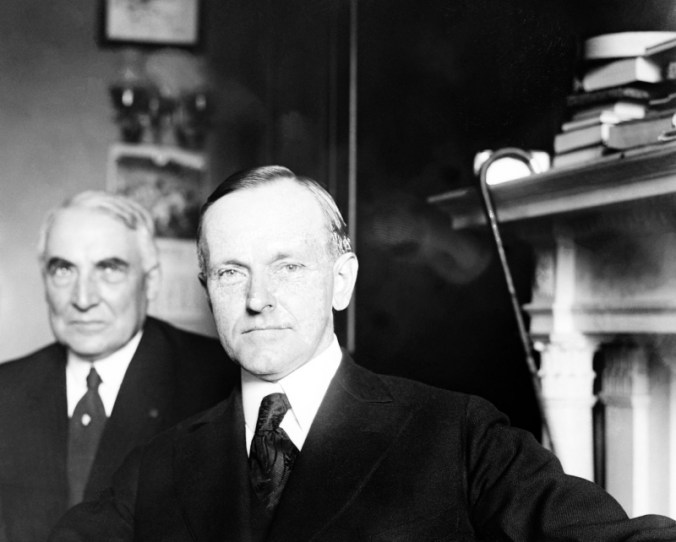
Harding-Coolidge-portrait


On Revolution and Respect

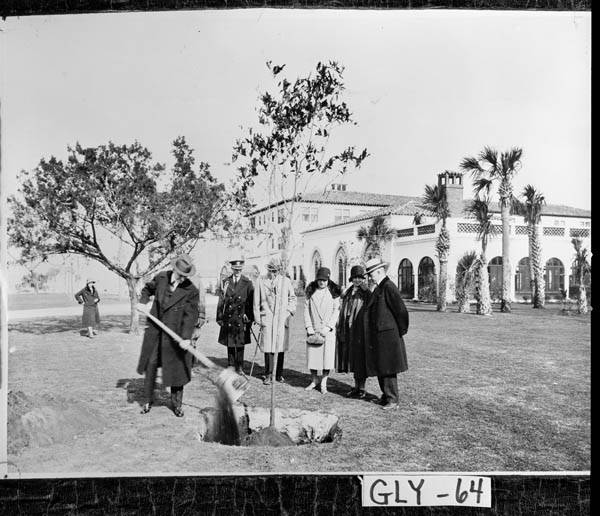
Sea_Island_Dec_1928_President_Calvin_Coolidge_tree_planting_ceremony_The_tree_known_as_Constitution_Oak_spent_Christmas_holidays_with_Howard_D_Coffi_on_Sapelo_Island

President Coolidge, seven years after this speech (1928), planting the Constitution Oak on the grounds of The Cloister, Sea Island, Georgia. Photo credit: Georgia Archives. 

Respect for law is a fundamental American principle. Not that there are no law breakers in our land. There are. But, even among these, there is not lacking some respect for the administration of the law. Those who deny its binding obligation, especially where their own rights are concerned, are few, and their counsels for the most part go unheeded. 

It is this respect for law which makes the American people worthy of every confidence, and whenever their attention can be gained, always to be trusted. Some of them may be swayed, momentarily, by strange doctrines taken through lack of information and discussion, but in the end good sense prevails. There may be a lack of appreciation on the part of new arrivals, but among them there are conspicuous examples of a sturdy American spirit, not outrivaled by the inheritors of generations of American training. 

There is need to resist radicalism, not because it may overthrow the Government, but because it is a disturbing and wasteful element in society. This does not mean resistance to the growth and expansion of our Constitution, but it does represent resistance to any change in its underlying principles. 

Those principles guarantee to American citizens the right of life, liberty and the pursuit of happiness. What more can be required? All that any revolution ever sough to accomplish was a life guarantee. What the oppressed of other lands may seek, every American holds as his birthright. 

There is an eternal obligation to remember the meaning of liberty, that liberty which goes with American citizenship. It is not license. It is far from the privilege of disregarding the rights of others. It is the fullest freedom of individual thought and action, limited by a like freedom of thought and action on the part of others. 

Men are free to think as they will, to speak as they will, to write as they will, provided thereby they do not trespass on the like privileges or do injury to others. The firm foundation of all liberty is the protection of the individual against the wrong-doing of others. 

All liberty is based on justice. The fair dealing between man and man. It is the law of unselfishness. Its basis is equality. Any class, any organization undertaking to secure for itself privileges not open to any other class or organization is hostile to American institutions and a menace to American liberty. 

There is a right of contract, of agreement, and association among individuals which is to be protected so long as the end sought is equal justice; but, any effort which contemplates coercion and force is an interference with our conception of American liberty and is justly denounced by American law. 

It is true that we hold to the theory of equality, not of character or possessions, but equality of opportunity and equality before the law. This does not mean that the Government guarantees any standard of achievement to its citizens, but that in its dealings with them it will grant to all an opportunity to be heard and the right to a decision based on the evidence of the law, without favor and without prejudice. It is the belief of an American that he creates opportunity, that his achievement, his destiny, his greatness, lies not in others but in himself. 

This respect for law has been justified by American accomplishments. In the 145 years which have intervened since the signing of the Declaration of Independence, the success of our nation has been the marvel of history. Those who desire to criticise, those who desire to destroy, will do well to study these accomplishments. Those who wish to join in any enterprise of destruction will do well to inquire what substitute is proposed. It needs no long investigation to demonstrate that under a reign of law there is an accumulation of property and the distribution of the rewards of industry among all the people, and that under a reign of disorder there is a destruction of property and a general increase of want, misery and destitution among the people. 

It is true that our institutions were established long ago, that they are justified alike by reason and by experience. It is equally true that they are not self-existent. Their defense and perpetuation requires constant effort and constant courage. If ever the time arrives that existence becomes so easy that effort and courage are not required, the decline and fall of civilization will be at hand. The glory of our history has been in the display of these qualities, from the clearing of the forests, the breaking away from old-world traditions, the prosecution of the Revolution, down to the fields of France, all have been examples of effort and courage. We may not know its source, we may attribute it to our contact with our broad plains or our lofty mountains, or ascribe it as the heritage of our forefathers; but, whatever it is, it has been the mark of American achievement. They may study it in the character of Washington, in Lincoln, in Roosevelt, or in the everyday life of the great body of our citizenship in war and in peace. It has won our wars, it has triumphed in our peace. It has made a garden place of the wilderness. It has raised up cities from their ashes. 

That courage, and effort, and confidence, which has marked our progress in the past, have not disappeared. They will not disappear. When conditions call for them, they come surging on. When there is need for leadership there are men appear who can lead. American resources have not failed, American faith must not fail. 

Obedience to law is not a mere appeal to the past, it is the sure foundation of progress. Our institutions provide for an orderly process of change, not through revolution but through the action of a wise, a duly ascertained and mature public opinion. This process goes on at every ballot box and in the deliberations and conclusions of every legislative assembly, from the Congress of the United States to the New England town meeting. The Government recognizes the binding force of all such actions. 

No party, no organization holds any guarantee of power. It acts under the direction of public opinion. Whenever its action becomes unwise and unwelcome, it is changed for some other party, some other organization, which is delegated to interpret the will of the people and execute the laws of the land. This is the rule not of force, not of a minority, but the rule of justice and of reason. 

There are those who speak of overthrowing the Government. In America, this reduces itself to the absurdity of overthrowing the people, for here the people are the government. Administrations and offices may change, have changed, as at the last election when the people entrusted their destinies to a wise and clear-visioned man from Ohio, who, in their service, toils on from day to day, seeking not his own but the public welfare. 

More than six score years have written our Constitution, not on parchment alone, nor yet on bronze, but into the everlasting soul of the nation. That is our security. That is our guarantee. 

There is discontent and unemployment at home, there are disorders abroad. Their remedy lies in our loyalty to our Government, in our obedience to constituted authority, that our own country, strong, well ordered, resolute, may continue to be the prosperous abiding place of such an institution of publicity and education as we have met here this evening to honor and acclaim, the stronghold of an enlightened liberty, the supporter of an advancing civilization. 

— Calvin Coolidge, marking the 150th Anniversary of the New York Commercial, May 23, 1921

Cabin_Bluff_19271928_Spiritual_singers_of_Georgia_Industrial_College_with_President_Calvin_Coolidge

President Coolidge and the musicians and artists of Georgia Industrial College, 1928. Photo credit: Georgia Archives. 

On Flag Day

Remembering the flag today…

gouverneurmorris's avatarThe Importance of the Obvious

Image

Reflecting on the significance of the flag a couple days in advance, the former President had these stirring thoughts to offer on Friday, June 12, 1931,

“National Flag Day has been observed for some years by official direction on June 14. It is the anniversary of the adoption by the Congress of the flag of the United States. We do honor to the Stars and Stripes as the emblem of our country and the symbol of all that our patriotism means.

     “The stars and the red, white and blue colors have a significance of their own, but when combined and arranged into the flag of our nation they take on a new significance which no other form or color can convey. We identify the flag with almost everything we hold dear on earth. It represents our peace and security, our civil and political liberty, our freedom of religious worship…

View original post 107 more words