Library of Congress Completes Digitization of Coolidge Papers!

The culmination of more than twenty years of effort, the marvelous staff at the Manuscript Division of the Library of Congress have completed the digitization of 3.3 million pages of documents, speeches, messages, correspondence, appointment books, and other materials from 23 Presidential collections, including 179,000 documents from the papers of President Coolidge. This represents the largest collection of original Coolidge documents in the world. Coolidge’s public papers, now available on the web for the first time, along with those of 22 other Presidents (Washington, Jefferson, Madison, Monroe, Jackson, Van Buren, W. H. Harrison, Tyler, Polk, Taylor, Pierce, Lincoln, A. Johnson, Grant, Garfield, Arthur, Cleveland, B. Harrison, McKinley, T. Roosevelt, Taft, and Wilson), can be accessed here.

Cal, who was the last to precede the Presidential Library system (under the auspices of the National Archives) and thus does not have a Presidential Library, left his personal papers in one of the most unprecedented of places: the innocuous Forbes Library in quiet Northampton, his adopted hometown.

It is welcome news to see that Coolidge’s papers can now be studied by researchers and citizens alike from the convenience of a small computer. While he may question all the attention that this means toward a legacy he usually neglected, he would be impressed by what this says about America’s technical ingenuity and the quality of her citizenship. He was not ashamed to love his country for all she had done across history and this achievement – one of both historical appreciation and scholarly precision – would join many others that would make Cal proud that America, in characteristic excellence, rose to the occasion yet again. She could add this gift to so many others given despite all the difficulties and all the pressures of such a year. It would likely prompt deserved praise from Coolidge that out of so much discouragement, suffering, and loss, that America is still exceeding expectations.
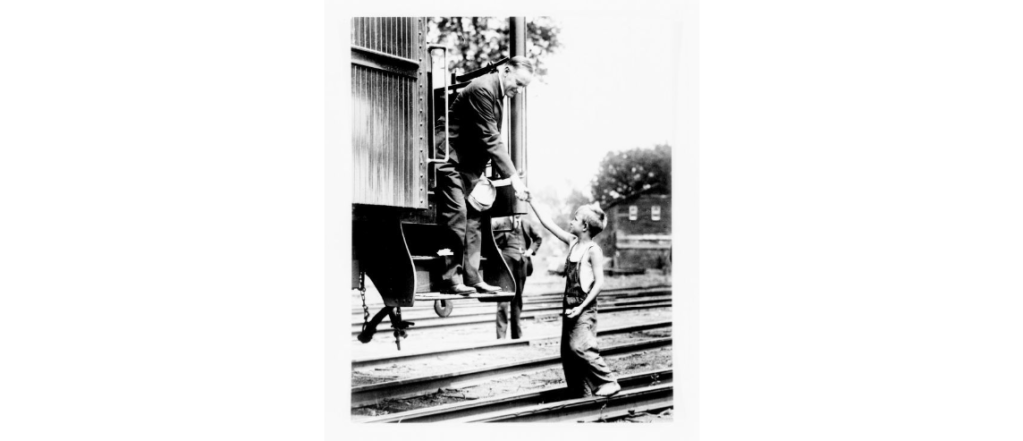
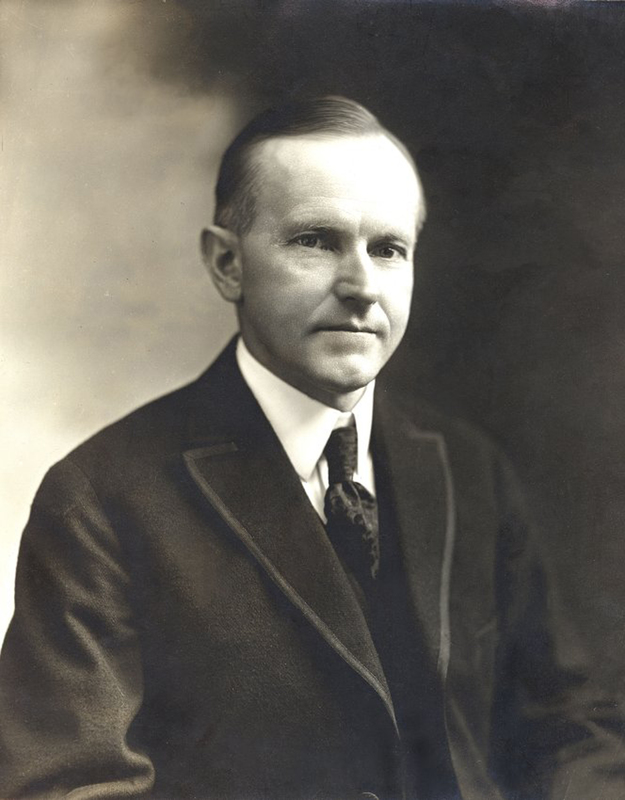
President Coolidge greeting a young American, August 24, 1925. Photo credit: Calvin Coolidge Papers from the Library of Congress.

On Application Over Annihilation

“As we can make progress in science not by the disregard, but by the application of the laws of mathematics, so in my firm conviction we can make progress politically and socially, not by a disregard of those fundamental principles which are the recognized, ratified and established American institutions, but by their scrupulous support and observance. American ideals do not require to be changed so much as they require to be understood and applied…

“Merely to state the American ideal is to perceive not only how far we still are from its realization, but to comprehend with what patience we must view many seeming failures, while we contemplate with great satisfaction much assured success…

“Our country is in process of development. Its physical elements are incomplete. Its institutions have been declared, but they are very far from being adopted and applied. We have not yet arrived at perfection. A scientific investigation of child life has been begun, but yet remains to be finished. There is a vast amount of ignorance and misunderstanding, of envy, hatred, and jealousy, with their attendant train of vice and crime. We are not yet free, but we are struggling to become free economically, socially, politically, spiritually…” — Calvin Coolidge, July 4, 1924

We too often quake with discontent while forgetting how far humans truly, authentically, genuinely have come thanks to the principles (and courage behind them) outlined (and lived) long before we were even a thought to our parents. We engage in too much vapid, empty gesture – the great symbolic act – calling for the latest version of reform and too little of either personal introspection or thoughtful application.  We are too ready as “joiners” of one movement upon another to condemn any currently deemed deviation of the ideal, railing against or joining in the mindless attack and ignorant vilification of values we simply do not understand with any mature judgment. We would do better to expend greater energy to an application of justice to those we know, along an individual and practical measure, jettisoning the crushing weight of building a universe of abstractions others so casually impose as our burden to bear. 

Coolidge had it right, our failure is not in the realm of ideals but in the practice of doing, the call each of us is tasked with to apply what is needed with courage not merely accuse others for falling short. Nor is it to concede principle for what is easiest. Ultimately, we are to realize that we are not in a boat where some are supposed to row for us while we give orders but rather we are all in the same vulnerable place, subject to fundamental truths that require greater application from us all. 

On Gratitude

“Thanksgiving is not only a holiday, it is a holy day. It is by no means enough to make it an occasion for recreation and feasting. Thanks are not to be returned merely to ourselves or to each other. The day is without significance unless it has a spiritual meaning. For more than three centuries our people have felt the need of celebrating the harvest time as a religious rite by offering thanks to the Creator for all their earthly blessings. There can be no true Thanksgiving without prayer.
 
“If at any time our rewards have seemed meager, we shall find our justification for Thanksgiving by carefully comparing what we have with what we deserve. The little band of Pilgrims who first established this institution on the shore by Plymouth Rock had no doubts. If their little colony of devoted souls, when exiled to a foreign wilderness by persecution, cut in half by disease, surrounded by hostility and threatened with famine, could give thanks how much more should this great nation, less deserving than the Pilgrims yet abounding in freedom, peace, security and plenty, now have the faith to return thanks to the author of all good and perfect gifts.”
 
—Calvin Coolidge, “Calvin Coolidge Says,” November 26, 1930.
 
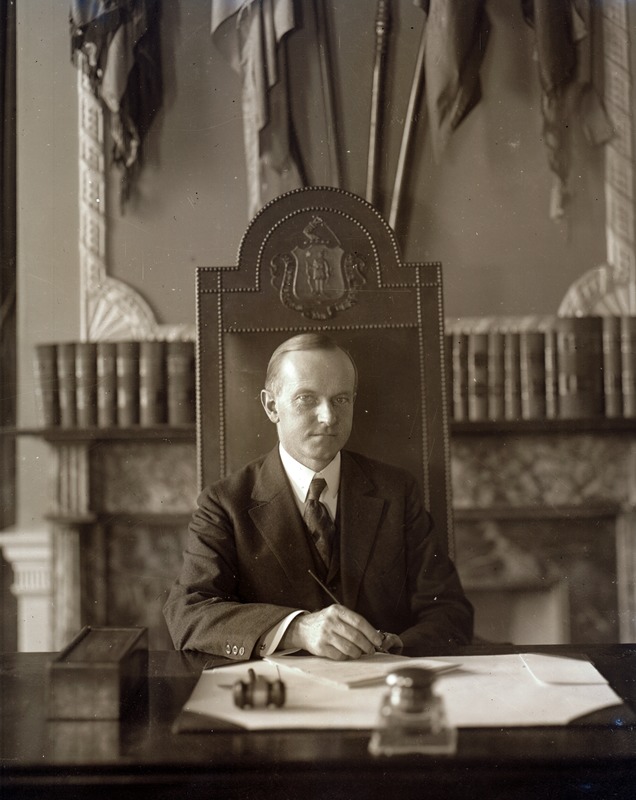
Calvin Coolidge, sitting at his desk in the Governor’s chair, a decade before he wrote these reflections on Thanksgiving.