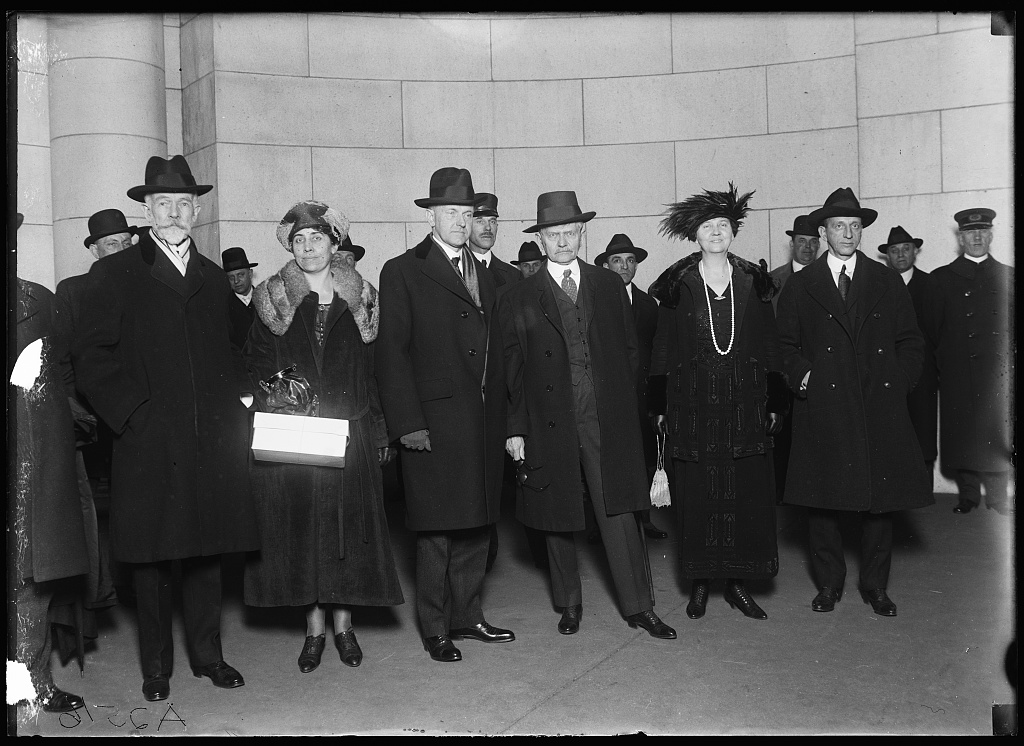
Before the Twentieth Amendment changed Inauguration Day from its original March 4th to the current January 20th of the year following Presidential & Vice Presidential elections, incoming administrations delivered their addresses and took their constitutionally prescribed oaths on the fourth of this month. This changed in January 1937. Three more pairs of Presidential-Vice Presidential tickets would observe the original day after the one that took place yesterday one hundred years ago (Coolidge-Charles G. Dawes, Herbert Hoover-Charles Curtis, and Franklin Delano Roosevelt-John N. Garner). It was the the fourth preceding duo (Warren G. Harding & Calvin Coolidge) who took the oath and delivered their inaugural addresses in 1921.
Coolidge, on the occasion of his oath, administered by friend and outgoing Vice President Thomas R. Marshall in the Senate Chamber, reflected deeply upon the institution of our branches of government, especially its bicameral National Legislature, the importance of having both bodies of deliberation, representing not only the people but also the States. The States were not, in his view, mere formulaic arms of the federal will. They were sovereigns in their own sacrosanct spheres. To Coolidge, both houses of Congress were genuinely vital safeguards to our constitutional system.
Coolidge expressed it this way:
“Five generations ago there was revealed to the people of this nation a new relationship between man and man, which they declared and proclaimed in the American Constitution. Therein they recognized a legislature empowered to express the will of the people in law, a judiciary required to determine and state such law, and an executive charged with securing obedience to the law, all holding their office, not by reason of some superior force, but through the duly determined conscience of their countrymen.
“To the House, close to the heart of the nation, renewing its whole membership by frequent elections, representing directly the people, reflecting their common purpose, has been granted a full measure of the power of legislation and exclusive authority to originate taxation. To the Senate, renewing its membership by degrees, representing in part the sovereign States, has been granted not only a full measure of the power of legislation, but, if possible, far more important functions.
“To it is entrusted the duty of review, that to negotiations there may be added ratification, and to appointment approval. Buts its greatest function of all, too little mentioned and too little understood, whether exercised in legislating or reviewing, is the preservation of liberty. Not merely the rights of the majority, they little need protection, but the rights of the minority, from whatever source they may be assailed. The great object for us to seek here, for the Constitution identifies the vice-presidency with the Senate, is to continue to make this chamber, as it was intended by the fathers, the citadel of liberty. An enormous power is here conferred, capable of much good or ill, open, it may be, to abuse, but necessary, wholly and absolutely necessary, to secure the required result.
“Whatever its faults, whatever its human imperfections, there is no legislative body in history that has used its powers with more wisdom and discretion, more uniformly for the execution of the public will, or more in harmony with the spirit of the authority of the people which has created it, than the United States Senate. I take up the duties which the people have assigned me under the Constitution, which we can neither enlarge nor diminish, of presiding over this Senate, agreeably to its rules and regulations, deeply conscious that it will continue to function in harmony with its high traditions as a great deliberative body, without passion and without fear, unmoved by clamor, but most sensitive to the right, the stronghold of government according to law, that the vision of past generations may be more and more the reality of generations yet to come.”


 The Importance of the Obvious