On Reuniting the States

On Reuniting the States

Return of the Confederate battle flags to Virginia, North Carolina and Texas on December 16, 1927. An earlier attempt by President Cleveland in 1887 met with successful opposition by the Grand Army of the Republic (Union veterans) as “trophies” of the War that should not be returned. It would be “treasonous” according to the large body of obstinate veterans.

President Theodore Roosevelt, through a careful coordination with Congress, restored a partial collection of battle flags to the Southern states in 1905, taking them from storage by the War Department in Washington.

Like so many old wounds, however, President Coolidge did not evade the controversy for fear that it would cost political support. Coolidge upheld just dealings toward all, whether it was the full citizenship for all tribes or fair honor due Southern Americans who fought just as valiantly as the Yankees did for principled reasons. It was overdue time to lay aside hostility, heal old grievances, and reestablish peace between Americans, North and South.

He recognized his duty included leadership by example to help reunite the country around the essentials we share as Americans. It would not be right to misuse a President’s influence by keeping us divided and at war with one another. He was as much an advocate of peace at home as he was abroad.
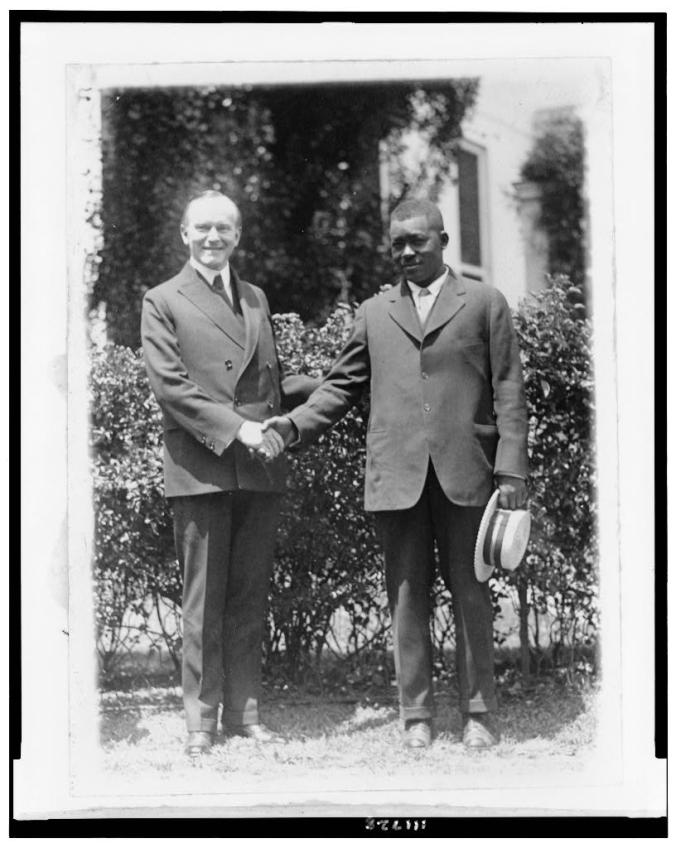
President Coolidge Recognizing Thomas Lee

President Coolidge recognizing Thomas Lee

Tom Lee, working for a levee repair contractor along the Mississippi, was returning from Helena, Arkansas to Memphis, Tennessee, on the afternoon of May 8, 1925. Alone and operating the company’s motorboat, he came to Cow Island Bend 16 miles south of the city when he saw the steamboat M. E. Norman. Passing it on the left, he happened to look back a half-mile upriver to see the vessel had begun listing and the wheel had stopped. The steamboat suddenly capsized but Mr. Lee had already turned around, heading back to the scene.

The Norman was a 114 foot boat, included a crew of 10 and was bringing several engineers and their families out to enjoy the River while they dined and surveyed project sites along the riverbanks. Listening to lectures, most of the engineers were below decks at the time and when the Norman capsized it disoriented everyone, trapping most below. Mr. Lee made five trips to shore, saving 32 people.

Twenty days later, he was honored at the White House by President Coolidge for his quick thinking and heroic rescue. The people of Memphis have placed a Memorial to him in their city, which reads, in part: “He has a finer monument than this–an invisible one – a monument of kindliness, generosity, courage and bigness of heart – his good deeds were scattered everywhere that day and into eternity.” Here, the President is publicly respecting the selfless service of a brave American. The political fallout for so public an endorsement mattered not to him.