On Broadcasting and the Movies

While it is better known that President Coolidge proficiently used the medium of radio, it is far lesser known what he thought of other forms of broadcasting, such as film and television, the latter in its earliest stages of potential. He was the first among Chief Executives to effectively employ the potential of radio communication. Long before the “fireside chat,” the voice Americans knew and liked was that of Calvin Coolidge.

As for the potential of movies, Coolidge hosted “movie previews,” both as Vice President and President for both friends and family, ranging from documentaries to entertainment pieces (Leab, “Coolidge, Hays, and 1920s Movies,” in Haynes 103). It was here that Coolidge’s realism built on faith manifested itself strikingly. He would navigate between the forces calling for outright censorship and those marketing and enthusiastically promoting D. W. Griffith’s pro-Klan picture, “Birth of a Nation,” steering legislation to decide by majority vote through commission whether the film should stand alone or include counterbalancing footage of black progress, like that at Tuskegee and Hampton Institutes. The latter prevailed in Massachusetts and served as a clear repudiation to the Klan and a rebuke of President Wilson, who was in favor of the movie as it stood. Coolidge’s bold act won respect, helped push the Klan into the margins and upstaged Wilson. It would not be the last time.

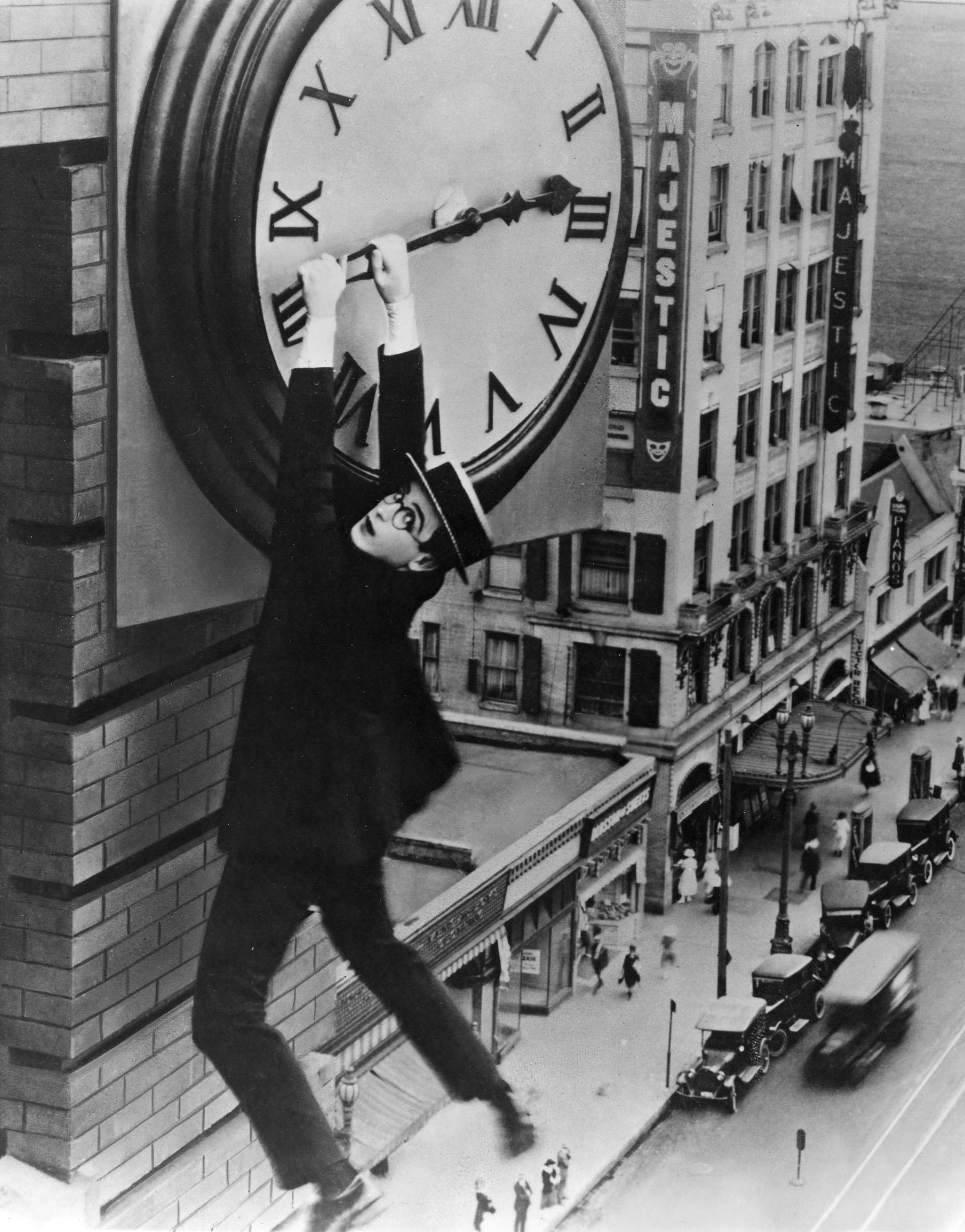
On the other hand, he recognized that moving pictures had great potential for good. The serious and educational served their purposes, of course, but so did comedy. Coolidge appreciated the need for balance between both. People need to be able to laugh, he would once remark. It is recalled by a regular guest to those “previews” that when a Harold Lloyd comedy was shown at the White House in 1925, he “never saw the President laugh more.” That potential for good was conditional, however, as he explains in his column on February 13, 1931, “The time may not be far away when it will be possible to have a receiving set in the home that will produce a sound motion picture. Central stations may be able to receive and broadcast to the eye and ear events taking place all over the world. It is difficult to comprehend what an enormous power this would be. New forces are constantly being created for good or for evil. When primitive people come in contact with civilization usually they use its powers for their own destruction. Unless the moral power of the world increases in proportion to its scientific power there is a real danger that the new inventions will prove instruments of our own destruction. If moral development keeps step, peace and good will have gained new allies.”

Given the general condition of modern film and television, can it be said that morality and goodness have kept pace with them? In small, isolated pockets broadcasting lives up to that noble alliance with morals, in praise of what is good and wholesome, and when it does, it exemplifies faithful stewardship and true progress. It is not coincidental that the best pictures appeal to timeless ideals.
                                    Image

                                    Image

                               Image

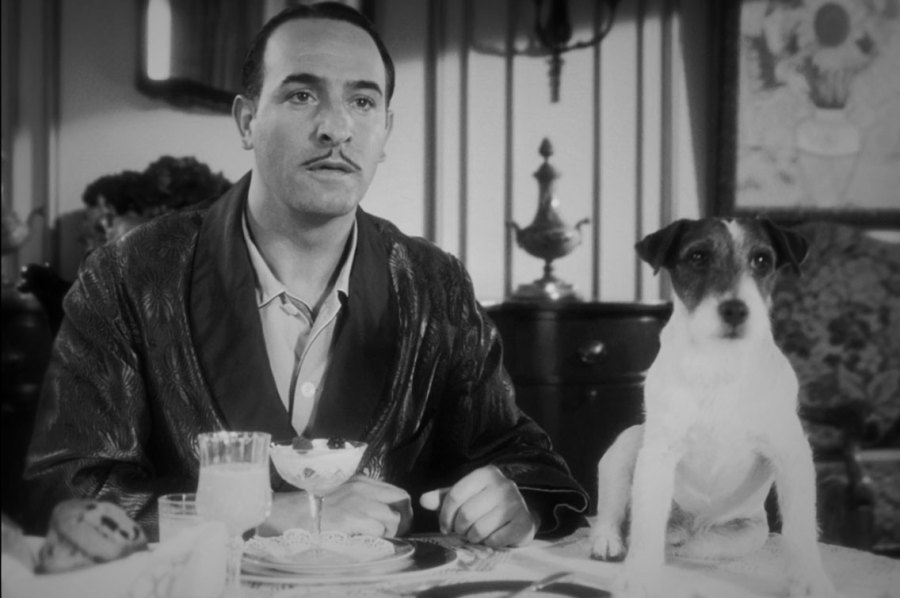
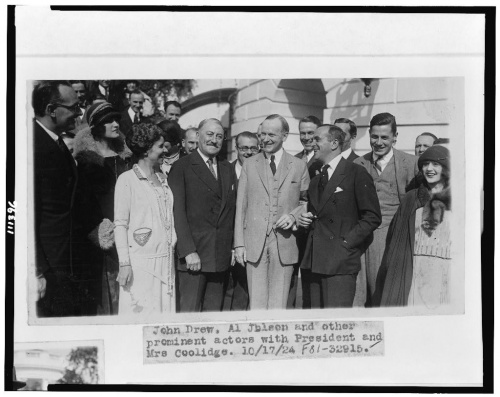
Top: Harold Lloyd in Safety Last! (1923); Middle: The Coolidges meeting Al Jolson and company, 1924; Bottom: Jean Dujardin and Uggie in The Artist (2011). Further Reading: chapter 4 “Coolidge, Hays, and 1920s Movies” by Daniel J. Leab in Calvin Coolidge and the Coolidge Era, Edited by John Earl Haynes. Washington, D.C.: Library of Congress, 1998.

On Getting to the Point

Calvin Coolidge was known for his incredible ability to distill the clutter of requests, technical details and verbose discussions into their essential qualities. His succinct style and disciplined pursuit of a matter’s basic point may have appeared lazy to the workaholic but to the one paying attention, it was a product of his practiced skills as a good listener and an effectual doer outside the limelight. Coolidge’s mastery of bringing the complex back down to its simplest principles left more than one contemporary amazed. Henry Stoddard, the owner and editor of the New York Evening Mail and student of Presidents from Grant through Coolidge and beyond had this instructive assessment of the man, writing in 1938:

“I doubt whether we have ever had a President–certainly not one in my time–who could probe so quickly and so surely to the heart of a problem as Calvin Coolidge did. He frequently said that if you got to the common sense of a question you had its answer–but how few possess that rare gift of seeking or even getting to the common sense of a question! In the lengthy debates in Congress how often have you heard common sense revealed? He insisted that worries beclouded clear thinking; therefore he refused to have them. No one would say that he was an optimist–he was too much of a realist–but his realism was of faith, not of fear. He never dreaded tomorrow. He prepared for it. No man having the right to know ever left Coolidge with the slightest doubt of his opinions…Slow to give his word, he never called it back” (‘It Costs to be President,’ p.133).

                 Image

Former President Coolidge at Madison Square Garden, his last public appearance, October 11, 1932. As he rose to speak, the crowds began to eat so much of his time with their enthusiastic standing ovations that he held up his watch to remind them that minutes were precious and he had to get to the point quickly in the time allotted. Even then, his determination to cut through the waste and get to the substance of why he was there mattered more than the accolades.

On Sports and Exercise

President Coolidge stood before those gathered at the National Conference on Outdoor Recreation, May 22, 1924, to address the importance of developing not only sound minds but also sound bodies. What made this possible, however, was not thanks to Washington’s involvement. It would never succeed to mandate or coerce fitness programs. It was going to come from taking advantage of the opportunities America’s liberty affords. He would observe the lifestyles of people had changed from those early days of settlement, when most worked outdoors and acquired the exercise of “active outdoor life in the open country.” Such was not so widespread anymore, Coolidge noted. However, “All of this makes it more necessary than ever that we should stimulate every possible interest in out of door health-giving recreation.” The President would emphatically remind his audience that this was not a responsibility of the Federal Government. “Necessarily they are largely local and individual, and to be helpful they must always be spontaneous.” There was no place for Washington telling people what to eat or how to exercise. To do so would defy freedom and undermine the very purpose of voluntary activity.

The conference should not expect him or any one else in the District to furnish the solutions. What the conference could do was bring private individuals together and coordinate their resources with ingenuity, exercising decisions at the local level for ways to restore the “natural balance of life” with both its physical and mental cultivation. For Coolidge, outdoor activities in all its forms — exercise, gardening, hunting, fishing and sports among so many others — afforded Americans the advantage of cherishing the wholesome in life. It knew no ethnic or racial bounds, it was a means to developing character, “a universal appeal.” Coolidge had seen men and women, of all backgrounds, work side by side during the War and that needed to continue in peace. Competitive sports — foremost baseball — afforded one such way to fully share in the identity of what America meant. While the rigors of training did not open participation in certain sports to the general public, such games “have no superior” when it came to “creating an interest which extends to every age and every class, for giving an opportunity for a few hours in the open air which will provide a change of scene, a new trend of thought, and the arousing of new enthusiasm for the great multitude of our people…”

If activities did not “represent an opportunity for a real betterment of the life of the people,” they were not worthy of America. They must “minister directly to the welfare of all our inhabitants.” The entertainment of ancient Greece and Rome, while they may have started on this ideal plane were, in the end, corrosive to the good and virtue of all people. Such could not be allowed a foothold in America’s pursuit of recreation. “It is altogether necessary that we keep our own amusements and recreations within that field which will be prophetic, not of destruction, but of development. it is characteristic of almost the entire American life that it has a most worthy regard for clean and manly sports. It has little appetite for that which is unwholesome or brutal.” Such ideals are what the moral experiment of America was all about.

Athletics and activity were a crucial resource to allocate and encourage, but it cannot be planned or enforced from a central government. It was up to the parents, civic-minded organizations, and volunteers in each neighborhood to foster a healthy balance of work and play. The supposed “High Priest of Big Business” (according to ignorant historians), President Coolidge, explained that balance as he continued speaking, “Our youth need instruction in how to play as much as they do in how to work. There are those who are engaged in our industries who need an opportunity for outdoor life and recreation no less than they need opportunity of employment. Side by side with the industrial plant should be the gymnasium and the athletic field. Along with the learning of a trade by which a livelihood is to be earned should go the learning of how to participate in the activities of recreation, by which life is made not only more enjoyable, but more rounded out and complete.”

As recreation, including sports from hunting to football, become less about the balance of good character in all people, and more about eradication of life’s risks, the good is being regulated away. When government is allowed to intervene in the name of public safety, to foster an environment of central management, ministering only to material gain, it deprives society of the intangible value of voluntary activities and outdoor exercise when and how individuals choose. Government, with all its good intentions, always fails to supply the needs of the soul and in the end, a people is left devoid of balance, empty, divided and dependent.

It was once understood by that man from Vermont that exercise and recreation “should be the means to acquainting all of us with the wonders and delights of this world in which we live, and of this country of which we are the joint inheritors. Through them we may teach our children true sportsmanship, right living, the love of being square, the sincere purpose to make our lives genuinely useful and helpful to our fellows…Our country is a land of cultured men and women. It is a land of agriculture, of industries, of schools, and of places of religious worship. It is a land of varied climes and scenery, of mountain and plain, of lake and river. It is the American heritage. We must make it a land of vision, a land of work, of sincere striving for the good, but we must add to all these, in order to round out the full stature of the people, an ample effort to make it a land of wholesome enjoyment and perennial gladness.”

Image

President Coolidge throwing the opening pitch in this 6-5 win by the Senators over the Yankees, April 22, 1924. Coolidge’s record stands at 3-1 for wins following opening pitches for the Senators. His only loss came from Boston beating Washington in 1928. As for the World Series, Coolidge threw first pitch for game one (1924), was present for games six and seven, and pitched again for game three in 1925. 1924 was the one and only championship for the National Capital to date.

                 Image

Vice President-elect Coolidge meeting the team captains in 1920’s Amherst versus Williams game.

Image

President Coolidge successfully hunting fowl in Georgia during his brief stay there in 1928.

               Image

Coolidge, in the summer of that same year, fishing on the Brule River in Wisconsin with the faithful Rob Roy and their guide John LaRock. Notice Coolidge’s aptly christened canoe.

Image

Ready to hit the slopes with the Coolidges…now for the snow…