“It is senseless to boast of our liberty when we find that to so shocking an extent it is merely the liberty to go ill-governed. It is time to take warning that neither the liberties we prize nor the system under which we claim them are safe while such conditions exist.
“We shall not correct admitted and grave defects if we hesitate to recognize them. We must be frank with ourselves. We ought to be our own harshest critics. We can afford to be, for in spite of everything we still have a balance of prosperity, of general welfare, of secure freedom, and of righteous purpose, that gives us assurance of leadership among the nations.
“What America needs is to hold to its ancient and well-charted course.
“Our country was conceived in the theory of local self-government. It has been dedicated by long practice to that wise and beneficent policy. It is the foundation principle of our system of liberty. It makes the largest promise to the freedom and development of the individual. Its preservation is worth all the effort and all the sacrifice that it may cost” — President Calvin Coolidge, Arlington National Cemetery, May 30, 1925.
Author: gouverneurmorris
On Belief in God
Long before Jefferson’s “wall of separation” was reinterpreted to mean a systematic removal of public expression of Christian faith, Robert A. Woods eloquently summarizes the faith Calvin Coolidge held firmly in God. He was not afraid to praise God yet a deep sense of humility kept him from flaunting his devotion and reliance on Him. He would never utilize religion as a tool to gain votes. His convictions were his own but he also knew they were grounded in reason. The strength to bear the responsibilities of office, including the deaths of his son and father, came from an Almighty Creator. As Woods would say,
“Any attempt to understand President Coolidge will go far amiss which does not take the fullest account of the great power of religious faith which has been continuous and increasing in his life. Beginning with his early nurture, greatly strengthened and broadened at Amherst, rising steadily as the responsibilities of life so steadily and so broadly increased — his faith in God with its correlative of faith in men, his sense of sustaining and uplifting spiritual realities, is, in modern terms, not less real to him and not less definite in its command and its reenforcement to righteousness than it was to the Puritans of old. He told an interviewer: ‘I have found that when a man does right, he is increasingly supported. I believe in God.’ There were some at least in the great audience that listened to his address at the dinner of the National Republican Club in New York City who understood him when, at its close, he paused and almost startled his audience with the words of the psalm: ‘He that keepeth Israel shall neither slumber nor sleep.’
“It too often seems in our public affairs that ‘belief and loyalty have passed away, and only the cant and false echo of them remain; and all solemnity has become pageantry.’ Whatever else may be set down as the final estimate of Calvin Coolidge, he will be among those leaders of the people whose reliance upon divine guidance is a part of the very fabric of their being. With a mind so clear, so free of pretence, this means not only a constant and vital constraint to righteous judgment, but as constant an aspiration toward a more righteous and more human order of the common life” (“The Preparation of Calvin Coolidge,” 1924, pp.234-5).
Visit to Rollins College
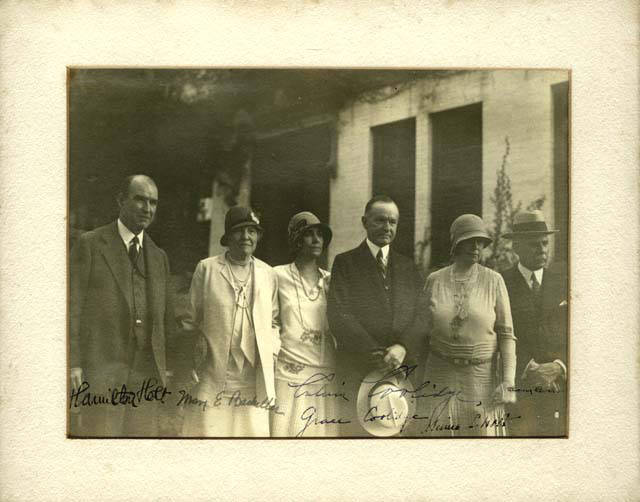
The former President and First Lady were invited for lunch at Rollins College in Winter Park, Florida, January 13, 1930. Pictured beside them, from left to right: Hamilton Holt, who would serve as President of the College from 1925-1949, after losing the Senate race in Connecticut in 1924, running as a Democrat; Mary E. Bacheller; Alexina L. Holt, Hamilton’s wife; and Irving Bacheller, a long-time trustee of Rollins College.
It was Mr. Bacheller who shared, during the event attended by the Coolidges in Rollins’ recreation hall (according to school history), “delightfully whimsical reminiscences” of the institution and his involvement with it. President Holt had promised Coolidge he would not have to speak at all nor would he be expected to take part in honorary degree ceremonies. He was welcome simply as a visitor, which was likely the most persuasive kind of invitation Coolidge would receive during this trip.
 The Importance of the Obvious