On Local Laxity and Disregard

“When the local government unit evades its responsibility in one direction, it is started in the vicious way of disregard of law and laxity of living. The police force which is administered on the assumption that the violation of some laws may be ignored has started toward demoralization. The community which approves such administration is making dangerous concessions. There is no use disguising the fact that as a nation our attitude toward the prevention and punishment of crime needs more serious attention…

“The conclusion is inescapable that laxity of administration reacts upon public opinion, causing cynicism and loss of confidence in both law and its enforcement and therefore in its observance. The failure of local government has demoralizing effect in every direction.

“These are vital issues, in which the nation greatly needs a revival of interest and concern. It is senseless to boast of our liberty when we find that to so shocking an extent it is merely the liberty to go ill-governed. It is time to take warning that neither the liberties we prize nor the system under which we claim them are safe while such conditions exist.

“We shall not correct admitted and grave defects if we hesitate to recognize them. We must be frank with ourselves. We ought to be our own harshest critics. We can afford to be...” — Calvin Coolidge, Arlington Amphitheater, May 30, 1925
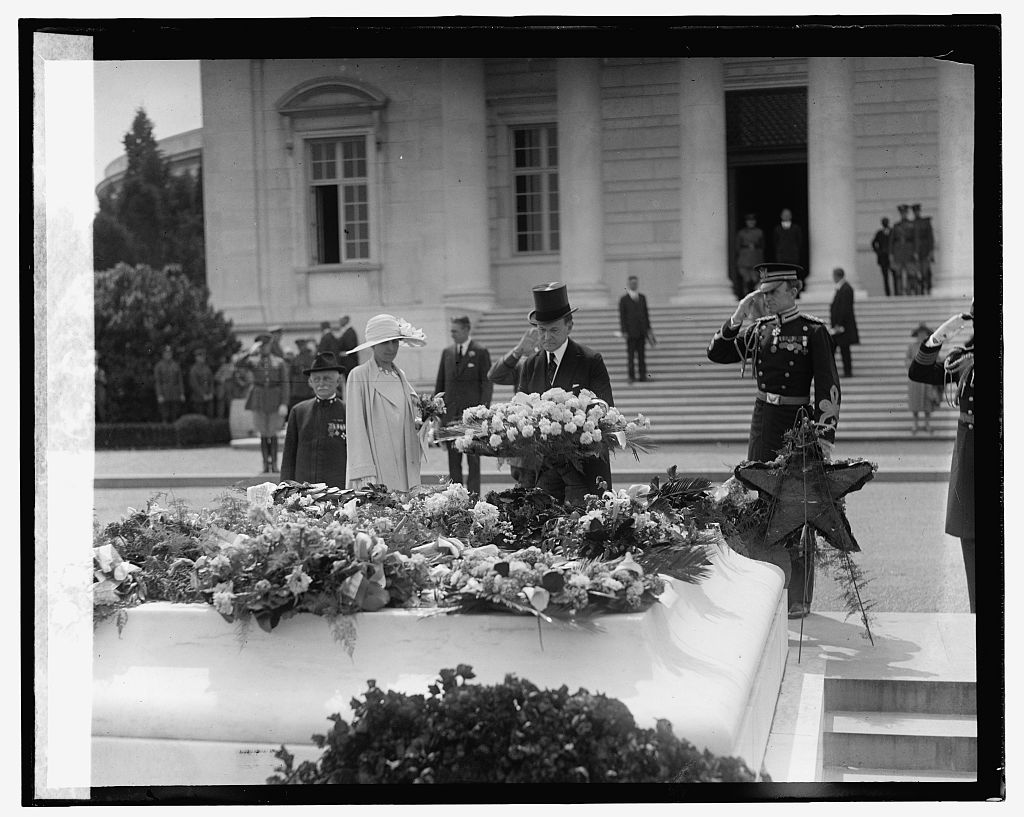
President and Mrs. Coolidge bestowing honors at Arlington’s Tomb of the Unknown Soldier, May 30, 1925

On Localized Not Nationalized Responsibility

“People are given to thinking and speaking of the national Government as “the Government.” They demand more from it than it was ever intended to provide; and yet in the same breath they complain that federal authority is stretching itself over areas which do not concern it. On one side, there are demands for more amendments to the Constitution. On the other, there is too much opposition to those that already exist.

“Without doubt, the reason for increasing demands on the federal Government is that the states have not discharged their full duties. Some have done better and some have done worse, but as a whole they have not done all they should. So demand has grown up for a greater concentration of powers in the federal government. If we will fairly consider it, we must conclude that the remedy would be worse than the disease. What we need is not more federal government, but better local government. Yet many people who would agree to this have large responsibility for the lapses of local authority.

“From every position of consistency with our system, more centralization ought to be avoided. The states would protest, promptly enough, anything savoring of federal usurpation. Their protection will lie in discharging the full obligations that have been imposed on them. Once the evasion of local responsibilities becomes a habit there is no knowing how far the consequences may reach. Every step in such a progression will be unfortunate alike for states and nation. The country needs, in grappling with the manifold problems of these times, all the courage, intelligence, training, and skill that can be enlisted…” — Calvin Coolidge, Arlington Amphitheater, May 30, 1925

On Federal Intrusion

“One insidious practice which sugar-coats the dose of federal intrusion is the division of expense for public improvements or services between state and national treasuries. The ardent states-rights advocate sees in this practice a vicious weakening of the state system. The extreme federalist is apt to look upon it in cynical fashion as bribing the states into subordination.

“The average American, believing in our dual-sovereignty system, must feel that the policy of national doles to the states is bad and may become disastrous. We may go on yet for a time with the easy assumption that, ‘if the states will not, the nation must.’ But that way lies trouble...Whenever by that plan we take something from one group of states and give it to another group, there is grave danger that we do an economic injustice on one side and a political injury on the other. We impose unfairly on the strength of the strong, and we encourage the weak to indulge in their weakness.” — Calvin Coolidge, Arlington Amphitheater, May 30, 1925