On Christmas Presence

“Christmas was a sacrament observed with the exchange of gifts, when the stockings were hung, and the spruce tree was lighted in the symbol of Christian faith and love.” - Calvin Coolidge, Autobiography

Singing Christmas carols from the North Portico of the White House, December 1923

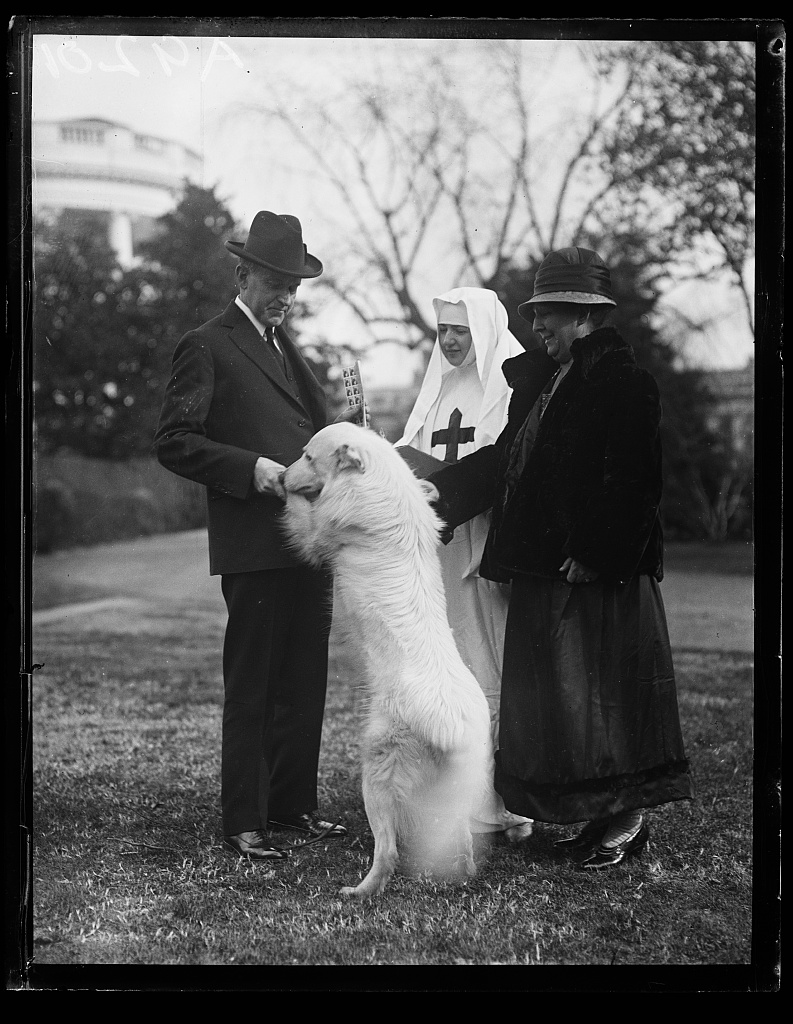
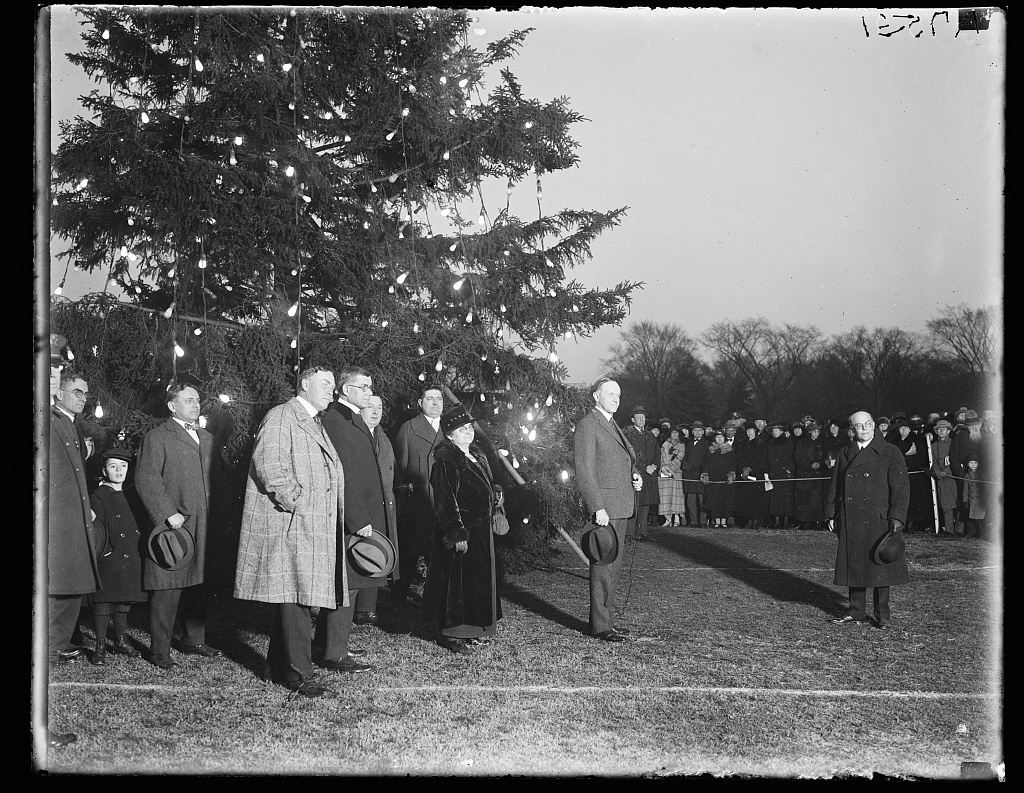
For the Coolidges, the season seemed to kindle an extra sense of the magical power inherent in its omnipotent roots, bringing everyone a little closer to those things of the spirit that no force can destroy, no will crush, no darkness extinguish. It harnessed, as Cal once said, far more than “just a season” but rather “a state of mind.” Its spirit found revived expression in the adornment of the White House as a home for young children once more, a tradition not enjoyed since the Taft years. The Blue Room returned to its place as the cozy spot for a humble tree trimmed by the First Lady and her boys. The spirit of service found rightful expression also in her preparation and distribution of food baskets and gift parcels. The President inaugurated the first community Christmas Tree lighting exactly one century ago. Together they launched the Christmas Seals campaign each year to support the work of the National Tuberculosis Association. It was their initiation of musical performances, though, that became a staple of Christmas during the Coolidge years. Nor were these programs limited to Sousa’s Marines or small groups of musicians but featured what became an annual — and beloved — custom: the singing, without accompaniment, of carols. The high point of these programs consisted of the sixty-member choir of the First Congregational Church under the direction of the talented Mrs. Ruby Smith Stahl. Alongside a full collection of established favorites, the lineup came to include Dr. Jason Noble Pierce’s “The Bells of Christmas,” composed in 1925 and dedicated to Mrs. Coolidge. When the Coolidges opened the grounds to the public and encouraged guests to sing along, they were tapping the power of music to reach souls.
They understood not every gift was tangible. Joining their inner official family, which included Mary Randolph and Laura Harlan, the First Lady’s secretaries, Ted and Henrietta Clark, the President’s personal secretary, Colonel Starling, the President’s Secret Service agent, Frank and Emily Stearns, and Dr. Joel and Helen Boone, assistant White House physician, who gave the Coolidges the daughter they did not have in their own little girl, Suzanne. Just six at the time, she became a regular recipient of the Coolidges’ adoration and generosity. When she learned from Dr. Boone that a Washington family had lost a father around Christmas, she gave up her presents to comfort the mourning children. Dr. Boone later remarked, “It gratified me, at her age to have her demonstrate her philanthropic disposition, which she has maintained throughout her life,” and whether acquired or born with that quality, he noted, “She was always most thoughtful of other people.”

It makes it easy to see the joy with which the President and First Lady both gave and received gifts, especially when Suzanne was concerned. When she gave them a carving knife and fork set (and cookies for good measure), Grace relayed the President’s playful doubt whether he had anything left to cut. Mrs. Coolidge shared her answer with Suzanne: If nothing else, “he can cut peas with it.” The next day (December 28, 1926), the President wrote his thanks to Suzanne, saying, “The Christmas cookies which you sent to me were all that you said of them in your note and you can be sure that they were much enjoyed.” The previous Christmas produced this note to Suzanne from Grace:

  For Suzanne’s dolly. An elderly lady made this quilt for me and Santa Claus and I knew that she would like to have Suzanne use it to keep her dolly warm this cold wintry weather. There are not enough squares to tell Suzanne how much Mrs. Coolidge loves her. Merry Christmas.

Dr. Boone became an older brother and confidante for the Coolidge boys too. He accompanied the boys almost daily during their Christmas break from school, especially Calvin Jr. Tragically, it proved his only Christmas at the White House. The boys came to relish their horseback rides through Rock Creek Zoo.

Without the Boones and the closely knit inner circle of extended Coolidge family, Christmas in the years to come would not have been as rich. We are shaped not only by the families in which we are born but also by the families which form by choice and circumstance. Without, however, that highest debt paid for us and which we owe everyone — selfless love — can Christmas be said to live, truly, in each of us?

A Merry Christmas to all this 2023!
Coolidge Back on the Campaign Trail

It is interesting to see that Calvin Coolidge has returned to the spotlight among Republican candidates this past week when they were asked “Which former President would you draw inspiration from for your own presidency and why?”

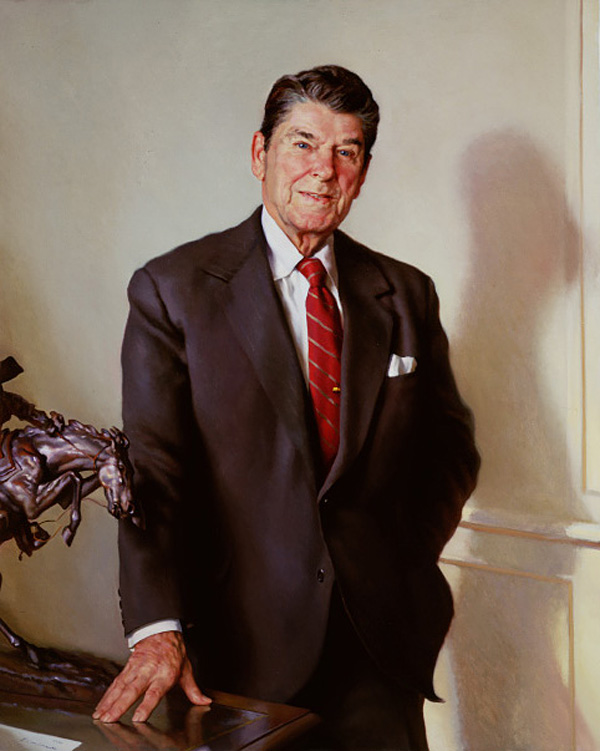
Former Governor of New Jersey Chris Christie declared that, for him, it had to be Ronald Reagan. Promoting his forthcoming book on the fortieth President (“What Would Reagan Do?”), Christie said Reagan was “a slave to the truth.” He was one who “stood up for the truth whether it was popular or unpopular at the moment.” Citing an example, Christie pointed to Reagan’s opposition to extremists in the anti-communist, socially right-wing John Birch Society in 1964, reflecting the kind of Presidency he aspires to have. Of all that could have been illustrative of Reagan, what an interesting choice of anecdote to make, Governor Christie. I suppose it reveals where your priorities rest. Of course, Reagan’s deep affinity for Cal — placing Coolidge’s portrait (by Frank O. Salisbury) in the Cabinet Room — is long known.

“Ron” Reagan (1981-1989)

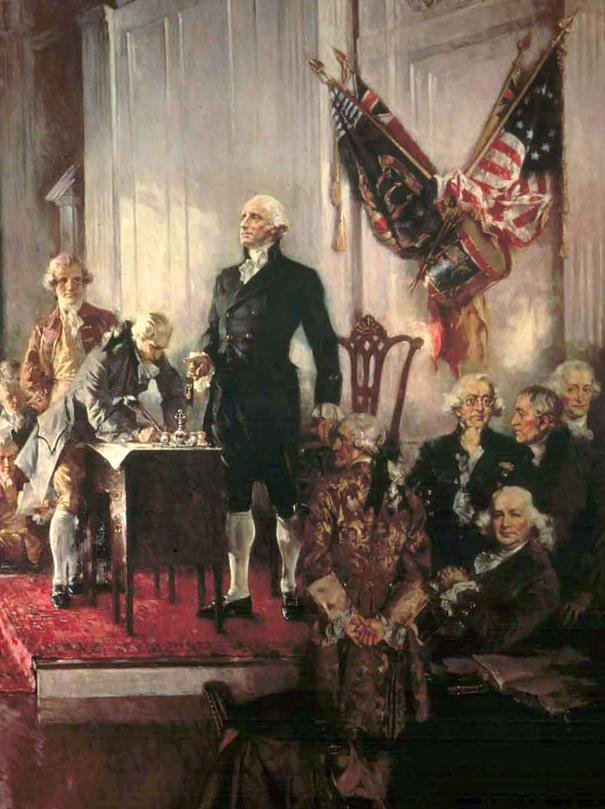
Former Governor of South Carolina and U. N. Ambassador Nikki Haley answered with both George Washington and Abraham Lincoln. For her, Washington’s sense of responsibility to “take on this great American experiment…intended to secure the rights and freedoms of the people” without becoming “all things to all people” illustrates the balance she would seek as President. Reflecting on the challenges and divisions Lincoln faced, she praised his ability “to lead in spite of the loud noises,” exemplifying a call for “what will bring out the best in people to get us to go forward,” supplying vital leadership that is needed “now more than ever.” Presiding at the 1926 sesquicentennial of American independence in Philadelphia, Coolidge learned that the half dollar minted for the occasion featured Washington’s profile alongside his own, an honor few Presidents have enjoyed. It is also consequential that among the possible Presidents recognized on Coolidge’s bookplate, it is Washington whose portrait features in the design. Cal made it clear that Washington deserved his preeminent standing “as the possession of all humanity, the first citizen of all the ages.” Of the sixteenth President, Coolidge also said: “In the greatness of Lincoln the people of this nation are lifted up to their own greatness. As they looked on him they beheld their better selves…The influence of Lincoln did not abide in America alone. The great cause which he led to victory went forth into the world…That vision has not yet been fully realized, but people see it more and more clearly; they strive for it with greater and greater success.”

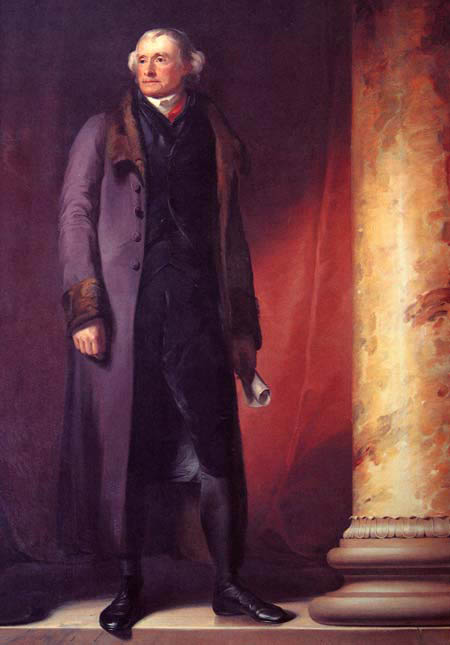
Vivek Ramaswamy, founder of Roivant Sciences, affirmed his inspiration was Thomas Jefferson. The man who wrote the Declaration at age 33 also invented the swivel chair, Ramaswamy asserted. Technically, the chair he used while writing the Declaration was a Revolving Windsor Armchair purchased the year before in Philadelphia and built according to his specifications. He did not patent the design and thus the now-familiar swivel chair is a later development. Nonetheless, Ramaswamy noted, Jefferson gives expression to that “founding spirit” of pioneers and explorers “that we miss.” Ramaswamy, in wondering what would Jefferson say to today’s Republican Party, averred that “one thing he’d remind us of” would be “freedom of speech” where “you get to express yourself freely no matter how heinous the opinion. Thomas Jefferson understood that. He’s an inspiration for me,” Ramaswamy said. Coolidge certainly felt a very strong link to July Fourth and the man who wrote its resonant Declaration. He could see, however, the ways in which Jefferson’s manifold ideas across a career of more than forty years had limits. When his ideas collided with conditions as they were, the dissonance provided a rich lesson in how governance by theoretical philosophy is not the same as governance by practical experience. As Cal wrote of Jefferson in his Autobiography, “In spite of all his greatness, anyone who had as many ideas as Jefferson was bound to find some of them would not work. But this does not detract from the wisdom of his faith in the people and his constant insistence that they be left to manage their own affairs. His opposition to bureaucracy will bear careful analysis, and the country could stand a great deal more of its application. The trouble with us is that we talk about Jefferson but do not follow him. In his theory that the people should manage their government, and not be managed by it, he was everlastingly right.” Coolidge was both a man of thought and ideas without ever being carried away by lofty abstractions. He kept his anchor, navigated the main currents, and proved how to win and how to govern well. Consequently, he could both sincerely admire and honestly disagree with his predecessors, however different they were from himself.

Thomas Jefferson (1801-1809)

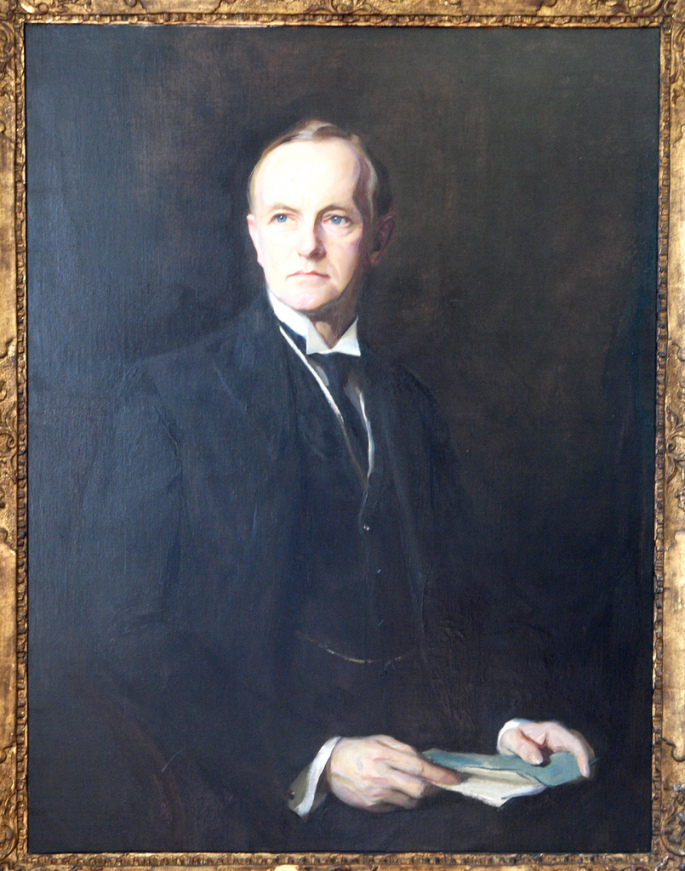
When Florida Governor Ron DeSantis was asked, he chose Calvin Coolidge. As cheers went up in the hall, he continued, “Now people don’t talk about him a lot but he was one of the few Presidents who got almost everything right. He understood the proper role of the federal government under the Constitution.” DeSantis urged the need to restore the central role of the Constitution to our outlook and the importance of a President who sees how to rein in the administrative state. He summarized: ” ‘Silent Cal’ knew the proper role of the federal government. The country was in great shape when he was President of the United States, and we can learn an awful from Calvin Coolidge.”

One of those lessons for certain candidates might be the choice when not to run. Sometimes a seemingly lesser office is a more meaningful and powerful place for leadership. As Coolidge once said, “The states are the sheet-anchors of our institutions. On them falls the task of administering local affairs.” He also once observed, “What we need is not more Federal government, but better local government.” Some candidates have already recognized this higher principle of service. Despite virtually launching his Presidential campaign in February this past year at the Coolidge Centennial Conference in Washington, D. C., it is evident that former Vice President Mike Pence, another admirer of Cal, took that advice to heart in October.

Ramaswamy noted that while DeSantis may have picked a President born on the Fourth of July, Vivek selected the President who died on that day…on its fiftieth anniversary. There are other lessons to be learned from Cal. Coolidge remains one of the most successful political candidates in American history, winning every contest for elected office except one early in his career: school board. Moreover, he achieved a governance with few mistakes. For candidates looking how to win campaigns, there is little need to go farther than Cal, whose style, strategy, and technique bear study and replication. Perhaps a President who places great value on the spoken word and who refuses to see himself as great or deserving of his turn in office is just what Americans need. If Coolidge were here, there is little doubt he would not be standing on a debate stage touting his own credentials. He would be talking about Jefferson’s Declaration, Washington’s character, and Lincoln’s perseverance, reminding Americans to keep faith with their ongoing experiment in self-government. Whatever choice is made for President next year, however, it is welcome to see Calvin Coolidge back in public discourse.

On Gratitude…A Century Ago

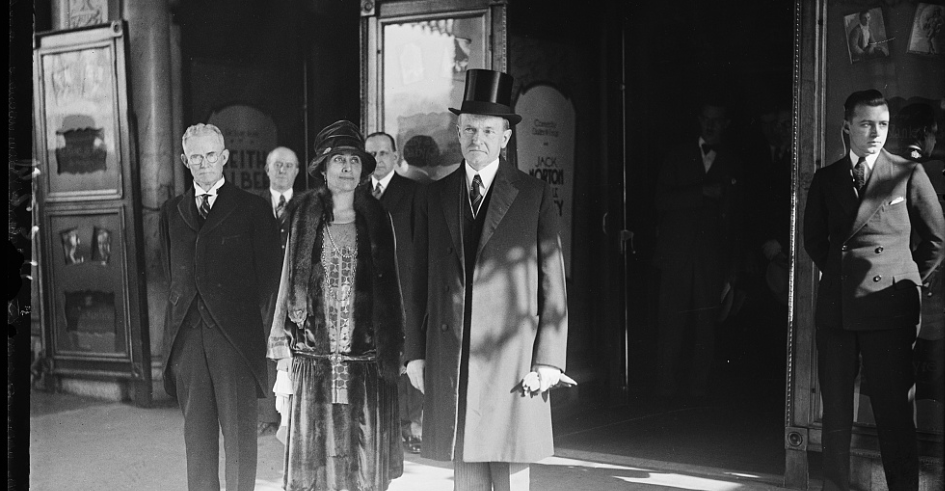
The Coolidges attended services at Keith’s Theater while the facilities of the First Congregational Church were undergoing repairs. The Church was noted for its open support for civil rights, a desegregated membership, and unostentatious worship. The minister, Jason Noble Pierce, spoke on 2 Corinthians 9.10-11 that day, Thursday, 24 November 1927. Photo credit: Library of Congress.

President Coolidge, on the 5th of November one hundred years ago, released the first of six Thanksgiving proclamations published during his five and a half years in office. Just over three months since succeeding upon the death of President Harding and two months after the traumatic earthquake in Japan, the Chief Executive was already proving his strength of leadership. He had not yet addressed Congress with the first of his annual messages (that would follow in December), but — in a substantial way — this was his first message to the nation. He did not disappoint as an effective communicator and his proclamation was shared at Thanksgiving gatherings, church services, and a broad range of organizational meetings large and small across the vast United States. For many, these were the first words most Americans read from their President since the shocking death of the previous POTUS that summer. His words, carefully composed, still resonate one hundred years later:

“The American people, from their earliest days, have observed the wise custom of acknowledging each year the bounty with which divine Providence has favored them. In the beginnings, this acknowledgment was a voluntary return of thanks by the community for the fruitfulness of the harvest. Though our mode of life has greatly changed, this custom has always survived. It has made thanksgiving day not only one of the oldest but one of the most characteristic observances of our country. On that day, in home and church, in family and public gatherings, the whole nation has for generations paid the tribute due from grateful hearts for blessings bestowed.

“To center our thought in this way upon the favor which we have been shown has been altogether wise and desirable. It has given opportunity justly to balance the good and the evil which we have experienced. In that we have never failed to find reasons for being grateful to God for a generous preponderance of the good. Even in the least propitious times, a broad contemplation of our whole position has never failed to disclose overwhelming reasons for thankfulness. Thus viewing our situation, we have found warrant for a more hopeful and confident attitude toward the future...

“…We have been blessed with much of material prosperity. We shall be better able to appreciate it if we remember the privations others have suffered, and we shall be the more worthy of it if we use it for their relief. We will do well then to render thanks for the good that has come to us, and show by our actions that we have become stronger, wiser, and truer by the chastenings which have been imposed upon us. We will thus prepare ourselves for the part we must take in a world which forever needs the full measure of service. We have been a most favored people. We ought to be a most generous people. We have been a most blessed people. We ought to be a most thankful people.

Gratitude is the appropriate response to our circumstance as a people and a nation. What we have been given necessitates a generosity for what we should bestow upon others. Coolidge understood this well, articulating potently the principle that to whom much is given, all the more is required.

Now he who supplies seed to the sower and bread for food will also supply and increase your store of seed and will enlarge the harvest of your righteousness. You will be enriched in every way so that you can be generous on every occasion, and through us your generosity will result in thanksgiving to God(2 Corinthians 9.10-11, NKJV).

Happy Thanksgiving to all this 2023!