Some Coolidge Advice

839284896-calvin-coolidge-opening-inauguration-lectern-us-president coolidge dam

When Calvin Coolidge took up the somber burden of writing a daily column after more than thirty years in public service, he was simply tapping into his natural talent for the pithy and, at times, indicting turn of phrase. It flowed from a mind prepared and full with what he had experienced guided by his personal fount of genuine wisdom. This is why those daily articles – each a precise marshaling of no more than two hundred words – speak with a volume and clarity that are unsurpassed in Presidential prose or political rhetoric both at the time or now. We especially need it now. Some of his offerings are very interconnected with the events of that year, 1930-1931. Others leap forth, cut free of any anchor to time or people and it is in some of those that we find the timeliest advice of all.

As we approach perhaps one of the most important decision of our generation (and consequently, of those yet to come) – the Republican Party’s nomination for President – we would do well to seek the judgment and insight of ol’ Cal. He, surprisingly to some, has much to say about what we might assume is an election year defying (seemingly at every turn) conventional appraisal.

We would do well to also acquaint or reacquaint ourselves with the many other occasions Coolidge had something to say about elected representation. Take, for instance, this golden bit of insight from 1920.

In his veto of what the state legislature had done as a result of pressure from their constituents, he wrote:

“Representative government ceases when outside influence of any kind is substituted for the judgment of the representative. This does not mean that the opinion of constituents is to be ignored. It is to be weighed most carefully, for the representative must represent, but his oath provides that it must be ‘faithfully and impartially according to the best of his abilities and understanding, agreeably to the rules and regulations of the Constitution and laws.’ Opinions and instructions do not outmatch the Constitution. Against it they are void. It is an insult to any…constituency to suggest that they were so intended. Instructions are not given unless given constitutionally. Instructions are not carried out unless carried our constitutionally. There can be no constitutional instruction to do an unconstitutional act.”

The people were not always right in every public decision. Their representatives were not merely bodies in a room to blindly follow popular preferences. Sometimes, representatives in our republic need to apply the brakes and prevent a state or a nation from careening into a political train wreck. That is ultimately why we are a republic instead of a direct democracy. Higher laws and larger obligations prevail over us all.
13002_t607

Or consider this one, from 1919:

“The conduct of public affairs is not a game. Responsible office does not go to the crafty. Governments are not founded upon an association for public plunder, but on the cooperation of men wherein each is seeking to do his duty.”

Writing during the mid-term election of 1930, much of what he observes nonetheless zeroes in on where we stand in 2016. His advice can be cutting at times, but by allowing it to cut, we may discover ears ready to hear and, at last, a readiness to receive the benefit of his instruction. Perhaps, we may yet obtain the blessing of listening and so avoid what seems a certain calamity for us and for generations to come. Below are excerpts from nine articles composed within a month’s time concerning the exercise of voting carefully, informedly, and conscientiously.
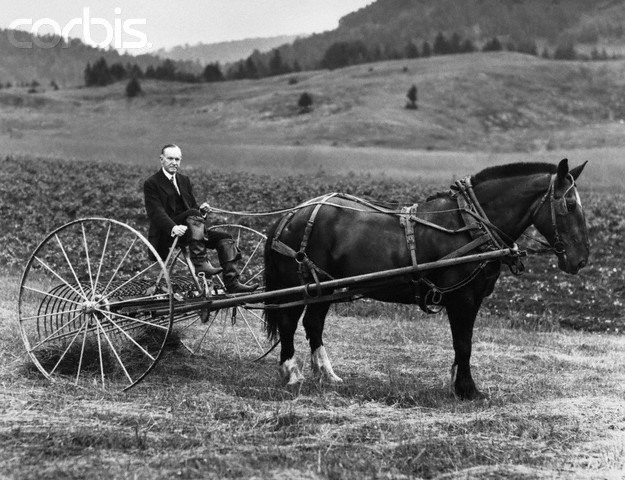
Former President Coolidge on Farm

Former President Coolidge working at the family Homestead, July 14, 1931. Courtesy of Corbis.

October 7, 1930 —

“When times are good and money is plenty we are willing to make liberal commitments. We take chances even to the extent of reckless extravagance. But at such times we want a conservative government. We disapprove of any proposed radical action. But when some depression in business comes we begin to be very conservative in our financial affairs. We save our money and take no chances in its investment. Yet in our political actions we go in the opposite direction. We begin to support radical measures and cast our votes for those who advance the most radical proposals. This is a curious and entirely illogical reaction. But when we are financially weakened we need the soundest and wisest of men and measures. The coming election is no time for rash experiments. The best we can get will be none too good. It is a time to use the same care in our politics that we use in our finances.”


October 8, 1930 —

“For importance political service the three qualifications necessary are character, ability and experience. Some of our voters are not giving sufficient consideration to these requirements. They are often supporting candidates whose greatest appeal is that they are good fellows. An agreeable personality is a fine quality, but it is not enough to administer a great office. It is vain to support office seekers who smile, if it results in electing officeholders who are not competent. The government cannot be run successfully by substituting the power of entertainment for the power of accomplishment. The essential quality for the voters to require in their choice of candidates is capacity for public service.”

cc retired at beeches 001

October 15, 1930 —

“All the predominant political opinion of the nation which is worth cultivating is never impressed by decisions made for effect. Those who compose that body want responsible officeholders to try to find out what is best for the welfare of the people and do that. They are moved by sincerity and integrity of purpose. Pretense does not appeal to them. That is the reason why those who seek popularity so seldom find it, while those who follow an informed conscience so often are astonished by a wide public approval. The people know a sham even when they seem to be trying to fool themselves and they cannot help having a wholesome respect for a reality. The best political effect usually comes to those who disregard it.”


October 17, 1930 —

“Notwithstanding the excellent practice of voting our ideals, nevertheless we have a representative government that must necessarily be about what we ourselves are. We demand entire freedom of action and then expect the government in some miraculous way to save us from the consequences of our own acts…Now the only way to hold the government entirely responsible for conditions is to give up our liberty for a dictatorship. If we continue the more reasonable practice of managing our own affairs we must bear the burdens of our own mistakes. A free people cannot shift their responsibility for them to the government. Self-government means self-reliance.”

$T2eC16ZHJGsFFMm92wKoBR6zvb0(tQ~~60_57

October 18, 1930 —

“Like almost everything else, the standards of the press are ultimately set by the people themselves. They will get what they insist on having. If they want a reliable, serious, informing newspaper, it will be furnished for them. If they are content with exciting, highly colored sensationalism, they will get that.”


October 25, 1930 —

“The law of action and reaction does not work anywhere more certainly than in our system of self-government. We get out of life exactly what we put into it. Surely the people can get out of their government only what they put into it. In a republic the people are sovereign. They can manifest their sovereignty from day to day through the avenue of public opinion. That will have some influence on their government. But their greatest opportunity and their gravest responsibility are on election day. With a careless, indifferent, uninformed electorate a republic will deteriorate into a very bad form of government. It will fall into the hands of the incompetent and the vicious. Good government under our system depends on the ballot box…It is a time when the serious second thought of the people is needed. We cannot receive what we do not give. Put good government into the ballot box.”


October 28, 1930 —

“We do not give enough attention to nominations nor elections. We let our choice turn on some immaterial personal characteristic that has nothing to do with the qualifications for the office. We heap so much abuse on public servants that many with every capacity for office will not subject themselves to the ordeal. Conspicuous success in private life is often considered a bar to public recognition. In response to some whim we support candidates who can only succeed in office by disregarding the reason for which they were elected. All of these practices put our government at a disadvantage. We are only saved from a complete disaster because the average person rises somewhat to responsibility. With our increasing intricate system of government and business we must give more attention to the capacity of candidates. Their decisions affect our whole national life. Public service is a most exacting profession. Honest and good intentions are almost useless unless they are supplemented by ability. When we vote for anything but the best we cheat ourselves, our families, and our country.”

1929cc

November 1, 1930 —

“This republic need fear little internal danger if the people conscientiously discharge their duty to vote. All abuses that may arise will be redressed by that constitutional method. We can secure a government of the bad by the good and avoid a government of the good by the bad only through a general expression of the qualified voters. We have plenty of unthinking people, some vicious, and other organized for selfish exploitation of the public through governmental agencies. All of these elements vote in full force. In a light vote they will be the decisive factor. The great body of our people are thoughtful, serious, unselfish and patriotic. They are not easily deceived, because they contemplate both the future and the past. Demagogues and false issues do not move them. They have wisdom. They are judges of men. The Republic is safe when they vote. Both the voters and public officers may be confused by complicated governmental questions. But the voters are not confused about candidates. They know a sham from a reality. The country needs the judgment of every enlightened voter…”

And finally,

November 3, 1930 —

“We need to exert ourselves to live up to the ideal of a sovereign, self-governing people. We need to think for ourselves. That means voting our own convictions. We need to act for ourselves. That means going to the polls without having to be dragooned by a ward committee…There is nothing new or complicated about the duty of the voter. Every one can understand it. The cheapest and best way is to meet it. The cost to the people of enfranchised indifference is one of our heaviest taxes. The public welfare requires but a little thought and time of the average citizen.”

411027_10150574765301639_861034477_o


Calvin Coolidge: Didn’t Get Much Done? Think Again

In difficult times, we very naturally seek out those who are often underrated and forgotten examples of courage and strength to steel ourselves for what needs to be done. When substantive heroes are wanted, we quickly find leaders like Calvin Coolidge who seem to be prepared for the occasion. Just when the times need most the qualities and perspective he possessed, an awareness and rediscovery of him is steadily and deservedly occurring. Here, contrary to the myth circulated by friends and foes alike, is a glimpse at a very productive and even busy President, who did more with less than we often realize fooled, as it were, by his carefully perfected appearance of inactivity. Even after the devastating loss of his youngest son early in his Presidency, he seemed to hunker down and work even harder not slackening his sense of duty but intensifying his efforts to serve the whole nation. His rediscovery could not come at a better time.

gouverneurmorris's avatarThe Importance of the Obvious

Courtesy of the Library of Congress Courtesy of the Library of Congress

Last December when we examined the First Annual Message delivered by President Calvin Coolidge, December 6, 1923, we observed that this speech shattered the perception that Cal had nothing to say, little to offer, and even less to do. A careful look at this and the Second Annual Message, delivered in December 1924, contradict this perception. Writing at the close of his administration, Coolidge would actually make the claim that most of what he had proposed in that first address had become law by the time he would leave Washington. How did such a historically-miscast “do-nothing” get so much accomplished? We will take a look at each of his proposals in brief as they reveal a Calvin Coolidge that simply has not been allowed out in public these days because it fails to fit the caricature or desired interpretation at a given time.

First…

View original post 2,085 more words

On Lessons Learned from a Father

6192827595_573be2c602_b

The Coolidges arrive at the Homestead in Plymouth Notch, following Calvin Jr’s death. Courtesy of the Leslie Jones Collection.

Our generation is no different from any other to perceive what it has known is not only fading away but perhaps doing so permanently. What is unique is the degree to which what were once indisputable essentials have now become the ground zero of cultural conflict. No one questioned the self-evident because they lacked modern sophistication or an open, inquisitive mind. They were not cowed by some dread of challenging the way things were as imposed on them by environment or authority. They simply knew better, they understood there were certain truths that are not defined by society but are eternal as the soul, whether they believed God had so ordered the world and humanity’s unique place in it or not. Their disbelief did not overturn so common sense a reality.

Generations have come and gone which mocked that reality and held it to be an illusion. Needless to say, they have not discovered anything truer or more enduring beyond the supposed smoke and veil of what others knew to be real all along. In fact, history is piled high with the bodies of those who espoused a naive faith in humanity to conceive its own realities or become its own source of transcendent standards. The highest flights of postmodernist fancy still plummet to the horrors of the guillotine or tragic tales of individual self-destruction by those who feel they can abandon oppressive reality without suffering real consequences.

There was a term for this kind of cavalier attitude about the consequences of one’s actions in Calvin Coolidge’s day. They were called “sports” and none of them ever saw old age. Cal saw this as correlating to their failure to live right, as he said, “Things are so ordered in the world that those who violate its law cannot escape the penalty. Nature is inexorable, if men do not follow the truth they cannot live.”

He was simply restating the biblical truth that a child lives longer when he or she honors one’s parents. Coolidge knew the way a person lived did not always catch up to him or her right away. He knew sometimes justice could be deferred but what was due was coming nonetheless. God’s judgment did not sleep forever.

6192830925_cab2acd2c6_b Coolidge with family during Boston Police Strike

Then Governor Coolidge with Grace and their boys: Calvin Jr (left) and John (right), the oldest, fall 1919. Courtesy of the Leslie Jones Collection.

Coolidge would likely not have imagined the degree a generation like ours would attempt to go to suspend reality. Yet, having enthusiastically courted it without any substantial skepticism, America’s brazen overconfidence in it is only exceeded by its rapid descent because of it. When Coolidge noted to a friend in the fall of 1932, that he felt he “no longer fit in with these times,” he was speaking of a public sentiment that gave what he believed lip service but no longer believed it and had, in fact, abandoned his principles for spending with impunity, prosperity as a right, and a pursuit of the shiny lure of autocratic, big government Republicanism. Before FDR, the policy forbears of the New Deal were not Democrats, they were the exuberant planners and power-awed courtiers of Hoover’s Grand Old Party.

These were not the ways Coolidge had learned from his father. They were not just environmental reflexes either but proven testaments of sound living. Cal did not have to experiment with alternatives to know their flaws and failings, he already knew because of what his father had taught in the daily, practical responsibilities of managing store, collecting local taxes, confronting bail jumpers, and upholding the responsibilities of farm, family, and faith. These were not warm and rosy constructions but sober and stern realities.

08_06_009770

The President’s father meeting with two Plymouth townspeople, as he continued to serve for the betterment of his neighbors in a range of menial and unassuming ways even with his son’s national notoriety. Courtesy of the Leslie Jones Collection.

When Coolidge reflected on some of the lessons learned from his father, he thought of his father’s competence at every task. There seemed to be nothing the diligent older man could not do with skill and lasting quality. Though the father was much more patient than the son, the older man abhorred waste and was firm in his resistance to it. The father was not indulgent but made clear to keep his son humble, a lesson Calvin learned well and perhaps inflicted it too harshly on his boys. One wishes he had not been quite so hard on his oldest son after young Calvin’s death. Young John needed his father’s tenderness and kindness not his distance or constraints. He did not understand how to handle anyone other than himself, including the son most like Grace and Grace herself. He knew Grace and loved her devotedly but his focus did not allow him to step out further as the kind of father each boy needed. The older Calvin retained well what he would call “the barnyard philosophy of his father” not as a derisive concept but as the wholesome dose of sense that people should not seek to light like chickens higher than they could roost. Instead, each should live with the fullest independence which meant living within one’s means, not upon borrowed time or borrowed resources.

6.21-Pres-Calvin-Coolidge-Program-Courtesy-of-Vermont-Division-for-Historic-Preservation-322x404

Coolidge also learned from his father the source of wealth is work. He put it this way,

My fundamental idea of both private and public business came first from my father…He was generous and charitable man, but he regarded waste as a moral wrong. Wealth comes from industry and from the hard experience of human toil. To dissipate it in waste and extravagance is disloyalty to humanity. This is by no means a doctrine of parsimony. Both men and nations should live in accordance with their means and devote their substance not only to productive industry, but to the creation of the various forms of beauty and the pursuit of culture which give adornments to the art of life.

08_06_009680

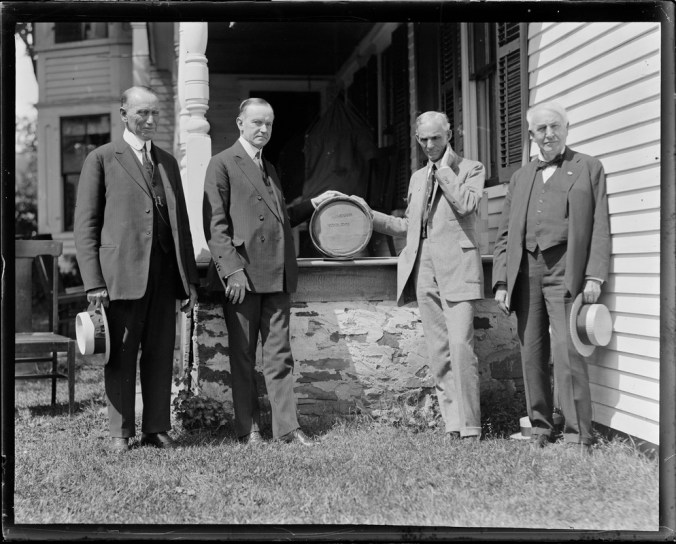
Colonel Coolidge (far left) beside the President with Henry Ford and Thomas Edison with one of Cal’s signed maple sap buckets, August 1924. Courtesy of the Leslie Jones Collection.

Coolidge was not finished, as he explained how this practical lesson changed the course of millions of lives as a defining accomplishment of his administration years later. By possessing the will, not merely the rhetoric, to hold government to an exact standard, actually removing expenditures, dismantling the crushing regulatory tax burden and paying down debt obligations, Coolidge proved that the interests of the whole country (or any business in particular) needs the competent not the novice at the helm. Coolidge would have been the last person to ever take credit for the labor and discipline of those millions of people helped by his tenaciously kept program of constructive economy. He simply enabled them to do for themselves, keeping more of what they had earned. Government’s greatest aid is not in appropriating money but in restoring the powers of ownership and opportunity.

He understood that virtue was no more unique to businessmen than to any other field of service, including politics. One’s fitness for public trust was not found in the appearance of being on the outside, let alone one’s cultural name recognition, but the character of the person and the fidelity to the responsibilities one has already shown. It was human nature to seek power, access, and others’ money. It was the President’s challenge to protect the whole people from those who would try to take advantage along any of these routes. He understood that trustworthiness was at the heart of all service whether that was public office or private business. In this way, he knew business better than most do today. He learned this by first drawing upon the insights of his father.

$T2eC16N,!)QE9s3HD)e-BQ9JNoc(3g~~60_57

The father understood his charge as a patient teacher of human nature and a watchman of his children’s souls. It is likewise unfortunate that while Calvin mastered a superb ability to detect charlatans and schemers, he exasperated his children with a marked favoritism for the younger and an unnecessary measure of severity on the elder. If Coolidge is to be faulted, it must also be remembered this was because he first poured himself into the oath he had taken and the public duty he owed that, in the end, left him with less to give as a father or husband. He spent himself in doing his work so faithfully each day that his family suffered the most for it. He felt it most sharply when he remembered both his younger son’s death and then that of his father’s, writing on one occasion, “It costs a great deal to be President.” Both he and his father put their youngest children in the frozen ground of the family plot. It is regrettable that the President responded so differently from his father when it came to grief. Yet, death impressed itself early on the son’s life in ways we dare not nor can quantify. It still did not override or paralyze Calvin’s sense of obligation to finish what he started as President. Both Colonel and President Coolidge, in spite of their shortcomings, were exemplary leaders of men, though it is in the father we find to a greater degree that most essential of qualities: first managing one’s house well. It is almost a proverb that those who serve in public ways often find their own house neglected in some substantial fashion. For Calvin Coolidge, who understood this in perhaps a morbid way by modern terms, he paid a penalty for his pride through these deaths on either side of him. The lessons of his father were never far away.

While both men were kind and manifested a heartfelt love for people, the father was more adept at showing it while it remained an awkward skill in the hands of the son. While Calvin had to work harder to show it, he felt it no less acutely for all people. He especially manifested it when someone was treated unfairly, at times descending on the offender with a fervid indignation to correct the wrong done. The White House staff was on the receiving end of this withering fury more than once. He hated liars and abhorred those who would distort integrity and manipulate for personal advantage. He had already seen his predecessor undone by indulgent habits, Calvin would not abide it in his tenure. He detested those who vaunted themselves above others. He was the best prepared leader when the times most needed someone of his mettle and focus. His intensity for the public service was genuine and unmatched.

coolidge-silhouette1

He spent himself so fully in the five and a half years of his administration that upon watching it be swept away in one large swath after another (inside of another four years), he would be gone. Yet, he exemplified some of his father’s most important lessons and he transmits them now to us long after his generation has passed. In a time when it seems politicians are just “warming up” to their roles after two terms, expecting lifelong careers ahead, Coolidge would already have completed his goals, laid down the office and returned as an equal to the people from which he came. Firmly adhering to the ideal of a servant-leader, he took care to uphold the original scope of the office, to mitigate the corrosive effect of power on – first of all – himself, to faithfully execute the laws and the Constitution, and to live worthy of his father’s lessons. He may not have been the best father himself but he and Grace still raised two of the finest boys ever known into exemplary men.

The faithful men and great women of the future will not spring from some other set of conditions outside every parents’ solemn task. It will not come by insulating our children for perpetual adolescence. It will still be incumbent on us to raise our boys to know they are to be men someday with sober responsibilities, foremost as husbands and fathers. It is no different from every generation that we are also to bring up our girls to prepare for equally important obligations, aspiring foremost to be as wives and mothers. It rests with us, especially us fathers, to face reality for what it is, to live up to the lessons good men have taught, and to leave what is worth preserving to those who will follow us.

Calvin Coolidge spoke in support of Herbert Hoover, at Madison Square Garden. On October 11, 1932, the former Republican Preside

Former President Coolidge’s last public appearance, Madison Square Garden, October 11, 1932. Courtesy of Everett Collection Historical/Alamy Stock Photo.