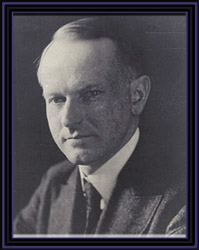
The first time Calvin Coolidge stepped into the White House was not in 1923, as President; it was not even in 1921 as Vice President or in 1920, as a candidate for office. It was technically not even at this occasion on March 4, 1919, when Cal — a wartime state governor of one of the most populous, important states in the country — presided at the Conference of Governors and mayors, held at the Executive Mansion at 1600 Pennsylvania Avenue. It seems his first visit to the White House occurred in 1916. Yet, as presiding officer at this meeting of Governors and mayors at the Wilson White House, Coolidge addressed two central questions:
- What should be done about returning soldiers to peacetime employment?
- What should be done to return business and the economy to a peacetime basis?
Following our own experience with a year of mammoth upheavals, his reflections on what should be done bear a new reading. This is especially so with the differences that very much exist between the now preceding administration and its successor. There was no real benefit to be had for the country to continue to operate in campaign mode when so much of the work of returning to a governance of peace needed full focus.
Governor Coolidge would observe that in his own state, most of the problem could be resolved by people doing what they needed to do, taking care of themselves. “Of the ten per cent who apply for situations many are placed, the only difficulty being with those who have been engaged in building industries, unskilled and office help.”
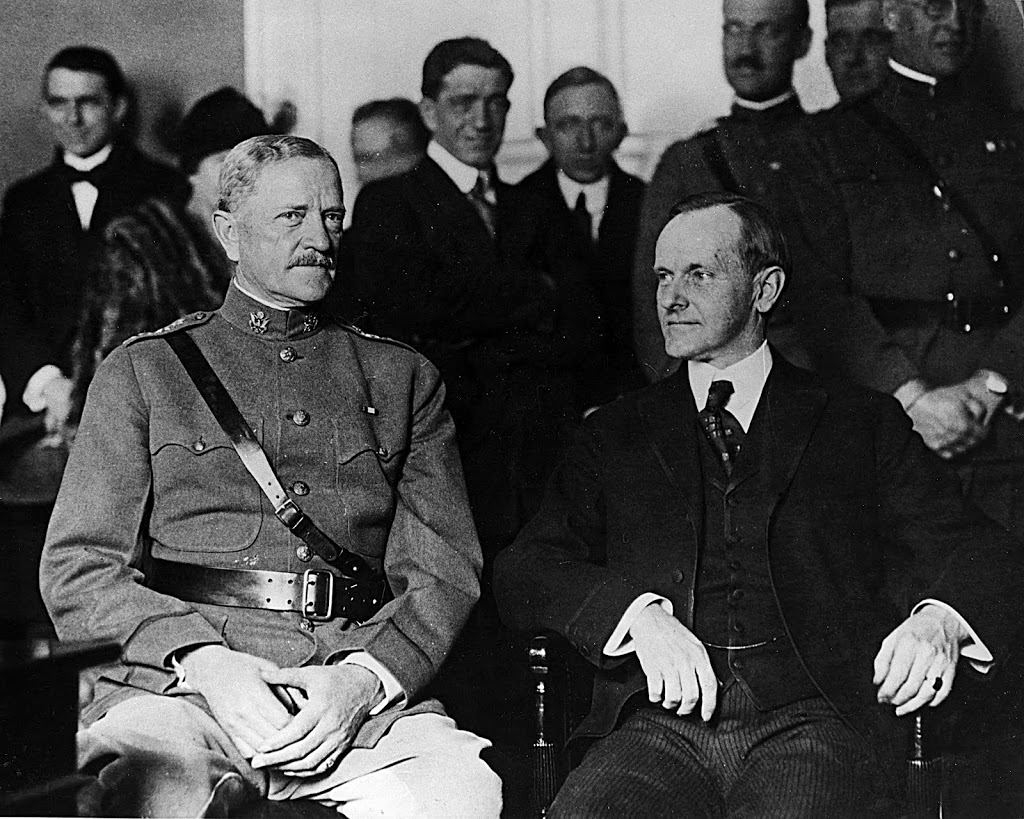
“The readjustment may be expected to be more difficult, but up to the present time there is no indication that it is working any very great hardship.” As was Cal’s way, he did not bother with anecdotal hearsay or politicized pandering but with hard numbers and statistical data. The facts showed that opportunities were trending upward not the reverse.
“Our factories are running on short time but are keeping in their employment substantially all of their people. The retail trade is extremely good, indicating no lack of money to buy what the people desire.” In Massachusetts, he would notice, “the building trade is yet at a standstill.”
“The question before us is what to do to start business generally on a peace basis. Of course the first thing to do is to make peace with those with whom we have been at war. Everything is waiting for that. There are other questions pending. One of the things that would be helpful is an immediate and generous settlement of all war claims, both formal and informal contracts. Hundreds of millions are tied up awaiting such settlements. The question of the price of food is one that is fundamental…It is my strong belief that the government should withdraw from any attempt at fixing prices and let business operate according to the law of supply and demand so far as domestic commerce is concerned.

“There ought to be protection from unreasonable foreign competition…Not merely for the purpose of lowering prices should this be done, but in order that business may understand that all prices are on a natural and not an artificial basis. Until our business does understand this it cannot go forward. This is not to be viewed from a point of local prejudice but as a national question, the decision of which will work by action and reaction for the benefit of all the people of the nation.
“Just as soon as these fundamental difficulties are adjusted there is more likely to be a scarcity of labor than an over-supply of it. In the first place, we are to have in the army and navy nearly half a million men. Our casualty list will take at least 100,000 through death and disability. The loss from the epidemic which has been raging in our country is not yet known, but runs into the hundreds of thousands. Before the war we had an immigration each of from 1,200,000 to nearly 2,000,000. The last four years this has dropped down to a very small figure. There will be as a result of the war a great shortage of man power abroad.
“There was never so much work to be done in the world as at the present time. There was never so much money in America. Where there is power to purchase there will be a demand to be supplied. The only thing that is lacking is an organization of our industries to produce and to supply the market and a conviction that prices and conditions are on a natural and not an artificial basis.

“If the commerce and industry of the country is to conduct itself rather than to be conducted by the government, it is time for it to begin such operation at once. It is time for it to assert itself and to display that courage and enterprise which has been the basis of our wonderful development. It must be under government or under its own control. It cannot have two masters. The sooner it asserts its independence, the sooner we shall start again on a normal basis for prosperity.”
 The Importance of the Obvious