On Power and Pledges

Page 1-4

But the fact that there is evil abroad, that there are those who are bent on wickedness and that their efforts oftentimes prevail, that there are limitations, is no reason for losing faith in the right. The fact that obligations may be disregarded, that pledges may be broken, is no reason for losing faith in honor and integrity. There are those those who argue that if government has sometimes been a means of oppression, that therefore government should be abolished, that if property has sometimes made its possessors selfish and cruel, that therefore property should be abolished. They argue, perhaps unconsciously, that if power has been misused by some, that power therefore should be abolished. The plain fact is that power cannot be abolished, nor can government and property, which are a species of power. Wherever mankind exists, these exist. Our only remedy is to regulate their use and strengthen the disposition to employ them all not for oppression but for service. 

This is but stating the condition into which mankind is born. This is but recognizing those restraints which are created by his very existence. We do not live in an imaginary life. We live in a real life. The individual may occasionally and temporarily secure an advantage for which he has made no return, but this is always impossible for society. Whatever it has, it must create itself. It is an entire delusion to look for a state of freedom, a system of government, an economic organization, under which society can be relieved from the necessity of effort. To be the beneficiaries of civilization is not easy, but hard. Those who promise an existence of ease are not raising mankind up, they are pulling them down. The greater freedom that men acquire, the better government they maintain, the higher economic condition they reach, the more difficult, the more laborious must be their lot. It is not a life of ease that will ever attract men, but the possession of power which comes from achievement, and the possession of character which is the result of sustained effort in well doing…

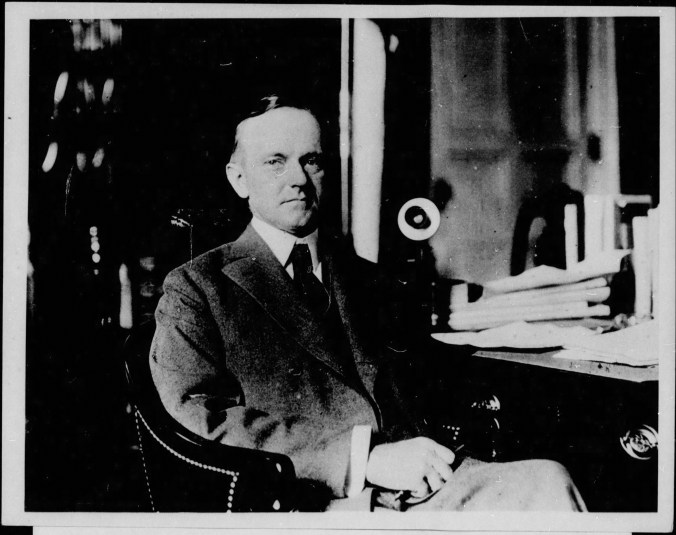
— Calvin Coolidge, excerpt of address before the Presbyterian General Assembly, May 21, 1922
On What Vermonters Can Give America

CC_Boston_Police_Strike1 (2)

I am here, as some one in the audience has suggested, by right of birth. Vermont is my birthplace; it is a high and noble birthright to have, and the rising up to it entails a great and high obligation. 

Part of that birthright you have seen as you came here in the mountains, in the brooks hurrying down to the restless sea and in the lakes shining like silver in their green settings. 

Part of it you see here about you in the field, well tilled, not by expensive farm machinery, but by what is much more skilled and intricate, the brain and hand of men. 

You can see it under the schoolhouse and the church across the way, which by their size and position testify to the regard in which are held by our people things temporal and those eternal. They testify to the temperance of those who live here. 

It is a great heritage to be born in Vermont, among men given to thrift and industry and pledged to all things pious and noble in mankind. And it seems to me the one important thing we have to do, to impart to our Nation some things of the birthright and heritage of Vermonters, doing away with ignorance by popular education, doing away with the cynicism of the present day by inspiring men to reverence through giving them a wider and deeper view of the works of nature than they see about them. 

These things we must give our fellow Americans that through them they may be attached to our institutions, that they may better approach the privilege of living under law and order and the privilege of being Americans. And so, being faithful to itself, America may be faithful to all mankind. 

— Governor Calvin Coolidge, speech at Plymouth Notch, Vermont, July 15, 1920

Happy Birthday, Cal and America!

fireworks-5007820_1920

No people can look forward who do not look backward. The strongest guarantee of the future is the past. Unless that which has been built shall stand with an assured security, the motive for further building is destroyed, and all our structures will go down in ruins. 

We need not only the story but the symbols of past history. We can best preserve our institutions by preserving our confidence in the men who did so much to establish them. It is only when men begin to worship that they begin to grow.  A wholesome regard for the memory of the great men of long ago is the best assurance to a people of a continuation of great men to come, who shall still be able to instruct, to lead, and to inspire. A people who worship at the shrine of true greatness will themselves be truly great…

This is the course of that inspiration which has moved different organizations to gather up the traditions of the past, to mark the location of historic events, to restore and preserve ancient habitations and buildings. It is all intensely American, it is done in the knowledge that where men have worked and wrought righteousness, there is holy ground. 

— Calvin Coolidge, excerpt from a speech called “The Great Virginians,” July 6, 1922

Happy 244th Year of Independence, America, and Happy 148th Birthday, Calvin Coolidge!