Interest has been generated of late, with still a dominance of septuagenarians among Presidential candidates, in the history of age and the Office. We offer the following statistical walk back through not only Presidential ages but a glimpse into the often full fields of candidates through the years. A closer look never fails to give us perspective.
Of the 39 instances in which a “seasoned” candidate (either Presidential or Vice Presidential) has campaigned for office, it is fair to conclude that Ronald Reagan’s success made it “cool,” one of The Gipper’s unintended influences on politics and the Presidency.
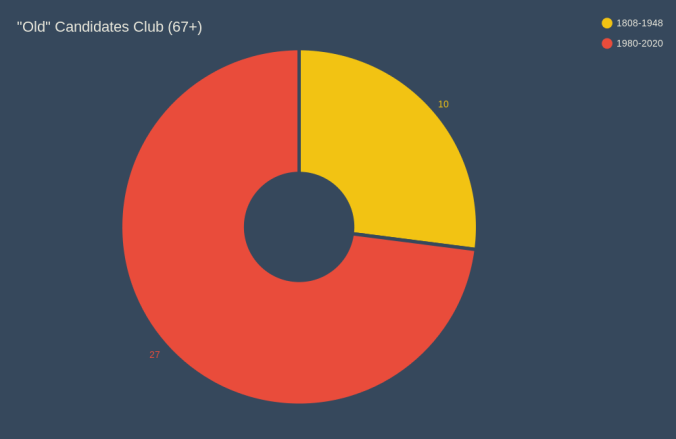
Of the first 12 instances (candidates between 1808-1948), seven were Vice Presidential candidates or incumbents. One third party candidate for President, 85-year old Peter Cooper (of the Greenback Party), became the first “grand old man” to run for President, teamed with 62-year old Samuel Fenton Cary in 1876. Van Buren, at still a youthful 65, had been the first ex-President to run again, heading the Free Soil Party in 1848. Fillmore would be the second former President, not counted here because he remained a baby. comparatively, at 56. 71-year old William Eustis, was voted for in the fractured election of 1824, being given a courteous nod on the ballot but otherwise was not a serious contender in a race that had four younger possibilities (J. Q. Adams, Andrew Jackson, William Crawford, and Henry Clay, all in their fifties save the last who was forty-seven). The remaining two were, like Pete Cooper, Presidential candidates. The elections of 1840 and 1844, well after the collapse of the Federalist Party (which ran formally for the last time in 1816), were the first to see a major party run Presidential candidates older than Washington had been when he retired (age 65): William H. Harrison, who would go on to win in 1840 over the younger Van Buren, and Henry Clay, who would go on to lose in 1844 to the even younger Polk, both Harrison and Clay age 67.

Jackson had retired in 1837 just short of age 70, surpassing Monroe as the oldest to retire from the Presidency up to that point. Buchanan would be next, retiring at 69, followed by Truman at 67. Eisenhower, leaving office in 1961 at age 70, would mark the first occasion of a Presidential septuagenarian. Only Reagan would surpass that mark at 77, and no President after Bush Sr. has yet left younger than he, at 68 years.
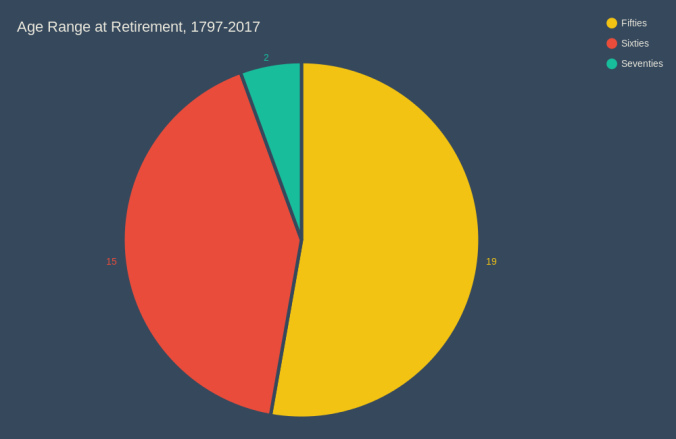
Unless a Vice Presidential candidate (from George Clinton, who died in office in 1812 at age 73, 74-year old Allen G. Turman in 1888 or 80-year old Henry G. Davis, who failed to win election with 52- year old Alton Parker against 46-year old TR and 52-year old Charles Fairbanks in 1904), no one after 69-year old “Fighting Bob” LaFollette’s disparaging effort in 1924 attempted to run for President until Reagan at age 69 tried and won in 1980, an office that typically went to candidates in their fifties. Even there, one of the oldest tickets was in 1944, with 62-year old FDR and 60-year old Truman topped in 1948 with 64-year old Truman and 70-year Alben Barkley. One of the widest contrasts in both tickets may be 2008, when 71-year old John McCain and 44-year old Sarah Palin ran against 47-year old Barack Obama and 65-year old Joe Biden. Biden would join septuagenarian Vice Presidents with reelection in 2012. He is now the favored septuagenarian to carry the Democrat Party banner in 2020. Candidate Biden is on his way to surpassing his duration as a Senator with the time he has spent as part of a Presidential ticket. He has virtually surpassed Bob Dole in that regard. At the same time, the track record for older Vice Presidents is an established one, usually done to strengthen support behind the ticket or attract notoriety for a younger, relatively less known, less experienced name at the top. As sometimes becomes apparent, it can even reach counterproductive proportions if a certain candidate lacks the stamina to campaign energetically or some other quality. Poor Vice Presidents, they seem, at times strongly bound by the same force that operates between brides and bridesmaids. It is not exactly true that “Once a Vice President, never a President,” as eight separate occasions prove it can be done and, in the case of some, handled very well. But, back to the campaign trail. Naturally, reelection campaigns have far less trouble there and greater ease in coalescing around the incumbent, with only a few notable exceptions (the Adamses, Benjamin Harrison, Ford, Carter, and Bush Sr., to name a few). Those were due to other reasons devolving on the Presidents directly, not so much the Vice Presidential candidates who ran with them.

Note: The Democrats in 1840 marked the one time a national party declined to nominate a Vice Presidential candidate to run with incumbent Martin Van Buren. His ticket of one is thus not counted in the numbers above. He would go on to lose to the Whig ticket, “Tippecanoe and Tyler too.” It is interesting to note that while the win-lose ratio is virtually even, the difference for those campaigns which ran a younger Presidential candidate and their subsequent win or loss is pronounced.
It also sometimes reveals, like in the Gilded Age, what can happen when one major party’s leadership languishes outside the Presidency for long enough, its foremost names are all old men by the time opportunity appears. After Lincoln, no Democrat attained the White House until 1884, a drought of twenty-four years. After the failure of 37-year old George McClellan and 39-year old George Pendleton to overcome Lincoln in 1864, subsequent results seemed only to confirm the Democrats’ hopeless situation: the loss of 58-year old Horatio Seymour to 46-year old Grant in 1868, 61-year old Horace Greeley to 50-year old Grant in 1872, and 62-year old Sam Tilden to 54-year old Hayes in the dubious 1876 election. The record for the youngest Chief Executive has had its ups and downs too (and is not a “race” at all), with the current trend not likely to break TR’s all-time record of 42, unchallenged since 1901. JFK came closest in 1961 but the odds are against the lone Presidential candidate under seventy in 2020.

The passing of the old men of the Democrat party found 47-year old Cleveland gave them the winning combination they had long sought. Of course, Cleveland slightly messes with the statistics here since he had to go and win a second term non-consecutively, giving us actually an even count overall between Presidents above the average age and below it. There has been no uninterrupted trend to out-youth the “other side” between the major parties but there have been periods of ebb and flow when the trend went toward older, hopefully wiser, leadership and away from the youngsters then back again. Candidates are very often attempts to mirror each other and thus tap into a winning combination. The effort to contrast is no less pervasive but for all the work to look different, similarities abound. As the Jeffersonians annihilated the Federalists, paving the way for the 1824 realignment and the Jacksonians, Whigs sought to capitalize on what the Democrats were doing and vice versa. The Republicans and Democrats, at times, do the same. Jackson’s presence (in his own way following in Washington’s appeal) would keep kindled the lure for an old soldier to lead and thus the Whigs sought out Harrison, Taylor and Scott as the Republicans later would with Grant to Eisenhower. It would manifest in the aftermath of the War that, though ended in 1865, doesn’t show any signs of concluding, as Republicans sought to capitalize on Grant’s appeal, with that series of Union soldiers: Hayes, Garfield, Arthur, Harrison, and McKinley. The Democrats would fare less successfully with their own poorly timed and badly executed renditions: George McClellan and Winfield Scott Hancock. Still later, conscientious attorney John W. Davis would be nominated to out-Coolidge Coolidge, Wendell Willkie would be chosen to out-FDR FDR, and Adlai Stevenson II to out-Ike Ike. When does that ever work, when the real deal is on the ballot?

Since 1980, only one presidential election cycle (2004) lacked a candidate (either President or Vice President) who was older than 67 years of age. The remaining nine, including 2020, now see a growing company of septuagenarians or those who will soon join them. Eighty-nine year old Mike Gravel has now entered the Harold Stassen League of “Never Quit Trying.” If God grants him four more years, we are confident Mr. Gravel will be back to break candidacy records into the 90s. Reagan broke his own record, of course, in 1984 and until 2016, no other septuagenarian proved successful at winning the White House. A candidate at 57 in 1968 and again in 1976, at age 65, Reagan seemed to find everything come together at age 69. We remember his joke in 1984 about Mondale’s youth and inexperience, all the more comical given that the Democrat opponent that year was, at age 56, on the upper range of the conventional spectrum for successful candidates. Reagan, once again, shattered that record. Moreover, given that average lifespans have lengthened since the beginning of the twentieth century, we could argue that the sixty-year olds of yesteryear were the septuagenarians of the current time.
All this simply adds up to what we already know instinctively, that no age range is, of itself, suspect. We have had plenty of reasons to doubt the boy Presidents as we have the grandfathers. Both, at times, have not been any more a safeguard to the errors of judgment, lack of character, or basic competence needed to lead well. Reagan demonstrated the septuagenarian could do just fine but he, like the youngsters among our Presidents, did not do everything he set out to do. Neither did FDR, who essentially grew up with the Presidency, nor Eisenhower who, like Truman, came to it as a grandfather. Likewise, the young men were not all perfect either. TR’s ego was often his own worst enemy and had he listened more than carried that big stick, he might not have blundered in the Brownsville Affair (not to mention the 1912 election). We will always rally to the defense of our favorite Presidents but perhaps this election cycle is a reminder of one who came in as one of those younger Chief Executives, one who was elected to national office one hundred years ago at the age of 48. He would defeat FDR that year for the Vice Presidency and orchestrate his remarkable political triumph in 1924 at age 51, winning later that year what usually is an impossible scenario: a three-way race for Vice Presidential successors. Only TR had done it and it would be TR who would join the ranks of unsuccessful attempts to make a comeback to the Presidency, following Van Buren, Fillmore, Hoover, Carter, and Bush Sr. TR never could stand being out of any gathering. Yet, it was the quietly industrious Coolidge who would succeed in ways his contemporaries in the Office did not. But, perhaps, most importantly, he encourages us continually to exercise care with the vote we possess. We are never, as his fan President Reagan put it, more than one generation away from freedom’s extinction. That is why studying Cal provides ample reward. He never fails to give us a lasting insight into what is the right or wise thing to do. After all, it was Coolidge who said, “Nothing is more dangerous to good government than great power in improper hands.” That remains, whatever the candidate’s age, credentials, or political affiliation, true for all times and all places.

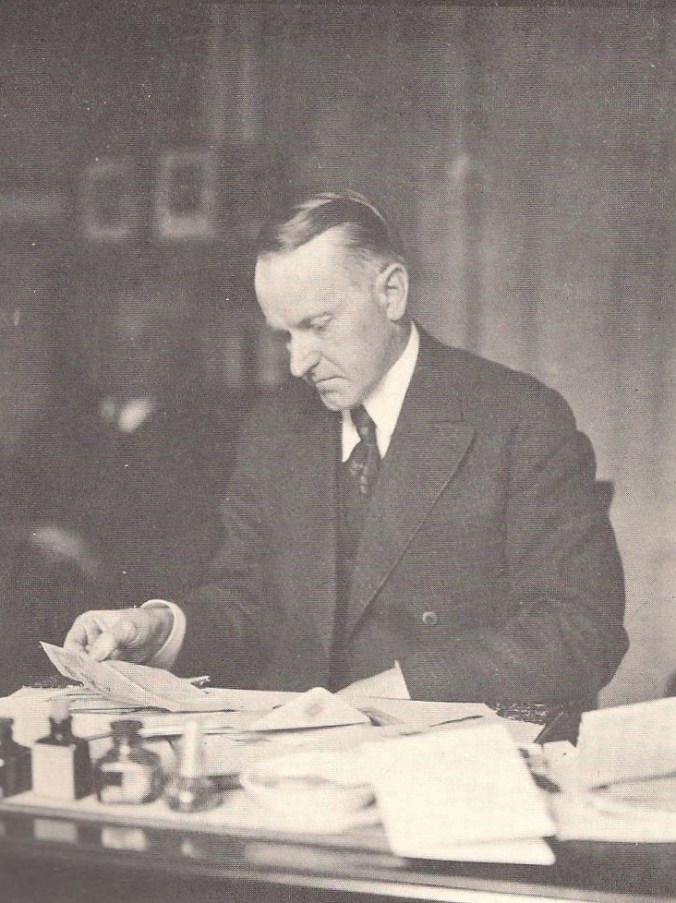
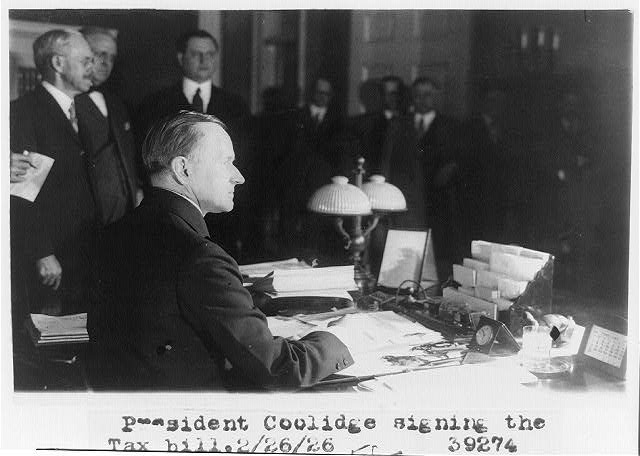
Calvin Coolidge, 30th President of the United States (1923-1929)


 The Importance of the Obvious