
Month: May 2019
On Dictators and Stenographers
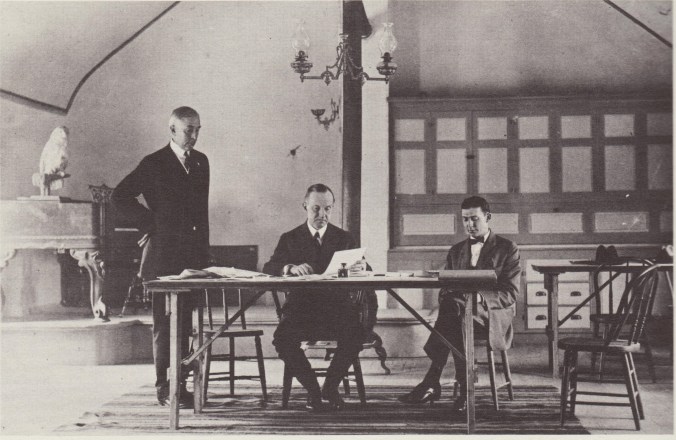
Working atop the General Store at Plymouth Notch, summer of 1924. L to R: Secretary C. Bascom Slemp, President Coolidge, and stenographer Edwin Geisser.
Calvin Coolidge was a master of administration and time management. He knew how to process the most daunting workload, leaving each day’s desk clear and ready for what tomorrow would bring. Each day brought something new. It gave practical expression to his old maxim: “Do the day’s work.” A large portion of Presidential responsibility is handling the paper that runs through the office. He stands as one of the best executive administrators the Presidency has yet to see. Moreover, he knew the “secret” of that success. He once visited the house of poet Emily Dickinson in Amherst and had the opportunity to view some of her manuscripts. As his focus turned from page to page, he calmly gave his appraisal: “She writes with her hands. I dictate.” He certainly did, relying principally upon his personal stenographer, Mr. Edwin Geisser, for the press conference transcription, voluminous correspondence, daily memos, and frequent addresses making their way from the President’s mind to millions present and future.
His pencil marks preside across thousands of documents but, ever efficient, they rarely appear with the content itself in his handwriting yet they are unmistakably his own. The handwritten exceptions have become some of his most famous statements (like his “I Do Not Choose to Run for President in Nineteen Twenty Eight” or his Christmas message of 1927).
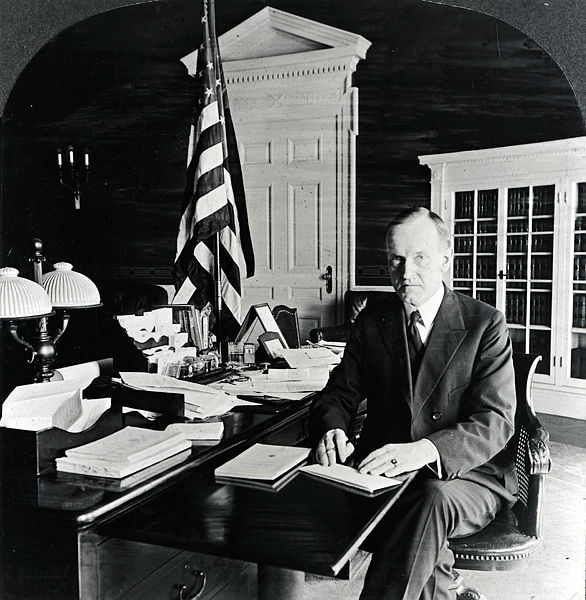
When Mr. Geisser had been tasked elsewhere, the work could not wait for him, that would be inefficient. One of the President’s backup stenographers was Mrs. Bernico Ponton, who usually assisted Mr. Geisser but also helped J. Stuart Crawford, one of Coolidge’s in-house researchers. Interviewed by the Springfield Republican in 1927, Mrs. Ponton’s distinction came not only from her skills for rapid transcription but also as the only woman to whom Cal dictated letters. Interestingly, Mrs. Coolidge never dictated letters but wrote them in longhand. If typing was to be done by “Polly” Randolph or Laura Harlan, it would be the First Lady who would write the letter herself. She enjoyed typing on her own typewriter so much, even that stage of the process would often witness her tapping away the reply herself.
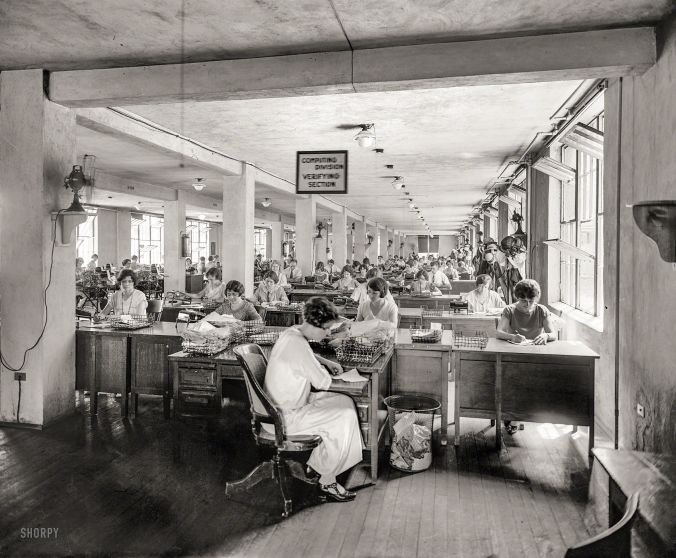
Calculating the various pensions of veterans appropriated by the “Bonus Bill,” taken at the Veterans’ Bureau, November 1924. Photo credit: Shorpy.
Mrs. Ponton, an experienced office manager in her own right, setting out on her career straight from high school in Maine, began working in Boston then at the Veterans’ Bureau in Washington to be shifted to the White House at the outset of the Christmas holiday in 1924. She found Mr. Coolidge to be the best dictator she had known. He never walked around, paced the floor or tore out his hair as he dictated. He never agonized over a single word. Instead, he sat beside the large mahogany desk in an armchair, working out quietly and exactly what he wanted to say. Once he began, he stated the entire sentence, rarely changing any of the wording and never struggling to find a better way to say what he had said. He had already thought it out.
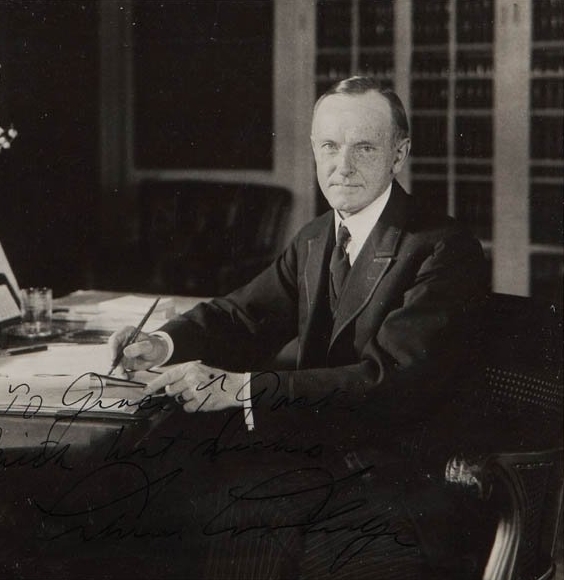
If he had one fault, Mrs. Ponton said, from her professional point of view, it was this: He had such an extensive vocabulary that it would force her to search out a dictionary for the obscure and unique words that seemed to effortlessly be at the top of his brain, ready to capture the precise meaning he wanted to convey. His letters, characteristically, were usually terse and concise, a source of many a humorous anecdote in their own right. For routine mail, as White House postman Ira Smith could attest, it received only the briefest glance and a rapid-fire note in pencil at the top of the letter, issuing what instructions he wanted for its reply, to be carried out by secretaries.
Mrs. Ponton was always on time, unlocking her desk at 9 each weekday morning, and ready to work. She witnessed some of the era’s most exciting moments, including the Lindbergh visit and the chaotic aftermath of Coolidge’s refusal to run again. She and her husband enjoyed the closeness to the White House in an apartment a few blocks away and, in an office of 18 people, the Coolidges meant more to them than mere employers. They would become family.


One of Coolidge’s regular habits when kept at his desk for long stretches of time was removing his shoes and placing his feet in the most comfortable place he could think of…inside the waste paper basket. It appears the photographer caught the placement of the bin even in the President’s absence. Photo credit: HistoricImages.

At the New Willard Hotel, early August 1923. Photo credit: Alarmy.

On Colonel Cheney, Manchester, and the Greater Generation
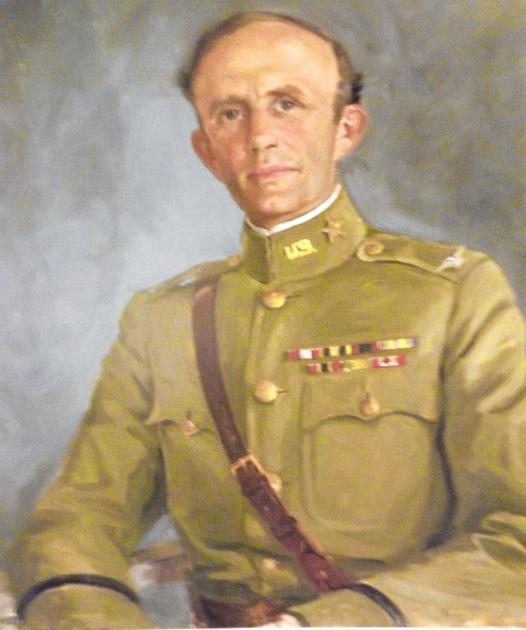
Mr. Bob Kanehl for Manchester, Connecticut’s Journal Inquirer, has recently featured one of the most illustrious Cheneys of the Manchester region of that state who played a very public part in American history. His family is known for many generous legacies in that area but one of its most unsung is national service. Perhaps this Cheney’s quiet and regrettably forgotten role will receive a measure of long-delayed recognition. He is Army Colonel and West Point graduate Sherwood Cheney, who served as a military aide for President Calvin Coolidge.
Colonel Cheney’s life is quite a remarkable one and we render our salute not only to the faithful Colonel but also to the commendable efforts underway to remember him and the many selfless men and women who faced the War that was thought would end them all. It was, after all, the one that not only took most of a generation, leaving cavernous marks not merely on the land but across countless human lives, leaving all who experienced it forever imprinted by its unprecedented material and psychological devastation. It was as much a spiritual conflict as a material one (as all wars are), and yet it came to America, still so much younger than the Old World, at a time when she seemed ready to shoulder the burden. It came with an intangible price but she also met that price squarely and unflinchingly, when it could have been far easier to pass the hard decisions to posterity.

Colonel Cheney’s generation demonstrated that sacrifice and obedience are not things to cynically scorn or treat with lip service allowed only in the mythical safe spaces of sublime feeling or personal convenience. They did not confuse the love due one’s neighbor with an unending permission to abuse or be abused as suited the ignorance, envy or cruelty of others. Neither was this summons to sacrifice a communal passing-of-the-buck to assume the entire weight of the burden only each one (and each nation) must bear alone, if freedom meant anything at all. The notion of equality did not contain some right to demand of others what you were unwilling to give yourself. Respect and honor were not hostile to happiness as if they were vestigial cargo from an unenlightened age. They were integral to fulfillment, something far more substantial than personal happiness. No, respect was not a privilege to be taken but an honor to be given.
Colonel Cheney and his contemporaries did not dismiss the faintest patriotic fervor as born of a sentiment that could only be possible under coercion, delusion or hypocrisy. Patriotism was something to share but it was authentic and often spontaneous, not cloistered in fear of social or cultural recrimination. They were expressions of which all could partake whether around the town square or beneath the Capitol dome itself. And most importantly, that generation did not fail to understand the difference between standards and ideals. They knew there were common qualities, a shared nature of humanity, that mankind (in the universal sense in which it had been understood for millennia) fell well below ideals constantly. Doing so no more discredited the dignity of those aspirations than it required the surrender of higher standards or the persistence to get up and start again. Such was the task and the joy of life. It was not someone else’s conscience to bear or life to answer for, it was your own. The practical application of sacrifice with obedience and the giving of respect with honor remain the only enduring things that bring us back out of all the counterfeit escapes and cheap imitations to genuine reality.
Here is to Colonel Cheney and that greater generation!

11 Jun 1927, President and Mrs. Calvin Coolidge are shown with Colonel Charles Lindbergh and mother at the Patterson House on DuPont Circle in Washington, D. C.,by © Bettmann/CORBIS


 The Importance of the Obvious